
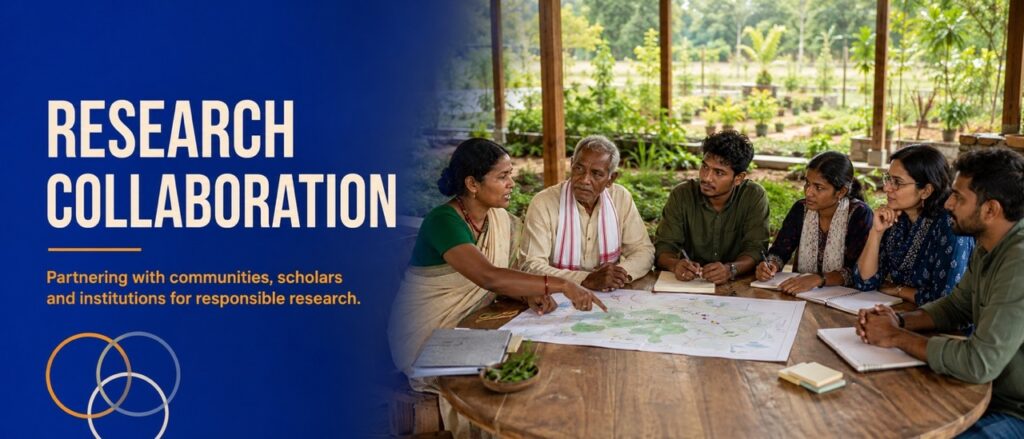
Building Ethical, Community-Centred and Evidence-Informed Research Partnerships
Research collaboration is an important part of the development of Hodopathy as a responsible knowledge platform. Hodopathy brings together traditional and Indigenous knowledge, community experience, ecological understanding, oral histories, plant knowledge, food traditions, agriculture, biodiversity, cultural practices and contemporary research.
However, research involving Indigenous and traditional knowledge requires more than collecting information and publishing findings. It requires trust, informed participation, cultural respect, transparent methods, appropriate evidence standards, community rights, ethical data management and meaningful benefit sharing.
Hodopathy therefore promotes a collaborative research model in which communities, knowledge holders, researchers, universities, botanical institutions, healthcare researchers, environmental scientists, social scientists, conservation organisations and other appropriate partners can work together without treating community knowledge as an unrestricted research resource.
The objective is to connect traditional knowledge with responsible research while ensuring that the people and communities who have maintained that knowledge remain central to how it is documented, interpreted, protected and communicated.
What Research Collaboration Means in Hodopathy
Research collaboration in Hodopathy means working together to investigate, document, preserve, understand and responsibly communicate knowledge associated with the Ho community and wider Adivasi communities of Jharkhand.
A collaborative project may involve:
- Community knowledge holders
- Elders and experienced practitioners
- Farmers and forest-dependent communities
- Traditional food practitioners
- Local plant knowledge holders
- Youth and community researchers
- Anthropologists
- Ethnobotanists
- Botanists
- Ecologists
- Agricultural scientists
- Nutrition researchers
- Public-health researchers
- Social scientists
- Historians and linguists
- Universities and research institutions
- Biodiversity and conservation organisations
- Museums, archives and cultural institutions
- Government and public research bodies
- Responsible non-profit organisations
The purpose is not to place modern science above traditional knowledge or traditional knowledge above science.
Instead, collaboration should allow different knowledge systems to be documented and understood on their own terms, while scientific research can be used where appropriate to investigate specific questions.
WHO’s current traditional-medicine research framework similarly emphasizes stronger evidence, research capacity, knowledge exchange, sustainability, equity and respect for local heritage, resources and rights.
A Community-First Research Model
Hodopathy follows a simple principle:
Research should be conducted with communities, not merely about communities.
This principle changes how research questions are developed, how fieldwork is conducted, how information is recorded, how data is stored, how findings are published and how benefits are returned to participating communities.
A responsible collaboration should therefore consider five connected stages:
Community Priorities → Ethical Research Design → Collaborative Documentation → Evidence & Analysis → Community Benefit & Knowledge Stewardship
This approach helps prevent extractive research in which researchers enter a community, collect traditional knowledge, publish it elsewhere and leave without meaningful participation or benefit.
1. Community Participation from the Beginning
Community participation should begin before fieldwork starts.
Researchers should discuss:
- What is being studied?
- Why is the research being conducted?
- Who will conduct it?
- What information will be collected?
- How will interviews be recorded?
- Where will information be stored?
- Who will have access?
- What will be published?
- What information will remain confidential?
- How will participants be acknowledged?
- What benefits will return to the community?
Where appropriate, communities should have meaningful opportunities to influence research priorities and methods.
This is particularly important when research concerns culturally sensitive subjects such as sacred places, restricted plant knowledge, traditional healing practices, ceremonial knowledge, ancestral stories or information about culturally important biological resources.
2. Community Knowledge Holders as Research Partners
Hodopathy recognizes knowledge holders as more than interview subjects.
A knowledge holder may contribute:
- Local plant identification
- Ho terminology
- Seasonal observations
- Agricultural knowledge
- Food preparation knowledge
- Forest-use knowledge
- Ecological observations
- Oral histories
- Cultural explanations
- Traditional classifications
- Historical memories
- Knowledge about harvesting practices
- Knowledge about changing landscapes
Where appropriate and agreed upon, knowledgeable community members can also participate as:
- Community researchers
- Field guides
- Co-documenters
- Cultural advisers
- Interviewers
- Reviewers
- Translators
- Local biodiversity observers
- Co-authors or contributors
This helps ensure that research interpretation does not depend entirely on an external academic perspective.
3. Co-Designing Research Questions
One of the strongest forms of collaboration is co-designed research.
Instead of beginning with a predetermined academic question, researchers can work with communities to identify questions that are locally meaningful.
Examples include:
Plant Knowledge
- Which plants are culturally important?
- What are their local Ho names?
- How are they distinguished from similar species?
- During which seasons are they collected?
- What traditional uses are associated with them?
- Which plants are becoming less common?
Food Knowledge
- Which wild and cultivated foods were traditionally consumed?
- How does food knowledge vary by season?
- How are foods preserved?
- Which traditional crops are declining?
- How does traditional food knowledge relate to agricultural biodiversity?
Forest Knowledge
- How do communities traditionally understand forest resources?
- What harvesting practices support regeneration?
- Which plants or habitats are considered important?
- How have forests changed over generations?
Agricultural Knowledge
- How are traditional crops selected?
- What local indicators are used for planting?
- How are seeds preserved?
- What role do festivals and seasonal traditions play in agriculture?
Language and Culture
- What traditional terminology exists for plants, foods and landscapes?
- How is ecological knowledge expressed through the Ho language?
- Which words or expressions are becoming less commonly used?
Research priorities should emerge through dialogue rather than assuming that outside researchers already know which questions matter most.
4. Collaboration with Universities and Research Institutions
Hodopathy can serve as a bridge between community knowledge and responsible academic research.
Potential collaborations may include departments and institutions working in:
- Ethnobotany
- Botany
- Ethnopharmacology
- Anthropology
- Sociology
- Ecology
- Forestry
- Agriculture
- Soil science
- Nutrition
- Public health
- Environmental science
- Biodiversity
- Linguistics
- History
- Cultural studies
- Geography
- Data science
- Conservation biology
Academic partners can contribute scientific methods, laboratory facilities, analytical expertise, research training and publication experience.
Hodopathy can contribute community-centred documentation frameworks, ethical protocols, contextual information, local terminology, archival structures and relationships with knowledge holders.
The strongest model is therefore complementary expertise rather than one-sided extraction.
5. Ethnobotanical Research Collaboration
Plant knowledge is an important area for collaboration within Hodopathy.
A responsible ethnobotanical project may combine:
Community Knowledge + Local Names + Field Observation + Botanical Identification + Voucher Documentation + Ecological Context + Research Evidence
For example, when documenting a traditionally used plant, researchers should attempt to distinguish:
- Local name
- Ho name where documented
- Other regional names
- Scientific name
- Plant family
- Plant part used
- Traditional use
- Preparation method
- Season of collection
- Habitat
- Harvesting method
- Cultural significance
- Knowledge source
- Evidence status
- Safety information
- Conservation status
Traditional identification should not automatically be treated as equivalent to scientific species identification. Botanical verification may be necessary, particularly where closely related species exist.
Similarly, a plant’s traditional use should not automatically be presented as proof of therapeutic efficacy.
6. Traditional Knowledge and Scientific Research
Hodopathy maintains a clear distinction between traditional knowledge and scientific evidence.
A community may have a longstanding observation or practice. That observation is important evidence of knowledge, practice and cultural continuity, but it does not automatically establish clinical efficacy or safety.
Research collaboration can investigate specific questions using appropriate methods.
Depending on the research question, this may involve:
Documentation Research
- Oral histories
- Interviews
- Focus-group discussions
- Participant observation
- Archival research
- Ethnographic documentation
Biological Research
- Botanical identification
- Herbarium voucher preparation
- Taxonomic studies
- Ecological surveys
- Biodiversity assessments
Laboratory Research
- Phytochemical analysis
- Microbiological studies
- Chemical characterization
- Toxicity screening
- Other appropriately designed laboratory investigations
Agricultural Research
- Crop diversity studies
- Soil and farming-system research
- Seed diversity
- Seasonal agricultural observations
- Sustainable harvesting studies
Human Research
Where appropriate and ethically approved:
- Observational studies
- Nutritional research
- Public-health studies
- Clinical research
- Safety studies
The method should always match the research question and the type of claim being investigated.
WHO emphasizes that traditional medicine research needs appropriate methodologies and robust evidence, while also recognizing the importance of respectful knowledge exchange with Indigenous communities.
7. Research Ethics and Prior Informed Consent
Ethical research is a foundation of Hodopathy.
Before collecting identifiable personal information, recordings, photographs, biological samples or culturally sensitive knowledge, researchers should establish appropriate consent procedures.
Participants should understand:
- The purpose of the study
- Who is conducting the study
- What participation involves
- Whether interviews will be recorded
- How data will be stored
- How information may be used
- Whether findings may be published
- Whether photographs or videos may be used
- Whether biological samples will be collected
- Potential risks
- Potential benefits
- Their right to decline participation
Consent should not be treated as a single administrative signature. In many contexts, ethical participation requires communication that is understandable, culturally appropriate and ongoing.
For sensitive knowledge, additional community-level safeguards may be necessary.
8. Protecting Restricted and Sensitive Knowledge
Not all knowledge should be publicly published.
Some knowledge may be:
- Sacred
- Ceremonial
- Family-specific
- Restricted to particular knowledge holders
- Associated with particular locations
- Vulnerable to commercial exploitation
- Ecologically sensitive
- Legally protected
- Culturally inappropriate to disclose publicly
Hodopathy therefore supports a tiered knowledge-access model.
Public Knowledge
Information that can responsibly be shared openly for education and research.
Community-Access Knowledge
Information available to participating communities or approved users but not necessarily to the general public.
Restricted Knowledge
Information requiring specific permission or controlled access.
Confidential Knowledge
Information that should not be publicly disclosed or reproduced.
This prevents the digital preservation of knowledge from unintentionally becoming a mechanism for knowledge extraction.
9. Community Review of Research Findings
Before important research findings are finalized, researchers should consider community review where appropriate.
Community review can help identify:
- Incorrect plant names
- Translation errors
- Misunderstood cultural meanings
- Incorrect seasonal information
- Misinterpretation of traditional practices
- Missing context
- Inappropriate photographs
- Incorrect attribution
- Sensitive information that should not be published
Community review does not mean that scientific conclusions should be changed simply to agree with traditional interpretations.
Instead, it helps ensure that community knowledge and cultural context are represented accurately.
Scientific conclusions should remain based on appropriate evidence, while cultural interpretation should be informed by the people who hold that knowledge.
10. Data Ownership, Attribution and Knowledge Rights
Research collaboration must address ownership and rights before information is collected.
Research agreements should clarify:
- Who owns collected data?
- Who controls recordings?
- Who can access photographs?
- Who can use biological samples?
- Who can publish findings?
- How will contributors be acknowledged?
- How will future uses of data be handled?
- Can data be reused in another project?
- What happens if commercial opportunities emerge?
Hodopathy supports clear attribution of community contributions and appropriate protection of Indigenous and traditional knowledge.
Research should not convert community knowledge into unrestricted intellectual property simply because it has been documented by a researcher.
11. Benefit Sharing
A responsible collaboration should create meaningful benefits for participating communities.
Benefits may include:
- Research training
- Community research capacity
- Educational materials
- Copies of publications
- Digitized oral-history recordings
- Community archives
- Biodiversity documentation
- Language resources
- Student scholarships or training opportunities
- Local employment
- Research infrastructure
- Conservation initiatives
- Support for community-led documentation
- Appropriate financial benefits where applicable
Where research produces commercial or other significant benefits, benefit-sharing arrangements should be discussed transparently and established through appropriate agreements and applicable laws.
Benefit sharing should not be treated as a symbolic gesture. It should be part of research planning from the beginning.
12. Joint Publications and Authorship
Hodopathy encourages appropriate recognition of community contributions.
Depending on the contribution and applicable publication standards, knowledge holders and community researchers may be:
- Acknowledged contributors
- Research collaborators
- Co-authors
- Interview participants
- Cultural advisers
- Community reviewers
Researchers should avoid presenting community-generated knowledge as if it originated entirely from academic investigators.
Publications should clearly distinguish:
What the community reported → What researchers observed → What was scientifically tested → What the evidence demonstrates
This distinction improves transparency and protects both community knowledge and scientific credibility.
13. Open Science with Responsible Access
Hodopathy supports knowledge sharing, but open access does not mean unrestricted access to everything.
Research outputs may include:
- Research papers
- Reports
- Datasets
- Plant records
- Maps
- Oral-history transcripts
- Photographs
- Audio recordings
- Educational resources
- Research protocols
- Evidence reviews
However, access should depend on the sensitivity of the information.
For example, a general description of a culturally important plant may be openly available, while the exact location of a rare population may require restricted access to reduce the risk of overharvesting.
Responsible research therefore balances:
Open Knowledge + Privacy + Cultural Protection + Biodiversity Conservation
14. Research Data Management
Every collaborative research project should have a clear data-management plan.
This can include:
Before Research
- Consent framework
- Data-collection protocol
- Research objectives
- Access permissions
- Storage plan
- Publication plan
During Research
- Secure recording
- Participant identification codes
- Field notes
- Metadata
- Sample documentation
- Geographic information management
After Research
- Data verification
- Community review
- Secure archival storage
- Access classification
- Publication
- Long-term preservation
Digital records should be protected against unauthorized access, alteration, loss or commercial misuse.
15. Collaboration in Biodiversity and Conservation Research
Hodopathy’s research collaboration can extend beyond traditional medicine into biodiversity and ecological conservation.
Community knowledge can contribute to research on:
- Wild edible plants
- Traditional crops
- Forest species
- Seasonal biodiversity
- Seed diversity
- Local ecological indicators
- Sustainable harvesting
- Habitat change
- Forest-use patterns
- Threatened or declining species
- Traditional conservation practices
Community observations can complement scientific ecological surveys.
This is particularly valuable because biodiversity is not only a biological issue. It is also connected to food systems, livelihoods, culture, language and historical relationships with landscapes.
WHO’s current traditional-medicine work explicitly connects research and evidence with biodiversity, sustainability, equity and respect for Indigenous knowledge.
16. Traditional Food and Nutrition Research
Hodopathy can support interdisciplinary research on traditional food systems.
Potential areas include:
- Traditional grains
- Millets
- Wild vegetables
- Forest foods
- Seasonal foods
- Fermented foods
- Food preservation
- Seed diversity
- Traditional agricultural systems
- Food security
- Dietary diversity
- Nutritional composition
- Changing food habits
Research should distinguish between:
Traditional food practice → Nutritional composition → Observational findings → Laboratory evidence → Human health evidence
This prevents traditional foods from being presented as medically beneficial simply because they have been consumed traditionally.
17. Language and Cultural Research Collaboration
Language is an essential part of traditional knowledge.
Research collaboration can help document:
- Ho plant names
- Agricultural vocabulary
- Forest terminology
- Food terminology
- Seasonal expressions
- Traditional classifications
- Proverbs
- Stories
- Songs where appropriate
- Oral narratives
- Place-based terminology
Such research can contribute to language preservation while improving the accuracy of plant and cultural documentation.
Researchers should avoid translating culturally specific concepts into simplistic equivalents when doing so would remove their original meaning.
18. Training Community Researchers
One of the most sustainable forms of collaboration is building local research capacity.
Hodopathy can support training in:
- Ethical interviewing
- Oral-history documentation
- Audio and video recording
- Plant photography
- Basic botanical observation
- GPS and mapping
- Biodiversity documentation
- Data entry
- Archival methods
- Ho-language documentation
- Research ethics
- Consent procedures
- Evidence evaluation
- Digital preservation
Community researchers can become long-term custodians of local knowledge rather than research projects depending entirely on external investigators.
19. Student and Early-Career Research Partnerships
Hodopathy can provide a structured environment for responsible student research.
Potential projects may include:
- Ethnobotanical surveys
- Traditional food documentation
- Oral histories
- Biodiversity studies
- Agricultural knowledge
- Language documentation
- Cultural geography
- Conservation research
- Traditional ecological knowledge
- Digital humanities
- Community archives
Students should receive clear guidance on ethics, consent, attribution, data protection and responsible publication before entering fieldwork.
The goal is to develop researchers who understand that Indigenous knowledge is not simply a source of academic data.
20. Interdisciplinary Research
Many Hodopathy topics cannot be adequately studied through one discipline alone.
For example, traditional plant knowledge may require collaboration between:
Community Knowledge Holder + Ethnobotanist + Botanist + Ecologist + Historian + Linguist + Conservation Scientist
Similarly, traditional food systems may require:
Community Food Practitioner + Nutrition Researcher + Agricultural Scientist + Anthropologist + Ecologist
Interdisciplinary collaboration can provide a more complete understanding while reducing the risk of interpreting complex knowledge through a single disciplinary framework.
21. International Research Collaboration
Hodopathy may also collaborate with appropriate international universities, museums, research networks, Indigenous knowledge organisations and scientific institutions.
International collaboration can provide:
- Advanced research expertise
- Comparative studies
- Research training
- Access to specialized laboratories
- Digital preservation expertise
- Biodiversity research
- Language documentation
- Global knowledge exchange
- Joint publications
- International visibility for community-led research
However, international collaboration should never weaken local ownership, ethical safeguards or community participation.
Global partnerships should strengthen local capacity rather than relocate control over knowledge outside the community.
WHO itself uses international collaboration, research networks, research-priority exercises and collaborating centres to strengthen evidence and knowledge exchange in traditional medicine.
22. Research Agreements and Partnership Frameworks
Before a major collaboration begins, Hodopathy can establish a written research framework covering:
- Research objectives
- Participating institutions
- Community participation
- Roles and responsibilities
- Consent procedures
- Data ownership
- Data access
- Sample ownership and use
- Publication rights
- Attribution
- Confidentiality
- Intellectual-property considerations
- Benefit sharing
- Commercialization conditions
- Community review
- Dispute resolution
- Long-term data stewardship
- Conditions for future research use
A written agreement helps prevent misunderstandings after research has already begun.
23. Research Quality and Evidence Standards
Collaboration does not reduce scientific standards.
All research associated with Hodopathy should follow appropriate methodological standards.
Depending on the project, this may include:
- Clearly defined research questions
- Transparent methods
- Appropriate sampling
- Accurate documentation
- Botanical verification
- Proper data analysis
- Ethical approval where required
- Appropriate statistical methods
- Reproducibility
- Peer review
- Disclosure of limitations
- Clear distinction between observation and interpretation
Hodopathy’s Evidence Standards provide the framework for distinguishing traditional knowledge, documented evidence, botanical verification, laboratory evidence, preclinical evidence and clinical evidence.
The fundamental principle remains:
The strength of a conclusion should never exceed the strength of the evidence supporting it.
WHO identifies inadequate scientific evidence and limited research capacity as major barriers in traditional-medicine research, reinforcing the importance of robust methods and evidence-building collaborations.
24. Avoiding Extractive Research
Hodopathy explicitly rejects research practices in which:
- Researchers collect knowledge without meaningful consent.
- Knowledge holders are treated only as informants.
- Community contributions are not acknowledged.
- Sensitive knowledge is published without permission.
- Plant locations are disclosed irresponsibly.
- Samples are transferred without transparent agreements.
- Traditional knowledge is commercially exploited without appropriate benefit sharing.
- Research results are returned only to academic institutions.
- Communities are excluded from interpretation.
- Findings are exaggerated for commercial or promotional purposes.
A successful collaboration should leave the community with greater knowledge capacity, stronger documentation, improved recognition and meaningful benefits, rather than simply leaving behind a published paper.
25. Community-Led Research
The most advanced form of collaboration is not simply research conducted by outsiders with community participation.
It is research in which communities can increasingly participate in deciding:
- What should be researched
- What should not be researched
- Who should conduct the research
- What methods are appropriate
- What information can be shared
- How findings should be interpreted
- Where information should be stored
- Who should access it
- What benefits should result
This moves the model from:
Research on Communities
to:
Research with Communities
and ultimately toward:
Community-Led Research
26. A Proposed Hodopathy Research Collaboration Framework
Hodopathy can use the following practical framework for future partnerships:
Stage 1 — Identify
Identify the research question and relevant community knowledge holders.
Stage 2 — Consult
Discuss the proposed project with participating communities before research begins.
Stage 3 — Consent
Establish informed consent and appropriate community permissions.
Stage 4 — Co-Design
Develop research questions, methods and documentation protocols collaboratively.
Stage 5 — Document
Record knowledge accurately, including language, context, source and limitations.
Stage 6 — Verify
Where appropriate, verify botanical, ecological, historical or scientific information.
Stage 7 — Research
Apply appropriate scientific or social-science methods.
Stage 8 — Review
Invite appropriate community review of cultural interpretation and representation.
Stage 9 — Analyse
Separate traditional knowledge from scientific findings and clearly communicate evidence strength.
Stage 10 — Publish
Publish responsibly, protecting confidential and restricted knowledge.
Stage 11 — Share
Return research outputs to participating communities in accessible formats.
Stage 12 — Benefit
Ensure agreed benefits reach participating communities.
Stage 13 — Preserve
Archive appropriate records for future generations.
Stage 14 — Monitor
Continue reviewing the research record, corrections, new evidence and community concerns.
27. Measuring Successful Collaboration
Hodopathy can evaluate collaborations using more than the number of publications produced.
Important indicators may include:
Community Indicators
- Meaningful community participation
- Number of trained community researchers
- Community satisfaction
- Community review completed
- Knowledge returned to communities
Research Indicators
- Quality of methodology
- Research transparency
- Verified data
- Peer-reviewed publications
- Independent confirmation
- Evidence gaps identified
Cultural Indicators
- Accurate Ho terminology
- Proper attribution
- Oral histories preserved
- Sensitive knowledge protected
- Cultural context maintained
Conservation Indicators
- Biodiversity records created
- Threatened knowledge documented
- Sustainable harvesting practices recorded
- Conservation initiatives supported
Benefit Indicators
- Training provided
- Educational materials created
- Research infrastructure developed
- Financial or non-financial benefits delivered where appropriate
This creates a broader definition of research success:
Good Research + Community Benefit + Cultural Protection + Evidence Quality + Biodiversity Stewardship
28. Long-Term Research Network of Hodopathy
Hodopathy can gradually develop a research network connecting:
Community Knowledge Holders
↓
Community Researchers
↓
Hodopathy Research Team
↓
Universities & Research Institutions
↓
Scientific & Cultural Specialists
↓
Conservation & Biodiversity Organisations
↓
National & International Research Networks
The objective should be to create a long-term knowledge ecosystem rather than isolated research projects.
Such a network could support:
- Collaborative field studies
- Student research
- Joint publications
- Research databases
- Oral-history projects
- Plant documentation
- Biodiversity monitoring
- Traditional food research
- Language preservation
- Community training
- Evidence reviews
- Conservation initiatives
- Research fellowships
- Digital knowledge preservation
29. Transparency in Research Collaboration
Every major collaboration should clearly communicate:
- Who funded the research
- Who conducted it
- Who participated
- What methods were used
- What data was collected
- What limitations existed
- What conflicts of interest exist
- What was published
- What was withheld and why
- What benefits were generated
- What future research is planned
Transparency builds trust.
It also helps future researchers understand the origin and limitations of the evidence contained within the Hodopathy knowledge ecosystem.
30. Research Collaboration and the Future of Hodopathy
Research collaboration can help Hodopathy evolve from a knowledge documentation platform into a responsible community-centred research and knowledge network.
Its long-term vision can connect:
Traditional Knowledge
→ Community Documentation
→ Ethical Research
→ Scientific Investigation
→ Evidence Assessment
→ Knowledge Preservation
→ Education
→ Conservation
→ Community Benefit
This approach recognizes that Indigenous knowledge has value not only as historical information but also as a living body of experience connected to people, landscapes, biodiversity, food systems, agriculture, culture and language.
At the same time, responsible research must avoid romanticizing traditional knowledge or presenting every traditional claim as scientifically proven. Collaboration should create space for both respect and critical inquiry.
Principles for Hodopathy Research Collaboration
All research partnerships should aim to follow these principles:
1. Respect
Respect communities, knowledge holders, culture, language and heritage.
2. Participation
Involve communities throughout the research process.
3. Consent
Obtain appropriate informed consent before documentation or research.
4. Transparency
Clearly communicate research objectives, methods, funding and intended outputs.
5. Accuracy
Document traditional knowledge faithfully and avoid distortion.
6. Scientific Integrity
Use methods appropriate to the research question and evidence claim.
7. Cultural Protection
Protect sacred, restricted and sensitive knowledge.
8. Data Responsibility
Store and share research data responsibly.
9. Attribution
Recognize knowledge holders and community contributions appropriately.
10. Benefit Sharing
Ensure communities receive meaningful and agreed benefits.
11. Conservation
Protect biodiversity and discourage harmful exploitation.
12. Reproducibility
Maintain sufficient methodological transparency for appropriate independent assessment.
13. Accountability
Provide mechanisms for correction, review and dispute resolution.
14. Long-Term Stewardship
Preserve appropriate research and cultural records for future generations.
Research Collaboration: A Shared Knowledge Journey
The future of Hodopathy should not be based on choosing between traditional knowledge and modern science.
It should be based on creating ethical relationships between knowledge holders, communities and researchers.
Traditional knowledge can provide questions, observations, classifications, historical perspectives and ecological experience. Scientific research can provide additional tools for identification, measurement, testing, comparison and evidence assessment. Community participation provides cultural context, ethical direction and accountability.
When these elements are brought together responsibly, research becomes more than the production of academic publications.
It becomes a process of learning, preservation, verification, education, conservation and community empowerment.
Hodopathy therefore seeks research collaborations that are:
Community-centred.
Ethically grounded.
Scientifically rigorous.
Culturally respectful.
Evidence-informed.
Biodiversity-conscious.
Transparent.
Reciprocal.
Long-term.
The ultimate goal is not to extract knowledge from communities, but to build a system in which knowledge can be protected, understood, responsibly researched, appropriately shared and carried forward by future generations.