
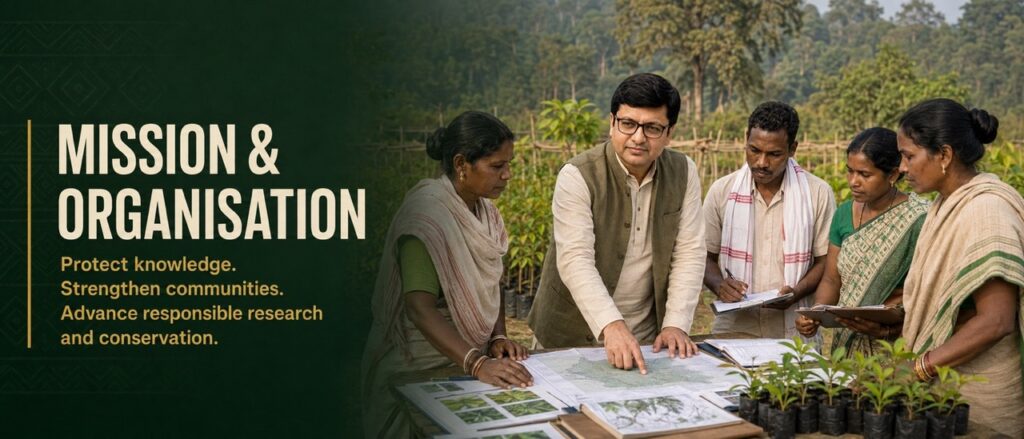
Hodopathy.org is a community-centred initiative dedicated to the preservation, documentation, protection and responsible advancement of Hodopathy and the indigenous knowledge traditions associated with the Ho community and the wider Adivasi heritage of Jharkhand.
Our mission is to create a respectful connection between traditional knowledge, communities, education, scientific research and biodiversity conservation while ensuring that the people and communities who have preserved this knowledge remain at the centre of the process.
Our Mission
Our mission is to ensure that valuable indigenous knowledge is not forgotten, misrepresented or exploited.
Much of the knowledge associated with traditional plants, forests, food, seasons, natural resources, cultural practices and community well-being has been passed from one generation to another through oral teaching, observation and practical experience.
As generations change and natural and cultural environments face increasing pressures, this knowledge can become vulnerable to loss.
Hodopathy.org works to preserve this living heritage through:
- Ethical documentation of permitted traditional knowledge
- Recognition of traditional knowledge holders
- Community-led knowledge preservation
- Education and training
- Responsible scientific and academic research
- Biodiversity and native-plant conservation
- Digital archiving
- Youth and community engagement
- Institutional collaboration
- Protection against misuse and unauthorised exploitation
Our Vision
We envision a future where Adivasi knowledge is respected as living cultural heritage, knowledge holders are appropriately recognised, younger generations remain connected with their heritage, and traditional knowledge can contribute to responsible education and research without losing its cultural identity.
We also envision a future where the forests, native plants, biodiversity, languages and cultural landscapes of Jharkhand are protected alongside the knowledge traditions that developed within them.
Our Core Principles
Community at the Centre
Communities and knowledge holders are central to the preservation of Hodopathy.
They should not be treated merely as sources of information. Their knowledge, experiences, cultural identity and decisions should be respected throughout documentation, research and knowledge-sharing activities.
Respect for Knowledge Holders
Elders, traditional practitioners, families and experienced community members have played an important role in carrying knowledge across generations.
Their contributions deserve dignity, recognition, appropriate attribution and meaningful participation.
Ethical Documentation
We support documentation of knowledge that communities and knowledge holders are willing to share.
Documentation may include:
- Oral histories
- Local plant names
- Traditional terminology
- Permitted plant knowledge
- Community narratives
- Photographs
- Audio and video recordings
- Field observations
- Traditional food knowledge
- Ecological observations
Documentation should preserve the meaning and cultural context of knowledge rather than reducing it to isolated information.
Protection of Sensitive Knowledge
Not all traditional knowledge should be publicly accessible.
Some knowledge may be sacred, confidential, culturally sensitive or traditionally restricted. Such knowledge should only be documented, stored or shared according to appropriate permissions and community decisions.
Preservation does not mean unrestricted publication.
Responsible Research
Hodopathy.org encourages responsible collaboration between traditional knowledge holders and researchers in fields such as:
- Botany
- Ethnobotany
- Ecology
- Anthropology
- Biodiversity
- Environmental studies
- Cultural studies
- Indigenous knowledge documentation
Traditional knowledge may provide valuable directions for research, while scientific methods can contribute identification, documentation, investigation and evaluation.
However, traditional use should not automatically be presented as scientifically proven.
We maintain a clear distinction between:
Traditional Knowledge → Documented Traditional Use → Research Investigation → Scientific Evidence
This distinction supports both cultural integrity and scientific credibility.
Biodiversity Conservation
The preservation of Hodopathy is closely connected with the preservation of the natural environment.
Traditional knowledge has developed through relationships with forests, native plants, agricultural landscapes, food resources and local biodiversity.
When these environments are damaged or disappear, the knowledge connected with them can also become vulnerable.
Our conservation efforts may support:
- Native plant conservation
- Community herbal gardens
- Seed preservation
- Plant nurseries
- Sustainable harvesting awareness
- Biodiversity documentation
- Habitat restoration
- Conservation education
- Protection of locally important plant species
Protecting biodiversity also helps protect the ecological foundation of indigenous knowledge.
Education & Training
Knowledge survives when it can be responsibly transmitted from one generation to another.
Hodopathy.org aims to support educational and training opportunities for community members, students, young people, traditional practitioners, researchers, teachers and conservation workers.
Training areas may include:
- Indigenous knowledge documentation
- Oral-history recording
- Plant identification
- Ethical field research
- Community consent
- Biodiversity documentation
- Herbarium preparation
- Digital archiving
- Sustainable plant collection
- Traditional knowledge protection
- Research ethics
Our objective is to encourage responsible learners, researchers and future knowledge custodians.
Building a Knowledge Archive
One of our long-term objectives is to develop an organised digital archive containing permitted and appropriately documented materials related to Hodopathy and Adivasi knowledge traditions.
The archive may include:
- Plant records
- Local terminology
- Oral histories
- Community narratives
- Photographs
- Audio recordings
- Videos
- Research publications
- Educational resources
- Biodiversity records
- Historical documentation
Access will depend on the nature of the material. Public information may be openly available, while sensitive or restricted knowledge may require controlled access or remain unpublished.
Connecting Communities & Research Institutions
Hodopathy.org seeks to build responsible connections between:
Adivasi Communities + Knowledge Holders + Researchers + Universities + Laboratories + Conservation Organisations
Traditional knowledge provides generations of observation and experience. Scientific institutions can provide methods for botanical identification, ecological assessment, documentation and research.
Our goal is not for one knowledge system to replace another.
Instead, we seek to encourage respectful dialogue, responsible collaboration and evidence-based understanding.
Community Participation & Benefit Sharing
Community participation should extend beyond providing information.
Where appropriate, communities and knowledge holders should have meaningful involvement in decisions about:
- What is documented
- How information is recorded
- Who can access it
- How it is represented
- How it may be used
- Whether it may be used for research
- How contributions are acknowledged
Where traditional knowledge contributes to research or other forms of value creation, applicable laws, ethical standards and appropriate benefit-sharing principles should be considered.
Preservation must never become extraction.
Organisational Approach
Hodopathy.org follows a collaborative approach that brings together different forms of knowledge and expertise.
Community Partners
Adivasi communities, elders, traditional practitioners and knowledge holders contribute cultural and experiential perspectives.
Research Partners
Researchers and academic institutions contribute expertise in botany, ethnobotany, ecology, anthropology, biodiversity and related fields.
Conservation Partners
Conservation organisations can contribute expertise in native plants, biodiversity protection, habitat restoration and sustainable resource management.
Education Partners
Schools, colleges, universities and training organisations can support knowledge transmission and responsible learning.
Documentation Partners
Trained documentarians can assist with oral histories, field observations, photography, audio-visual documentation and digital preservation.
Through these collaborations, we aim to keep community participation, cultural respect and responsible knowledge management at the centre.
Transparency & Integrity
Credibility is fundamental to our work.
We aim to clearly distinguish between:
- Community knowledge
- Oral traditions
- Historical information
- Traditional uses
- Ethnobotanical documentation
- Preliminary research
- Published scientific findings
- Established scientific evidence
We do not intend to present unverified claims as established scientific facts.
Where evidence is limited, that limitation should be communicated clearly.
Where information comes from a particular knowledge holder or community, appropriate attribution should be maintained wherever permission allows.
Protecting Indigenous Knowledge
Indigenous knowledge can be vulnerable to unauthorised commercialisation, misrepresentation and extraction.
Hodopathy.org seeks to promote responsible practices based on:
- Prior informed consent
- Community participation
- Cultural sensitivity
- Proper attribution
- Confidentiality
- Responsible access
- Research transparency
- Appropriate benefit sharing
- Respect for applicable laws
Hodopathy.org does not claim ownership over the collective knowledge traditions of Adivasi communities.
Our role is to support preservation, education, responsible research and community recognition.
Our Long-Term Goals
Hodopathy.org aims to build a sustainable framework for indigenous knowledge preservation through:
- Community-led documentation
- Digital knowledge preservation
- Traditional knowledge education
- Responsible research collaboration
- Native plant and biodiversity conservation
- Training and capacity building
- Youth engagement
- Knowledge-protection practices
- Academic and institutional partnerships
- Responsible public education
These goals will continue to evolve according to community needs, ethical considerations and opportunities for meaningful collaboration.
Join Our Mission
Preserving Hodopathy is a shared responsibility.
Knowledge holders, community members, students, researchers, educators, conservationists and responsible organisations can contribute in different ways.
You can support our work by:
- Contributing permitted oral histories
- Participating in documentation projects
- Supporting native plant conservation
- Joining educational programmes
- Conducting responsible research
- Supporting community initiatives
- Volunteering in preservation activities
- Contributing to digital documentation
- Developing responsible institutional collaborations
Every contribution should be guided by respect for communities, protection of knowledge and responsibility toward nature.
Our Commitment
We believe that:
Knowledge should be preserved without being exploited.
Communities should be recognised as custodians and active participants.
Research should be conducted without removing knowledge from its cultural context.
Biodiversity should be protected alongside cultural heritage.
Traditional knowledge should be represented honestly, with respect for both cultural experience and scientific evidence.
Our Mission in One Statement
Hodopathy.org works to preserve and responsibly advance the indigenous knowledge heritage associated with the Ho community and Adivasi communities of Jharkhand through ethical documentation, community participation, education, responsible research, knowledge protection and biodiversity conservation.
Preserving Knowledge. Respecting Communities. Protecting Nature. Advancing Responsible Research.