
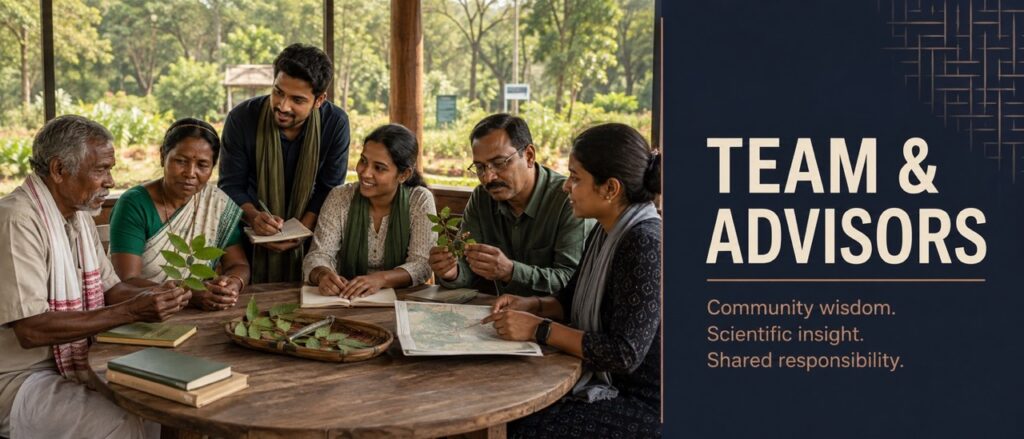
People Behind the Hodopathy Mission
The preservation of Hodopathy and Adivasi knowledge requires more than documentation. It requires people who understand the importance of community, culture, language, biodiversity, ethical research and responsible knowledge preservation.
Hodopathy.org aims to bring together a multidisciplinary network of community knowledge holders, traditional practitioners, researchers, botanists, ethnobotanists, educators, conservationists, students and subject-matter advisors.
Our approach places community knowledge and cultural integrity at the centre while creating opportunities for responsible academic and scientific collaboration.
Our Team
The Hodopathy.org team is envisioned as a collaborative group working across several areas of knowledge preservation and community engagement.
Community Knowledge Holders
At the heart of the initiative are the elders, experienced community members, traditional practitioners and knowledge holders who carry knowledge passed through generations.
Their knowledge may include traditional plant identification, local terminology, seasonal practices, food traditions, forest resources, ecological observations and community experiences.
Knowledge holders are not simply sources of information. They are important custodians and participants in the preservation process.
Their consent, perspective, recognition and cultural context are essential to responsible documentation.
Traditional Practitioners
Traditional practitioners may possess specialised knowledge developed through years of observation and practical experience.
Where practitioners choose to participate, Hodopathy.org aims to support the respectful documentation of permitted knowledge, traditional terminology, preparation practices and community experiences.
Traditional practices are documented within their cultural context and are not automatically presented as scientifically established medical treatments.
Community Coordinators
Community coordinators can help establish communication between Hodopathy.org and local communities.
Their role may include:
- Supporting community consultations
- Helping identify appropriate knowledge holders
- Facilitating documentation activities
- Supporting consent processes
- Communicating community concerns
- Coordinating educational programmes
- Helping ensure cultural protocols are respected
Local participation helps ensure that documentation is conducted with communities rather than simply about communities.
Research & Scientific Advisors
Responsible research requires expertise from multiple disciplines.
Hodopathy.org seeks to develop an advisory network involving specialists who can contribute knowledge, methodology and independent perspectives.
Botanists
Botanists can contribute expertise in plant identification, classification, morphology, taxonomy and botanical documentation.
Accurate identification is particularly important when traditional plant knowledge is being documented because local names can vary between communities and regions.
Scientific identification can help create more reliable records while preserving the original local terminology and cultural context.
Ethnobotanists
Ethnobotany provides an important bridge between people, plants and culture.
Ethnobotanical advisors can help document relationships between communities and plant resources while considering traditional uses, local knowledge, cultural practices and ecological contexts.
Their contribution can help ensure that documentation captures more than biological information alone.
Ecologists & Biodiversity Experts
Ecologists and biodiversity specialists can contribute to understanding the environments in which traditional knowledge has developed.
Their work may include:
- Habitat documentation
- Native plant conservation
- Biodiversity assessment
- Species monitoring
- Ecological restoration
- Sustainable resource-use practices
- Conservation education
This supports the principle that preserving knowledge also requires protecting the ecosystems connected with that knowledge.
Researchers & Academic Advisors
Researchers from relevant universities and institutions may contribute expertise in traditional knowledge documentation, cultural studies, anthropology, environmental science and related disciplines.
Research collaborations should follow appropriate ethical standards, community permissions and applicable regulations.
Cultural & Heritage Advisors
Adivasi Cultural Advisors
Cultural advisors can help ensure that traditional knowledge is presented with appropriate cultural sensitivity.
They may provide guidance on:
- Cultural terminology
- Community traditions
- Oral histories
- Local customs
- Cultural boundaries
- Appropriate representation
- Sensitive or restricted information
Their role is particularly important when knowledge is being translated from community contexts into digital or academic formats.
Language Advisors
Language is an important carrier of indigenous knowledge.
Language advisors can help document and preserve local terminology, pronunciation, meanings and cultural context where communities permit such documentation.
Local names should not automatically be replaced by scientific terminology.
Instead, where appropriate, traditional names and scientific names can be documented together, allowing both cultural and scientific information to remain visible.
Conservation Advisors
Hodopathy is closely connected with the natural environment.
Conservation advisors may support programmes involving:
- Native plant conservation
- Community nurseries
- Herbal gardens
- Seed preservation
- Sustainable harvesting
- Forest awareness
- Habitat restoration
- Biodiversity education
- Protection of locally important plant species
Their role helps connect cultural preservation with practical environmental stewardship.
Education & Training Advisors
Education is essential for transferring knowledge responsibly to future generations.
Education advisors may help develop programmes for:
- Students
- Teachers
- Community members
- Young knowledge learners
- Researchers
- Traditional practitioners
- Conservation workers
- Documentation volunteers
Training may cover:
- Indigenous knowledge documentation
- Oral-history methods
- Plant identification
- Field observation
- Biodiversity documentation
- Ethical interviewing
- Community consent
- Digital archiving
- Research ethics
- Knowledge protection
The objective is to develop responsible learners and future custodians of knowledge.
Ethics & Knowledge Protection
Because indigenous knowledge can be vulnerable to misuse, ethical oversight is an important part of our organisational approach.
Advisors may help establish appropriate practices relating to:
- Prior informed consent
- Community participation
- Confidential information
- Cultural sensitivity
- Attribution
- Responsible access
- Research transparency
- Benefit sharing
- Knowledge protection
Not every piece of knowledge should automatically be placed in the public domain.
Where communities or knowledge holders identify information as sacred, confidential, sensitive or restricted, appropriate safeguards should be applied.
Scientific Integrity
Hodopathy.org aims to maintain a clear distinction between traditional knowledge and scientific evidence.
Our advisors and researchers are encouraged to distinguish among:
Community Knowledge
Knowledge maintained and transmitted within communities.
Traditional Use
Documented accounts of how a plant, food, resource or practice has traditionally been used.
Research Investigation
Scientific or academic work undertaken to investigate a particular observation or claim.
Scientific Evidence
Findings supported by appropriate scientific research and evidence.
This distinction is essential to prevent traditional knowledge from being either dismissed without consideration or presented as scientifically proven without sufficient evidence.
A Multidisciplinary Network
Hodopathy cannot be fully understood through a single discipline.
It exists at the intersection of:
Indigenous Knowledge
↓
Culture & Language
↓
Plants & Ethnobotany
↓
Forests & Biodiversity
↓
Community Life
↓
Education & Research
For this reason, Hodopathy.org seeks to encourage collaboration among people with different forms of expertise.
A community elder may provide knowledge that a botanist can help identify.
An ethnobotanist may document the cultural relationship with a plant.
An ecologist may study its habitat.
An educator may develop learning materials.
A conservation specialist may help protect the species and its environment.
Together, these perspectives can create a more complete understanding while respecting the distinct role of each contributor.
Community Before Extraction
Our team and advisors are guided by a fundamental principle:
Traditional knowledge should be preserved with communities, not extracted from them.
We therefore seek to avoid approaches in which knowledge is collected without meaningful participation or later separated from its cultural origin.
Where knowledge is contributed, appropriate recognition and attribution should be provided whenever permission allows.
Where research or other activities create value from community knowledge, applicable ethical principles, laws and appropriate benefit-sharing arrangements should be considered.
Independence & Responsible Advice
Advisors associated with Hodopathy.org may contribute expertise, guidance, review or research support.
Being listed as an advisor or contributor does not automatically mean that the individual endorses every statement, project or activity associated with the platform.
Where appropriate, individual areas of expertise and contributions should be clearly identified.
The organisation aims to maintain transparency regarding the distinction between:
- Community knowledge holders
- Volunteers
- Researchers
- Academic collaborators
- Scientific advisors
- Cultural advisors
- Conservation specialists
- Organisational team members
This helps visitors understand the source, role and context of different forms of knowledge.
Our Commitment to Knowledge Holders
Hodopathy.org recognises that the most important contributors to this work may be the people whose knowledge has been carried through generations.
We are committed to encouraging:
- Respectful engagement
- Appropriate acknowledgement
- Informed participation
- Protection of sensitive knowledge
- Accurate representation
- Community involvement
- Responsible research practices
The objective is to ensure that knowledge holders are treated with dignity and respect rather than simply as research subjects.
Building the Next Generation
The future of Hodopathy depends significantly on younger generations.
Our long-term approach includes encouraging young people to learn about:
- Their cultural heritage
- Local languages
- Native plants
- Biodiversity
- Traditional ecological knowledge
- Responsible documentation
- Community history
- Ethical research
Young people can become researchers, educators, conservationists, documentarians and knowledge custodians while remaining connected to the heritage of their communities.
Collaboration With Institutions
Hodopathy.org welcomes responsible collaboration with institutions whose objectives align with ethical knowledge preservation and conservation.
Potential collaborators may include:
- Universities
- Research centres
- Botanical institutions
- Laboratories
- Museums and archives
- Biodiversity organisations
- Conservation groups
- Educational institutions
- Indigenous and community organisations
Institutional collaboration should always respect community rights, cultural context and applicable ethical and legal requirements.
How Our Team Works
Our organisational model is based on collaboration rather than hierarchy of knowledge.
Different contributors bring different strengths:
Knowledge Holders
Provide lived experience and traditional knowledge.
Community Coordinators
Support communication and participation.
Researchers
Develop responsible research and documentation methods.
Botanists & Ethnobotanists
Support plant identification and ethnobotanical documentation.
Ecologists & Conservationists
Support biodiversity and habitat conservation.
Cultural & Language Advisors
Protect cultural context and terminology.
Educators & Trainers
Help transmit knowledge responsibly.
Digital Archivists & Documentarians
Support long-term preservation and responsible access.
This collaborative model allows Hodopathy.org to approach indigenous knowledge from multiple perspectives without reducing it to a single discipline.
Meet the Team & Advisors
As Hodopathy.org develops, profiles of participating team members, knowledge holders, researchers and advisors can be published with their consent and appropriate contextual information.
Each profile may include:
- Name
- Community or institutional affiliation, where appropriate
- Area of expertise
- Role within the initiative
- Relevant experience
- Research or conservation interests
- Contribution to Hodopathy preservation
Profiles should be published responsibly and only with the individual’s permission.
A Shared Responsibility
The preservation of Hodopathy cannot be achieved by one organisation alone.
It requires cooperation among communities, knowledge holders, researchers, educators, conservationists and future generations.
Our team and advisory network are intended to provide a framework for this cooperation while ensuring that the voices and rights of the communities connected with the knowledge remain central.
Our Guiding Principle
The people who preserve knowledge deserve to be part of its future.
Hodopathy.org seeks to build a community-centred network where traditional knowledge is respected, research is responsible, biodiversity is protected and every contribution is treated with integrity.
Preserving Knowledge. Respecting Custodians. Supporting Research. Protecting Biodiversity.
Hodopathy.org — bringing together community wisdom, cultural heritage, responsible research and conservation for future generations.