
Preserving Indigenous Knowledge, Culture and Living Heritage
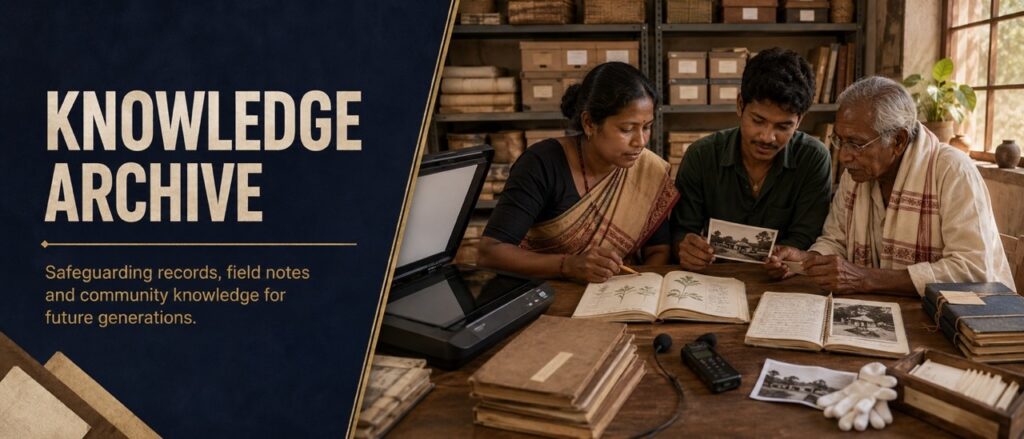
The Knowledge Archive of Hodopathy is a dedicated knowledge-preservation initiative focused on documenting, protecting and responsibly sharing the traditional knowledge and cultural heritage associated with the Ho community and wider Adivasi communities of Jharkhand.
Hodopathy represents a living tradition shaped by generations of close relationships with plants, forests, food, agriculture, seasons, biodiversity, natural resources, language, culture and community life.
Much of this knowledge has historically been passed from one generation to another through oral traditions, observation, family teaching and practical experience. The Knowledge Archive seeks to help preserve this heritage while ensuring that knowledge remains connected to the people, communities and landscapes from which it originates.
The Knowledge Archive is not simply a collection of information. It is an effort to preserve memory, culture, knowledge, language and the relationship between communities and nature.
What Is the Knowledge Archive of Hodopathy?
The Knowledge Archive is envisioned as a community-centred digital repository for permitted and responsibly documented materials related to Hodopathy.
It may bring together:
- Traditional knowledge
- Oral histories
- Plant knowledge
- Indigenous ecological knowledge
- Local terminology
- Traditional food knowledge
- Cultural practices
- Biodiversity information
- Historical records
- Ethnobotanical documentation
- Research publications
- Educational resources
- Conservation materials
- Photographs, audio and video documentation
The archive is designed to preserve knowledge in its cultural, historical and ecological context, rather than presenting individual facts in isolation.
Why Preserve Hodopathy Knowledge?
Traditional knowledge can gradually disappear when the systems that transmit it are disrupted.
Knowledge may become vulnerable because of:
- Loss of experienced knowledge holders
- Reduced intergenerational transmission
- Migration and social change
- Decline of traditional languages
- Changing lifestyles
- Loss or degradation of natural habitats
- Declining use of traditional practices
- Lack of systematic documentation
Once knowledge disappears from community memory, reconstructing it accurately may be extremely difficult.
A carefully managed archive can provide an additional layer of preservation for knowledge that communities choose to document and share.
A Living Knowledge Archive
The Knowledge Archive is intended to remain a living and evolving resource.
It may grow through:
- Community-led documentation
- Oral-history projects
- Plant documentation
- Ethnobotanical fieldwork
- Biodiversity surveys
- Historical research
- Academic collaboration
- Conservation projects
- Student research
- Community education programmes
Records may also be reviewed, corrected and updated as new information becomes available.
The archive should therefore not be treated as a final authority. It is a continuing process of documentation, verification, learning and preservation.
Oral History & Community Memory
Oral history is an essential part of indigenous knowledge preservation.
Elders, traditional practitioners, families and community members may possess knowledge that has never been formally written down.
With appropriate consent, the archive may preserve:
- Elder interviews
- Community stories
- Personal experiences
- Traditional plant knowledge
- Forest observations
- Food traditions
- Seasonal knowledge
- Historical memories
- Local terminology
- Changes in landscapes and community life
Audio and video records can help preserve not only the information itself but also the voices, expressions and perspectives of knowledge holders.
Preserving Ho Language & Terminology
Language carries knowledge.
Traditional names for plants, foods, places and natural resources may contain meanings that are difficult to capture through translation alone.
Where appropriate and permitted, the archive may document:
- Ho names
- Local plant names
- Traditional terminology
- Alternative names
- Meanings
- Pronunciation
- Regional variations
- Cultural context
- Verified botanical names
The aim is to preserve indigenous terminology alongside scientific terminology rather than allowing local knowledge systems to disappear behind standardised classifications.
Plant Knowledge Archive
Plant knowledge is an important part of the Hodopathy knowledge ecosystem.
The archive may preserve information about plants associated with:
- Traditional knowledge
- Forest resources
- Food systems
- Cultural practices
- Agriculture
- Community life
- Biodiversity
- Conservation
A plant record may include its local name, botanical identification where verified, habitat, seasonal availability, documented traditional use, cultural context, photographs and research references.
Traditional information should always be distinguished from scientifically established evidence.
Traditional Food Knowledge
Food is an important expression of cultural and ecological knowledge.
The archive may document permitted information relating to:
- Traditional foods
- Wild edible plants
- Seasonal foods
- Local grains
- Fruits
- Seeds
- Roots and tubers
- Traditional ingredients
- Food preparation
- Food preservation
- Cultural food practices
Traditional food knowledge can also provide insight into local biodiversity, seasonal cycles and community relationships with natural resources.
Indigenous Ecological Knowledge
Hodopathy includes knowledge developed through long-term observation of the natural environment.
The archive may document community observations relating to:
- Seasonal changes
- Forest ecosystems
- Plant behaviour
- Agricultural cycles
- Water resources
- Wildlife
- Soil and landscape
- Natural resources
- Sustainable resource use
Such knowledge can contribute to broader understanding of local ecosystems while remaining rooted in its community context.
Cultural Heritage & Community Practices
Hodopathy should not be reduced to plant knowledge alone.
The archive may also preserve permitted information about:
- Cultural traditions
- Community practices
- Relationships with nature
- Seasonal activities
- Traditional terminology
- Historical experiences
- Knowledge-transmission practices
- Community relationships with forests and plants
Sacred, confidential or restricted cultural knowledge should not be publicly published without appropriate permission.
Historical Records
Historical documentation can help show how knowledge, culture and environments have changed over time.
The archive may include:
- Historical documents
- Older photographs
- Published ethnographic materials
- Community records
- Historical plant references
- Oral histories
- Records of environmental change
Historical materials should be accompanied by appropriate source information and context wherever possible.
Knowledge Classification
Not all information in the archive has the same status.
For transparency, materials may be categorised as:
Community Knowledge
Knowledge shared or maintained within a community.
Traditional Use
A documented account of a traditional practice or use.
Ethnobotanical Documentation
Information recorded through structured ethnobotanical research.
Historical Record
Information preserved through historical or archival sources.
Preliminary Research
Early research findings that may require further investigation.
Published Scientific Evidence
Research supported by scientific publications.
Established Evidence
Information supported by appropriate and credible evidence.
This distinction helps visitors understand where information comes from and how it should be interpreted.
Ethical Documentation
The archive is guided by responsible documentation principles.
These include:
- Prior informed consent
- Community participation
- Cultural sensitivity
- Proper attribution
- Privacy
- Confidentiality
- Responsible access
- Transparency
- Knowledge protection
- Appropriate benefit-sharing considerations
Knowledge should be documented with communities and knowledge holders rather than extracted from them.
Protecting Sensitive Knowledge
An important principle of the archive is that not everything should be publicly available.
Some knowledge may be:
- Sacred
- Confidential
- Family-specific
- Practitioner-specific
- Community-restricted
- Culturally sensitive
- Ecologically sensitive
Depending on the circumstances, information may be:
Public → Community Restricted → Research Restricted → Confidential
Access should reflect the wishes of knowledge holders and communities and the sensitivity of the material.
Responsible preservation does not mean publishing everything. It means protecting what should remain protected.
Knowledge Holder Recognition
The archive seeks to preserve both knowledge and its provenance.
Where appropriate and permitted, records may acknowledge:
- Individual knowledge holders
- Traditional practitioners
- Families
- Communities
- Researchers
- Documentation teams
- Published sources
Where a contributor requests anonymity, their identity should remain protected.
Recognition should be accurate, respectful and consistent with the contributor’s wishes.
Digital Preservation
Modern digital technology can help preserve knowledge in multiple formats.
The archive may contain:
- Written documents
- Photographs
- Audio recordings
- Video interviews
- Scanned historical materials
- Plant records
- Research papers
- Field notes
- Educational materials
Long-term preservation also requires attention to:
- Metadata
- File integrity
- Secure storage
- Backup systems
- Access permissions
- Documentation of consent
- Future usability
Protecting Digital Knowledge
Publishing knowledge online can create risks because digital information can be copied, altered and redistributed.
Sensitive materials may therefore require:
- Controlled access
- Permission-based viewing
- Download restrictions
- Usage conditions
- Source attribution
- Privacy safeguards
- Secure storage
The archive seeks to balance knowledge accessibility with community rights and cultural protection.
Research & Academic Resources
The Knowledge Archive may serve as a resource for responsible researchers working in areas such as:
- Botany
- Ethnobotany
- Ecology
- Anthropology
- Biodiversity
- Environmental science
- Indigenous studies
- Cultural heritage
- Conservation
Research access should not automatically be interpreted as permission for commercial exploitation, redistribution, publication or biological collection.
Researchers should obtain any additional permissions required for their proposed work.
Connecting Traditional Knowledge With Science
The archive can create a respectful space where traditional knowledge and scientific research can inform one another.
A responsible process may look like:
Community Knowledge
↓
Ethical Documentation
↓
Identification & Contextualisation
↓
Scientific Investigation
↓
Evidence Assessment
↓
Responsible Communication
Traditional knowledge should not be dismissed simply because it does not originate in a laboratory.
At the same time, traditional observations should not be presented as scientifically proven unless appropriate evidence supports those claims.
Biodiversity & Conservation
Hodopathy is closely connected with the natural environments in which the knowledge developed.
The archive may document:
- Native plants
- Traditionally important species
- Local habitats
- Community conservation practices
- Seed resources
- Sustainable harvesting knowledge
- Environmental changes
- Biodiversity initiatives
Preserving knowledge therefore goes hand in hand with protecting the plants, forests and ecosystems connected with that knowledge.
Conservation Before Extraction
Some plants may be rare, vulnerable or commercially valuable.
Publishing detailed information about their location or harvesting methods could increase pressure on wild populations.
For this reason, sensitive ecological information may be restricted.
The guiding principle is:
Conservation Before Extraction.
Knowledge preservation should strengthen biodiversity protection rather than unintentionally contribute to exploitation.
Community Review & Corrections
The archive recognises that knowledge can be corrected and improved over time.
Community members, knowledge holders and researchers may identify:
- Incorrect plant identification
- Incorrect local names
- Translation errors
- Cultural inaccuracies
- Incorrect attribution
- Incomplete records
- Outdated information
Appropriate review and correction processes can help maintain the quality and credibility of the archive.
Preventing Knowledge Exploitation
Preservation must not become a pathway for unauthorised extraction.
The archive seeks to protect against situations where knowledge is:
- Collected without meaningful consent
- Removed from its cultural context
- Published without permission
- Commercialised without appropriate participation
- Incorrectly attributed
- Used for research without proper recognition
Where traditional knowledge contributes to research, innovation or commercial activity, applicable legal, ethical and benefit-sharing requirements should be considered.
Knowledge Ownership & Community Rights
Hodopathy.org does not claim ownership over the collective cultural heritage of the communities associated with Hodopathy.
The archive exists to support:
- Preservation
- Documentation
- Education
- Community recognition
- Responsible research
- Cultural continuity
- Biodiversity conservation
Traditional knowledge should remain connected to the communities and knowledge holders who have preserved and transmitted it.
For Communities
The archive can support communities by providing a long-term record of permitted knowledge.
Potential benefits include:
- Intergenerational learning
- Cultural preservation
- Language documentation
- Plant knowledge preservation
- Community history
- Biodiversity awareness
- Recognition of knowledge holders
- Educational resources
The archive should remain responsive to community needs and cultural protocols.
For Students & Learners
Students can use the archive to explore:
- Ho cultural heritage
- Adivasi knowledge systems
- Indigenous ecological knowledge
- Ethnobotany
- Botany
- Biodiversity
- Traditional food systems
- Conservation
- Ethical research
Students are encouraged to approach indigenous knowledge with curiosity, accuracy and respect.
For Researchers
Researchers may use appropriate archive materials to develop questions and conduct responsible research.
Responsible research should consider:
- Clear research objectives
- Appropriate permissions
- Ethical documentation
- Accurate attribution
- Community participation
- Protection of sensitive information
- Responsible publication
- Appropriate benefit sharing
Research should create partnerships and understanding rather than simply extract information.
For Future Generations
The most important purpose of the Knowledge Archive is to create a bridge between generations.
Future generations may be able to discover:
- Traditional plant names
- Community stories
- Elder knowledge
- Local terminology
- Forest knowledge
- Traditional food practices
- Biodiversity records
- Cultural history
- Research connected with their heritage
The archive can help ensure that knowledge does not disappear simply because the circumstances through which it was traditionally transmitted have changed.
Our Archive Principles
The Knowledge Archive of Hodopathy is guided by ten core principles:
1. Respect
Honour communities, cultures and knowledge holders.
2. Consent
Seek appropriate permission before documenting or sharing knowledge.
3. Community Participation
Involve communities in decisions concerning their knowledge.
4. Attribution
Recognise knowledge holders and sources where appropriate.
5. Confidentiality
Protect sensitive and restricted information.
6. Accuracy
Verify information wherever possible and clearly communicate uncertainty.
7. Transparency
Distinguish traditional knowledge from scientific evidence.
8. Conservation
Protect the biodiversity and environments connected with knowledge.
9. Responsible Access
Share appropriate information without exposing protected knowledge.
10. Accountability
Remain open to community feedback, corrections and concerns.
Building a Knowledge Bridge
The long-term vision of the Knowledge Archive is to connect:
People
Knowledge holders and communities
Language
Ho terminology and local expressions
Plants
Traditional plant knowledge and botanical records
Culture
Stories, traditions and heritage
Nature
Forests, habitats and biodiversity
Research
Ethnobotanical, botanical and scientific resources
Education
Learning and training
Future Generations
Responsible transmission of knowledge
Together, these elements create a more complete understanding of Hodopathy.
Our Long-Term Vision
We envision the Knowledge Archive becoming a trusted platform where indigenous knowledge, cultural heritage, biodiversity conservation, education and responsible research can exist together.
The goal is not to transform traditional knowledge into a collection of isolated facts.
The goal is to preserve the relationships behind that knowledge:
People ↔ Plants ↔ Forests ↔ Food ↔ Culture ↔ Knowledge ↔ Community
Our Commitment
Hodopathy.org is committed to developing the Knowledge Archive as a community-centred, ethically managed and continuously evolving resource.
We seek to:
- Preserve permitted traditional knowledge
- Honour knowledge holders
- Protect sensitive information
- Encourage intergenerational learning
- Support responsible research
- Promote biodiversity conservation
- Improve documentation quality
- Respect community rights
- Encourage meaningful collaboration
The archive should remain a bridge—not a barrier—between generations, communities, researchers, educators and conservationists.
Preserving Living Knowledge
The Knowledge Archive of Hodopathy is ultimately about preserving more than documents.
It is about preserving memory, language, cultural identity, plant knowledge, ecological understanding, community experience and relationships with nature.
By responsibly documenting knowledge today, we can help future generations learn from the experiences and observations of those who came before them.
Hodopathy Knowledge Archive — Preserving Indigenous Knowledge, Honouring Knowledge Holders, Protecting Cultural Heritage and Conserving Living Biodiversity.