
Understanding Hodopathy, Indigenous Knowledge, Culture, Research and Community Heritage
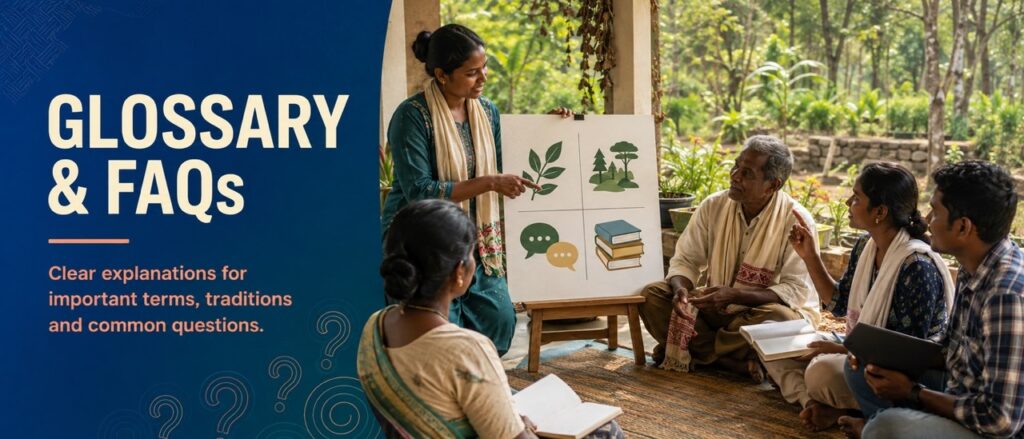
The Glossary & FAQs of Hodopathy provides a clear and accessible guide to the key terms, concepts, principles and frequently asked questions surrounding Hodopathy, Ho community knowledge, Adivasi heritage, traditional ecological knowledge, plant knowledge, oral histories, traditional food, forests, biodiversity and responsible research.
Hodopathy is understood as a living knowledge tradition connected with people, plants, forests, food, agriculture, seasons, language, culture, natural resources and community life. Its understanding requires more than definitions—it requires respect for the communities and knowledge holders who have preserved and transmitted knowledge across generations.
This glossary is intended to support respectful learning, cultural preservation and responsible research. It does not replace community knowledge holders or claim ownership over indigenous knowledge.
What Is Hodopathy?
Hodopathy refers to a living indigenous knowledge tradition associated particularly with the Ho community and wider Adivasi communities of Jharkhand.
It encompasses knowledge and practices connected with:
- Plants and forests
- Traditional food
- Agriculture
- Seasons and natural cycles
- Biodiversity
- Natural resources
- Language
- Culture
- Community life
- Intergenerational knowledge
Hodopathy should not be understood only as a collection of medicinal plants or traditional remedies. It represents broader relationships between people, nature, culture, knowledge and community experience.
What Is Indigenous Knowledge?
Indigenous knowledge refers to knowledge, observations, skills, practices and understandings developed and transmitted within indigenous communities over generations.
It may include knowledge related to:
- Plants
- Forests
- Food
- Agriculture
- Water
- Animals
- Seasons
- Natural resources
- Biodiversity
- Language
- Cultural practices
Such knowledge is often developed through long-term observation, practical experience and intergenerational learning.
What Is Traditional Knowledge?
Traditional knowledge generally refers to knowledge, skills and practices maintained and transmitted within communities over generations.
It can include ecological, agricultural, food-related, cultural, artistic and plant-related knowledge.
Traditional knowledge should be understood within the cultural, geographical and community context in which it developed.
What Is Traditional Ecological Knowledge?
Traditional Ecological Knowledge (TEK) refers to community knowledge concerning relationships between people and their natural environment.
It may include observations about:
- Forests
- Plants
- Animals
- Soil
- Water
- Weather
- Seasons
- Agriculture
- Biodiversity
- Landscape changes
Traditional ecological knowledge can provide valuable cultural and environmental information and may also help identify areas for responsible scientific research.
What Is Ethnobotany?
Ethnobotany is the study of relationships between people and plants.
It may examine how communities:
- Identify plants
- Name plants
- Use plants
- Cultivate plants
- Collect plants
- Prepare plant resources
- Understand plant habitats
- Incorporate plants into food and cultural practices
Hodopathy-related plant documentation can therefore have important connections with ethnobotanical research.
What Is an Oral History?
An oral history is a recorded account of a person’s memories, experiences, observations or knowledge.
Within Hodopathy documentation, oral histories may preserve:
- Community memories
- Plant knowledge
- Food traditions
- Forest knowledge
- Local terminology
- Cultural practices
- Environmental observations
- Intergenerational experiences
Oral histories are particularly important where knowledge has traditionally been transmitted through spoken communication.
Who Are Knowledge Holders?
Knowledge holders are people who possess, practise, maintain or transmit particular forms of community knowledge.
They may include:
- Elders
- Traditional practitioners
- Farmers
- Forest-dependent community members
- Food-knowledge holders
- Cultural practitioners
- Experienced community members
Knowledge holders should be treated as contributors and participants, not simply as sources from whom information can be extracted.
What Is Ho Knowledge?
Ho knowledge refers to knowledge, traditions, practices, language and cultural understanding associated with the Ho community.
It may include relationships with:
- Plants
- Forests
- Food
- Agriculture
- Seasons
- Landscapes
- Community traditions
- Language
The exact knowledge and practices may vary between communities, families, locations and individual knowledge holders.
What Is Adivasi Knowledge?
Adivasi knowledge broadly refers to knowledge systems developed and maintained by Adivasi communities.
It can encompass:
- Cultural traditions
- Agriculture
- Food systems
- Forest relationships
- Plants
- Natural resources
- Language
- Environmental observations
- Community practices
Adivasi communities are diverse, and their knowledge systems should not be treated as a single uniform tradition.
What Is a Plant Database?
A Plant Database is an organised collection of information about plants.
A Hodopathy plant record may include, where appropriate:
- Local name
- Ho name
- Alternative names
- Scientific name
- Botanical description
- Habitat
- Traditional context
- Documented uses
- Photographs
- Conservation information
- Knowledge source
- Research references
Scientific identification should be verified wherever possible.
What Is a Knowledge Archive?
A Knowledge Archive is a structured repository for preserving permitted knowledge and cultural materials.
The Hodopathy Knowledge Archive may contain:
- Oral histories
- Plant records
- Photographs
- Audio recordings
- Video recordings
- Transcripts
- Local terminology
- Historical materials
- Research references
- Educational resources
Not all information should necessarily be publicly available. Sensitive or restricted knowledge may require controlled access.
What Is Traditional Food Knowledge?
Traditional food knowledge refers to community knowledge about food resources, cultivation, collection, preparation, preservation and seasonal availability.
It may include:
- Grains
- Millets
- Pulses
- Vegetables
- Fruits
- Leafy foods
- Seeds
- Roots and tubers
- Wild edible plants
- Food preparation
- Food preservation
Traditional food knowledge represents both practical experience and cultural heritage.
What Is Forest Knowledge?
Forest knowledge refers to community understanding of forests, plants, natural resources and ecological relationships.
It may include:
- Plant identification
- Forest foods
- Seasonal changes
- Plant habitats
- Natural resources
- Collection practices
- Biodiversity observations
- Cultural relationships with forests
Forest knowledge should be understood together with the people, landscapes and cultural practices connected with it.
What Is Biodiversity?
Biodiversity refers to the variety of living organisms and ecosystems, including plants, animals, microorganisms and ecological systems.
Within the context of Hodopathy, biodiversity may include:
- Native plants
- Forest ecosystems
- Agricultural diversity
- Traditional food resources
- Local habitats
- Community conservation practices
Protecting biodiversity is closely connected with protecting the natural environments in which indigenous knowledge has developed.
What Is Agrobiodiversity?
Agrobiodiversity refers to diversity within agricultural systems, including crops, varieties, livestock and associated biological resources.
Traditional agricultural knowledge may contribute to preserving:
- Local crop varieties
- Traditional seeds
- Millets
- Pulses
- Indigenous vegetables
- Seasonal crops
Agricultural diversity can have ecological, nutritional, cultural and historical significance.
What Is a Local Plant Name?
A local plant name is a name used by people within a particular community, region or language.
A single plant may have different names in different communities.
Local names are important cultural information, but a local name alone may not be sufficient to establish a plant’s scientific identity.
What Is Botanical Identification?
Botanical identification is the process of determining the scientific identity of a plant.
It may involve:
- Field observation
- Plant morphology
- Botanical references
- Herbarium comparison
- Expert consultation
- Scientific literature
Accurate identification is particularly important when documenting plants associated with traditional uses.
What Is Ethnobotanical Documentation?
Ethnobotanical documentation records relationships between people and plants.
It may include:
- Local plant names
- Traditional uses
- Cultural significance
- Collection practices
- Seasonal availability
- Habitat
- Community knowledge
- Botanical identification
Documentation should be conducted with appropriate consent and ethical safeguards.
What Is Prior Informed Consent?
Prior Informed Consent (PIC) means obtaining appropriate permission before collecting, recording, documenting or using knowledge after providing relevant information about the proposed activity.
Contributors should understand, as appropriate:
- Why information is being collected
- What will be recorded
- How it may be used
- Who may access it
- Whether it will be published
- Whether their identity will be disclosed
Consent should be informed, voluntary and meaningful.
What Is Community Consent?
Community consent refers to appropriate participation and agreement concerning knowledge that is collectively held or strongly connected with a community.
Individual permission may not always be sufficient where knowledge has a collective cultural dimension.
Relevant community protocols, ethical standards and applicable legal requirements should therefore be considered.
What Is Benefit Sharing?
Benefit sharing refers to arrangements intended to ensure that communities or knowledge holders appropriately participate in benefits arising from the use of their knowledge or associated resources.
Depending on the circumstances, benefits may involve:
- Recognition
- Research collaboration
- Educational opportunities
- Capacity building
- Conservation support
- Financial arrangements
- Community development
Specific requirements depend on applicable laws, agreements and circumstances.
What Is Knowledge Extraction?
Knowledge extraction occurs when information is taken from a community without adequate participation, recognition, consent or appropriate benefit.
Examples may include:
- Collecting knowledge without permission
- Publishing restricted knowledge
- Commercialising knowledge without appropriate community involvement
- Removing knowledge from its cultural context
- Failing to acknowledge knowledge holders
Hodopathy.org seeks to support preservation rather than extraction.
What Is Biopiracy?
Biopiracy is a term commonly used to describe the unauthorised appropriation or exploitation of biological resources or associated traditional knowledge, particularly where communities do not receive appropriate recognition or benefits.
Protecting traditional knowledge requires ethical documentation, community participation, legal awareness and responsible research practices.
What Is Cultural Heritage?
Cultural heritage includes traditions, knowledge, language, practices, memories, places, objects and expressions that communities recognise as meaningful parts of their history and identity.
In the context of Hodopathy, this may include:
- Oral traditions
- Language
- Plant knowledge
- Food traditions
- Forest relationships
- Community memories
- Traditional practices
What Is Living Heritage?
Living heritage refers to cultural knowledge and practices that continue to be maintained, practised, adapted and transmitted by communities.
Hodopathy is approached as living heritage because it exists through people, practice and intergenerational transmission, not simply through historical documents.
What Is Restricted Knowledge?
Restricted knowledge refers to information that should not be freely accessible to everyone.
It may be:
- Sacred
- Confidential
- Family-specific
- Practitioner-specific
- Community-restricted
- Ecologically sensitive
- Commercially sensitive
Such information may require permission-based access or may remain unpublished.
What Is Community Review?
Community review allows knowledge holders or authorised community representatives to examine documented material for accuracy, cultural context and appropriate representation.
Review may identify:
- Incorrect terminology
- Translation issues
- Plant misidentification
- Cultural inaccuracies
- Incorrect attribution
- Sensitive information requiring restriction
Community review can strengthen the credibility and cultural integrity of an archive.
What Is Responsible Research?
Responsible research is research conducted with appropriate attention to ethics, consent, accuracy, cultural context, community participation and applicable legal requirements.
In relation to Hodopathy, responsible research should:
- Respect knowledge holders
- Obtain required permissions
- Protect sensitive information
- Acknowledge sources
- Distinguish traditional accounts from scientific evidence
- Communicate findings accurately
- Consider appropriate benefit-sharing principles
Frequently Asked Questions
Is Hodopathy the Same as Modern Medicine?
No.
Hodopathy, as presented by Hodopathy.org, refers to a traditional and indigenous knowledge framework associated with community relationships with plants, forests, food, culture, nature and community life.
It should not automatically be equated with modern medicine or presented as a substitute for professional healthcare.
Is Hodopathy Only About Medicinal Plants?
No.
Plant knowledge may be an important component, but Hodopathy is understood more broadly through relationships involving:
People → Plants → Forests → Food → Agriculture → Culture → Language → Environment
Reducing Hodopathy to medicinal plants would overlook its wider cultural and ecological dimensions.
Does Traditional Use Prove That a Plant Is Medically Effective?
No.
Traditional use can provide valuable information about cultural practice and may identify questions for further research. However, traditional use alone does not establish medical effectiveness, safety, dosage or suitability.
Specific health claims require appropriate scientific evaluation.
Can Every Traditional Practice Be Published Online?
No.
Some knowledge may be sacred, confidential, family-specific, practitioner-specific or community-restricted.
Information should only be published when appropriate permissions and ethical considerations have been addressed.
Who Owns Hodopathy Knowledge?
Hodopathy.org does not claim ownership over the collective cultural knowledge or heritage of the communities associated with Hodopathy.
Traditional knowledge can have complex cultural, community, legal and intellectual-property dimensions.
The platform’s intended role is to support preservation, documentation, education, community recognition and responsible research.
Can Researchers Use Information From the Hodopathy Archive?
Access depends on the nature and conditions of the material.
Public information may be available for appropriate educational or research purposes, while sensitive information may require additional permission.
Researchers should respect:
- Access conditions
- Consent requirements
- Attribution
- Community rights
- Ethical requirements
- Applicable laws
Can Traditional Knowledge Found in the Archive Be Commercialised?
Not automatically.
Access to information does not itself grant permission for commercial use.
Commercial activities may require additional permissions, agreements, legal compliance, community participation and appropriate benefit-sharing arrangements.
Can Anyone Contribute an Oral History?
Potentially, if the person has relevant knowledge or experience and voluntarily wishes to participate.
Documentation should follow appropriate consent, ethical and community procedures.
Contributors should understand how their material may be recorded, stored and used.
Can an Oral-History Contributor Remain Anonymous?
Yes, where appropriate.
A contributor may request that their identity not be publicly disclosed.
Personal and sensitive information should be handled according to consent and applicable privacy requirements.
Can Contributors Correct Their Oral Histories?
Where practical, contributors should have opportunities to clarify statements, correct errors and provide additional context.
Community review may also help identify terminology, translation or cultural inaccuracies.
Why Is Preserving the Ho Language Important?
Language can carry cultural meaning that may be lost through translation.
Preserving original terminology and recordings can help maintain:
- Plant names
- Cultural expressions
- Local meanings
- Pronunciation
- Historical terminology
- Knowledge-transmission traditions
Translations can improve accessibility without replacing the original language record.
Why Are Some Plant Locations Not Publicly Displayed?
Precise locations may be restricted when disclosure could increase risks to rare, vulnerable or commercially valuable plants.
Potential risks include:
- Overharvesting
- Unauthorised collection
- Habitat disturbance
- Commercial exploitation
Biodiversity conservation should take priority over unrestricted disclosure.
Can Traditional Food Knowledge Be Used to Make Health Claims?
Traditional food knowledge can be documented as cultural heritage, but health or nutritional claims should be supported by appropriate evidence.
A food should not automatically be described as medically beneficial simply because it has been traditionally consumed.
Does the Archive Replace Traditional Ways of Learning?
No.
Digital documentation is intended to complement—not replace—community-based learning and intergenerational transmission.
Direct relationships between younger generations and knowledge holders remain essential.
Why Document Knowledge if Communities Already Possess It?
Documentation can provide an additional safeguard against knowledge loss when traditional transmission becomes disrupted.
It can preserve:
- Voices
- Memories
- Language
- Plant knowledge
- Food traditions
- Historical experiences
- Environmental observations
However, documentation should never remove control from the communities that maintain the knowledge.
How Can Young People Participate?
Young people can participate by:
- Learning from elders
- Supporting permitted documentation
- Studying local plants
- Learning traditional terminology
- Supporting biodiversity conservation
- Participating in educational programmes
- Developing responsible research skills
- Recording permitted community histories
Intergenerational learning is essential to keeping knowledge alive.
How Can Researchers Collaborate With Hodopathy.org?
Potential research areas may include:
- Ethnobotany
- Botany
- Ecology
- Anthropology
- Indigenous studies
- Biodiversity
- Food heritage
- Environmental history
- Linguistics
- Conservation
Research proposals should respect appropriate permissions, community participation, ethical standards and applicable legal requirements.
How Can Communities Contribute?
Communities and knowledge holders may participate through:
- Oral-history projects
- Plant documentation
- Food-heritage projects
- Cultural documentation
- Language preservation
- Biodiversity surveys
- Training programmes
- Conservation initiatives
- Community-led research
Participation should remain voluntary and community-centred.
What Happens if Information in the Archive Is Incorrect?
Accuracy should be treated as an ongoing responsibility.
When an error is identified, appropriate action may include:
- Updating the record
- Adding clarification
- Correcting terminology
- Revising plant identification
- Updating references
- Recording community feedback
Community and knowledge-holder feedback can help maintain the quality of the archive.
Is Everything on Hodopathy.org Scientifically Verified?
No.
The platform may contain different categories of information, including:
- Community knowledge
- Oral histories
- Traditional practices
- Ethnobotanical documentation
- Historical information
- Preliminary research
- Published scientific research
These categories should be clearly distinguished so that visitors understand the source and evidence status of information.
Is Information on Hodopathy.org Medical Advice?
No.
Traditional health-related information is provided for cultural, educational and research-awareness purposes. It should not be used for self-diagnosis or self-treatment.
Questions concerning health, treatment, medication or individual medical conditions should be discussed with an appropriately qualified healthcare professional.
A Simple Framework for Understanding Hodopathy
Hodopathy can be explored through seven interconnected areas:
1. People
Knowledge holders, elders, practitioners, families and communities.
2. Plants
Native plants, traditional plant knowledge and botanical documentation.
3. Food
Traditional foods, agricultural resources and seasonal food practices.
4. Forests
Forest resources, ecological knowledge and community relationships with nature.
5. Culture
Language, oral traditions, memories and community heritage.
6. Research
Responsible documentation, scientific investigation and evidence assessment.
7. Conservation
Protection of biodiversity, native plants, forests and traditional landscapes.
Together, these areas provide a broader understanding of Hodopathy as a living, interconnected knowledge tradition.
A Responsible Knowledge Pathway
The relationship between traditional knowledge and modern research can be represented as:
Community Experience
↓
Oral Tradition
↓
Ethical Documentation
↓
Community Review
↓
Botanical / Cultural Identification
↓
Research Where Appropriate
↓
Evidence Assessment
↓
Responsible Knowledge Sharing
This approach helps ensure that traditional knowledge is neither dismissed nor presented as scientific proof without adequate evidence.
Our Commitment
Hodopathy.org seeks to promote an approach based on:
Respect → Consent → Documentation → Recognition → Research → Conservation → Intergenerational Learning
The objective is not simply to create a large collection of information.
It is to develop a responsible knowledge platform where:
- Communities remain visible
- Knowledge retains its cultural context
- Knowledge holders receive appropriate recognition
- Sensitive information is protected
- Research is conducted responsibly
- Biodiversity is respected
- Younger generations can continue learning
Learn, Preserve and Respect
The Glossary & FAQs of Hodopathy is designed as an introductory resource for communities, students, researchers, educators and visitors seeking to understand the concepts surrounding this living knowledge tradition.
The central principle is simple:
Knowledge should be preserved without separating it from the people, communities, languages, cultures and landscapes that give it meaning.
Hodopathy represents an ongoing relationship between people and nature, memory and knowledge, tradition and future learning.
Through responsible documentation, ethical research, cultural preservation and biodiversity conservation, Hodopathy.org seeks to help ensure that valuable knowledge can continue to be understood, respected and transmitted across generations.