
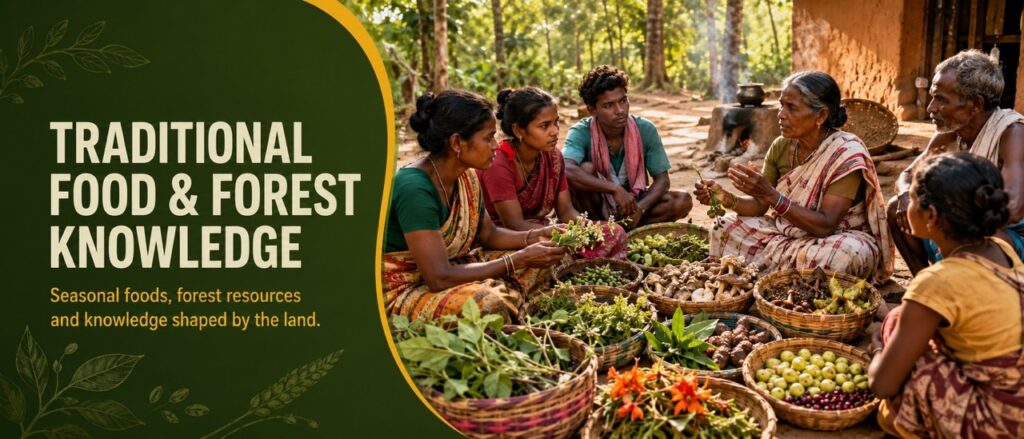
Preserving Food Traditions, Forest Wisdom and Indigenous Ecological Knowledge
Traditional Food & Forest Knowledge of Hodopathy explores the interconnected knowledge, practices, memories and relationships that communities associated with the Ho people and wider Adivasi communities of Jharkhandhave developed around food, forests, plants, agriculture, seasons and natural resources.
For generations, food and forest knowledge has been learned through observation, family teaching, community participation and practical experience. Knowledge about what grows in a particular season, which plants are edible, how foods are prepared, where resources can be found, and how natural resources should be used has traditionally formed part of everyday community life.
This knowledge is not simply a collection of recipes or a list of forest plants. It represents a broader understanding of the relationship between people, food, plants, forests, seasons, agriculture, biodiversity and community well-being.
Traditional food and forest knowledge is living knowledge—carried through people, practiced within communities and connected to the landscapes in which it developed.
Understanding Food and Forest Knowledge
In many indigenous communities, food knowledge and forest knowledge are closely connected.
Forests may provide fruits, leaves, seeds, roots, flowers, mushrooms and other resources. Agricultural landscapes provide grains, vegetables, pulses and seasonal crops. Knowledge holders understand these resources through repeated observation and experience.
Traditional knowledge may include:
- Identifying edible plants
- Recognising seasonal availability
- Understanding local plant names
- Selecting food resources
- Traditional harvesting practices
- Food preparation methods
- Food preservation
- Seed selection
- Agricultural traditions
- Knowledge of forest resources
- Seasonal environmental observations
- Sustainable resource practices
- Cultural relationships with particular foods and plants
These practices have developed within specific ecological and cultural contexts and should be understood within those contexts.
The Forest as a Source of Knowledge
For communities closely connected with forests, the forest can represent much more than a source of natural resources.
It can be a place of:
- Food
- Traditional knowledge
- Medicine-related cultural knowledge
- Livelihood
- Biodiversity
- Seasonal observation
- Cultural memory
- Community history
- Ecological learning
Generations of observation may have created detailed knowledge about plants, animals, seasons, water, soil and changing environmental conditions.
Preserving this knowledge therefore also means recognising the relationship between community life and the natural landscape.
Traditional Foods of the Region
Traditional food knowledge can include locally cultivated, collected and prepared foods that have been part of community diets over generations.
Depending on community traditions and local ecology, documentation may cover:
- Traditional grains
- Millets
- Pulses
- Vegetables
- Fruits
- Leafy foods
- Wild edible plants
- Seeds
- Roots and tubers
- Flowers
- Mushrooms
- Forest fruits
- Traditional beverages
- Seasonal foods
The purpose of documentation is not to suggest that every traditional food is universally suitable or nutritionally superior, but to preserve the cultural knowledge and historical context associated with these foods.
Seasonal Food Knowledge
Seasonality is an important part of traditional food systems.
Different plants and foods may become available at different times of the year.
Community knowledge may identify:
When to grow → When to collect → When to prepare → When to preserve → When to share
Seasonal knowledge can provide insight into how communities adapted their food practices to local climate, agriculture, forests and biodiversity.
Documenting these traditions can also help future generations understand historical relationships between food availability and seasonal cycles.
Wild Edible Plants
Wild edible plants can form an important part of traditional food knowledge in forest-connected communities.
Knowledge holders may understand:
- Which plants are traditionally eaten
- Which parts are used
- When they are collected
- How they are prepared
- How they are preserved
- Where they traditionally occur
- Which plants require particular preparation
Such knowledge must be documented carefully.
A plant being traditionally consumed does not automatically establish that every part of the plant is safe, that it can be consumed in any quantity or that it is suitable for everyone.
Where necessary, botanical identification and food-safety assessment should be undertaken by appropriately qualified experts.
Traditional Food Preparation
Traditional food knowledge includes not only ingredients but also methods of preparation.
Oral histories and community documentation may preserve information about:
- Cleaning
- Washing
- Cutting
- Grinding
- Boiling
- Cooking
- Fermentation
- Drying
- Roasting
- Preservation
- Storage
- Seasonal preparation
Preparation techniques can be important because the properties, taste, texture and safety of some foods may depend on how they are processed.
Documentation should preserve the community context without presenting traditional preparation methods as universally validated food-safety procedures.
Food Preservation and Storage
Traditional communities have developed ways of extending the availability of seasonal foods.
Knowledge may include:
- Sun drying
- Natural preservation
- Fermentation
- Seed storage
- Grain storage
- Drying leaves and vegetables
- Storage of fruits and other seasonal resources
These practices can provide valuable cultural and historical information about how communities managed food availability across seasons.
They may also offer research opportunities in areas such as food heritage, ethnobotany and traditional food systems.
Traditional Grains and Agricultural Knowledge
Food knowledge is closely connected with agriculture.
Traditional agricultural knowledge may include:
- Crop selection
- Local varieties
- Seed preservation
- Seasonal sowing
- Harvest timing
- Soil observations
- Mixed cropping
- Crop diversity
- Traditional storage
- Community agricultural practices
Local crop varieties may carry cultural as well as ecological significance.
Preserving traditional agricultural knowledge can therefore contribute to both cultural heritage preservation and agricultural biodiversity awareness.
Seeds and Agricultural Heritage
Seeds are more than agricultural inputs.
Traditional seed varieties may represent generations of selection, adaptation and community experience.
Community knowledge may include:
- Selecting seeds from healthy plants
- Storing seeds for future seasons
- Maintaining local varieties
- Sharing seeds within communities
- Recognising seasonal characteristics
- Preserving crop diversity
Where appropriate, documentation of traditional seeds can complement biodiversity and agricultural conservation initiatives.
Knowledge of Native Plants
Traditional plant knowledge can provide information about plants that may not be widely represented in formal records.
Community members may have local names and practical knowledge concerning:
- Trees
- Shrubs
- Herbs
- Climbers
- Grasses
- Fruits
- Vegetables
- Medicinally regarded plants
- Food plants
- Fodder plants
- Culturally important species
The Hodopathy Plant Database can help organise such information while distinguishing traditional knowledge from scientifically verified botanical information.
Local Plant Names and Language
A plant may have several names across communities and regions.
Local terminology can provide important cultural information about:
- Plant identity
- Physical characteristics
- Habitat
- Traditional use
- Seasonality
- Cultural significance
Where possible, the archive may record:
Local Name → Ho Terminology → Alternative Names → Scientific Name → Documentation Source
Scientific identification should be verified where possible rather than assumed from a local name alone.
Traditional Ecological Knowledge
Traditional food and forest knowledge can form part of a broader system often described as traditional ecological knowledge.
This may include long-term community observations of:
- Plants
- Animals
- Forests
- Soil
- Water
- Seasons
- Weather
- Agricultural cycles
- Biodiversity
- Landscape changes
Such knowledge is valuable as a record of community experience.
It can also provide research questions for ecology, ethnobotany, environmental history and conservation.
Forest Seasons and Environmental Observation
Knowledge holders may recognise seasonal changes through observations of:
- Flowering
- Fruiting
- Leaf emergence
- Plant availability
- Animal activity
- Rainfall patterns
- Water availability
- Agricultural conditions
These observations can preserve historical perspectives on local environmental change.
However, community observations should remain clearly identified as traditional or experiential knowledge unless independently supported by scientific measurements.
Sustainable Harvesting Traditions
Traditional resource collection may include knowledge concerning how, when and where natural resources are collected.
Responsible documentation may examine:
- Seasonal harvesting
- Selective collection
- Avoiding unnecessary destruction
- Collection of appropriate plant parts
- Protection of regenerating plants
- Community resource practices
- Traditional conservation approaches
Not every historical practice should automatically be assumed to be sustainable under present-day population, market or environmental conditions.
Contemporary conservation assessment is therefore important.
Biodiversity and Food Security
Food diversity and biodiversity can be closely connected.
Traditional food systems may include a variety of:
- Crops
- Wild foods
- Fruits
- Vegetables
- Seeds
- Grains
- Leafy plants
Maintaining diversity can contribute to cultural resilience and preserve knowledge of locally available resources.
The preservation of traditional food knowledge can therefore support wider discussions around agrobiodiversity, food heritage and ecological conservation.
Forest Knowledge and Community Well-Being
Forests can influence many aspects of community life.
Traditional forest knowledge may relate to:
- Food
- Materials
- Agriculture
- Cultural practices
- Livelihoods
- Seasonal activities
- Local ecology
- Community traditions
The objective of documenting this knowledge is to understand these relationships rather than reducing forests to collections of commercially valuable plants.
Traditional Knowledge and Health-Related Practices
Some traditional food and forest knowledge may include information about plants or preparations traditionally associated with health.
Such information should be documented as cultural and traditional knowledge.
Traditional use alone does not establish:
- Medical effectiveness
- Safety
- Appropriate dosage
- Drug interactions
- Suitability for particular health conditions
Where health-related claims are discussed, Hodopathy.org seeks to distinguish community reports from scientifically established evidence.
This distinction is essential for responsible public communication.
From Traditional Knowledge to Responsible Research
Traditional knowledge can help identify questions for further study.
A responsible research pathway may be:
Community Knowledge
↓
Ethical Documentation
↓
Plant or Food Identification
↓
Scientific Investigation
↓
Evidence Assessment
↓
Responsible Communication
Research should recognise the communities and knowledge holders whose experience contributed to the research question.
Traditional knowledge should not be presented as scientifically proven simply because it has been used for generations.
Documenting Food Knowledge Through Oral Histories
Food traditions are often best understood through the voices of people who have practiced them.
Oral-history interviews may record:
- Names of traditional foods
- Seasonal preparation
- Family recipes
- Food memories
- Local ingredients
- Traditional cooking methods
- Food preservation
- Stories associated with particular foods
- Changes in food practices
Where appropriate, audio and video recordings can preserve pronunciation, demonstrations and cultural context.
Food Knowledge and Intergenerational Learning
Traditional food knowledge is frequently learned within families and communities.
A younger person may learn by:
Watching → Helping → Practising → Receiving Guidance → Teaching Others
This process allows knowledge to remain connected with everyday experience.
Oral histories can preserve these learning pathways and demonstrate how food knowledge has been passed from one generation to another.
Protecting Sensitive Food and Forest Knowledge
Not all knowledge should automatically be published online.
Information may be:
- Sacred
- Family-specific
- Community-restricted
- Practitioner-specific
- Ecologically sensitive
- Commercially sensitive
Access may therefore be:
Public → Community Access → Research Restricted → Confidential
The wishes of knowledge holders and relevant community protocols should determine how information is handled.
Protecting Vulnerable Plants and Forest Resources
Detailed information about rare or commercially valuable plants may create risks if published without appropriate safeguards.
Potential risks include:
- Overharvesting
- Unauthorised collection
- Commercial exploitation
- Habitat disturbance
- Destruction of vulnerable populations
Sensitive locations may therefore need to be generalised or withheld.
Conservation Before Extraction
The purpose of documentation should be to support preservation and responsible understanding—not to create a catalogue for exploitation.
Community Rights and Benefit Sharing
Traditional food and forest knowledge may represent collective cultural heritage built over generations.
Hodopathy.org does not claim ownership over the traditional knowledge of communities associated with Hodopathy.
Where knowledge is used for research, education, innovation or commercial purposes, appropriate attention should be given to:
- Prior informed consent
- Attribution
- Community participation
- Access conditions
- Applicable legal requirements
- Benefit-sharing considerations
Knowledge holders and communities should not be excluded from discussions about the use of their knowledge.
Preventing Knowledge Extraction
Preservation should never become a new form of extraction.
Responsible documentation should avoid:
- Collecting knowledge without consent
- Publishing sensitive information without permission
- Removing knowledge from its cultural context
- Misrepresenting traditional practices
- Commercialising knowledge without appropriate participation
- Failing to recognise contributors
- Sharing sensitive plant locations unnecessarily
The goal is to create a relationship of preservation, learning and respect.
Community-Centred Documentation
Communities should have meaningful participation in decisions concerning their knowledge.
Where appropriate, community members and knowledge holders may contribute to:
- Identifying important topics
- Selecting knowledge for documentation
- Reviewing records
- Correcting terminology
- Establishing access conditions
- Protecting sensitive information
- Deciding how contributors are acknowledged
This approach helps ensure that the archive remains connected to the communities whose knowledge it preserves.
Connecting Food Knowledge With the Plant Database
Traditional food information can complement botanical records.
For example:
Traditional Food Name
↓
Local Plant Name
↓
Oral History
↓
Field Documentation
↓
Botanical Identification
↓
Plant Database
↓
Research & References
This connection can preserve both the scientific identity of a plant and the cultural knowledge associated with it.
Connecting Forest Knowledge With Biodiversity Conservation
Forest knowledge can also contribute to conservation awareness.
Documentation may help identify:
- Traditionally important species
- Native plants
- Seasonal resources
- Community conservation practices
- Changes in plant availability
- Areas requiring further ecological study
Such information should be used carefully, particularly when documenting vulnerable species or sensitive habitats.
For Communities
Traditional food and forest documentation can support:
- Cultural preservation
- Intergenerational learning
- Local-language preservation
- Recognition of knowledge holders
- Food heritage documentation
- Biodiversity awareness
- Community education
The objective is to strengthen the connection between knowledge and the communities that maintain it.
For Students
Students can use this knowledge to explore connections between:
- Food and culture
- Plants and people
- Forests and communities
- Agriculture and biodiversity
- Traditional knowledge and science
- Language and ecological understanding
Students are encouraged to approach indigenous knowledge with curiosity, respect and critical thinking.
For Researchers
Traditional food and forest knowledge can provide research opportunities in:
- Ethnobotany
- Botany
- Ecology
- Anthropology
- Food heritage
- Indigenous studies
- Agricultural biodiversity
- Environmental history
- Conservation
- Linguistics
Researchers should respect community protocols, access conditions, attribution requirements and applicable ethical and legal frameworks.
Building a Traditional Food & Forest Knowledge Archive
The long-term vision is to preserve a structured collection containing:
- Traditional food records
- Plant knowledge
- Forest knowledge
- Oral histories
- Local terminology
- Food preparation traditions
- Seasonal observations
- Agricultural knowledge
- Seed and crop information
- Biodiversity records
- Historical photographs
- Audio and video documentation
- Research references
The collection should remain dynamic and open to correction, community review and new documentation where appropriate.
Our Principles
The Traditional Food & Forest Knowledge initiative follows several core principles:
Respect
Honour the people, communities and cultures that maintain the knowledge.
Consent
Document and share knowledge only with appropriate permission.
Cultural Context
Preserve knowledge within its historical and cultural setting.
Accuracy
Verify information where possible and clearly identify uncertainty.
Language Preservation
Respect Ho and local terminology.
Community Participation
Keep communities involved in documentation and decision-making.
Knowledge Protection
Protect confidential, sacred and restricted information.
Conservation
Prioritise biodiversity and ecosystem protection.
Responsible Research
Distinguish traditional knowledge from scientific evidence.
Fair Recognition
Acknowledge knowledge holders and contributors appropriately.
Responsible Access
Make information available according to agreed conditions.
A Living Relationship Between People, Food and Forests
Traditional food and forest knowledge demonstrates that relationships between people and nature can extend across generations.
A food may be connected to a particular season. A plant may be associated with a specific forest landscape. A seed may carry the memory of generations of cultivation. A local name may preserve a piece of cultural history.
Together, these connections form a rich body of living knowledge.
Preserving them requires more than creating lists of plants or recipes. It requires preserving the stories, languages, practices, landscapes and people connected with them.
Our Vision
We envision a future in which younger generations can learn about traditional foods, local plants and forest knowledge from the people and communities who have carried this knowledge through generations.
We envision responsible research that respects indigenous knowledge rather than extracting it.
We envision conservation efforts that recognise the importance of local ecological understanding.
And we envision a future where traditional food and forest knowledge remains a living part of cultural heritage rather than becoming a forgotten record of the past.
Preserving Food Traditions. Protecting Forest Knowledge. Honouring Living Heritage.
Traditional Food & Forest Knowledge of Hodopathy is ultimately about preserving the relationship between people, plants, food, forests, seasons, agriculture and culture.
By documenting this knowledge responsibly, supporting intergenerational learning and protecting the biodiversity connected with it, Hodopathy.org seeks to contribute to the preservation of the living heritage of the Ho and wider Adivasi communities of Jharkhand.
Hodopathy — Preserving Traditional Knowledge, Celebrating Food Heritage, Protecting Forest Wisdom and Building a Responsible Future.