
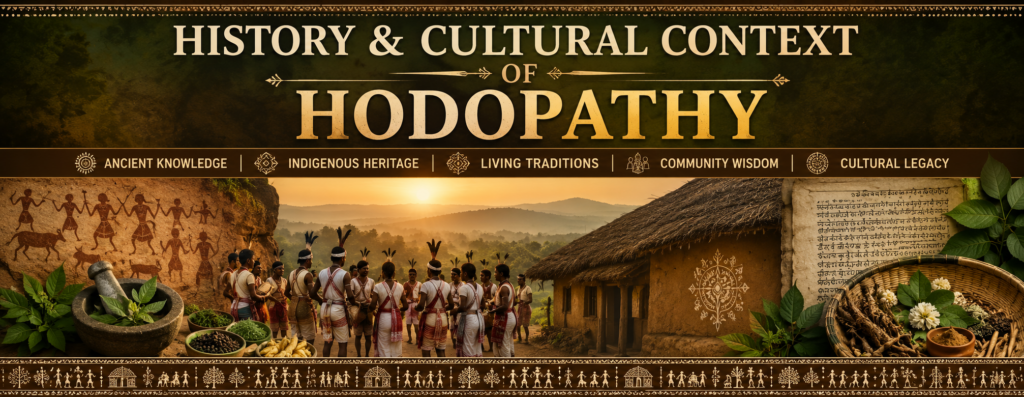
A Living Adivasi Knowledge Tradition
The history of Hodopathy is deeply connected with the indigenous knowledge traditions of the Ho community and the wider Adivasi communities of Jharkhand. It represents generations of knowledge developed through close and continuous relationships with forests, native plants, food, land, water, seasons, biodiversity and community life.
Hodopathy is not a tradition that can be attributed to a single individual, book or historical event. Rather, it has evolved through generations of observation, experience, practice and oral transmission. Knowledge has traditionally been learned within families and communities, particularly through elders, experienced practitioners and people with deep familiarity with local plants and natural resources.
This makes Hodopathy a living cultural heritage, rather than simply an archive of historical information.
Rooted in the Land and Forests of Jharkhand
The natural landscape of Jharkhand forms an important part of the cultural setting in which Adivasi knowledge has developed.
For generations, communities have maintained close relationships with forests and surrounding ecosystems. This relationship has supported knowledge of native plants, seasonal foods, forest resources, agricultural practices and sustainable ways of interacting with the natural environment.
Traditional knowledge may include understanding where particular plants grow, recognising them through their physical characteristics, knowing their local names, observing their seasonal cycles and understanding traditional methods of collection and preparation.
Such knowledge is therefore closely connected to the ecology of the region and the everyday experiences of the communities living within it.
Knowledge Passed Through Generations
Historically, much of the knowledge associated with Hodopathy has been transmitted through oral teaching and practical experience.
Elders and experienced knowledge holders may teach younger members by explaining, demonstrating and sharing knowledge during everyday activities. Learning can occur in forests, fields, homes, community spaces and other environments where people interact directly with plants and natural resources.
A learner may acquire knowledge through:
- Listening to elders and experienced practitioners
- Observing plants in their natural environment
- Learning local plant names and terminology
- Participating in seasonal activities
- Understanding traditional collection practices
- Observing preparation methods
- Learning through family and community experience
- Developing practical familiarity with the local environment
This method of transmission allows knowledge to remain connected to place, practice and cultural memory.
Plants as Part of Cultural Knowledge
Plants hold an important place within the knowledge systems associated with Hodopathy.
However, traditional plant knowledge should not be understood merely as a catalogue of medicinal species. A plant may have significance in relation to food, culture, livelihood, seasonal practices, ecology, traditional uses and community life.
Local knowledge can include information about:
- Native and traditionally used plants
- Plant identification
- Local names and terminology
- Seasonal availability
- Traditional methods of collection
- Preparation practices
- Food plants and wild foods
- Forest resources
- Cultural associations
- Ecological relationships
The significance of a plant is therefore often understood within a much larger cultural and environmental context.
The Importance of Oral Tradition
One of the most important features of indigenous knowledge traditions is the role of oral transmission.
Knowledge may be communicated through conversations, demonstrations, stories, local terminology, practical instruction and personal experience. Unlike information preserved exclusively in written texts, oral knowledge can be closely tied to relationships between generations.
This creates both strength and vulnerability.
Oral transmission allows knowledge to remain dynamic and connected to community life. At the same time, knowledge can become vulnerable when experienced knowledge holders pass away, younger generations have fewer opportunities to learn, local languages decline, or traditional environments change.
Preserving Hodopathy therefore requires respectful efforts to document knowledge that communities and knowledge holders are willing to share.
Language, Identity and Cultural Memory
Language is an important part of cultural knowledge.
Local names for plants, foods, places and natural resources may carry meanings and distinctions that cannot always be fully represented by scientific terminology. Recording local terminology, where communities permit it, can therefore contribute significantly to cultural preservation.
The preservation of Hodopathy should consider not only what knowledge is recorded, but also how that knowledge is expressed and understood within its original cultural context.
For this reason, oral histories, local vocabulary, community narratives and the experiences of knowledge holders can be important components of responsible documentation.
Hodopathy as Collective Heritage
Hodopathy should be approached as a form of community and cultural heritage, rather than as information belonging automatically to any one outside individual or organisation.
Different families, practitioners and communities may hold different knowledge, interpretations and practices. Some knowledge may be widely shared, while other knowledge may be restricted to particular families, practitioners or cultural contexts.
This diversity should be respected.
A responsible approach recognises knowledge holders as participants and custodians, not merely as research subjects or sources of information.
Why Historical Documentation Matters
A substantial amount of indigenous knowledge has historically remained outside formal written records.
Without responsible documentation, valuable knowledge may gradually disappear due to:
- Generational changes
- Migration and changing lifestyles
- Reduced interaction with forests
- Declining use of local languages
- Changing food and agricultural practices
- Loss of traditional habitats
- Environmental degradation
- The passing of experienced knowledge holders
Documentation can help create a record for future generations, but it must be conducted carefully.
The purpose should be preservation and respectful learning—not extraction or unrestricted publication.
Protecting Sensitive Cultural Knowledge
Not every aspect of Hodopathy should necessarily be made publicly available.
Some knowledge may be sacred, private, confidential, culturally sensitive or traditionally restricted. Such knowledge should only be documented or shared when appropriate permission has been provided by the relevant knowledge holders or communities.
Responsible preservation therefore requires:
- Prior informed consent
- Community participation
- Cultural sensitivity
- Proper acknowledgement
- Protection of confidential information
- Appropriate access controls
- Respect for community decisions
Preserving knowledge does not mean making all knowledge publicly accessible.
Hodopathy and Biodiversity
The cultural history of Hodopathy is closely connected with the biodiversity of Jharkhand.
Traditional knowledge develops through repeated interaction with living ecosystems. Knowledge of plants, seasons, forests and natural resources depends on those ecosystems continuing to exist.
When forests are degraded or native plant species disappear, the cultural knowledge associated with them can also become vulnerable.
For this reason, preserving Hodopathy also means supporting:
- Native plant conservation
- Forest protection
- Community herbal gardens
- Seed conservation
- Sustainable harvesting
- Habitat restoration
- Protection of rare and threatened species
- Biodiversity education
Protecting the environment helps protect the knowledge that developed within it.
From Traditional Knowledge to Responsible Research
Hodopathy can provide valuable opportunities for responsible research in areas such as botany, ethnobotany, ecology, anthropology, biodiversity conservation and cultural studies.
Traditional knowledge holders possess generations of practical observations. Researchers can contribute scientific methods for botanical identification, documentation, ecological assessment and further investigation.
The two knowledge systems should, however, be represented honestly.
Traditional knowledge should not automatically be presented as scientifically proven simply because it has been practiced for generations. Similarly, scientific investigation should not remove traditional knowledge from its cultural context.
A responsible approach recognises the difference between:
Traditional Knowledge → Documented Traditional Use → Research Investigation → Scientific Evidence
This distinction is important for maintaining both cultural respect and scientific integrity.
A History That Continues
Hodopathy is not simply a historical subject. It is a living tradition that continues to exist through people, language, memory, practice and relationships with nature.
Its future depends on whether knowledge can be respectfully transmitted to younger generations while the forests, plants, biodiversity and cultural environments connected to that knowledge are protected.
Preservation should therefore be understood as an ongoing process—one that brings together community knowledge, cultural heritage, education, biodiversity conservation and responsible research.
The Role of Hodopathy.org
Hodopathy.org seeks to contribute to this preservation by creating a responsible platform for documentation, education, research awareness and cultural recognition.
The platform aims to connect:
- Adivasi elders and knowledge holders
- Ho community members
- Traditional practitioners
- Botanists and ethnobotanists
- Researchers and students
- Universities and research institutions
- Biodiversity and conservation organisations
- Responsible cultural and educational organisations
The purpose is not to replace traditional knowledge with modern science, nor to claim ownership of community heritage.
Instead, the aim is to preserve knowledge responsibly, recognise its custodians, encourage ethical research and support the protection of the cultural and ecological environments in which the knowledge has developed.
Preserving a Living Heritage
The history of Hodopathy is ultimately a history of relationships between generations, communities and nature.
It reflects the knowledge of people who have observed their environment closely, learned from those who came before them and passed knowledge forward through everyday practice.
Preserving this heritage means more than recording plant names or traditional practices. It means protecting the people, languages, forests, biodiversity, cultural memory and community participation that give the knowledge its meaning.
Our Perspective
Hodopathy is a living Adivasi knowledge heritage associated particularly with the Ho community and the wider cultural landscape of Jharkhand.
Its history continues through the knowledge holders, families, practitioners and communities who preserve and transmit this heritage.
Our responsibility is to ensure that this knowledge is documented with consent, represented with accuracy, protected from misuse, connected to biodiversity conservation and carried forward with respect for its cultural custodians.
Preserve the knowledge. Respect the custodians. Protect the culture. Conserve the living landscape.