
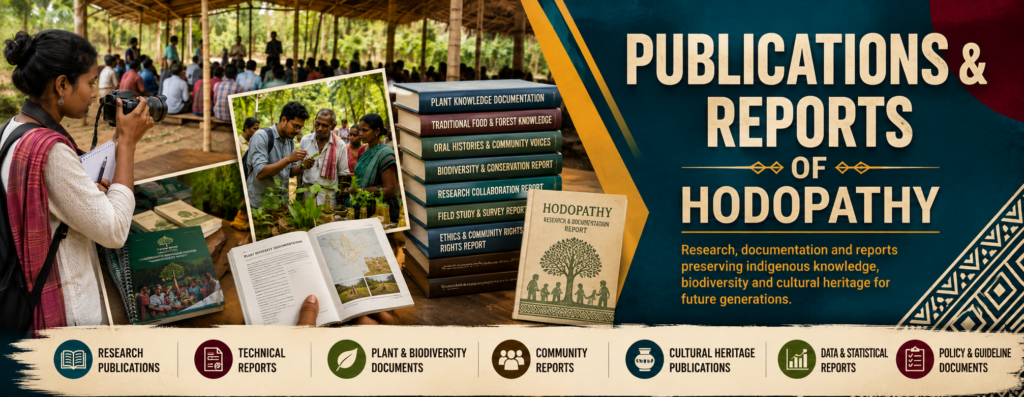
Publications & Reports of Hodopathy can provide an organized foundation for documenting research, observations, methodologies, developments, and emerging evidence related to Hodopathy. As the field evolves, publication should focus on transparency, scientific quality, reproducibility, responsible communication, and continuous improvement.
A strong publication system can help transform individual ideas and projects into a structured body of knowledge that can be reviewed, compared, replicated, and improved over time.
Important: Publications about Hodopathy should clearly distinguish established evidence, preliminary findings, traditional knowledge, theoretical concepts, and claims that remain unverified. Health-related conclusions should not be presented as proven without appropriate evidence.
1. Purpose of Hodopathy Publications
The primary purpose of publications is to create a reliable record of knowledge and research.
Publications can help:
- Document research findings
- Share new hypotheses
- Present experimental methods
- Report observational studies
- Record clinical research where ethically and scientifically appropriate
- Analyze historical and traditional knowledge
- Report safety findings
- Encourage independent replication
- Identify research gaps
- Promote interdisciplinary collaboration
- Support evidence-based development of Hodopathy
A well-developed publication system should make it possible for researchers to understand what has already been studied, how it was studied, what was discovered, and what still needs investigation.
2. Research Papers
Research papers can become the core publication format for Hodopathy.
A standard research paper may include:
Title
A precise description of the research question or intervention.
Abstract
A concise summary of:
- Background
- Objective
- Methods
- Results
- Conclusion
- Limitations
Introduction
Explains the scientific or practical background and identifies the research question.
Methodology
Describes exactly how the study was conducted so that other researchers can evaluate or reproduce it.
Results
Reports the findings without exaggerating their significance.
Discussion
Explains what the results may mean and compares them with previous research.
Limitations
Clearly identifies weaknesses, uncertainties and factors that may affect interpretation.
Conclusion
Provides conclusions that remain proportional to the evidence.
3. Review Articles
Review articles can bring together existing information from multiple studies.
Potential review topics include:
- History and development of Hodopathy
- Hodopathy and nutrition
- Hodopathy and lifestyle
- Natural-resource research
- Environmental wellness
- Traditional knowledge
- Digital health applications
- AI-assisted wellness research
- Safety considerations
- Existing scientific evidence
High-quality reviews should use transparent literature-search methods and clearly explain how studies were selected and evaluated.
4. Systematic Reviews & Evidence Mapping
As research increases, systematic reviews can become especially valuable.
A systematic review can:
- Define a specific research question
- Search relevant scientific literature
- Establish inclusion and exclusion criteria
- Evaluate study quality
- Extract relevant data
- Compare findings
- Identify inconsistencies
- Assess the overall strength of evidence
An Evidence Map of Hodopathy Research could visually organize areas where evidence is:
- Strong
- Moderate
- Preliminary
- Inconsistent
- Insufficient
- Not yet investigated
This would help researchers identify the most important priorities for future investigation.
5. Hodopathy Research Reports
Research reports can provide detailed documentation of individual projects.
Reports may cover:
- Laboratory investigations
- Pilot studies
- Field studies
- Observational research
- Community programs
- Nutrition projects
- Environmental studies
- Technology projects
- Product-quality investigations
- Safety assessments
A research report should document both positive and negative findings.
Reporting unsuccessful results is important because it prevents researchers from repeatedly investigating approaches that have already shown limited promise.
6. Clinical Research Reports
Where Hodopathic interventions are investigated for health outcomes, clinical reports should follow appropriate research and ethical standards.
Reports can include:
- Study design
- Participant characteristics
- Intervention details
- Comparison groups
- Outcome measurements
- Statistical methods
- Adverse events
- Results
- Limitations
- Conflicts of interest
Clinical publications should avoid presenting preliminary research as proof of medical effectiveness.
7. Safety Reports
Safety documentation should become an important component of future Hodopathy publications.
Safety reports may investigate:
- Potential adverse effects
- Product quality
- Contamination
- Ingredient identification
- Dosage consistency
- Interactions with medicines
- Contraindications
- Long-term exposure
- Manufacturing and storage conditions
A dedicated Hodopathy Safety Database could eventually organize safety observations and research findings in a standardized format.
8. Traditional Knowledge Documentation
Publications can also preserve historical and traditional knowledge.
Possible documentation includes:
- Historical practices
- Traditional dietary approaches
- Plant-use traditions
- Cultural wellness practices
- Historical texts
- Regional knowledge
- Traditional preparation methods
However, documentation of traditional use should be separated from scientific validation.
For example:
“Traditionally used for X” does not automatically mean “scientifically proven to treat X.”
This distinction is essential for responsible publication.
9. Case Reports & Case Series
Case reports may document unusual observations or experiences that could generate future research hypotheses.
A case report might describe:
- Background
- Relevant history
- Intervention or exposure
- Observed outcome
- Follow-up
- Limitations
- Possible explanations
Case reports can be useful for hypothesis generation, but they cannot by themselves establish treatment effectiveness or causation.
10. Hodopathy Annual Research Report
An annual report could provide a comprehensive overview of progress during each year.
A future Annual Hodopathy Research Report might contain:
Research Highlights
Major studies and developments.
Publications
Papers, reviews and reports released during the year.
Research Projects
Ongoing and completed projects.
Scientific Collaborations
Universities, laboratories and research organizations involved in legitimate collaborations.
New Technologies
Applications of AI, digital health, data science and laboratory technologies.
Safety Findings
Important safety observations and quality-control results.
Research Gaps
Questions requiring additional investigation.
Future Priorities
Recommended research directions for the following year.
11. Hodopathy Research Bulletin
A regular research bulletin could provide shorter updates between major publications.
Possible sections:
🧪 New Research
📊 Research Findings
🌱 Natural Resource Studies
🥗 Nutrition Research
🧬 Biological Research
🤖 AI & Digital Innovation
🌍 Environmental Research
🔬 Laboratory Updates
📚 Literature Reviews
⚠️ Safety Updates
This format could make research developments easier to follow without replacing peer-reviewed publications.
12. Data Reports & Research Datasets
Modern research increasingly depends on high-quality datasets.
Hodopathy research could develop datasets covering:
- Lifestyle patterns
- Dietary information
- Environmental measurements
- Wellness questionnaires
- Laboratory measurements
- Longitudinal observations
- Intervention outcomes
Whenever ethically and legally possible, anonymized datasets and research protocols could be shared to support independent analysis.
13. AI & Data-Driven Research Reports
Future publications could document the use of artificial intelligence and data science in Hodopathy research.
Potential topics include:
- AI-assisted literature analysis
- Pattern recognition
- Research trend analysis
- Personalized wellness modeling
- Predictive analytics
- Large-scale observational datasets
- Digital health monitoring
AI should be treated as a research and analytical tool, not as an independent authority for medical conclusions.
Research reports should disclose:
- Data sources
- Model methodology
- Validation procedures
- Potential bias
- Limitations
- Human oversight
14. Nutrition & Food Research Publications
A dedicated publication series could examine food and nutrition from scientific and public-health perspectives.
Potential publications:
“Hodopathy & Nutrition Research Review”
Reviewing research concerning dietary patterns and wellness.
“Traditional Foods Research Report”
Documenting traditional foods and their nutritional characteristics.
“Plant-Based Nutrition Research”
Examining scientifically measurable nutritional properties.
“Food Quality & Safety Report”
Investigating quality, contamination, processing and storage.
15. Environmental Wellness Reports
Environmental research publications could examine relationships between environmental conditions and human wellbeing.
Possible reports include:
- Indoor environmental quality
- Air quality
- Green-space exposure
- Noise exposure
- Workplace environment
- Nature-based activities
- Sustainable living
- Environmental behavior
Such reports could combine environmental measurements with validated health and wellbeing indicators.
16. Research Methodology & Standards
One of the most important future publication areas is the development of standardized Hodopathy research methodology.
A methodological handbook could establish guidance for:
- Research design
- Data collection
- Sample selection
- Measurement methods
- Statistical analysis
- Reporting standards
- Reproducibility
- Ethical research
- Safety monitoring
- Data management
Standardization would make studies easier to compare and replicate.
17. Peer Review & Independent Evaluation
A mature research publication ecosystem should encourage independent evaluation.
A proposed publication pathway could be:
Research Proposal → Ethical Review → Study → Data Analysis → Manuscript → Peer Review → Revision → Publication → Independent Replication
Peer review does not guarantee that a finding is correct, but it provides an important quality-control mechanism.
Independent researchers should be encouraged to challenge, reproduce and refine published findings.
18. Research Integrity & Transparency
Future Hodopathy publications should adopt strong principles of research integrity.
These include:
- Accurate data reporting
- Transparent methodology
- Proper statistical analysis
- Disclosure of funding
- Declaration of conflicts of interest
- Proper authorship
- Correction of errors
- Publication of negative findings
- Protection of research participants
- Avoidance of exaggerated health claims
Trust in research depends not only on interesting results but also on how honestly and transparently those results are reported.
19. Open-Access Knowledge Development
Where practical, Hodopathy research could adopt an open-access model.
This could include:
- Open research articles
- Public research summaries
- Research protocols
- Data dictionaries
- Methodology documents
- Evidence maps
- Research registries
Open access can make research available to researchers, students, educators and interested members of the public.
20. Proposed Hodopathy Publication Series
A future publication platform could organize information into dedicated series:
📘 Hodopathy Research Journal
Peer-reviewed original research.
📗 Hodopathy Review Series
Systematic and narrative reviews.
📙 Hodopathy Research Reports
Detailed project reports.
📕 Hodopathy Safety Reports
Safety and quality-control research.
📒 Hodopathy Evidence Reports
Evidence assessments and systematic reviews.
📓 Hodopathy Annual Report
Yearly progress and research activities.
📔 Hodopathy Methodology Handbook
Research methods and reporting standards.
📚 Hodopathy Knowledge Archive
Historical, traditional and scientific documentation.
21. Future Digital Publication Platform
An advanced Hodopathy research platform could integrate publications, datasets and research projects in one searchable ecosystem.
Possible features
🔎 Research Search
Find studies by topic, year, methodology or research area.
📊 Evidence Dashboard
Visualize the current evidence for different research questions.
🧪 Project Registry
Track ongoing and completed research.
📚 Publication Library
Organize papers, reviews and reports.
📈 Research Trends
Identify rapidly developing areas.
🤖 AI Research Assistant
Help researchers discover relevant literature and research gaps while keeping human scientific review in control.
🔗 Research Connections
Connect researchers working on related questions.
22. International Collaboration
Future publications can benefit from interdisciplinary and international collaboration.
Potential contributors may include experts in:
- Medicine
- Biology
- Nutrition
- Psychology
- Agriculture
- Environmental science
- Pharmacology
- Biochemistry
- Statistics
- Epidemiology
- Data science
- Artificial intelligence
- Public health
The purpose should be to bring multiple scientific perspectives together rather than isolating Hodopathy from established research disciplines.
23. Future Research Publication Roadmap
Phase 1 — Documentation
Collect existing knowledge, historical references, research ideas and available evidence.
Phase 2 — Standardization
Develop terminology, research protocols and reporting frameworks.
Phase 3 — Pilot Research
Conduct small, carefully designed exploratory studies.
Phase 4 — Controlled Research
Investigate promising hypotheses using stronger study designs.
Phase 5 — Independent Replication
Encourage researchers outside the original team to reproduce findings.
Phase 6 — Evidence Synthesis
Combine available evidence through systematic reviews and meta-analysis where appropriate.
Phase 7 — Global Knowledge Platform
Develop an accessible, searchable and continuously updated research database.
24. Vision for the Future
The future of Publications & Reports of Hodopathy should not simply be about producing more documents. It should be about creating a reliable knowledge system.
The progression can be:
Document → Investigate → Publish → Review → Replicate → Evaluate → Improve → Apply
A strong publication ecosystem can help identify which Hodopathy concepts deserve further research, which findings remain uncertain, and which claims are supported—or not supported—by available evidence.
The ultimate goal should be to establish a culture of scientific openness, responsible innovation and evidence-based development, where traditional knowledge can be documented respectfully, modern technologies can accelerate research, and every significant claim remains open to rigorous testing.
Core Publication Principle
“Publish what was studied, show how it was studied, report what was found, acknowledge what remains uncertain, and let evidence—not assumption—guide the next step.”