
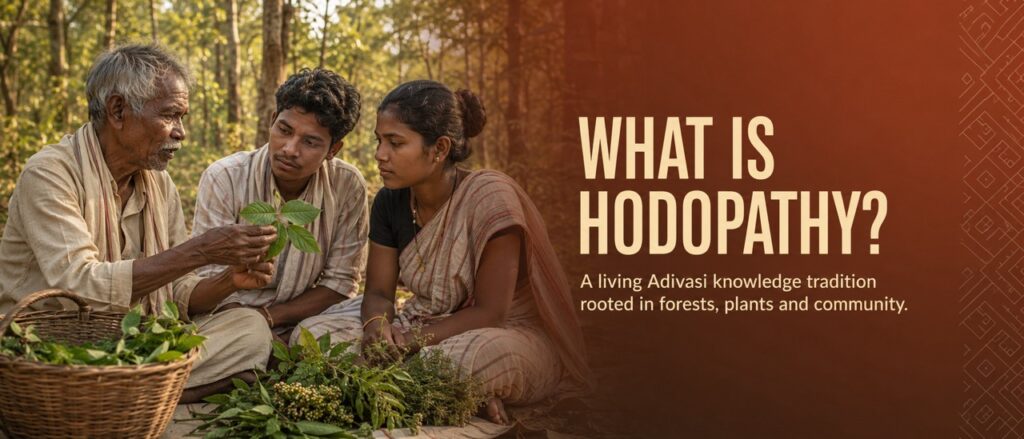
Hodopathy is a living indigenous knowledge tradition associated particularly with the Ho community and the wider Adivasi heritage of Jharkhand. It represents generations of knowledge, observation, experience and practices developed through a close relationship between people, forests, native plants, food, seasons, natural resources, culture and community life.
Hodopathy is not simply a collection of medicinal plants or traditional remedies. It is a broader body of community-held knowledge about nature and human well-being, shaped by generations of observation and practical experience. This knowledge has traditionally been transmitted through families, elders, experienced practitioners and community members through oral teaching, observation, participation and everyday practice.
Much of this knowledge has never been formally documented. As a result, preserving Hodopathy requires more than recording plant names or traditional preparations. It requires preserving the cultural context, languages, ecological knowledge, traditional practices, landscapes and communities through which this knowledge has survived.
Understanding Hodopathy
The word Hodopathy is used here to describe a knowledge tradition rooted in the lived experiences of Adivasi communities, particularly the Ho community of Jharkhand.
Over generations, communities have developed detailed familiarity with their surrounding environment. This may include knowledge of:
- Native and locally occurring plants
- Traditional plant identification
- Forest resources and their uses
- Seasonal plants, foods and natural resources
- Traditional methods of collection and preparation
- Local food and nutrition practices
- Sustainable harvesting and resource management
- Community relationships with forests and biodiversity
- Cultural practices and beliefs associated with nature
- Knowledge passed through families, elders and traditional practitioners
- Changes in plants, seasons and local environments
This knowledge is inseparable from the ecological and cultural environment in which it developed.
Hodopathy and the Relationship With Nature
At the heart of Hodopathy is a long-standing relationship between people and the natural world.
Forests are not viewed merely as sources of raw materials. They can form part of a community’s food systems, cultural identity, traditional knowledge and everyday life. Native plants may be understood not only by their physical characteristics but also through their seasonal availability, habitat, traditional uses and place within community practices.
This relationship has created a rich body of practical environmental knowledge.
Understanding Hodopathy therefore also means understanding the forests, biodiversity, plants, food traditions, languages and communities connected to it.
Hodopathy Is More Than Traditional Medicine
Hodopathy should not be reduced to the idea of traditional medicine alone.
Although traditional plant knowledge and community health practices may form an important part of the knowledge tradition, Hodopathy encompasses a much wider field of indigenous understanding.
It can include the relationship between:
People → Plants → Forests → Food → Seasons → Culture → Community → Environment
These relationships provide an important perspective for understanding how Adivasi communities have interacted with and learned from their surroundings over generations.
For this reason, the preservation of Hodopathy should include ethnobotanical knowledge, biodiversity, cultural heritage, oral histories, traditional terminology, ecological practices and community knowledge, while respecting the boundaries established by the knowledge holders themselves.
How Hodopathy Knowledge Is Traditionally Preserved
For generations, much of this knowledge has been preserved without formal books or databases.
Knowledge may be transmitted through:
- Oral traditions
- Family teachings
- Elders and community knowledge holders
- Traditional practitioners
- Observation and demonstration
- Practical experience
- Seasonal activities
- Community participation
- Local language and terminology
- Direct interaction with forests and plants
A young person may learn about a plant not simply by memorising its name, but by observing where it grows, when it appears, how it is identified, how it is traditionally collected and how elders describe its significance.
This makes Hodopathy a living tradition rather than a static historical record.
Why Hodopathy Matters Today
Much of the world’s indigenous knowledge is vulnerable to gradual loss. Traditional knowledge can disappear when experienced knowledge holders pass away without having an opportunity to transmit their knowledge, when younger generations move away from traditional environments, when local languages decline, or when forests and natural habitats are degraded.
Hodopathy therefore represents an important cultural and ecological heritage that deserves careful documentation and protection.
Responsible documentation can help future generations understand:
- Traditional relationships with native plants
- Local biodiversity
- Indigenous ecological knowledge
- Traditional food systems
- Cultural practices
- Local terminology and oral histories
- Community approaches to natural-resource use
However, documentation must never become a means of extracting or commercialising community knowledge without permission.
Hodopathy and Responsible Research
Hodopathy can provide valuable starting points for ethnobotanical, botanical, ecological, cultural and interdisciplinary research.
Traditional knowledge may help researchers identify plants, practices or ecological observations that deserve further investigation. Scientific research can then contribute additional methods of identification, documentation and evaluation.
However, traditional knowledge and scientific evidence should not be treated as identical.
A traditional practice being used by a community for generations does not automatically establish its scientific efficacy, safety or suitability for every individual. Such questions require appropriate scientific investigation.
Therefore, Hodopathy.org distinguishes between:
Traditional Knowledge → Documented Traditional Use → Preliminary Research → Published Research → Established Scientific Evidence
Maintaining this distinction is essential for honest and responsible communication.
Protecting Traditional Knowledge
Indigenous knowledge belongs within the cultural and community contexts from which it originates. Documentation should therefore be carried out with respect, consent, acknowledgement and community participation.
Not every piece of knowledge should necessarily be published online.
Sacred, confidential, sensitive or restricted knowledge should remain protected when communities or knowledge holders determine that it should not be publicly disclosed.
Responsible preservation means ensuring that communities and knowledge holders retain appropriate recognition and control over how their knowledge is documented, represented and shared.
Hodopathy and Biodiversity Conservation
The future of Hodopathy is closely connected with the future of Jharkhand’s natural environment.
When native plants disappear, forests are degraded and traditional landscapes change, the ecological foundation supporting indigenous knowledge can also disappear.
Preserving Hodopathy therefore involves supporting the conservation of:
- Native plants
- Medicinal and traditionally used species
- Forest ecosystems
- Local biodiversity
- Traditional food plants
- Community seed resources
- Natural habitats
- Sustainable harvesting practices
Cultural preservation and biodiversity conservation are deeply connected.
Protecting the knowledge without protecting the environment in which that knowledge evolved would leave only part of the heritage intact.
The Role of Hodopathy.org
Hodopathy.org is envisioned as a community-centred platform for preserving, documenting, studying and responsibly sharing this living heritage.
The platform seeks to bring together Adivasi knowledge holders, traditional practitioners, botanists, ethnobotanists, students, researchers, universities, laboratories, conservation organisations and responsible institutions.
Its purpose is not to replace traditional knowledge with modern science, nor to present traditional knowledge as scientific fact without evidence.
Instead, the goal is to create a respectful space where indigenous knowledge and responsible research can exist in dialogue, while recognising the distinct value and context of each.
A Living Heritage, Not a Forgotten Past
Hodopathy is not merely a record of the past. It is a living tradition carried through people, language, practice, memory and relationships with nature.
Preserving it means listening to knowledge holders, documenting what communities permit to be documented, protecting sensitive knowledge, conserving native biodiversity and creating opportunities for younger generations to learn.
It also means ensuring that indigenous knowledge is not separated from the people and landscapes that have preserved it.
Our Understanding of Hodopathy
Hodopathy is a living Adivasi knowledge tradition rooted in the relationship between communities, nature, plants, forests, food, culture and ecological experience.
Its preservation requires respect for traditional knowledge holders, ethical documentation, responsible research, biodiversity conservation and community participation.
Hodopathy.org works toward a future in which this knowledge is not forgotten, misrepresented or exploited, but is documented responsibly, respected as living heritage and carried forward for future generations.
Hodopathy — Preserving Adivasi Knowledge, Protecting Living Heritage and Connecting Traditional Wisdom With Responsible Research.
Important Note
Information presented through Hodopathy.org is intended primarily for cultural preservation, education, documentation and research awareness. Traditional knowledge described on this platform should not automatically be interpreted as scientifically established medical advice or as a substitute for professional healthcare. Traditional uses and practices should be understood within their cultural context, and claims relating to safety or effectiveness should be supported by appropriate evidence.