
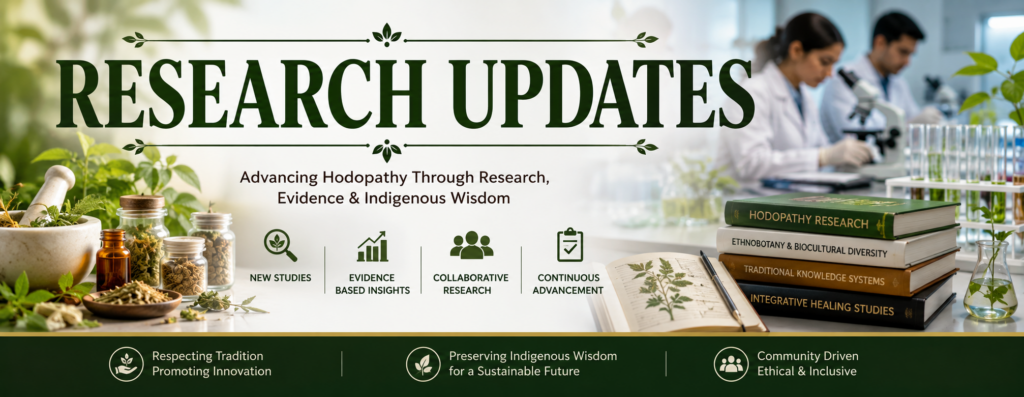
The Research Updates of Hodopathy section is designed to provide a clear, responsible, and continuously developing record of research connected with Hodopathy, indigenous knowledge, biodiversity, traditional food systems, plants, forests, culture, ecology, and community knowledge.
Research at Hodopathy should not be understood simply as the collection of traditional knowledge. Its purpose is to encourage ethical documentation, careful study, evidence-based inquiry, community participation, and responsible knowledge development while respecting the rights and interests of knowledge-holding communities.
The Research Updates section can therefore become a trusted space where members, researchers, students, knowledge holders, and the wider public can follow the progress of research—from emerging questions and fieldwork to publications, collaborations, findings, and future research directions.
🔬 What Are Hodopathy Research Updates?
Research Updates are periodic reports and announcements about research activities taking place within or in collaboration with the Hodopathy knowledge ecosystem.
Updates may cover:
- New research projects.
- Ongoing field studies.
- Ethnobotanical research.
- Plant and biodiversity studies.
- Traditional food research.
- Forest and ecological research.
- Oral-history documentation.
- Community-based research.
- Research collaborations.
- New publications.
- Conference presentations.
- Research findings.
- Methodological developments.
- Research opportunities.
- Follow-up studies.
- Corrections or updates to previous research.
The objective is to make research visible, understandable, traceable, and accountable without exposing information that communities or knowledge holders have not authorised for publication.
🌿 Research Areas at Hodopathy
Research Updates can be organised around several major research themes.
1. Indigenous & Traditional Knowledge
Research may examine how knowledge is developed, transmitted, practised, and preserved across generations.
Possible topics include:
- Traditional ecological knowledge.
- Indigenous plant knowledge.
- Community knowledge systems.
- Intergenerational learning.
- Traditional skills.
- Knowledge transmission.
- Cultural relationships with nature.
- Changes in traditional practices.
Research should recognise that indigenous knowledge is living knowledge, continuously shaped by experience, environment, social relationships, and changing circumstances.
2. Plant & Ethnobotanical Research
Plant knowledge is an important area for responsible documentation and research.
Research updates may cover:
- Local plant identification.
- Indigenous plant names.
- Traditional plant uses.
- Seasonal plant availability.
- Wild edible plants.
- Cultivated plants.
- Forest plants.
- Plant conservation.
- Ethnobotanical observations.
- Relationships between plants and community life.
Where traditional medicinal uses are discussed, Hodopathy should clearly distinguish traditional claims or practices from scientifically established clinical evidence.
3. Biodiversity & Conservation Research
Hodopathy can support research exploring the relationship between indigenous knowledge and biodiversity conservation.
Research themes may include:
- Native plant diversity.
- Forest biodiversity.
- Local ecosystems.
- Traditional conservation practices.
- Sustainable resource use.
- Community stewardship.
- Threatened or declining species.
- Habitat changes.
- Traditional ecological indicators.
- Conservation education.
Such research can help examine how local knowledge and community participation may contribute to understanding and protecting biodiversity.
🌳 Forest & Ecological Research
Forests are not only ecological spaces but can also be important sources of food, materials, cultural knowledge, livelihoods, and community identity.
Research updates may explore:
- Traditional forest use.
- Seasonal ecological knowledge.
- Forest food systems.
- Sustainable collection practices.
- Changes in forest landscapes.
- Community conservation.
- Plant–people relationships.
- Environmental changes.
- Local ecological observations.
Research should avoid publishing precise or sensitive information where doing so could facilitate harmful exploitation of biological resources.
🍚 Traditional Food & Food Heritage Research
Traditional food systems provide an important area for interdisciplinary research.
Research updates may investigate:
- Indigenous crops.
- Traditional grains and millets.
- Wild edible plants.
- Seasonal foods.
- Traditional recipes and preparation.
- Food preservation.
- Food biodiversity.
- Agricultural practices.
- Cultural meanings of food.
- Changes in traditional diets.
- Local food resilience.
Research in this area can connect food culture, biodiversity, agriculture, nutrition research, environmental knowledge, and cultural heritage while avoiding unsupported health claims.
🎙️ Oral History & Community Research
A significant part of indigenous knowledge is transmitted orally.
Research projects may therefore document:
- Stories from elders.
- Community memories.
- Traditional practices.
- Historical experiences.
- Local ecological observations.
- Changes in landscapes.
- Traditional food practices.
- Intergenerational knowledge transmission.
Oral-history research should be undertaken with informed consent and appropriate control over recording, storage, access, attribution, and future use.
🧑🤝🧑 Community-Based Research
Hodopathy can promote research models in which communities are not merely subjects of research but meaningful participants in the research process.
Community-based research can involve:
Community members → Knowledge holders → Researchers → Students → Educators → Conservation practitioners
Depending on the project, communities may contribute to:
- Identifying research questions.
- Providing contextual knowledge.
- Reviewing interpretations.
- Participating in documentation.
- Determining appropriate access.
- Reviewing publications.
- Identifying culturally sensitive information.
This approach can help move research from knowledge extraction toward respectful collaboration.
📊 From Research Question to Research Update
A Hodopathy research project can be communicated through a transparent progression.
01 — Research Question
What is the research trying to understand?
02 — Background
What existing knowledge or research provides the context?
03 — Community Context
Which communities or knowledge holders are connected to the subject?
04 — Methodology
How is the research being conducted?
05 — Ethical Framework
What consent, privacy, attribution, and community-rights considerations apply?
06 — Fieldwork / Data Collection
What information is being collected and how?
07 — Analysis
How are researchers interpreting the information?
08 — Findings
What has the research established?
09 — Limitations
What remains uncertain or requires additional research?
10 — Publication & Knowledge Sharing
What can appropriately be shared publicly, with members, researchers, or communities?
This structure can make Research Updates more informative and credible.
🧪 Evidence & Research Standards
Hodopathy should maintain a clear distinction between different types of knowledge and evidence.
Research Updates may identify information as:
Traditional Knowledge
Information transmitted through community practice and generations.
Community Observation
Observations reported or documented by community members.
Historical Evidence
Information supported by historical records or documentation.
Scientific Research
Findings generated through defined research methods.
Preliminary Findings
Early observations that require additional investigation.
Established Evidence
Findings supported by appropriate and sufficient evidence.
Research Gap
An area where existing evidence remains insufficient.
This distinction helps prevent traditional knowledge from being incorrectly presented as scientifically proven—and prevents valuable traditional knowledge from being dismissed simply because it does not originate within conventional academic research.
🤝 Research Collaboration Updates
The Research Updates section can announce and document collaborations involving:
- Universities.
- Research institutions.
- Independent researchers.
- Knowledge holders.
- Community organisations.
- Biodiversity organisations.
- Cultural heritage organisations.
- Students.
- Environmental practitioners.
Collaboration updates may explain:
- Research objectives.
- Participating groups.
- Areas of study.
- Methodology.
- Expected outcomes.
- Community participation.
- Publication plans.
- Knowledge-sharing arrangements.
Where institutional names, researchers, or partners are published, information should be accurate and appropriately authorised.
📚 Publications & Research Outputs
Completed research may lead to different forms of outputs, including:
- Research papers.
- Field reports.
- Knowledge articles.
- Case studies.
- Oral-history collections.
- Plant documentation.
- Biodiversity reports.
- Educational resources.
- Conference presentations.
- Research datasets, where appropriate.
- Community reports.
Research outputs should include appropriate references, contributor recognition, and relevant community attribution.
🌱 Research & Knowledge Protection
Research involving indigenous knowledge requires particular attention to knowledge rights and responsible access.
Not all research findings should automatically become public.
Depending on the nature of the information, Hodopathy may consider:
Public Information
Suitable for general educational access.
Member Resources
Available to registered members under defined conditions.
Research Access
Available to approved researchers where appropriate.
Community-Controlled Information
Access determined by the relevant community or knowledge holders.
Restricted Information
Information that should not be publicly distributed.
This framework can help balance research openness with community rights and knowledge protection.
🛡️ Ethical Research Principles
Hodopathy Research Updates should reflect a strong ethical foundation.
Informed Consent
Participants should understand the purpose and potential uses of research.
Respect for Knowledge Holders
Traditional knowledge contributors should be treated as knowledge holders and collaborators where appropriate.
Proper Attribution
Contributors and communities should receive appropriate recognition.
Privacy
Personal information and sensitive stories should be protected.
Cultural Sensitivity
Research should respect cultural practices and community-defined boundaries.
Data Responsibility
Research data should be stored, managed, and shared responsibly.
Benefit Sharing
Potential benefits arising from research should be considered fairly and transparently.
No Unauthorised Exploitation
Research should not become a pathway for unauthorised commercialisation or appropriation of community knowledge.
📈 Progress Reports
For long-term projects, Hodopathy can publish periodic progress updates such as:
Research Started → Fieldwork Underway → Community Review → Data Analysis → Preliminary Findings → Publication → Follow-Up Research
This allows members and stakeholders to understand the development of research over time rather than seeing only the final result.
🎓 Opportunities for Students & Emerging Researchers
The Research Updates section can also highlight opportunities for students and early-career researchers.
These may include:
- Research projects.
- Field documentation programmes.
- Academic discussions.
- Research workshops.
- Mentorship opportunities.
- Knowledge documentation projects.
- Interdisciplinary collaborations.
- Conference participation.
- Research assistant opportunities.
Students should be encouraged to approach indigenous knowledge with respect, methodological care, proper attribution, and ethical responsibility.
📰 Research News & Announcements
The section can also provide timely announcements about:
- New research launches.
- Research partnerships.
- Fieldwork programmes.
- Publication releases.
- Conference participation.
- New research resources.
- Research funding opportunities.
- Calls for collaboration.
- Knowledge documentation initiatives.
- Important research milestones.
This creates a central research communication channel for the Hodopathy community.
🔎 Research Archive
Over time, Research Updates can develop into a searchable research archive.
Visitors could explore updates by:
- Research topic.
- Year.
- Research stage.
- Geographic or ecological context, where appropriate.
- Knowledge category.
- Researcher.
- Project.
- Publication.
- Community initiative.
A structured archive would help preserve the research history and intellectual development of Hodopathy.
🌍 Connecting Research with the Knowledge Centre
Research Updates can be connected to other Hodopathy resources, including:
Plant Database
→ Connect research findings with relevant plant documentation.
Knowledge Archive
→ Link research with historical and community records.
Oral Histories
→ Connect research with approved oral-history materials.
Traditional Food & Forest Knowledge
→ Provide deeper context for food and ecological research.
Evidence Standards
→ Explain how evidence is evaluated.
Research Collaboration
→ Help researchers discover opportunities to work together.
Knowledge Articles
→ Translate appropriate research findings into accessible educational content.
This interconnected structure can turn the website into a research and knowledge ecosystem rather than a collection of isolated pages.
🔄 Research Is a Continuing Process
Research does not always produce immediate or final answers.
A responsible Research Updates section should be comfortable communicating:
- What is known.
- What is uncertain.
- What is being investigated.
- What evidence is still needed.
- What interpretations may change.
- What communities have contributed.
- What questions require further study.
This creates a culture of intellectual honesty and continuous learning.
Our Research Vision
Hodopathy seeks to encourage research that brings together indigenous knowledge, community participation, ethical documentation, biodiversity awareness, and contemporary research methods.
The goal is not to extract traditional knowledge for academic or commercial purposes. It is to create conditions in which knowledge can be documented respectfully, studied responsibly, protected appropriately, and shared in ways that recognise the rights and contributions of knowledge-holding communities.
Good research does not simply ask what knowledge can be collected. It asks who holds the knowledge, how it should be understood, who should participate, what evidence supports it, and how it can be protected for the future.
Through its Research Updates, Hodopathy can build a transparent record of ongoing inquiry and collaboration—helping connect knowledge holders, communities, researchers, students, educators, conservationists, and future generations in the responsible development and preservation of a living indigenous knowledge system.