
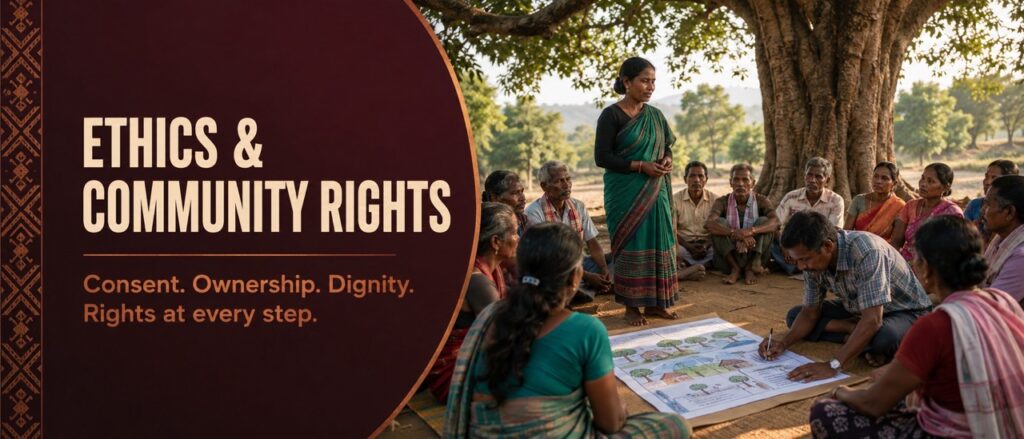
Protecting Knowledge, People, Culture, Biodiversity & Community Rights
Ethics & Community Rights of Hodopathy establishes the principles that guide how Hodopathy-related knowledge is documented, researched, preserved, interpreted, shared, and communicated.
Hodopathy is connected with living indigenous knowledge traditions associated with the Ho community and other Adivasi communities of Jharkhand. Such knowledge is not simply a collection of information. It may be connected with people, families, communities, landscapes, languages, cultural practices, biodiversity, memories, livelihoods, and generations of experience.
For this reason, knowledge documentation must be approached with respect, consent, accountability, cultural sensitivity, and community participation.
The purpose of this page is to establish a clear ethical foundation for Hodopathy.org and to encourage responsible engagement by knowledge holders, community members, researchers, students, practitioners, institutions, journalists, educators, and other users.
Our Ethical Foundation
Hodopathy follows a simple principle:
Knowledge should be documented and shared in ways that respect the people, communities, cultures, environments, and contexts from which that knowledge comes.
This means that preservation should not become extraction, research should not become exploitation, and public access should not automatically mean unrestricted access.
The Hodopathy platform seeks to balance:
Knowledge Preservation + Community Rights + Research Integrity + Cultural Respect + Biodiversity Protection + Responsible Access
Why Ethics & Community Rights Matter
Indigenous and traditional knowledge can contain significant cultural, ecological, agricultural, food-related, medicinal, linguistic, and historical information.
However, making such knowledge publicly available without safeguards can create risks.
These may include:
- Misappropriation of traditional knowledge
- Loss of community control
- Commercial exploitation
- Misrepresentation
- Removal of knowledge from its cultural context
- Unauthorized publication
- Inappropriate research
- Misuse of biological resources
- Disclosure of sensitive locations
- Stereotyping of communities
- Loss of attribution
- Unauthorized recording or reproduction
- Harm to vulnerable ecosystems
Ethical documentation therefore requires more than collecting information.
It requires understanding rights, relationships, responsibilities, and consequences.
Core Ethical Principles
1. Respect for Knowledge Holders
Knowledge holders should be treated as contributors and participants rather than simply as sources of information.
Their experience, expertise, language, identity, preferences, and contributions should be recognized appropriately.
Where a knowledge holder prefers anonymity, that preference should be respected.
2. Free, Prior & Informed Consent
Participation in interviews, fieldwork, photography, audio recording, video recording, research, documentation, or publication should be based on appropriate informed consent.
Participants should understand:
- What is being documented
- Why it is being documented
- Who is conducting the work
- How the information may be used
- Where it may be published
- Who may access it
- Whether photographs or recordings will be retained
- Whether material may be translated
- Whether material may be reused
- What restrictions may apply
Consent should not be treated as a one-time formality when circumstances change.
3. Community Participation
Whenever knowledge has a strong community dimension, documentation should involve appropriate community participation.
Communities should have meaningful opportunities to contribute to decisions concerning:
- Documentation
- Interpretation
- Attribution
- Publication
- Access
- Storage
- Correction
- Future use
The objective is to move from extractive documentation toward participatory knowledge stewardship.
4. Community Knowledge Is Not Automatically Public Knowledge
One of the most important principles of Hodopathy is:
Documentation does not automatically create permission for unrestricted publication.
Some knowledge may be:
- Public
- Shared within families
- Shared within communities
- Seasonal
- Ceremonial
- Sacred
- Gender-specific
- Restricted to particular knowledge holders
- Sensitive
- Confidential
- Ecologically sensitive
Such distinctions should be respected.
A responsible knowledge platform must recognize that different kinds of knowledge require different kinds of access.
5. Cultural Context
Knowledge should not be separated unnecessarily from the cultural context in which it exists.
A plant, food, practice, story, object, place, or tradition may have meanings that are not immediately visible to an outside researcher or visitor.
Hodopathy documentation should therefore seek to preserve relevant:
- Cultural context
- Historical context
- Local terminology
- Community perspective
- Ecological context
- Seasonal context
- Social context
- Knowledge-transmission context
This helps prevent oversimplification and misinterpretation.
6. Proper Attribution
Contributors and knowledge holders should receive appropriate recognition.
Attribution may include:
- Individual contributor
- Knowledge holder
- Community
- Research team
- Institution
- Photographer
- Interviewer
- Translator
- Archive contributor
Attribution should follow the contributor’s wishes and relevant community protocols.
Where anonymity is requested or necessary, information should be presented without revealing the individual’s identity.
7. Protection Against Misappropriation
Traditional knowledge should not be treated as an unrestricted resource for commercial or intellectual exploitation.
Users should not assume that information published on Hodopathy.org can automatically be:
- Commercialized
- Republished
- Repackaged
- Patented
- Sold
- Used in products
- Used for advertising
- Incorporated into commercial research
- Presented as independently discovered knowledge
Where appropriate, additional permission, agreements, attribution, benefit-sharing arrangements, or legal review may be necessary.
8. Benefit Sharing
When knowledge contributes to research, education, innovation, conservation, publications, or other activities, Hodopathy supports fair and responsible consideration of benefits to relevant contributors and communities.
Benefit sharing may take different forms depending on the project, including:
- Recognition
- Capacity building
- Educational opportunities
- Research participation
- Training
- Community resources
- Collaborative publications
- Conservation support
- Agreed financial benefits
- Institutional partnerships
Benefits should not be assumed to be identical for every project.
9. Research Ethics
Research involving Hodopathy-related knowledge should follow appropriate ethical standards.
Researchers should consider:
- Informed consent
- Community participation
- Research purpose
- Methodology
- Data protection
- Attribution
- Cultural sensitivity
- Publication plans
- Benefit sharing
- Intellectual and cultural rights
- Biodiversity protection
- Relevant institutional and legal requirements
Researchers should clearly distinguish between community knowledge and scientific evidence.
Traditional knowledge can generate valuable research questions, but it should not automatically be presented as scientifically proven.
10. Evidence Integrity
Hodopathy promotes careful communication of evidence.
Information may originate from:
- Oral traditions
- Community observations
- Historical accounts
- Field observations
- Documentary sources
- Ethnobotanical records
- Scientific literature
- Laboratory research
- Clinical or ecological studies
- Preliminary research
These forms of knowledge and evidence have different characteristics.
Hodopathy should avoid converting:
Traditional use → Scientific proof
or
Observation → Established fact
without appropriate evidence.
Evidence Standards therefore work alongside Ethics & Community Rights to ensure that knowledge is both respectfully represented and accurately characterized.
11. Health & Traditional Knowledge
Some Hodopathy-related knowledge may concern plants, foods, preparations, or traditional practices associated with health and wellbeing.
Such information requires particular care.
Traditional knowledge should be clearly identified as traditional or community knowledge.
Hodopathy should not present traditional practices as proven medical treatments unless appropriate scientific evidence supports the specific claim.
Health-related information should also avoid encouraging unsafe self-treatment or replacing professional medical advice.
12. Biodiversity & Environmental Responsibility
Knowledge about plants, forests, wildlife, habitats, and biological resources can have ecological implications.
Publishing detailed information about rare or vulnerable species may unintentionally increase exploitation.
Therefore, Hodopathy may limit or generalize information concerning:
- Sensitive plant locations
- Rare species
- Vulnerable habitats
- Valuable biological resources
- High-risk collection sites
- Ecologically sensitive landscapes
Knowledge preservation should support biodiversity conservation rather than uncontrolled extraction.
13. Data Responsibility
Digital documentation can persist for decades.
Hodopathy therefore treats digital records as materials requiring responsible stewardship.
Relevant information may include:
- Interview recordings
- Photographs
- Videos
- Field notes
- Geographic information
- Plant records
- Oral histories
- Research data
- Community documents
- Historical materials
Data handling should consider:
- Who provided the information
- Who can access it
- How long it should be retained
- Whether it can be downloaded
- Whether it can be reproduced
- Whether access should change over time
14. Privacy & Confidentiality
Personal information should be collected only when necessary and handled responsibly.
Privacy protections may apply to:
- Names
- Contact information
- Family information
- Personal stories
- Private conversations
- Exact locations
- Photographs
- Audio recordings
- Video recordings
- Sensitive community information
Where publication creates unnecessary risk, information may be anonymized, generalized, restricted, or excluded.
15. Ethical Photography, Audio & Video
Visual and audio documentation can be powerful forms of knowledge preservation.
However, recording should never be assumed to equal permission for unrestricted publication.
Before recording, appropriate consent should be considered for:
- Photography
- Video
- Audio
- Interviews
- Livestreaming
- Online publication
- Documentary use
- Educational use
- Commercial use
- Future reuse
Participants should have clear information about the intended use.
16. Local Languages & Indigenous Terminology
Language is part of knowledge.
Hodopathy should make reasonable efforts to preserve important local terminology rather than replacing it entirely with external terminology.
Where appropriate, documentation may include:
Local Term → Translation → Explanation → Context
Scientific names or standardized terminology can be added where verified, but they should not erase the linguistic and cultural identity of the original knowledge.
17. Intergenerational Knowledge Rights
Knowledge may move from elders and experienced knowledge holders to younger generations through:
- Observation
- Storytelling
- Demonstration
- Participation
- Family practices
- Community activities
- Apprenticeship
- Seasonal activities
Hodopathy supports responsible intergenerational transmission while recognizing that some knowledge may have access conditions or cultural restrictions.
18. Community Review & Correction
Knowledge documentation can contain errors.
A plant may initially be misidentified. A translation may be incomplete. A historical detail may require correction. A contributor may later request changes to attribution or access.
Hodopathy should provide appropriate mechanisms for:
- Corrections
- Community feedback
- Attribution updates
- Contextual clarification
- Access changes
- Removal requests where appropriate
- Record updates
A living knowledge archive should be capable of learning and correcting itself.
19. Right to Context
Knowledge should not be presented in a way that changes its meaning.
For example, a traditional practice documented in a particular ecological or cultural context should not automatically be presented as universally applicable.
Hodopathy seeks to preserve:
Who → What → Where → When → Why → How → According to Whom
This approach helps readers understand the boundaries and context of documented knowledge.
20. Responsible Use by Researchers
Researchers using Hodopathy resources should:
- Cite sources appropriately.
- Identify community contributions.
- Avoid presenting community knowledge as their own discovery.
- Respect access restrictions.
- Seek additional permission where required.
- Follow applicable research ethics requirements.
- Communicate findings accurately.
- Share appropriate outcomes with participating communities.
- Avoid commercial exploitation without appropriate agreements.
- Distinguish community knowledge from independently generated evidence.
Access to a digital resource should never be interpreted as unlimited research permission.
21. Responsible Use by Media
Journalists, photographers, documentary makers, and other media professionals should:
- Verify information.
- Preserve cultural context.
- Seek appropriate consent.
- Attribute knowledge holders.
- Avoid stereotypes.
- Avoid sensationalism.
- Protect sensitive information.
- Distinguish traditional knowledge from scientific evidence.
- Avoid publishing sensitive ecological information unnecessarily.
- Respect community preferences concerning representation.
The Press & Media of Hodopathy section can provide additional guidance for media engagement.
22. Responsible Use by Website Visitors
Visitors to Hodopathy.org are encouraged to treat the information as a knowledge resource rather than an unrestricted repository.
Users should:
- Read the context provided with each record.
- Respect attribution.
- Follow access restrictions.
- Avoid unauthorized commercial use.
- Avoid misrepresenting traditional knowledge.
- Avoid copying sensitive information.
- Cite Hodopathy and original contributors appropriately.
- Contact Hodopathy when intended use is unclear.
Knowledge Access Framework
Hodopathy can use a structured access model to balance openness and protection.
Public Knowledge
Information considered appropriate for general educational access.
Member Knowledge
Resources available to registered members under applicable conditions.
Research Access
Materials requiring additional conditions for research use.
Community-Controlled Knowledge
Information whose access and use are determined substantially by relevant communities or knowledge holders.
Restricted Knowledge
Sensitive information that should not be publicly distributed.
This framework recognizes that ethical access is not the same as maximum access.
Community Rights & the Knowledge Archive
The Knowledge Archive of Hodopathy should preserve approved materials while maintaining information about:
- Source
- Contributor
- Date
- Context
- Rights
- Consent
- Access level
- Attribution
- Restrictions
- Updates
Archiving should preserve not only the content but also the provenance and conditions associated with that content.
Community Rights & Field Stories
The Field Stories of Hodopathy section should apply these principles to field-based narratives.
Field Stories should document:
- Who participated
- Why the story was documented
- Where and when it occurred
- What was observed
- What was shared
- What permissions were obtained
- What information remains restricted
- How contributors wish to be recognized
This ensures that storytelling does not become extraction.
Community Rights & Oral Histories
Oral histories require particular sensitivity because they may preserve personal memories, community experiences, cultural information, and intergenerational knowledge.
Appropriate consent should address:
- Recording
- Transcription
- Translation
- Publication
- Online access
- Archiving
- Future use
Speakers should not lose control over their identity or story simply because an interview has been recorded.
Community Rights & Plant Documentation
The Plant Database of Hodopathy should distinguish between botanical information and community knowledge.
A plant record may contain:
- Local name
- Verified scientific name
- Habitat
- Community knowledge
- Traditional uses
- Cultural significance
- Ecological observations
- Research evidence
- Conservation status
- Source
- Access level
Sensitive information should be withheld or generalized where necessary.
Community Rights & Research Collaboration
Research collaboration should be based on relationships rather than extraction.
Potential collaborators should discuss:
- Research objectives
- Community participation
- Consent
- Data ownership and governance
- Attribution
- Publication
- Benefit sharing
- Intellectual property
- Confidentiality
- Long-term access
- Return of research outcomes
A strong collaboration should create value for both research and participating communities.
Intellectual, Cultural & Knowledge Rights
Hodopathy recognizes that traditional knowledge may not always fit neatly into conventional intellectual-property categories.
Community knowledge can have collective, intergenerational, cultural, or customary dimensions.
Therefore, ethical stewardship should consider:
- Traditional knowledge rights
- Cultural heritage
- Community protocols
- Attribution
- Collective interests
- Data governance
- Intellectual property
- Benefit sharing
- Applicable legal protections
Where legal questions arise, appropriate legal and institutional advice should be obtained rather than assuming that website publication determines ownership.
Ethical Documentation Checklist
Before publishing a new knowledge record, Hodopathy can ask:
People
- Who contributed the information?
- Were relevant contributors appropriately recognized?
Consent
- Was appropriate informed consent obtained?
- Was the intended use explained?
Context
- Is the knowledge presented within its cultural and ecological context?
Evidence
- Is the source of the information clear?
- Are traditional knowledge and scientific evidence distinguished?
Privacy
- Does the record reveal unnecessary personal information?
Cultural Sensitivity
- Is any restricted, sacred, ceremonial, or sensitive knowledge included?
Biodiversity
- Could publication increase ecological exploitation?
Attribution
- Are sources and contributors appropriately credited?
Access
- Is the selected access level appropriate?
Community Review
- Is community or contributor review appropriate?
Future Use
- Could the material be misused if reproduced or commercialized?
Only after these questions have been considered should publication proceed.
Ethical Governance
As Hodopathy develops, an Ethics & Community Rights framework can be supported by appropriate governance mechanisms.
Potential structures may include:
- Ethics advisory group
- Community advisory representatives
- Research ethics review
- Knowledge-holder consultation
- Documentation protocols
- Media guidelines
- Data governance policies
- Access review
- Consent management
- Complaint and correction procedures
- Periodic policy review
Governance should evolve with community participation, research experience, technological change, and emerging ethical standards.
Concerns, Feedback & Requests
Hodopathy should provide a clear pathway for people to raise concerns about published material.
Concerns may relate to:
- Incorrect attribution
- Cultural misrepresentation
- Privacy
- Unauthorized publication
- Incorrect information
- Sensitive knowledge
- Image or recording use
- Access restrictions
- Research use
- Commercial use
Where appropriate, Hodopathy can review concerns and determine whether content should be corrected, restricted, updated, or removed.
Our Commitment
Hodopathy is committed to building a knowledge platform where preservation and protection work together.
We recognize that responsible knowledge stewardship requires continuous learning.
Ethical standards may evolve as communities, researchers, institutions, and knowledge holders identify new challenges and opportunities.
Hodopathy therefore aims to maintain an approach that is:
Community-informed
Consent-based
Context-sensitive
Evidence-aware
Privacy-conscious
Biodiversity-conscious
Transparent
Accountable
A Shared Responsibility
Ethics & Community Rights are not the responsibility of one person or one department.
They are a shared responsibility among:
- Knowledge holders
- Communities
- Researchers
- Students
- Practitioners
- Educators
- Conservationists
- Journalists
- Institutions
- Technology partners
- Website contributors
- Members
- Visitors
Everyone who interacts with Hodopathy-related knowledge has a role in ensuring that it is treated with care.
Looking Ahead
The future of Hodopathy should not be measured only by how much knowledge can be collected.
It should also be measured by how responsibly that knowledge is documented, how respectfully contributors are recognized, how effectively communities participate, and how carefully sensitive knowledge and biodiversity are protected.
A strong digital knowledge platform should not simply ask:
“What information can we publish?”
It should also ask:
“Who shared it?”
“Under what conditions?”
“Who should have access?”
“What context must be preserved?”
“What responsibilities accompany its use?”
“What could happen if it is misused?”
These questions are central to responsible knowledge stewardship.
Our Ethical Vision
Ethics & Community Rights of Hodopathy provides the foundation for a knowledge ecosystem built on trust.
It seeks to ensure that the documentation of indigenous knowledge does not separate information from the people, communities, cultures, landscapes, and responsibilities connected with it.
The guiding philosophy is:
Respect before access.
Consent before documentation.
Context before interpretation.
Attribution before publication.
Evidence before scientific claims.
Protection before exposure.
Community participation before extraction.
Responsibility before reuse.
Through these principles, Hodopathy aims to support a future in which indigenous knowledge can be preserved, researched, taught, and responsibly shared without compromising community dignity, cultural integrity, knowledge rights, or biodiversity.
Knowledge is not merely something to collect.
It is something to respect, protect, understand, and steward together.