
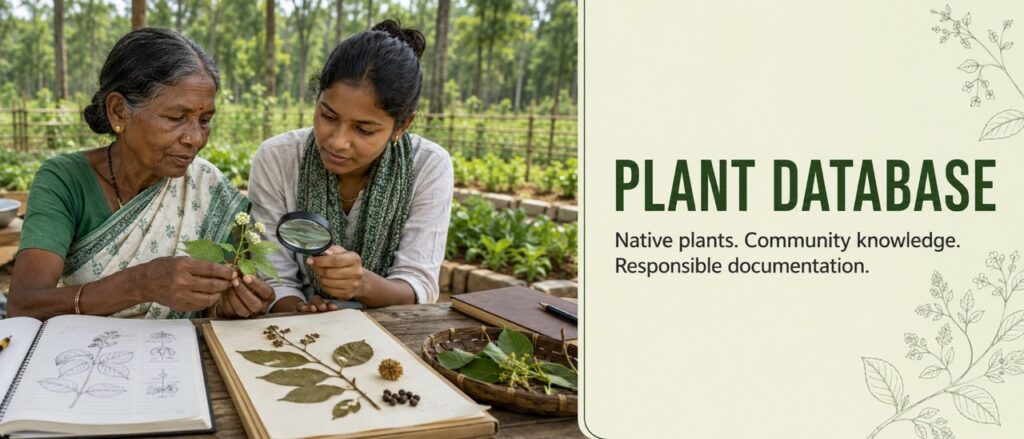
Documenting Plants, Traditional Knowledge and Biodiversity
The Hodopathy Plant Database is envisioned as a structured knowledge resource for documenting plants associated with the Ho community and wider Adivasi knowledge traditions of Jharkhand.
Plants have long been connected with local food systems, forests, cultural practices, seasonal activities, traditional knowledge and community life. The purpose of the Plant Database is to preserve permitted knowledge about these plants while maintaining the cultural and ecological context in which that knowledge exists.
The database is not intended to be simply a catalogue of medicinal plants. It seeks to document the broader relationship between people, plants, forests, food, biodiversity and traditional knowledge.
Every plant record represents more than a species—it can represent knowledge, culture, ecology and generations of observation.
Purpose of the Plant Database
A significant amount of plant knowledge is transmitted orally through elders, traditional practitioners, families and community members.
Such knowledge may become vulnerable when:
- Traditional knowledge holders become fewer
- Younger generations move away from traditional communities
- Local languages and terminology decline
- Forest habitats change
- Native plant populations are disturbed
- Traditional practices become less common
- Knowledge remains undocumented
The Plant Database aims to create a responsible long-term record of permitted and appropriately documented plant knowledge for education, cultural preservation, biodiversity awareness and responsible research.
It does not seek to replace community-based knowledge transmission. Instead, it provides an additional method for preserving information for future generations.
What the Plant Database Contains
Each plant record may bring together information from several perspectives.
Depending on available documentation and permission, a record may include:
- Local or traditional plant name
- Ho or other local terminology
- Scientific or botanical name
- Family
- Plant description
- Identifying characteristics
- Habitat
- Distribution
- Seasonal availability
- Traditional cultural context
- Documented traditional uses
- Food-related uses
- Ecological importance
- Conservation information
- Community knowledge source
- Research references
- Photographs
- Documentation notes
- Evidence status
Not every record will contain every field.
Information will be added progressively as reliable documentation becomes available.
Local Names & Indigenous Terminology
Local plant names are an important part of Adivasi knowledge.
A scientific name can identify a species, but a community name may carry information about appearance, habitat, use, season, cultural significance or local history.
Where permission allows, the Plant Database may preserve:
- Ho names
- Local names
- Alternative names
- Traditional terminology
- Pronunciation information
- Meaning or interpretation
- Regional variations
Local terminology should not automatically be replaced by scientific classification.
Where botanical identification is verified, traditional and scientific names can be presented together.
Botanical Identification
Accurate plant identification is essential for a reliable plant database.
The same local name may sometimes refer to different plants, while different communities may use different names for the same species.
Where appropriate, identification may involve:
- Field observation
- Botanical references
- Herbarium comparison
- Expert consultation
- Taxonomic literature
- Photographic documentation
- Scientific verification
The database should distinguish between reported identification and verified identification.
Where identification remains uncertain, that uncertainty should be clearly stated.
We do not intend to assign a scientific name merely to make a record appear complete.
Traditional Plant Knowledge
Traditional knowledge may include information about how communities have historically interacted with particular plants.
Where permitted, the database may document:
- Traditional uses
- Plant parts traditionally used
- Seasonal collection
- Traditional preparation methods
- Food uses
- Cultural associations
- Local harvesting practices
- Community observations
Such information should be presented as documented traditional knowledge, not automatically as scientifically established fact.
Medicinal Plant Knowledge
Some plants documented in the database may have traditional associations with health and well-being.
These records require particular care.
A traditional account that a community has historically used a plant for a particular purpose does not, by itself, establish that the plant is safe, effective or medically appropriate.
The database therefore aims to distinguish between:
Traditional Use
What has been reported or documented as a traditional practice.
Ethnobotanical Record
A documented relationship between people and a plant.
Research Finding
A result reported through scientific investigation.
Established Evidence
A conclusion supported by appropriate scientific evidence.
This distinction helps prevent cultural knowledge from being presented as unsupported medical advice.
Food Plants & Traditional Nutrition
Plants are also important sources of food and community nutrition.
The Plant Database may include information about permitted traditional food plants such as:
- Wild edible plants
- Seasonal greens
- Fruits
- Seeds
- Roots and tubers
- Traditional grains
- Leaves
- Flowers
- Culinary herbs
Traditional food knowledge can provide valuable insight into local biodiversity and seasonal food systems.
Where nutritional information is provided, scientific nutritional data should be clearly distinguished from traditional descriptions.
Forest Plants & Natural Resources
Many plants associated with Adivasi knowledge are connected with forest environments.
The database may document plants used or observed in relation to:
- Food
- Household practices
- Traditional materials
- Cultural activities
- Agriculture
- Forest resources
- Community life
- Ecological practices
Such records can help demonstrate the relationship between forest biodiversity and indigenous knowledge.
Seasonal Plant Knowledge
Traditional communities often maintain detailed observations of seasonal availability.
Where documented and appropriate, plant records may include information about:
- Flowering periods
- Fruiting seasons
- Harvesting periods
- Seasonal food availability
- Leaf emergence
- Seed collection
- Traditional collection periods
Seasonal information can contribute to both cultural documentation and ecological understanding.
Habitat & Ecological Context
A plant cannot always be understood independently from its environment.
The Plant Database may therefore document appropriate ecological information such as:
- Forest habitat
- Grassland
- Agricultural landscape
- Wetland
- River margins
- Home gardens
- Community-managed areas
- Other local habitats
Sensitive location information may be withheld or generalised when disclosure could threaten vulnerable plants, habitats or communities.
Biodiversity Conservation
The Plant Database is intended to support awareness of Jharkhand’s plant diversity and the importance of conservation.
Some traditionally important plants may face pressure from:
- Habitat loss
- Unsustainable harvesting
- Land-use changes
- Invasive species
- Environmental degradation
- Climate-related changes
- Declining traditional cultivation
Plant documentation can help identify species that may require greater conservation attention.
However, documenting a plant does not mean encouraging its collection from the wild.
Conservation must take priority over extraction.
Sustainable Harvesting
Traditional knowledge may include practices concerning when and how plants are collected.
Where appropriate, documentation can record community observations relating to sustainable use.
The database may support awareness of:
- Seasonal harvesting
- Regeneration
- Seed preservation
- Cultivation
- Community nurseries
- Responsible collection
- Protection of rare species
Information that could facilitate harmful overharvesting should be treated carefully.
Community Sources
The source of traditional knowledge is an important part of every responsible record.
Where consent permits, a plant entry may identify:
- Knowledge holder
- Traditional practitioner
- Community
- Documentation team
- Field researcher
- Published source
Attribution should be provided respectfully.
Where anonymity is preferred or necessary, the identity of the contributor should not be disclosed.
Community Consent
The Plant Database follows the principle that traditional knowledge should not be documented or published without appropriate consideration of community rights.
Before recording community knowledge, appropriate consent should be obtained.
Participants should understand:
- What is being documented
- Why it is being documented
- How the information may be used
- Whether it will be publicly available
- Whether their identity will be included
Sensitive or restricted knowledge should receive appropriate protection.
Protected & Restricted Information
Not every plant record should necessarily be completely public.
Some information may involve:
- Sacred plants
- Restricted cultural practices
- Confidential preparation methods
- Sensitive habitats
- Rare or vulnerable species
- Community-specific knowledge
- Personally identifiable information
The database may therefore use different levels of access.
Public information may be openly available, while sensitive information may remain restricted or unpublished.
Photographic Documentation
Photographs can provide valuable evidence for plant identification and educational purposes.
Where permitted, photographs may document:
- Whole plants
- Leaves
- Flowers
- Fruits
- Seeds
- Bark
- Habitat
- Traditional cultivation
- Community gardens
Images should be accurately labelled where identification is verified.
Photographs of people, cultural practices or restricted activities should only be published with appropriate permission.
Research References
The Plant Database aims to connect traditional knowledge documentation with reliable research resources.
Where available, records may reference:
- Botanical publications
- Ethnobotanical research
- Taxonomic databases
- Biodiversity studies
- Academic publications
- Conservation reports
- Historical sources
References help researchers and learners distinguish between documented community knowledge and independently published information.
Evidence Classification
To improve transparency, plant records may use an evidence or information-status framework.
Community Knowledge
Information provided or transmitted by community knowledge holders.
Traditional Use
A documented historical or contemporary traditional use.
Ethnobotanical Documentation
Information recorded through ethnobotanical or cultural research.
Preliminary Research
Early scientific findings that require further investigation.
Published Scientific Evidence
Findings reported through scientific research and appropriate publications.
Unverified Information
Information that has not yet been sufficiently confirmed.
This classification prevents different types of knowledge from being presented as though they have the same level of evidence.
Plant Database & Scientific Research
The database may provide researchers with a starting point for further investigation.
Researchers may use appropriately accessible records to explore areas such as:
- Plant taxonomy
- Ethnobotany
- Ecology
- Biodiversity
- Conservation
- Traditional food systems
- Indigenous ecological knowledge
- Historical plant use
Research access should remain subject to applicable permissions, ethical standards, community rights and legal requirements.
Traditional Knowledge Is Not Automatically Medical Advice
Some plant records may contain traditional health-related information.
Such information is provided for cultural documentation, educational purposes and research awareness.
It should not be interpreted as:
- A diagnosis
- A prescription
- A guarantee of safety
- Proof of medical effectiveness
- A substitute for professional healthcare
Plant identity, preparation, quantity, contamination, interactions and individual circumstances can all affect safety.
Anyone considering the use of a plant for health purposes should consult an appropriately qualified healthcare professional.
Knowledge Protection & Benefit Sharing
Traditional knowledge can sometimes contribute to research, innovation or commercial activity.
Where such situations arise, the rights and interests of relevant communities and knowledge holders should be considered.
Hodopathy.org supports principles including:
- Prior informed consent
- Proper attribution
- Community participation
- Transparency
- Responsible access
- Appropriate benefit sharing
- Respect for applicable laws
The Plant Database should not become a mechanism through which community knowledge is extracted and commercialised without appropriate safeguards.
A Living Plant Archive
The Plant Database is intended to grow over time.
New records may emerge through:
- Community documentation
- Field research
- Botanical identification
- Oral-history projects
- Academic collaboration
- Conservation programmes
- Student research
- Community gardens
- Native plant initiatives
Existing records may also be updated as new information becomes available.
A database should therefore be viewed as a living archive, not a final or unchanging authority.
Corrections & Community Review
Plant knowledge and scientific identification can evolve.
A record may require correction when:
- A local name has been misunderstood
- A translation is inaccurate
- A plant has been misidentified
- A source was incorrectly attributed
- New scientific information becomes available
- A community identifies a cultural error
Hodopathy.org welcomes appropriate corrections and community feedback to improve the quality of the database.
Protecting Vulnerable Plants
Some species may be vulnerable because of rarity, habitat loss or commercial demand.
For such plants, detailed location or harvesting information may require restricted access.
The objective is to ensure that the database contributes to conservation rather than increasing pressure on vulnerable species.
Where appropriate, records may provide general ecological information without publishing precise locations.
Connecting Traditional Knowledge With Conservation
The Plant Database can help demonstrate how traditional plant knowledge and biodiversity conservation are connected.
For example, documentation may help identify:
Traditional Plant Knowledge → Important Species → Habitat Awareness → Conservation Action → Intergenerational Learning
This approach recognises that the protection of knowledge and the protection of biodiversity can reinforce one another.
For Students & Learners
The database can serve as an educational resource for students interested in:
- Botany
- Ethnobotany
- Adivasi studies
- Environmental science
- Biodiversity
- Anthropology
- Indigenous knowledge
- Conservation
- Cultural heritage
Students can learn how to approach traditional knowledge responsibly while developing skills in observation, documentation and research.
For Researchers
Researchers may use appropriate Plant Database materials to identify areas for further investigation.
However, access to a record does not automatically provide permission for:
- Commercial use
- Redistribution
- Publication
- Biological collection
- Patent applications
- Extraction of community knowledge
Researchers should obtain any additional permissions required for their proposed activities.
For Communities
The Plant Database can provide communities with a digital means of preserving permitted knowledge and documenting local biodiversity.
It can help support:
- Intergenerational learning
- Community education
- Local plant identification
- Cultural preservation
- Biodiversity awareness
- Native plant conservation
- Recognition of knowledge holders
The ultimate value of the database should be measured not simply by the number of plant records but by how responsibly it serves the communities connected with the knowledge.
Our Plant Database Principles
The Hodopathy Plant Database is guided by:
Community First — Knowledge holders remain central.
Consent — Appropriate permission should precede documentation.
Accuracy — Botanical and cultural information should be carefully documented.
Context — Plant knowledge should remain connected to people, culture and ecology.
Protection — Sensitive knowledge and vulnerable species should be safeguarded.
Transparency — Traditional knowledge and scientific evidence should be clearly distinguished.
Conservation — Documentation should support biodiversity protection.
Responsibility — Research and use should respect community rights.
Accessibility With Care — Useful knowledge can be shared without making sensitive knowledge unrestricted.
Our Long-Term Vision
We envision a Plant Database that becomes a valuable resource connecting:
Ho & Adivasi Knowledge Holders
↓
Traditional Plant Knowledge
↓
Botanical Science
↓
Ethnobotany
↓
Biodiversity Conservation
↓
Education & Research
↓
Future Generations
The goal is to create a resource where traditional knowledge is preserved with dignity, scientific information is presented accurately, and plants are understood as part of larger cultural and ecological systems.
Preserving Plants, Preserving Knowledge
The Hodopathy Plant Database is ultimately about more than identifying plants.
It is about preserving the relationships between people and nature, recognising the generations of knowledge that have contributed to those relationships, and supporting the conservation of the landscapes and biodiversity in which that knowledge has developed.
Hodopathy.org is committed to building a plant knowledge resource that is community-centred, scientifically responsible, culturally respectful and environmentally conscious.