
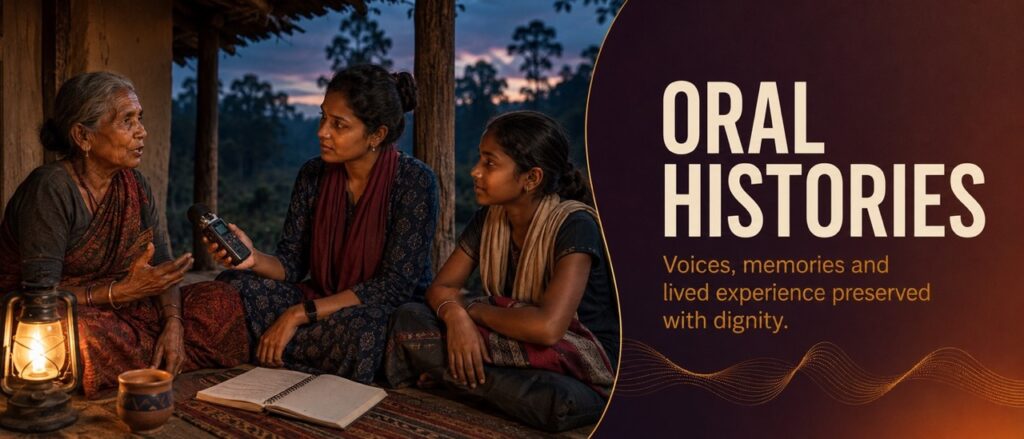
Preserving Voices, Memories, Language and Indigenous Knowledge
Oral Histories of Hodopathy is a community-centred initiative dedicated to documenting and preserving the memories, experiences, stories, terminology, observations and traditional knowledge of elders, knowledge holders, practitioners, families and community members associated with the Ho community and wider Adivasi communities of Jharkhand.
For generations, knowledge has been transmitted through spoken traditions, observation, storytelling, family teaching, community participation and practical experience. Long before much of this knowledge entered written records, it was carried through conversations, demonstrations, seasonal activities and everyday relationships with plants, forests, food, agriculture, landscapes and community life.
The Oral Histories initiative seeks to preserve these voices responsibly while respecting the cultural context, rights, wishes and knowledge traditions of the people who share them.
An oral history is more than a recording of words. It is a record of memory, identity, language, experience, culture and a community’s relationship with the natural world.
Why Oral Histories Matter
A substantial part of indigenous knowledge exists outside formal books, databases and academic publications. It lives within communities and is often transmitted directly from one generation to another.
Elders and experienced knowledge holders may carry generations of knowledge concerning:
- Native plants and forests
- Traditional foods
- Seasonal cycles
- Agricultural practices
- Local ecological observations
- Community history
- Cultural traditions
- Traditional terminology
- Natural resources
- Biodiversity
- Traditional knowledge transmission
- Relationships between people and their environment
When this knowledge is no longer passed between generations, valuable cultural and ecological memory can gradually disappear.
The need for responsible documentation becomes particularly important when communities experience social change, migration, changing livelihoods, language loss, environmental degradation or reduced engagement with traditional practices.
Oral-history documentation can help create a lasting record while keeping the knowledge holder and community at the centre of the process.
Oral History as Living Heritage
Hodopathy should not be understood simply as a collection of written facts.
It is a living knowledge tradition shaped by people, places, language, experience and relationships with nature.
An elder explaining how a plant was traditionally recognised, a practitioner describing how knowledge was learned from previous generations, or a community member recalling how a forest has changed over time can provide valuable insight into the development and transmission of indigenous knowledge.
These accounts preserve something that a conventional database may not capture: the human story behind the knowledge.
Oral histories therefore help connect information with:
People → Place → Language → Memory → Culture → Nature → Knowledge
Who May Contribute?
Oral-history projects may involve people who possess relevant knowledge, memories or experiences and who voluntarily choose to participate.
Potential contributors may include:
- Ho elders
- Adivasi elders and community members
- Traditional knowledge holders
- Traditional practitioners
- Farmers
- Forest-dependent communities
- Food-knowledge holders
- Cultural practitioners
- Community educators
- Local environmental observers
- Community historians
- Researchers documenting cultural history
Every contribution should be approached with respect, transparency and appropriate informed consent.
What Can Oral Histories Preserve?
Depending on the contributor’s wishes, cultural protocols and the purpose of documentation, oral histories may cover many aspects of community knowledge.
Plant Knowledge
Oral accounts may document:
- Local plant names
- Traditional identification methods
- Plant characteristics
- Seasonal availability
- Traditional uses
- Habitat observations
- Cultural associations
- Knowledge of plant collection
- Stories associated with particular plants
Such information can complement botanical and ethnobotanical documentation.
Forest Knowledge
Community members may share knowledge relating to:
- Forest resources
- Seasonal forest changes
- Traditionally important species
- Sustainable resource use
- Relationships with forest landscapes
- Community conservation practices
Food Knowledge
Oral histories may preserve information about:
- Traditional foods
- Wild edible plants
- Seasonal foods
- Local grains
- Fruits and seeds
- Traditional ingredients
- Food preparation
- Food preservation
- Community food traditions
Community Life
Documentation may also explore:
- Family traditions
- Intergenerational learning
- Community practices
- Local customs
- Historical experiences
- Changes in everyday life
- Relationships between generations
Environmental Knowledge
Community observations may include:
- Seasonal patterns
- Changes in plant availability
- Water resources
- Agricultural cycles
- Local biodiversity
- Landscape changes
- Forest conditions
These observations can provide valuable historical and cultural perspectives, while scientific claims should be independently assessed where necessary.
Preserving Ho Language
Language is one of the most important carriers of indigenous knowledge.
A traditional word may contain historical, ecological or cultural meaning that cannot always be fully expressed through translation.
Where contributors and communities permit documentation, oral histories may preserve:
- Original Ho terminology
- Local plant names
- Traditional expressions
- Pronunciation
- Meanings
- Regional variations
- Context of use
- Related cultural terminology
Whenever possible, the original-language recording should be preserved alongside transcripts and translations.
Translation should provide additional accessibility without replacing the original language or voice of the knowledge holder.
Stories of Plants and Nature
Scientific plant descriptions can tell us what a plant is. Oral histories can help explain what that plant means to a community.
A knowledge holder may describe:
- How a plant was traditionally recognised
- When it appeared during the year
- Where it was traditionally found
- How knowledge about it was learned
- How it was connected with food or community life
- How its availability has changed
- Its cultural importance
- Stories or memories associated with it
These accounts can provide important cultural context for the Hodopathy Plant Database and related ethnobotanical research.
Intergenerational Knowledge Transmission
Traditional knowledge is often learned through relationships rather than formal instruction.
A young person may learn through:
Observation → Participation → Practice → Guidance → Experience → Transmission
Knowledge may move from grandparents to parents, from parents to children and from experienced community members to younger generations.
Oral histories help document these pathways of transmission and preserve not only what people know, but also how they learned it.
This is particularly important for understanding indigenous knowledge as a living and evolving system.
Memories of Changing Landscapes
Many community members have observed their surroundings over decades.
Their memories may provide historical perspectives on:
- Forest conditions
- Plant availability
- Water sources
- Agricultural practices
- Seasonal patterns
- Wildlife
- Biodiversity
- Land-use changes
- Changes in local habitats
These accounts should be preserved as oral testimony and community observation.
They may provide valuable research questions and historical context, but they should not automatically be presented as scientifically measured environmental data.
Traditional Knowledge and Responsible Research
Oral histories can provide important starting points for research.
For example, a knowledge holder may identify a locally known plant, explain its traditional name and describe its historical use. Researchers may then investigate its botanical identity, ecological characteristics or ethnobotanical context through appropriate methods.
A responsible pathway may be:
Community Knowledge
↓
Oral History
↓
Ethical Documentation
↓
Verification
↓
Research
↓
Evidence Assessment
↓
Responsible Knowledge Sharing
The contribution of the original knowledge holder should remain visible throughout this process.
Traditional Knowledge Is Not Automatically Scientific Evidence
Oral histories may contain information concerning traditional health practices, plants or preparations.
Such information should be respected as traditional and cultural knowledge, but traditional use alone does not establish that a practice or preparation is safe, effective or medically proven.
Hodopathy.org seeks to distinguish clearly between:
- Community-reported knowledge
- Traditional use
- Historical documentation
- Ethnobotanical documentation
- Preliminary research
- Published scientific evidence
- Established scientific evidence
This distinction helps protect both the integrity of indigenous knowledge and the accuracy of scientific communication.
Information presented on the platform should not be treated as a substitute for professional medical advice, diagnosis or treatment.
Ethical Oral-History Documentation
Recording someone’s story carries important responsibilities.
Before an interview or recording, contributors should receive appropriate information about:
- The purpose of the project
- What will be recorded
- How the material will be stored
- Whether it may be published
- Who may access it
- Whether their name will be used
- Whether translations will be created
- Whether excerpts may be used
- Potential educational or research applications
Participation should be voluntary and based on appropriate informed consent.
The Right to Decide What Is Shared
Knowledge holders should never be pressured to disclose information they consider private, sacred or restricted.
A contributor may choose to:
- Share information publicly
- Share it only within the community
- Permit limited research access
- Remain anonymous
- Restrict particular sections
- Exclude certain topics
- Request conditions on use
- Keep information unpublished
The wishes of knowledge holders and relevant community protocols should guide access.
Responsible preservation is not about recording everything. It is about preserving what communities choose to preserve, in ways that respect their rights and values.
Consent as an Ongoing Relationship
Consent should be understood as more than a one-time administrative step.
Where practical, contributors should have opportunities to:
- Review their information
- Clarify statements
- Correct inaccuracies
- Confirm translations
- Request access restrictions
- Raise cultural concerns
- Request withdrawal where appropriate
This approach can help create a relationship based on trust, transparency and mutual respect.
Respecting Knowledge Holders
Knowledge holders are not simply sources of information.
They are individuals and community members who have carried knowledge through lived experience and intergenerational relationships.
Their participation should be approached with:
- Dignity
- Respect
- Recognition
- Transparency
- Cultural sensitivity
- Appropriate acknowledgement
Where permission is provided, contributors may be acknowledged by name, community or role.
Where anonymity is requested, personal identity should be protected.
Accurate Attribution and Documentation
Every oral-history record should preserve appropriate information about its origin.
Depending on sensitivity and consent, metadata may include:
- Contributor
- Community
- Date of interview
- Interviewer
- General geographical context
- Language
- Subject
- Consent status
- Access conditions
- Related research references
Sensitive personal information should not be disclosed unnecessarily.
Accurate attribution helps future users understand who shared the knowledge, when it was documented and under what conditions.
Audio, Video and Written Records
Oral histories can be preserved in multiple formats.
Audio Recordings
Useful for preserving voice, pronunciation, language and storytelling.
Video Recordings
Can capture demonstrations, expressions, traditional activities and visual context.
Transcripts
Make spoken material easier to search, analyse and study.
Translations
Can make the material accessible to wider audiences while preserving the original-language version.
Photographs
May provide additional cultural, environmental or contextual information where appropriate.
Whenever possible, original recordings should be preserved alongside transcripts and translations.
Digital Preservation
Long-term preservation requires careful management of digital materials.
The archive may consider:
- Secure storage
- Multiple backups
- File integrity
- Appropriate file formats
- Metadata
- Consent documentation
- Access permissions
- Preservation of original recordings
- Long-term digital accessibility
Sensitive material may be stored under restricted access rather than published openly.
Community Review and Correction
Community participation can strengthen the accuracy and cultural integrity of oral-history records.
Knowledge holders and authorised community representatives may help identify:
- Incorrect translations
- Misunderstood terminology
- Incorrect plant names
- Cultural inaccuracies
- Missing context
- Incorrect attribution
- Sensitive information requiring restriction
Community review should be regarded as an important part of responsible knowledge preservation.
Protecting Sacred and Sensitive Knowledge
Not all cultural knowledge is intended for public distribution.
Some information may be:
- Sacred
- Confidential
- Family-specific
- Practitioner-specific
- Community-restricted
- Culturally sensitive
- Ecologically sensitive
Such material may be designated as:
Public → Community Access → Research Restricted → Confidential
The appropriate level of access should depend on the nature of the information and the wishes of the people and communities concerned.
Protecting Sensitive Plant Locations
Oral histories may identify locations of rare, culturally significant or commercially valuable plants.
Publishing precise locations could increase risks such as:
- Overharvesting
- Unauthorised collection
- Commercial exploitation
- Habitat disturbance
- Loss of vulnerable populations
Where necessary, sensitive location information may therefore be generalised, withheld or restricted.
Conservation Before Extraction
The preservation of knowledge should contribute to the protection of biodiversity rather than unintentionally encouraging exploitation.
Oral Histories and Cultural Preservation
Oral histories can preserve dimensions of cultural heritage that may not appear in conventional historical records.
They can document:
- Community memories
- Local terminology
- Relationships with nature
- Knowledge transmission
- Traditional practices
- Historical experiences
- Changes in community life
- Cultural perspectives
Together, these accounts can create a richer record of the history and cultural context surrounding Hodopathy.
Oral Histories and Biodiversity
Indigenous communities may hold long-term observations about plants, forests and local ecosystems.
When responsibly documented, these observations may contribute to:
- Biodiversity education
- Ethnobotanical research
- Historical ecological understanding
- Conservation awareness
- Identification of research questions
Community observations should remain clearly identified as such, while scientific conclusions should be supported by appropriate research.
Connecting Oral Histories With the Plant Database
Oral histories can complement the Hodopathy Plant Database.
A possible documentation pathway is:
Knowledge Holder
↓
Traditional Plant Name
↓
Oral History Recording
↓
Field Documentation
↓
Botanical Identification
↓
Plant Database Record
↓
Research References
This approach can preserve the connection between a plant record and the community knowledge that originally brought attention to it.
Research Opportunities
Oral histories may help researchers explore questions in:
- Ethnobotany
- Botany
- Anthropology
- Indigenous studies
- Ecology
- Biodiversity
- Environmental history
- Linguistics
- Cultural heritage
- Conservation
Research should respect access conditions, community participation, attribution and applicable ethical and legal requirements.
Preventing Knowledge Extraction
Documentation should never become a pathway for extracting knowledge from communities for outside benefit.
Hodopathy.org seeks to avoid practices such as:
- Recording without meaningful consent
- Publishing without appropriate permission
- Removing knowledge from its cultural context
- Misrepresenting traditional knowledge
- Commercialising knowledge without appropriate participation
- Failing to acknowledge contributors
- Using recordings for purposes beyond agreed conditions
Where knowledge contributes to research, innovation or other forms of value creation, appropriate recognition and benefit-sharing considerations should be addressed.
Community Rights and Knowledge Protection
Hodopathy.org does not claim ownership over the collective cultural heritage or traditional knowledge of the communities associated with Hodopathy.
The initiative seeks to support:
- Knowledge preservation
- Cultural continuity
- Community recognition
- Education
- Responsible research
- Biodiversity conservation
The collection, use, publication and sharing of traditional knowledge should respect applicable laws, ethical standards, community protocols and the rights of knowledge holders.
For Communities
The Oral Histories initiative can help communities preserve permitted knowledge for future generations.
Potential outcomes include:
- Preservation of community memories
- Intergenerational learning
- Local-language documentation
- Recognition of knowledge holders
- Plant knowledge preservation
- Cultural education
- Biodiversity awareness
- Historical documentation
The community should remain an active participant in deciding what is documented, how it is represented and who can access it.
For Students and Young People
Oral histories can provide younger generations with a direct connection to knowledge that may otherwise become distant from everyday life.
Students can learn about:
- Ho cultural heritage
- Adivasi knowledge traditions
- Local plants
- Traditional foods
- Forest relationships
- Indigenous ecological knowledge
- Community history
- Language
- Conservation
Listening to knowledge holders can help students understand that knowledge is not only found in books—it can also exist in memory, practice, experience and community relationships.
For Researchers
Researchers may find appropriately accessible oral histories useful as primary cultural and ethnographic resources.
Responsible researchers should:
- Follow access conditions
- Obtain required permissions
- Preserve attribution
- Protect confidential information
- Avoid decontextualising statements
- Communicate findings responsibly
- Recognise community contributions
- Consider appropriate benefit-sharing
Research should build understanding and respectful relationships rather than simply extract information.
A Bridge Between Generations
Oral histories create a pathway connecting generations:
Elders & Knowledge Holders
↓
Oral Tradition
↓
Ethical Documentation
↓
Digital Preservation
↓
Education & Research
↓
Younger Generations
Through this process, knowledge can continue to live and evolve while retaining its cultural and historical roots.
Our Oral History Principles
The Oral Histories of Hodopathy initiative is guided by several core principles:
Respect
Honour communities, cultures and knowledge holders.
Consent
Seek informed and voluntary participation.
Community Participation
Involve communities in decisions concerning their knowledge.
Cultural Context
Preserve knowledge within its social, historical and ecological setting.
Language Preservation
Respect Ho and other local terminology and original-language recordings.
Attribution
Recognise contributors and sources appropriately.
Confidentiality
Protect private, sacred and restricted information.
Accuracy
Document carefully and acknowledge uncertainty where necessary.
Transparency
Distinguish oral testimony from scientific evidence.
Conservation
Protect biodiversity and sensitive ecological information.
Responsible Access
Provide access according to agreed permissions.
Accountability
Remain open to correction, review and community feedback.
Building a Permanent Oral History Collection
The long-term vision is to develop a carefully managed collection of:
- Elder interviews
- Community stories
- Audio recordings
- Video recordings
- Transcripts
- Translations
- Photographs
- Plant-related knowledge
- Traditional food knowledge
- Historical memories
- Language documentation
- Environmental observations
- Research references
The collection should remain organised and accessible where appropriate while protecting materials that require restricted access.
Our Vision
We envision a future in which the knowledge of an elder does not disappear simply because it was never written in a book.
A future generation should be able to hear the voices of those who came before them. Young people should have opportunities to learn their local terminology and cultural history. Communities should be able to preserve their memories. Researchers should be able to understand the cultural context behind the knowledge they study.
The Oral Histories of Hodopathy can help create that bridge.
Preserving Voices. Preserving Memory. Preserving Living Knowledge.
The Oral Histories of Hodopathy initiative is ultimately about preserving more than recordings and transcripts.
It is about preserving voices, memories, language, cultural identity, plant knowledge, ecological understanding, community experience and relationships with nature.
Every story, word, observation and memory can contribute to a deeper understanding of Ho and Adivasi cultural heritage and the living knowledge traditions of Jharkhand.
Our responsibility is to preserve these voices with consent, with respect and without separating the knowledge from the people, communities and landscapes that have kept it alive.