
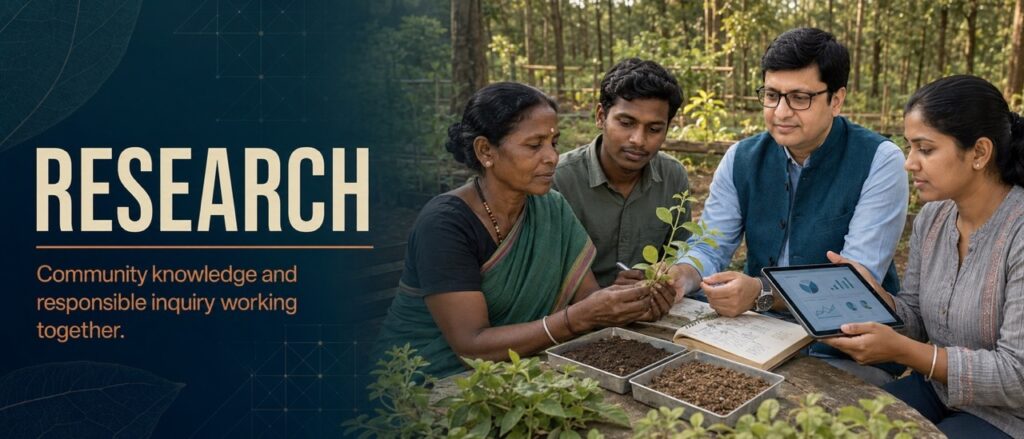
From Indigenous Knowledge to Responsible Research
Research of Hodopathy is envisioned as a structured, ethical and community-centred approach to documenting, studying and understanding the traditional knowledge associated with the Ho community and wider Adivasi communities of Jharkhand.
Hodopathy research focuses on the relationships between people, plants, forests, food, agriculture, biodiversity, seasons, language, culture and community experience.
Traditional knowledge has often been transmitted through oral teaching, observation, practical experience and intergenerational learning. Research can help document this knowledge, preserve its context, identify areas for further investigation and connect community observations with appropriate botanical, ecological, ethnobotanical, nutritional and cultural research.
Importantly, research should not treat traditional knowledge as automatically scientifically proven. Instead, community knowledge can provide valuable evidence of cultural practice, historical observation and research questions that can be investigated through appropriate scientific methods.
The purpose of Hodopathy research is not to replace indigenous knowledge with science, but to create a respectful bridge between community experience, documentation and scientific investigation.
What Is Hodopathy Research?
Hodopathy research refers to the systematic study and documentation of traditional knowledge connected with plants, forests, food, agriculture, biodiversity, culture and community life.
It may involve:
- Ethnobotanical research
- Botanical identification
- Traditional ecological knowledge documentation
- Oral-history research
- Food and nutrition research
- Agricultural studies
- Biodiversity research
- Conservation research
- Cultural and linguistic documentation
- Environmental history
- Community-based research
- Laboratory investigation where appropriate
The research framework should recognise that different forms of knowledge have different sources, methods and levels of evidence.
Why Research Matters
A considerable amount of indigenous knowledge exists outside conventional academic literature.
Research can help preserve information that may otherwise become difficult to recover as:
- Knowledge holders become fewer
- Intergenerational transmission changes
- Young people migrate
- Traditional practices decline
- Habitats change
- Local biodiversity is affected
- Languages and terminology become less commonly used
Research can therefore serve both a knowledge-preservation function and a scientific function.
The Jharkhand Biodiversity Board maintains a substantial body of biodiversity-related documentation, including People’s Biodiversity Registers intended to record community knowledge of biodiversity and support community interests in biological resources.
Research Built Around Community Knowledge
The starting point of Hodopathy research should be the knowledge and experience of communities.
A research process may begin with:
Community Observation
↓
Knowledge Holder / Oral History
↓
Ethical Documentation
↓
Community Review
↓
Botanical or Cultural Identification
↓
Research Question
↓
Scientific Investigation
↓
Evidence Assessment
↓
Responsible Publication
This process helps maintain the connection between research findings and the communities whose knowledge helped generate the research question.
Indigenous Knowledge Is a Research Resource
Traditional knowledge can provide researchers with valuable information about:
- Local plants
- Plant names
- Plant habitats
- Seasonal availability
- Food resources
- Agricultural practices
- Forest resources
- Environmental changes
- Traditional preparation
- Biodiversity
- Cultural relationships with nature
For example, recent ethnographic research among Ho communities in West Singhbhum examined how seasonal festivals are connected with agricultural practices and biodiversity conservation, using interviews, focus groups and participant observation.
This illustrates how cultural practices can also provide important material for ecological and agricultural research.
Ethnobotanical Research
Ethnobotany is an important research area within Hodopathy.
It examines relationships between people and plants, including:
- Local plant identification
- Traditional plant names
- Plant uses
- Plant parts used
- Collection practices
- Seasonal availability
- Cultural significance
- Habitat
- Conservation practices
Research should document the source of the information and distinguish community-reported uses from independently verified scientific findings.
Botanical Identification
Accurate plant identification is fundamental to responsible plant research.
A traditional name may refer to different species in different areas, while a single plant may have several local names.
Therefore, research may involve:
- Field observation
- Botanical descriptions
- Plant morphology
- Expert identification
- Herbarium comparison
- Botanical literature
- Voucher specimens where ethically and legally appropriate
- Digital photographic documentation
The goal is to connect local knowledge with accurate botanical identity without erasing the importance of local terminology.
Local Names and Scientific Names
A Hodopathy research record may ideally preserve both:
Local / Ho Name
and
Scientific Botanical Name
along with:
- Alternative names
- Meaning
- Pronunciation
- Community source
- Location at an appropriate level of detail
- Photograph
- Traditional context
- Research references
A scientific name should not replace the local name. Both can provide different forms of information.
Oral History as Research
Oral histories are an important research resource.
Interviews with elders and knowledge holders may provide information about:
- Traditional plant knowledge
- Forest history
- Food traditions
- Agricultural practices
- Seasonal observations
- Community memories
- Language
- Environmental changes
- Knowledge transmission
Oral testimony should be preserved with appropriate metadata and consent.
It should also be clearly identified as oral testimony or community knowledge, rather than presented as independently verified scientific data.
Traditional Food Research
Research into traditional food systems can explore the connections between:
Food → Culture → Agriculture → Forests → Seasonality → Nutrition → Community Life
Research areas may include:
- Traditional grains
- Millets
- Pulses
- Vegetables
- Wild edible plants
- Fruits
- Seeds
- Food preparation
- Food preservation
- Seasonal food availability
- Agricultural biodiversity
- Food access
A published mixed-methods study of Ho communities in West Singhbhum examined traditional foodways, including foraging, traditional farming, food access, cultural food practices and environmental factors.
Such research demonstrates the importance of studying food not simply as individual ingredients but as part of a broader cultural and ecological system.
Traditional Forest Knowledge
Forests are an important area of research because community knowledge may encompass:
- Plant identification
- Forest foods
- Seasonal resources
- Collection practices
- Local habitats
- Biodiversity
- Agricultural relationships
- Cultural practices
- Environmental observations
Research should avoid reducing forests to sources of commercially valuable plants.
The objective should be to understand the ecological, cultural and community relationships surrounding forest landscapes.
Biodiversity Research
Hodopathy research can contribute to understanding local biodiversity by documenting:
- Native plant species
- Traditional crop varieties
- Wild edible plants
- Culturally important species
- Forest resources
- Seasonal species
- Habitat observations
- Community conservation practices
Research may help identify areas where biodiversity is declining or where additional conservation work is needed.
Traditional Knowledge and Conservation
Traditional knowledge can contribute to conservation research, particularly when communities have long-term relationships with local ecosystems.
Recent research on Ho festivals in Jharkhand reported connections between seasonal cultural practices, agricultural activities and biodiversity conservation.
However, historical practices should not automatically be assumed to be sustainable under every modern environmental or demographic condition.
Research should therefore examine both:
Traditional Practice
and
Contemporary Ecological Conditions
to understand what conservation approaches remain appropriate today.
Agricultural Research
Traditional agriculture may provide valuable research areas including:
- Local crop varieties
- Seed preservation
- Seasonal sowing
- Crop diversity
- Mixed cropping
- Soil observations
- Harvest practices
- Traditional storage
- Climate adaptation
- Agricultural biodiversity
Research can examine how traditional agricultural knowledge interacts with modern farming systems without assuming that either system is universally superior.
Research on Traditional Seeds
Traditional seeds can carry biological, agricultural and cultural significance.
Research may examine:
- Local varieties
- Seed selection
- Seed storage
- Seasonal adaptation
- Crop diversity
- Community seed exchange
- Genetic conservation
- Agricultural resilience
Such research should recognise community participation and address applicable requirements relating to biological resources and traditional knowledge.
Traditional Knowledge and Health Research
Some Hodopathy records may contain traditional information concerning plants or preparations associated with health.
This area requires particular care.
A community report that a plant has traditionally been used for a particular purpose should be documented as traditional use.
It should not automatically be described as:
- Clinically proven
- Medically effective
- Safe for everyone
- Suitable for self-treatment
- A substitute for professional healthcare
Scientific investigation may be required to evaluate specific claims.
From Traditional Claim to Scientific Question
A responsible research pathway can be represented as:
Traditional Observation
↓
Documented Community Account
↓
Research Question
↓
Botanical Identification
↓
Material Authentication
↓
Laboratory / Field Investigation
↓
Safety Assessment
↓
Evidence Review
↓
Scientific Interpretation
This process protects the distinction between what communities report and what research demonstrates.
Scientific Evidence Levels
Hodopathy research should clearly communicate the status of available evidence.
Information may be classified as:
Community Knowledge
Information shared by knowledge holders or community members.
Traditional Use
A documented account of historical or continuing use.
Ethnobotanical Documentation
Information recorded through structured ethnobotanical research.
Preliminary Research
Early scientific findings requiring further investigation.
Published Research
Research reported in academic or scientific publications.
Established Evidence
Findings supported by appropriate and sufficiently strong evidence.
This structure helps prevent traditional knowledge from being either dismissed or exaggerated.
Laboratory Research
Where appropriate and ethically justified, selected plant materials or other resources may become subjects of laboratory investigation.
Potential research areas could include:
- Botanical authentication
- Phytochemical profiling
- Nutritional analysis
- Microbiological assessment
- Quality evaluation
- Contaminant testing
- Safety studies
- Biological activity research
Laboratory findings should be interpreted within appropriate scientific and regulatory frameworks.
Laboratory results should never be used to make broader health claims than the evidence supports.
Quality and Authentication
Research involving plants requires reliable identification and sample integrity.
Important considerations may include:
- Correct species identification
- Correct plant part
- Collection documentation
- Sample handling
- Storage conditions
- Contamination control
- Laboratory methods
- Reproducibility
- Documentation of analytical procedures
This is particularly important when traditional plant knowledge is being connected with scientific research.
Research Methodology
Depending on the research question, Hodopathy research may use qualitative, quantitative or mixed methods.
Qualitative Methods
- Oral histories
- Semi-structured interviews
- Focus groups
- Participant observation
- Community discussions
- Cultural documentation
Quantitative Methods
- Plant inventories
- Species counts
- Food composition analysis
- Biodiversity measurements
- Agricultural data
- Seasonal observations
Scientific Methods
- Botanical identification
- Laboratory analysis
- Nutritional testing
- Ecological surveys
- Chemical analysis
- Controlled investigations where appropriate
Mixed Methods
Combining community knowledge with field and scientific methods can provide a more complete understanding of complex questions.
Community-Based Research
Community participation should not be limited to providing information.
Where appropriate, communities can participate in:
- Research design
- Topic selection
- Field documentation
- Interpretation
- Review
- Data governance
- Communication of findings
- Conservation planning
This creates a model of research with communities rather than research only about communities.
Ethical Research
Hodopathy research should follow strong ethical principles.
These include:
- Prior informed consent
- Voluntary participation
- Cultural sensitivity
- Privacy
- Confidentiality
- Proper attribution
- Community participation
- Responsible data management
- Protection of sensitive information
- Appropriate benefit sharing
Research should respect both individual contributors and collectively held knowledge.
Protecting Sensitive Knowledge
Not every research finding should automatically be published.
Information may require restricted access if it concerns:
- Sacred practices
- Confidential knowledge
- Family-specific knowledge
- Practitioner-specific information
- Sensitive plant locations
- Rare species
- Commercially valuable resources
Research publication should therefore consider not only scientific value, but also community and conservation consequences.
Protecting Sensitive Plant Locations
Publishing exact locations of rare or valuable plants can increase risks of:
- Illegal collection
- Overharvesting
- Commercial exploitation
- Habitat disturbance
Where necessary, research records should generalise locations or apply restricted access.
Conservation Before Extraction
The value of research should never be measured simply by how much biological material can be collected.
Knowledge Ownership and Rights
Hodopathy research should not assume that traditional knowledge is free for unrestricted use simply because it has been documented.
Traditional knowledge may involve:
- Individual knowledge holders
- Families
- Communities
- Cultural institutions
- Local customary practices
- Legal rights
- Access and benefit-sharing considerations
Researchers should identify and respect applicable legal and ethical requirements before collecting or using knowledge or biological resources.
Preventing Knowledge Extraction
Research becomes problematic when knowledge is collected without meaningful participation and later used primarily for outside benefit.
Hodopathy research should avoid:
- Extracting knowledge without consent
- Publishing restricted information
- Misrepresenting community practices
- Removing knowledge from cultural context
- Failing to acknowledge contributors
- Commercialising knowledge without appropriate participation
- Using biological resources without required permissions
Research should create pathways for recognition, collaboration and responsible benefit.
Benefit Sharing
Where research creates educational, scientific, commercial or other value from community knowledge or associated biological resources, benefit-sharing considerations may be relevant.
Depending on the circumstances, benefits could include:
- Community recognition
- Research collaboration
- Training
- Capacity building
- Educational opportunities
- Conservation support
- Community development
- Financial arrangements where appropriate
Specific arrangements should be determined according to applicable law, agreements and project circumstances.
Research and the Knowledge Archive
The Knowledge Archive of Hodopathy can provide an important foundation for research.
It may preserve:
- Oral histories
- Plant records
- Photographs
- Audio recordings
- Video interviews
- Historical documents
- Local terminology
- Research references
The archive can help researchers understand not only what knowledge exists, but also where it came from and what conditions govern its use.
Research and the Plant Database
The Hodopathy Plant Database can provide a structured platform for connecting community plant knowledge with botanical information.
A research-oriented plant record may include:
Local Name
→
Ho Name
→
Scientific Identification
→
Habitat
→
Traditional Context
→
Documented Uses
→
Knowledge Source
→
Research Evidence
→
Conservation Information
This structure helps keep cultural knowledge and scientific information connected while maintaining a clear distinction between them.
Research and Oral Histories
Oral histories can provide the qualitative foundation for understanding traditional knowledge.
Researchers may use permitted oral-history records to study:
- Knowledge transmission
- Plant terminology
- Food traditions
- Forest memories
- Agricultural practices
- Environmental change
- Cultural transformation
Where appropriate, researchers should preserve the original language and context rather than relying exclusively on translated summaries.
Research and Traditional Food Knowledge
Research can examine traditional food systems from several perspectives:
Cultural
How food connects with identity, traditions and community life.
Ecological
How food depends on forests, agriculture and biodiversity.
Nutritional
What foods contribute to dietary diversity and nutrition.
Agricultural
How traditional crops and farming practices are maintained.
Historical
How food systems have changed over generations.
Recent research among Ho communities highlights the links between traditional foodways, foraging, farming, environmental resources and changing livelihoods.
Research and Language
Language is an important research area because traditional terminology can encode information about:
- Plants
- Landscapes
- Seasons
- Food
- Cultural practices
- Relationships with nature
Research should document local terminology carefully and avoid assuming that one translated word completely captures its cultural meaning.
Environmental and Climate Research
Long-term community observations may provide useful historical perspectives on environmental change.
Research may investigate community observations concerning:
- Rainfall
- Seasons
- Flowering
- Fruiting
- Water availability
- Forest conditions
- Crop cycles
- Plant distribution
Such observations can complement scientific monitoring, while remaining clearly identified as community observations unless independently validated.
Research on Knowledge Loss
One important research area is the changing transmission of indigenous knowledge.
Research may examine:
- Intergenerational learning
- Youth participation
- Migration
- Language change
- Changing food systems
- Changing forest relationships
- Modernisation
- Educational transitions
Recent research involving Ho communities reported concerns among participants about declining knowledge transmission associated with youth migration and changing cultural dynamics.
This highlights the importance of documenting knowledge while it remains accessible to knowledge holders.
Research Collaboration
Hodopathy research can potentially bring together:
- Knowledge holders
- Community organisations
- Botanists
- Ethnobotanists
- Ecologists
- Agricultural researchers
- Nutrition researchers
- Anthropologists
- Linguists
- Conservationists
- Universities
- Research institutions
- Students
Collaborative research should establish clear responsibilities, permissions, data-management arrangements and publication expectations before work begins.
Students and Young Researchers
Hodopathy can provide opportunities for students to learn responsible research methods.
Students may participate in:
- Plant documentation
- Biodiversity surveys
- Oral-history projects
- Food documentation
- Language recording
- Literature reviews
- Community-based projects
- Conservation research
Students should be trained to distinguish between observation, traditional knowledge, interpretation and scientific evidence.
Research Documentation Standards
Every research record should aim to preserve sufficient context to understand how information was obtained.
Where appropriate, documentation may include:
- Research question
- Date
- General location
- Contributors
- Methodology
- Language
- Consent status
- Sample information
- Botanical identification
- References
- Limitations
- Evidence status
Sensitive personal or community information should not be disclosed unnecessarily.
Transparency and Reproducibility
Research should be transparent about:
- What was studied
- How information was collected
- Who participated
- What methods were used
- What limitations exist
- What remains uncertain
- What evidence supports the conclusions
This allows readers to distinguish established findings from preliminary observations.
Publication and Knowledge Sharing
Research findings may be communicated through:
- Academic papers
- Reports
- Educational resources
- Community presentations
- Plant database records
- Knowledge archive materials
- Workshops
- Digital publications
Before publication, researchers should consider whether information can be safely and ethically disclosed.
Not every research finding needs to become unrestricted public data.
Community Review of Research
Where appropriate, community review can help identify:
- Incorrect translations
- Misidentified plants
- Missing cultural context
- Misunderstood practices
- Inaccurate attribution
- Sensitive information
- Unintended interpretations
Community review does not replace scientific peer review, and scientific peer review does not replace community consultation. Both can serve different purposes.
Research Integrity
Hodopathy research should be based on:
Accuracy
Report findings honestly.
Respect
Recognise communities and knowledge holders.
Consent
Obtain appropriate permission before documentation.
Transparency
Clearly describe methods and evidence.
Independence
Avoid presenting unsupported claims as established facts.
Accountability
Correct errors when identified.
Conservation
Consider ecological consequences.
Community Rights
Respect applicable cultural, legal and knowledge rights.
Research Gaps and Future Opportunities
Future research may explore:
- Ho ethnobotany
- Traditional food systems
- Indigenous agricultural knowledge
- Forest biodiversity
- Traditional seed systems
- Local plant terminology
- Oral histories
- Environmental change
- Community conservation
- Traditional ecological knowledge
- Food biodiversity
- Cultural landscapes
- Knowledge transmission
- Digital heritage preservation
These areas can support interdisciplinary research while maintaining community participation at the centre.
Building a Research Evidence Framework
A long-term Hodopathy research framework can connect several stages:
1. Knowledge Collection
Document permitted community knowledge.
2. Knowledge Preservation
Store records responsibly in the archive.
3. Identification
Verify plants, terminology and other information where required.
4. Research Design
Develop questions based on documented knowledge.
5. Scientific Investigation
Apply appropriate research methods.
6. Evidence Assessment
Evaluate findings critically.
7. Community Review
Consider cultural accuracy and appropriate representation.
8. Publication
Share findings responsibly.
9. Conservation & Application
Use knowledge to support education, conservation and appropriate community benefit.
What Hodopathy Research Is Not
Hodopathy research should not be understood as:
- Automatically validating every traditional claim
- Replacing modern healthcare
- Extracting community knowledge for commercial use
- Publishing all knowledge without restriction
- Treating all Adivasi communities as identical
- Replacing Ho terminology with scientific terminology
- Collecting plants without appropriate permissions
- Presenting preliminary research as established evidence
The objective is responsible investigation, not uncritical validation.
Our Research Principles
The Research of Hodopathy initiative is guided by:
Community First
Research should respect the people and communities connected with the knowledge.
Consent
Participation and documentation should follow appropriate consent procedures.
Cultural Context
Knowledge should not be separated from its cultural and ecological setting.
Scientific Integrity
Claims should be evaluated using appropriate evidence.
Transparency
Methods, sources and limitations should be clearly communicated.
Attribution
Knowledge holders and research contributors should receive appropriate recognition.
Protection
Sensitive knowledge and vulnerable biological resources should be safeguarded.
Conservation
Research should contribute to responsible biodiversity stewardship.
Collaboration
Researchers and communities should work as partners wherever possible.
Benefit Sharing
Where appropriate, communities should participate in benefits arising from knowledge and research.
Intergenerational Learning
Research should help create opportunities for future generations to learn responsibly.
A Bridge Between Traditional Knowledge and Modern Research
The central vision of Hodopathy research is to build a respectful bridge:
Traditional Knowledge
↕
Community Experience
↕
Ethnobotany & Cultural Research
↕
Botanical & Ecological Science
↕
Laboratory & Evidence-Based Investigation
↕
Conservation & Education
This bridge should never require indigenous knowledge to lose its identity in order to become research material.
Instead, research should help explain, preserve and responsibly investigate knowledge while keeping its people, language, history and cultural context visible.
Our Vision for the Future
We envision a research platform where:
- Elders and knowledge holders are respected as contributors.
- Ho knowledge is documented with cultural context.
- Traditional plant knowledge is connected with accurate botanical research.
- Food traditions are studied as cultural and ecological systems.
- Forest knowledge contributes to conservation research.
- Oral histories preserve voices and memories.
- Scientific evidence is clearly distinguished from traditional claims.
- Sensitive knowledge is protected.
- Young researchers learn ethical community-based methods.
- Communities participate meaningfully in research.
- Research benefits are considered fairly.
- Biodiversity remains a central priority.
Preserving Knowledge. Advancing Research. Respecting Communities.
Research of Hodopathy is ultimately about creating a responsible pathway between indigenous knowledge and scientific inquiry.
The knowledge preserved through generations of observation and experience can provide valuable starting points for research. But responsible research requires more than collecting information—it requires consent, cultural understanding, accurate documentation, scientific discipline, community participation and respect for biodiversity.
Hodopathy seeks to support research that listens before it studies, documents before it interprets, verifies before it claims, and respects before it uses.
Hodopathy — Connecting Indigenous Knowledge, Responsible Research, Scientific Evidence and the Conservation of Living Heritage.