
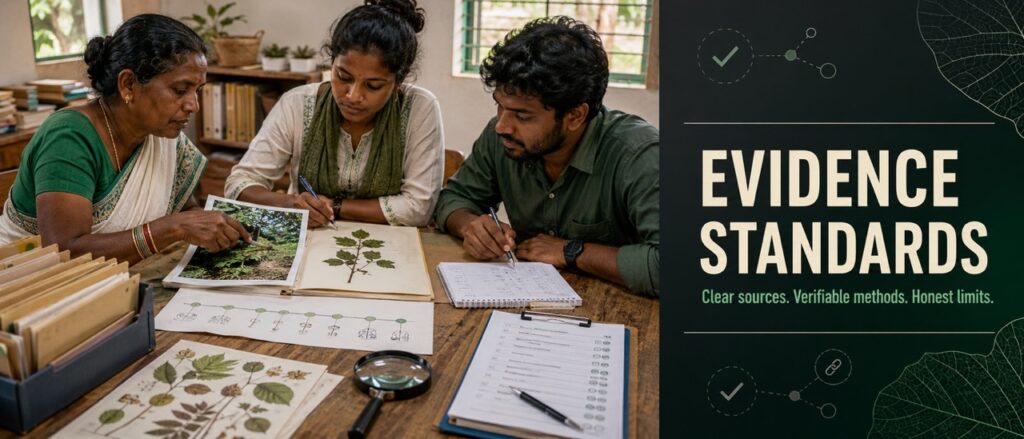
A Framework for Evaluating Traditional Knowledge, Research, Safety, and Scientific Evidence
Evidence Standards of Hodopathy establishes a clear and responsible framework for understanding, documenting, evaluating and communicating knowledge associated with Hodopathy, the Ho community, wider Adivasi communities of Jharkhand, traditional ecological knowledge, ethnobotany, food traditions, forest knowledge and plant-based practices.
Hodopathy.org recognises that knowledge can come from different sources. Community experience, oral histories, traditional practices, field observations, historical records and scientific research each provide different kinds of information. They should therefore not be treated as though they have identical evidentiary status.
The purpose of an evidence standard is not to dismiss traditional knowledge simply because it does not originate in a laboratory. Nor is it to describe every traditional observation as scientifically proven.
Instead, the objective is to establish a transparent pathway:
Traditional Knowledge → Documentation → Identification → Research → Evidence Assessment → Responsible Communication
The World Health Organization similarly emphasises the need to strengthen research methods and evidence for traditional medicine while respecting local heritage, resources and rights.
Respect traditional knowledge. Document it accurately. Test claims appropriately. Communicate evidence honestly.
Why Evidence Standards Matter
Traditional knowledge may have been transmitted through generations of observation and practical experience. Such knowledge can provide important cultural, ecological and research information.
However, different questions require different forms of evidence.
For example:
- A community member’s account can document traditional use.
- An oral-history recording can establish what a person remembers or reports.
- A botanical specimen can support plant identification.
- Laboratory research can investigate chemical or biological properties.
- Clinical research can investigate health effects in people.
- Systematic reviews can assess the overall body of available research.
Therefore, evidence should always be considered in relation to the specific claim being made.
Evidence Is Not the Same as Tradition
A practice may have existed for generations and still require scientific investigation before a specific health, safety or efficacy claim can be established.
Traditional use can demonstrate that:
“This practice or plant has been used traditionally in a particular community.”
It does not automatically demonstrate:
“This practice is clinically effective for a particular disease.”
This distinction is essential for responsible documentation.
WHO guidance similarly notes that widespread or historical use does not by itself assure a favourable risk-benefit profile and that benefits and risks require appropriate evaluation.
Evidence Categories Used by Hodopathy
Hodopathy.org can classify information according to its source and level of verification.
1. Community Knowledge
Information shared by community members, elders, practitioners or knowledge holders.
This may include:
- Plant names
- Food traditions
- Forest knowledge
- Agricultural practices
- Seasonal observations
- Cultural practices
Community knowledge is important cultural evidence, but its evidentiary meaning should remain clearly identified.
2. Oral Testimony
Information recorded through interviews or oral histories.
This may preserve:
- Personal experience
- Family knowledge
- Community memories
- Traditional terminology
- Historical observations
Oral testimony should be presented as testimony rather than automatically converted into scientific fact.
3. Ethnobotanical Documentation
Structured documentation of relationships between people and plants.
This can include:
- Local names
- Traditional uses
- Plant parts used
- Preparation methods
- Collection practices
- Seasonal availability
- Community context
High-quality ethnobotanical research should document methods and plant identities transparently. Published methodological standards emphasise clear research questions, literature review, appropriate methods, proper plant-use documentation and transparent analysis.
4. Historical Evidence
Historical books, archival records, older publications, photographs, field notes and other documentary sources.
Historical evidence can help establish how knowledge or practices were described in the past, although historical records may themselves contain inaccuracies or outdated terminology.
5. Botanical Evidence
Evidence concerning the identity, classification and characteristics of a plant.
This may involve:
- Botanical descriptions
- Herbarium specimens
- Expert identification
- Taxonomic databases
- Field photographs
- Voucher specimens
Correct identification is particularly important because different plants can share similar local names.
6. Laboratory Evidence
Laboratory studies may investigate:
- Chemical constituents
- Biological activity
- Toxicity
- Antioxidant activity
- Microbiological effects
- Other measurable properties
Laboratory findings can provide useful evidence, but in-vitro or laboratory activity does not automatically demonstrate effectiveness in humans.
7. Preclinical Evidence
Animal or other non-human experimental studies can investigate biological effects and potential safety.
Such studies can provide important preliminary information but cannot automatically establish that an intervention is safe or effective for humans.
8. Clinical Evidence
Clinical studies investigate effects in human participants.
Depending on the research question, these may include:
- Observational studies
- Cohort studies
- Controlled studies
- Clinical trials
- Randomised controlled trials
The strength of evidence depends on study design, quality, sample size, methodology and relevance to the specific claim.
9. Systematic Reviews and Meta-Analyses
Systematic reviews evaluate multiple studies using predefined methods.
Where appropriate studies are sufficiently comparable, meta-analysis may statistically combine results.
These sources can provide a higher-level assessment of available evidence, but their reliability depends on the quality and consistency of the underlying studies.
A Practical Evidence Hierarchy
For health-related claims, a useful general framework is:
Level 1 — Systematic Reviews / Meta-Analyses of High-Quality Studies
↓
Level 2 — Well-Designed Randomised Controlled Trials
↓
Level 3 — Controlled and Observational Human Studies
↓
Level 4 — Preclinical and Laboratory Evidence
↓
Level 5 — Case Reports and Case Series
↓
Level 6 — Ethnobotanical and Documented Traditional Use
↓
Level 7 — Individual Oral Testimony or Anecdotal Observation
This hierarchy is a guide rather than a universal rule. The appropriate evidence standard depends on the question being investigated.
For example, an oral history may be the strongest appropriate source for answering:
“How did a particular community traditionally describe this plant?”
But it would not be sufficient by itself to answer:
“Is this plant clinically effective for treating a disease?”
Evidence Must Match the Claim
One of the most important principles is:
The stronger the claim, the stronger and more appropriate the evidence should be.
Consider three statements:
Statement A
“Community members traditionally used this plant.”
This may be supported by oral histories and ethnobotanical documentation.
Statement B
“Laboratory research found biological activity in an extract.”
This requires appropriate laboratory evidence.
Statement C
“This plant treats a particular disease in humans.”
This requires substantially stronger clinical evidence.
These three statements should never be presented as equivalent.
Traditional Use as Evidence
Traditional use is valuable evidence of historical and cultural practice.
It can help researchers investigate:
- Which plants communities have used
- How plants were prepared
- Which parts were traditionally used
- How knowledge was transmitted
- Which practices may deserve further study
Traditional use can therefore serve as a starting point for research.
However, traditional use alone should not be presented as definitive proof of clinical efficacy or safety.
WHO’s current approach emphasises evidence-based evaluation and rigorous assessment of safety and effectiveness when traditional practices are considered for healthcare use.
Oral Histories as Evidence
Oral histories have a specific evidentiary role.
They can provide primary information about:
- Personal experience
- Community memory
- Traditional terminology
- Historical practice
- Knowledge transmission
- Environmental observations
An oral history should be attributed appropriately and, where possible, documented with information about:
- Contributor
- Date
- Interviewer
- Language
- Topic
- Context
- Consent
- Access conditions
The archive should distinguish between what the contributor reported and what has subsequently been independently verified.
Plant Identification Standards
Plant identification is a foundational requirement for reliable Hodopathy research.
A record should ideally connect:
Local Name → Photograph → Specimen → Botanical Identification → Scientific Name → Source
Where possible, researchers should use appropriate botanical expertise and voucher specimens.
This is especially important because:
- One plant may have multiple local names.
- One local name may refer to different plants.
- Similar-looking species may have different properties.
- Scientific names can change as taxonomy develops.
Research standards for ethnopharmacological field studies specifically emphasise proper plant-use documentation linked unambiguously to voucher specimens.
Evidence for Traditional Food Knowledge
Food knowledge should be evaluated according to the claim being made.
For example, documentation may establish that:
“A particular food has traditionally been prepared during a particular season.”
This is primarily cultural and ethnographic evidence.
However, a statement such as:
“This food prevents a specific disease.”
requires appropriate nutritional, epidemiological or clinical evidence.
Traditional consumption does not automatically establish:
- Universal safety
- Medical effectiveness
- Nutritional superiority
- Appropriate dosage
- Suitability for every person
Evidence for Forest Knowledge
Forest knowledge can provide valuable ecological and cultural information.
Community observations may document:
- Plant availability
- Flowering and fruiting seasons
- Forest resources
- Changes in local landscapes
- Traditional collection practices
- Biodiversity observations
These observations can generate research questions and contribute to environmental history.
Where scientific conclusions are made, however, community observations should be distinguished from measurements obtained through systematic ecological research.
Evidence for Traditional Health Claims
Health-related claims require particular care.
A traditional statement such as:
“This plant has traditionally been used for a particular health concern”
should be clearly identified as a traditional-use claim.
It should not automatically be rewritten as:
“This plant treats that health condition.”
To support treatment or therapeutic claims, appropriate evidence may be needed from:
- Pharmacological studies
- Toxicology
- Clinical studies
- Controlled trials
- Systematic reviews
- Safety monitoring
WHO identifies research on safety and efficacy as an important evidence gap in traditional medicine and supports stronger research capacity and methods.
Safety Evidence
Safety should be evaluated separately from efficacy.
A substance may show biological activity without having an established safety profile.
Safety assessment may consider:
- Toxicity
- Dose
- Duration of use
- Preparation method
- Route of administration
- Age
- Pregnancy
- Existing health conditions
- Drug interactions
- Contamination
- Product quality
Therefore:
“Traditionally used” ≠ “Proven safe for everyone.”
Evidence for Dosage and Preparation
Traditional preparation methods can be important to document.
However, documenting a traditional preparation does not automatically establish a medically appropriate dose.
Variables can include:
- Plant species
- Plant part
- Fresh or dried material
- Preparation method
- Concentration
- Amount consumed
- Frequency
- Duration
- Individual characteristics
Any modern therapeutic recommendation requires appropriate scientific and clinical evaluation.
Evidence Quality
Not all studies are equally reliable.
Evidence quality may depend on:
- Research design
- Sample size
- Appropriate controls
- Randomisation
- Blinding where relevant
- Measurement methods
- Statistical analysis
- Reproducibility
- Bias
- Confounding
- Completeness of reporting
- Peer review
A published study should therefore not automatically be treated as strong evidence simply because it appears in a journal.
Reproducibility and Transparency
Reliable research should provide enough methodological information for other researchers to understand how the work was conducted and, where appropriate, reproduce or independently assess it.
Important information may include:
- Research question
- Study design
- Sampling method
- Plant identification
- Intervention details
- Laboratory methods
- Statistical methods
- Limitations
- Funding
- Conflicts of interest
Recent work in ethnopharmacology has also highlighted the importance of more rigorous, standardised and transparent reporting.
Peer Review
Peer review means that research is evaluated by qualified experts before or during publication.
Peer review can improve:
- Methodological quality
- Scientific clarity
- Identification of errors
- Interpretation
- Reporting
However, peer review does not guarantee that every published finding is correct.
Evidence should continue to be assessed based on the quality, consistency and relevance of the research.
Independent Confirmation
A single study may produce an interesting finding, but confidence generally increases when independent studies reach similar conclusions.
Evidence becomes more convincing when findings are:
- Repeated
- Consistent
- Methodologically sound
- Relevant to the same population or intervention
- Supported by multiple research groups
This is particularly important when evaluating strong health or safety claims.
Conflicting Evidence
Scientific research does not always produce identical results.
Studies may disagree because of differences in:
- Plant material
- Species identification
- Preparation
- Dosage
- Population
- Study design
- Sample size
- Measurement methods
When evidence conflicts, Hodopathy.org should not selectively present only the favourable findings.
Instead, the disagreement should be acknowledged and explained where possible.
Evidence Gaps
An evidence gap exists when available information is insufficient to answer a research question confidently.
Evidence gaps may occur when:
- Few studies exist
- Studies are small
- Research methods vary
- Plant identity is uncertain
- Safety information is limited
- Clinical research is unavailable
- Traditional knowledge has not been systematically documented
An evidence gap does not mean that a traditional practice is false.
It means that the available evidence is insufficient to make a stronger conclusion.
“No Evidence” vs “Evidence of No Effect”
These concepts must be distinguished carefully.
No Evidence of Effect
Available research is insufficient to establish an effect.
Evidence of No Effect
Good-quality research has investigated the question and found no meaningful effect.
These are not the same conclusion.
Hodopathy.org should avoid turning absence of research into a claim that a traditional practice is ineffective.
Negative Findings Matter
Research that does not support a traditional claim is also valuable.
Negative or inconclusive results can:
- Prevent misleading claims
- Identify research gaps
- Improve future study design
- Protect users
- Refine traditional knowledge documentation
Responsible evidence standards should therefore include findings that challenge as well as support expectations.
Evidence and Cultural Respect
Scientific evaluation should not be used as a reason to dismiss cultural knowledge.
A traditional practice may have:
- Historical importance
- Cultural significance
- Linguistic value
- Ecological relevance
- Social meaning
even when a particular scientific health claim has not been established.
Scientific uncertainty about one claim does not erase the cultural value of the knowledge itself.
Evidence and Community Rights
Research involving indigenous knowledge should respect:
- Prior informed consent
- Community participation
- Attribution
- Confidentiality
- Access restrictions
- Intellectual-property considerations
- Applicable legal requirements
- Benefit-sharing considerations
WHO research guidance also recognises the importance of safeguarding traditional peoples’ rights and ensuring appropriate benefits from discoveries based on their knowledge.
Evidence Should Preserve Context
Removing a traditional statement from its cultural context can change its meaning.
For example, a community may describe a plant as being traditionally used in a particular situation. A researcher should not automatically convert that description into a modern pharmaceutical claim.
Good documentation preserves:
Who said it → What was said → In what context → How it was learned → How it was used → What evidence exists today
Source Classification
Hodopathy records can use source categories such as:
| Source Type | What It Can Establish |
|---|---|
| Oral history | Personal or community testimony |
| Knowledge-holder interview | Traditional knowledge and lived experience |
| Ethnobotanical survey | Structured community–plant relationships |
| Historical document | Historical documentation |
| Botanical reference | Plant taxonomy and identification |
| Laboratory study | Experimental biological or chemical findings |
| Preclinical study | Non-human experimental findings |
| Clinical study | Human health outcomes |
| Systematic review | Synthesis of multiple studies |
| Regulatory guidance | Applicable standards or requirements |
This classification helps users understand what kind of evidence they are reading.
Evidence Rating for Hodopathy Records
Where appropriate, individual records may use descriptive evidence labels such as:
Traditional Knowledge
Documented community knowledge without independent scientific verification of a specific claim.
Documented
Supported by a recorded source, interview, publication or field record.
Botanically Verified
Plant identity supported by appropriate botanical evidence.
Research Supported
A specific claim has supporting scientific research.
Clinically Investigated
The claim has been investigated in human studies.
Stronger Evidence
Supported by a consistent body of higher-quality research.
Evidence Limited
Available research is insufficient or preliminary.
Evidence Conflicting
Available studies do not reach consistent conclusions.
Not Established
Current evidence does not adequately establish the claim.
These labels should describe the available evidence, not assign a value judgment to the community tradition itself.
Evidence and Research Methods
Different research questions require different methods.
Ethnobotanical Questions
May use:
- Interviews
- Participant observation
- Field surveys
- Use reports
- Plant specimens
- Qualitative analysis
- Quantitative ethnobotanical methods
Botanical Questions
May use:
- Morphological identification
- Herbarium comparison
- Taxonomic references
- DNA-based methods where appropriate
Ecological Questions
May use:
- Field surveys
- Biodiversity assessments
- Habitat studies
- Seasonal monitoring
- Geographic data
Food Questions
May use:
- Food composition analysis
- Nutritional research
- Food-safety assessment
- Dietary studies
Health Questions
May require:
- Pharmacological studies
- Toxicological studies
- Clinical research
- Controlled trials
- Systematic reviews
The method must match the question.
Evidence Does Not Have One Universal Ladder
An evidence hierarchy is useful, but it should not be applied mechanically to every type of knowledge.
For example:
- A scientific trial is appropriate for investigating clinical efficacy.
- An oral history is appropriate for preserving personal memory.
- A community interview is appropriate for documenting traditional terminology.
- A botanical specimen is appropriate for supporting plant identification.
- Historical records are appropriate for investigating historical practices.
Therefore, evidence quality is partly determined by whether the evidence is appropriate for the question being asked.
Responsible Communication of Evidence
Hodopathy.org should avoid exaggerated language such as:
- “Miracle cure”
- “Guaranteed treatment”
- “Scientifically proven” without appropriate evidence
- “Completely safe”
- “Works for everyone”
- “No side effects”
Instead, evidence-aware language can include:
- “Traditionally used”
- “Reported by community members”
- “Documented in ethnobotanical literature”
- “Laboratory evidence suggests…”
- “Preliminary research indicates…”
- “Clinical evidence is limited”
- “Further research is needed”
- “Evidence remains inconclusive”
This helps readers understand what is actually known.
Research Limitations
Every evidence record should acknowledge relevant limitations.
Potential limitations include:
- Small sample size
- Limited geographic coverage
- Incomplete documentation
- Uncertain plant identification
- Recall bias
- Selection bias
- Lack of controls
- Limited clinical evidence
- Differences in preparation
- Lack of long-term safety data
Acknowledging limitations strengthens rather than weakens responsible research.
Updating Evidence
Scientific evidence changes over time.
New research may:
- Confirm earlier findings
- Challenge previous conclusions
- Identify safety concerns
- Improve plant identification
- Provide stronger clinical evidence
- Reveal new mechanisms
- Change scientific understanding
Hodopathy.org should therefore treat evidence records as living resources that may require periodic review and updating.
Community Knowledge and Scientific Research Can Complement Each Other
Traditional knowledge and scientific research do not have to be viewed as competing systems.
They can form a responsible research pathway:
Community Knowledge
↓
Ethical Documentation
↓
Community Validation
↓
Botanical / Cultural Identification
↓
Scientific Investigation
↓
Independent Evaluation
↓
Evidence Synthesis
↓
Responsible Application
This model respects the origin of the knowledge while applying appropriate scientific standards to specific research questions.
What Evidence Standards Do Not Mean
Evidence standards do not mean:
- Rejecting traditional knowledge
- Treating scientific research as the only form of cultural knowledge
- Assuming traditional practices are automatically ineffective
- Publishing confidential knowledge for verification
- Commercialising community knowledge
- Replacing knowledge holders with databases
Instead, evidence standards are intended to provide clarity, transparency and responsible interpretation.
Our Core Evidence Principles
1. Respect
Traditional knowledge should be treated with cultural respect.
2. Transparency
Readers should be able to understand where information comes from.
3. Accuracy
Claims should not exceed the evidence supporting them.
4. Appropriate Methods
Research methods should match the question being investigated.
5. Independent Verification
Important scientific claims should be independently evaluated where possible.
6. Reproducibility
Research should be sufficiently documented for appropriate assessment.
7. Community Participation
Knowledge holders should have meaningful involvement in documentation of their knowledge.
8. Safety
Health-related claims require appropriate safety evaluation.
9. Conservation
Sensitive biodiversity information should be protected from exploitation.
10. Continuous Review
Evidence should be updated as new research becomes available.
A Simple Evidence Pathway
The Hodopathy evidence framework can be represented as:
1. Identify the Knowledge
What is being claimed or documented?
↓
2. Identify the Source
Who provided the information and how was it obtained?
↓
3. Preserve Context
What cultural, geographical and historical context surrounds it?
↓
4. Verify Identity
Where relevant, confirm plant, food or material identity.
↓
5. Assess Existing Research
What scientific or historical evidence already exists?
↓
6. Evaluate Evidence Quality
How reliable, relevant and consistent is the evidence?
↓
7. Identify Limitations
What remains uncertain?
↓
8. Communicate Carefully
Use language that accurately reflects the evidence.
↓
9. Update Over Time
Revise the record when credible new evidence becomes available.
The Evidence Standard for the Hodopathy Knowledge Archive
The evidence framework should work together with the Knowledge Archive, Plant Database, Oral Histories and Research Methods sections of Hodopathy.org.
A complete record can therefore connect:
Knowledge Holder
→ Oral History
→ Traditional Use
→ Plant Record
→ Botanical Identification
→ Research References
→ Evidence Assessment
→ Current Status
This creates a transparent chain between community knowledge and published evidence.
For Students
Students should learn to ask:
- Where did this information come from?
- Who documented it?
- Is the source primary or secondary?
- Has the plant been correctly identified?
- Is the claim traditional or scientific?
- What research supports it?
- Are there conflicting studies?
- What are the limitations?
- What remains unknown?
These questions encourage critical thinking without dismissing indigenous knowledge.
For Researchers
Researchers working with Hodopathy-related knowledge should aim for:
- Clear research questions
- Ethical study design
- Appropriate community engagement
- Accurate documentation
- Botanical verification
- Transparent methodology
- Appropriate statistical analysis
- Complete reporting
- Recognition of knowledge holders
- Protection of sensitive information
Published standards for ethnopharmacological field research similarly emphasise ethical and legal research, transparent data collection, appropriate methodology and proper plant documentation.
For Communities
Evidence standards can also help communities maintain control over how their knowledge is represented.
Communities can ask:
- Is our knowledge accurately represented?
- Is the original language preserved?
- Are contributors properly recognised?
- Has confidential information been protected?
- Are traditional claims clearly identified?
- Has scientific research been separated from community testimony?
- Are researchers respecting agreed access conditions?
Community review is therefore an important part of evidence integrity.
Our Commitment
Hodopathy.org seeks to develop an evidence framework that is:
Scientifically responsible + culturally respectful + transparent + community-centred + conservation-aware.
The platform aims to avoid two opposite mistakes:
Mistake 1: Rejecting Traditional Knowledge
Assuming that knowledge has no value simply because it has not yet been scientifically tested.
Mistake 2: Overclaiming Traditional Knowledge
Presenting traditional experience as scientific proof without appropriate research.
The responsible path lies between these extremes:
Preserve the knowledge faithfully, investigate claims appropriately and communicate conclusions honestly.
Conclusion
Evidence Standards of Hodopathy provides a foundation for responsible research, documentation and communication across the Hodopathy knowledge ecosystem.
Traditional knowledge can preserve generations of observation and experience. Oral histories can preserve memory and language. Ethnobotany can document relationships between people and plants. Botanical science can establish plant identity. Laboratory and clinical research can investigate specific biological and health claims.
Each has a role—but each must be interpreted according to what it can actually demonstrate.
The ultimate objective is to build a knowledge system where traditional knowledge is respected, scientific evidence is rigorous, uncertainty is acknowledged, communities are recognised and biodiversity is protected.
Preserving Knowledge. Testing Claims. Respecting Communities. Advancing Evidence.
Hodopathy — Where Indigenous Knowledge, Responsible Research, Cultural Heritage and Scientific Evidence Meet.