
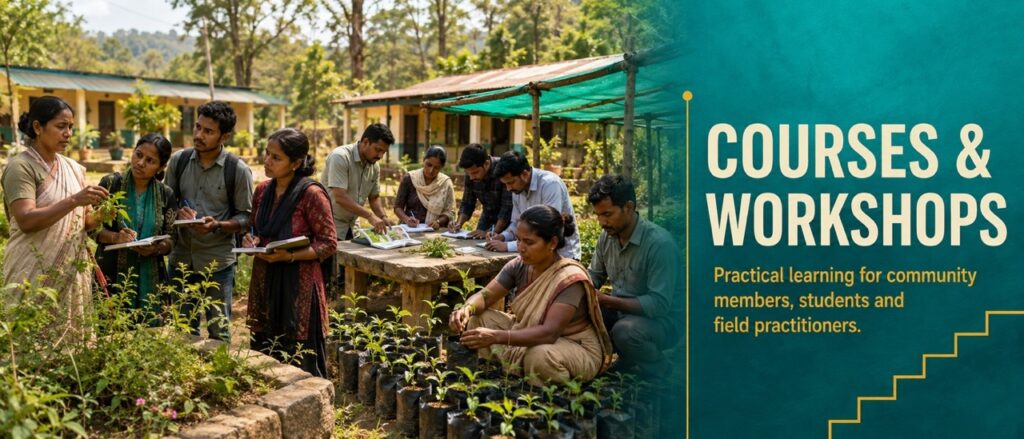
As Hodopathy develops into a more structured field of study and research, courses and workshops can provide a systematic pathway for learning, practical skill development, research training, evidence evaluation, ethics, safety, and professional development. A future-ready education model should not focus only on theoretical knowledge. It should also teach participants how to ask meaningful questions, examine evidence, document observations, conduct responsible research, evaluate uncertainty, and communicate conclusions accurately.
The objective should be to create learning programs that are structured, transparent, interdisciplinary, research-oriented, and continuously updated according to new scientific findings.
Important principle: Educational courses should distinguish clearly between traditional knowledge, hypotheses, preliminary findings, and scientifically established evidence. Training should not present unproven health claims as established medical facts.
1. Purpose of Courses & Workshops
Courses and workshops can create a common educational foundation for students, researchers, educators, practitioners, and professionals interested in Hodopathy.
The major objectives can include:
- Building foundational knowledge of Hodopathy
- Understanding its history, concepts, terminology, and evolving frameworks
- Developing scientific and critical-thinking skills
- Teaching research methodology and study design
- Learning evidence evaluation and scientific literature review
- Understanding nutrition, lifestyle, environmental and preventive-health research
- Developing ethical and responsible research practices
- Learning documentation and data-management techniques
- Introducing laboratory and observational research concepts
- Developing statistical and analytical skills
- Understanding digital health, AI, and data science
- Encouraging interdisciplinary collaboration
- Improving scientific communication and reporting
- Promoting reproducibility and independent validation
- Supporting lifelong learning and professional development
2. Foundational Courses in Hodopathy
A Foundation Course in Hodopathy can serve as the starting point for learners with little or no previous research experience.
Suggested Topics
- Introduction to Hodopathy
- History and development
- Fundamental terminology
- Major concepts and theoretical frameworks
- Traditional knowledge and modern scientific investigation
- Current research landscape
- Scientific thinking and critical reasoning
- Introduction to evidence-based evaluation
- Research ethics and responsible conduct
- Basic health and wellness concepts
- Introduction to nutrition and lifestyle research
- Understanding scientific publications
The course should emphasize the difference between what is known, what is hypothesized, and what remains uncertain.
3. Advanced Hodopathy Research Course
An advanced research course can prepare learners to participate in structured research projects.
Core Modules
- Research question development
- Literature searching
- Systematic literature review
- Hypothesis formulation
- Study-design selection
- Participant selection and sampling
- Data-collection methods
- Outcome measurement
- Statistical analysis
- Bias and confounding
- Research ethics
- Safety assessment
- Scientific reporting
- Peer review
- Reproducibility
- Independent replication
- Evidence synthesis
Participants can finish the course by developing a research proposal or small research project.
4. Evidence Evaluation Workshop
Because evidence quality is central to responsible development, an Evidence Evaluation Workshop can teach participants how to assess different types of information.
The workshop can examine:
- Traditional knowledge
- Expert opinion
- Anecdotal reports
- Case reports
- Laboratory findings
- Observational studies
- Controlled studies
- Randomized controlled trials
- Systematic reviews
- Meta-analyses
- Evidence syntheses
Participants can learn to ask:
What was studied? → How was it studied? → What was measured? → What were the limitations? → Can the result be reproduced? → How strong is the conclusion?
This approach prevents weak evidence from being presented as definitive proof.
5. Research Methodology Workshops
Short, practical workshops can focus on individual research skills.
Possible Workshops
Research Question Workshop
Teaches participants how to convert broad ideas into clear, measurable research questions.
Study Design Workshop
Explains when observational, experimental, longitudinal, comparative, or controlled designs may be appropriate.
Data Collection Workshop
Covers questionnaires, interviews, measurements, digital tools, documentation, and data-quality procedures.
Statistical Thinking Workshop
Introduces averages, variability, confidence intervals, effect sizes, uncertainty, statistical significance, and practical significance.
Research Reporting Workshop
Teaches participants how to present methods, results, limitations, references, and conclusions transparently.
6. Clinical and Human Research Training
Where Hodopathy-related hypotheses involve human health or wellbeing, specialized training should introduce responsible human research principles.
Topics can include:
- Research ethics
- Informed consent
- Participant privacy
- Risk assessment
- Inclusion and exclusion criteria
- Control and comparison groups
- Outcome measurement
- Adverse-event monitoring
- Data protection
- Research registration
- Statistical planning
- Transparent reporting
- Independent ethical review
Such courses should make clear that educational training does not itself establish clinical effectiveness or authorize medical practice.
7. Nutrition & Lifestyle Research Workshops
Nutrition and lifestyle can be important areas for interdisciplinary investigation.
Workshops could cover:
Nutrition Research
- Dietary assessment
- Food composition
- Dietary patterns
- Nutrient intake
- Whole-food research
- Food safety
- Personalized nutrition research
- Nutrition data analysis
Lifestyle Research
- Physical activity
- Sleep
- Stress management
- Daily routines
- Screen exposure
- Social and environmental factors
- Healthy-aging research
Participants can learn how to distinguish between associations and causal relationships, an essential skill when studying complex lifestyle factors.
8. Plant-Based and Natural Resource Research Workshops
Where Hodopathy research examines plants or naturally derived materials, specialized training can connect traditional knowledge with modern scientific investigation.
A structured pathway may include:
Traditional use → Accurate identification → Documentation → Chemical characterization → Laboratory investigation → Safety assessment → Human research where appropriate → Independent validation
Workshops can introduce:
- Botanical identification
- Traditional knowledge documentation
- Phytochemical research concepts
- Laboratory testing
- Quality control
- Contamination and adulteration risks
- Standardization
- Toxicity and safety assessment
- Responsible communication of findings
Traditional use should be treated as a source of research questions, rather than automatically as proof of effectiveness.
9. Laboratory Research Workshops
Laboratory-oriented workshops can introduce the principles required for responsible experimental research.
Potential subjects include:
- Laboratory safety
- Sample collection
- Sample preparation
- Experimental controls
- Measurement techniques
- Quality assurance
- Laboratory documentation
- Reproducibility
- Data recording
- Interpretation of laboratory findings
Participants should understand that laboratory activity can generate useful evidence but does not automatically demonstrate effectiveness in humans.
10. Digital Health & AI Workshops
Future Hodopathy education can incorporate emerging technologies while maintaining strong validation standards.
Possible Topics
- Digital health research
- Wearable-device data
- Mobile health applications
- Remote monitoring
- Health-data visualization
- Artificial intelligence
- Machine learning
- Predictive modeling
- Natural-language processing
- Research databases
- Automated literature analysis
AI can assist with research organization, pattern detection, data analysis, and literature discovery, but AI-generated conclusions should be independently checked and scientifically validated.
11. Data Science & Statistical Training
Advanced courses can introduce participants to modern research analytics.
Learning Areas
- Research databases
- Data cleaning
- Data visualization
- Descriptive statistics
- Inferential statistics
- Effect sizes
- Confidence intervals
- Regression analysis
- Missing-data management
- Confounding
- Multiple comparisons
- Longitudinal analysis
- Meta-analysis
- Reproducible analytical workflows
The objective should be to move from simply collecting large amounts of data toward producing reliable, interpretable, and reproducible evidence.
12. Environmental Health Workshops
A broader Hodopathy research framework can also examine environmental factors associated with health and wellbeing.
Workshops may investigate:
- Air quality
- Water quality
- Noise exposure
- Light exposure
- Green spaces
- Workplace environments
- Household environments
- Urban design
- Climate-related health factors
- Environmental stressors
These workshops can teach participants how to design observational studies and evaluate environmental-health relationships without overstating causality.
13. Traditional Knowledge & Scientific Documentation Workshop
Traditional knowledge can be valuable for identifying research questions, but it requires careful documentation and ethical treatment.
This workshop can teach:
- Historical documentation
- Source verification
- Community knowledge
- Cultural sensitivity
- Ethical documentation
- Attribution
- Intellectual-property considerations
- Evidence classification
- Hypothesis development
- Scientific validation
The goal is to create a respectful bridge between knowledge preservation and scientific investigation.
14. Research Ethics & Integrity Workshop
Ethics should be integrated throughout Hodopathy education rather than treated as an optional topic.
Participants can learn about:
- Research integrity
- Informed consent
- Participant safety
- Privacy and confidentiality
- Conflicts of interest
- Responsible authorship
- Data integrity
- Plagiarism prevention
- Honest reporting
- Publication ethics
- Responsible use of AI
- Handling negative findings
- Correction and retraction procedures
A strong educational culture should encourage researchers to report positive, negative, null, and inconclusive results.
15. Scientific Writing & Publication Workshop
Researchers need to communicate findings clearly and accurately.
Training can cover:
- Research-paper structure
- Abstract writing
- Literature reviews
- Methods sections
- Results presentation
- Tables and figures
- Citation practices
- Reference management
- Research limitations
- Scientific conclusions
- Peer-review responses
- Research reports
- Conference presentations
A central principle should be:
The strength of the language should match the strength of the evidence.
16. Practical Hands-On Workshops
Courses become more effective when learners apply knowledge through practical activities.
Possible exercises include:
- Designing a research question
- Creating a research protocol
- Conducting a literature search
- Building a data-collection form
- Designing a survey
- Performing basic statistical analysis
- Evaluating published studies
- Identifying research bias
- Creating an evidence table
- Preparing a research report
- Presenting research findings
- Conducting a reproducibility exercise
Project-based learning can help participants develop skills that cannot be acquired through lectures alone.
17. Short-Term Certificate Workshops
Short programs can make specialized learning accessible to different audiences.
Suggested Programs
Certificate in Fundamentals of Hodopathy
Certificate in Hodopathy Research Methods
Certificate in Evidence Evaluation
Certificate in Nutrition & Lifestyle Research
Certificate in Plant-Based Research
Certificate in Research Ethics & Integrity
Certificate in Digital Health & AI Research
Certificate in Scientific Writing
Certificate in Data Analysis for Hodopathy Research
These programs should define their learning outcomes, assessment methods, prerequisites, and evidence standards clearly.
18. Progressive Learning Structure
A future education system could follow a progressive pathway:
Level 1 — Foundation
Introduction, terminology, history, scientific thinking and evidence literacy.
Level 2 — Intermediate
Research methodology, documentation, nutrition, lifestyle, ethics and data collection.
Level 3 — Advanced
Experimental research, statistics, laboratory methods, digital health and evidence synthesis.
Level 4 — Research Specialist
Independent research design, advanced analytics, publication, peer review and interdisciplinary projects.
Level 5 — Research Leadership
Research program management, collaboration, scientific governance, mentoring and international research coordination.
This structure allows learners to progress according to their knowledge and experience.
19. Workshops for Researchers
Specialized workshops can support researchers already working in the field.
Potential advanced sessions include:
- Systematic-review methodology
- Meta-analysis
- Research reproducibility
- Open research practices
- Research data management
- Advanced statistics
- Clinical research design
- Biomarker research
- Microbiome research
- AI-assisted research
- Research protocol development
- Grant and proposal writing
- Peer-review methodology
- Research collaboration
- Scientific communication
These workshops can help establish a stronger research culture around Hodopathy.
20. Interdisciplinary Courses
The future development of Hodopathy may benefit from collaboration across multiple disciplines.
Potential contributors could include experts in:
- Medicine and public health
- Nutrition
- Biology
- Botany
- Chemistry
- Psychology
- Environmental science
- Statistics
- Data science
- Artificial intelligence
- Epidemiology
- Social science
- Research ethics
- Scientific communication
Interdisciplinary education can reduce isolated thinking and encourage more comprehensive research questions.
21. Digital Learning Platform
A future Hodopathy Learning & Research Platform could provide online education and research resources in one ecosystem.
Possible features:
- Video courses
- Interactive lessons
- Digital textbooks
- Research-methodology modules
- Evidence database
- Research-paper library
- Recorded workshops
- Online assessments
- Certificates
- Research-project marketplace
- Expert lectures
- Discussion forums
- AI-assisted learning tools
- Research dashboards
- Continuing education tracking
The platform should clearly separate educational information from validated clinical guidance.
22. Assessment & Certification
A credible training system should evaluate actual knowledge and skills rather than simply award certificates for attendance.
Assessment methods can include:
- Written examinations
- Practical assignments
- Research-protocol development
- Literature-review projects
- Data-analysis exercises
- Case-based learning
- Presentations
- Research reports
- Final projects
- Ethical decision-making exercises
Certificates should clearly state the course completed, learning outcomes, assessment method, and level of training.
23. Continuing Professional Development
Science changes continuously. Therefore, Hodopathy training should not end after one certificate.
A continuing professional development system could offer:
- Annual refresher courses
- Research-methodology updates
- New evidence reviews
- Safety updates
- New technology workshops
- Statistical training
- AI research updates
- Publication-quality training
- Research ethics updates
- Interdisciplinary seminars
This creates a culture of continuous improvement rather than one-time education.
24. Future Research Training Centers
Specialized Hodopathy Research & Education Centers could eventually combine education, research, data analysis, laboratory collaboration, and scientific communication.
A center could include:
Education Unit → Research Unit → Data Science Unit → Evidence Evaluation Unit → Ethics & Safety Unit → Publication Unit → Collaboration Network
Such an integrated structure could support both learners and researchers.
25. International Courses & Workshops
As research develops, international educational collaboration could improve consistency and knowledge exchange.
Potential activities include:
- International webinars
- Research-methodology conferences
- Joint workshops
- Visiting researcher programs
- Collaborative research training
- Cross-disciplinary summer schools
- International student projects
- Shared research databases
- Joint publications
- Research-methodology exchanges
International collaboration should prioritize shared standards, transparent methodology, independent evaluation, and responsible communication.
26. Proposed Future Course Projects
To advance education, the following initiatives could be developed:
📘 Hodopathy Foundation Academy
A structured introductory learning program.
🔬 Hodopathy Research School
Advanced education in scientific methodology and research design.
📊 Evidence & Data Science Lab
Training in statistics, evidence synthesis, AI and research analytics.
🌿 Natural Resource Research School
Interdisciplinary training in botanical and natural-resource research.
🧪 Experimental Research Workshop Series
Hands-on training in laboratory and controlled research principles.
🤖 AI for Hodopathy Research Program
Responsible application of AI to literature, datasets and research workflows.
🌍 Global Hodopathy Education Network
A collaborative international platform for courses, workshops and research exchange.
27. Recommended Future Course Framework
A mature course-development model can follow:
Define Learning Objectives
↓
Develop Evidence-Based Curriculum
↓
Expert Review
↓
Pilot Course
↓
Learner Assessment
↓
Independent Evaluation
↓
Curriculum Improvement
↓
Certification
↓
Continuous Updating
This creates an education system that evolves as new evidence and research methods become available.
28. Long-Term Vision
The long-term goal of Courses & Workshops of Hodopathy should be to build a learning ecosystem that values knowledge, scientific curiosity, critical thinking, research integrity, safety, reproducibility and continuous improvement.
Instead of teaching learners simply what to believe, advanced education should teach them how to investigate, how to evaluate evidence, how to recognize uncertainty, and how to improve existing knowledge.
The future model can connect:
Education + Research + Evidence + Technology + Ethics + Data Science + Collaboration
Together, these components can provide a stronger foundation for the responsible development of Hodopathy as an evolving research and educational subject.
Core Educational Principle
Learn carefully. Question responsibly. Research systematically. Measure objectively. Evaluate critically. Communicate honestly. Improve continuously.