
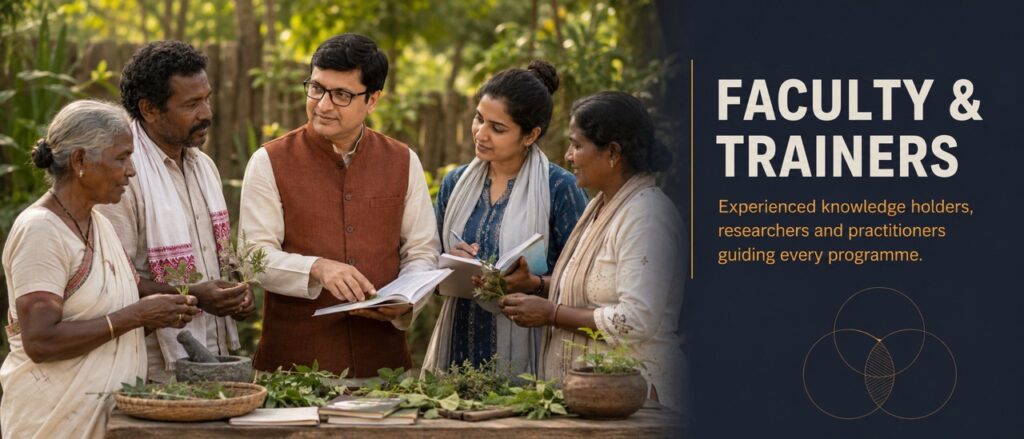
The Faculty & Trainers of Hodopathy can play a central role in developing a structured, responsible, research-oriented, and future-ready education system. As the field evolves, faculty should not be limited to delivering theoretical information. They should help learners develop scientific thinking, research skills, evidence literacy, practical abilities, ethical judgment, data-analysis skills, and a commitment to continuous improvement.
A progressive faculty system should bring together educators, researchers, subject specialists, statisticians, data scientists, nutrition experts, environmental researchers, laboratory specialists, ethics professionals, and other relevant disciplines.
Evidence responsibility: Faculty should clearly distinguish established evidence from traditional knowledge, observations, hypotheses, preliminary findings, and unverified claims. Educational programs should never represent unsupported health claims as scientifically established facts.
1. Vision of Faculty Development
The long-term vision should be to create a faculty community capable of teaching, researching, mentoring, evaluating, collaborating, and innovating.
The faculty ecosystem can be built around seven pillars:
- Academic Excellence
- Research Competence
- Evidence Evaluation
- Teaching Excellence
- Ethics & Safety
- Technology & Innovation
- Continuous Professional Development
Together, these pillars can create educators who are capable of adapting as new evidence and research technologies emerge.
2. Role of Faculty & Trainers
Faculty members can perform several interconnected roles.
Educator
Provide structured knowledge through lectures, courses, workshops, seminars, and digital learning.
Researcher
Develop and participate in research projects using appropriate scientific methodologies.
Mentor
Guide students and early-career researchers through research projects and professional development.
Evidence Evaluator
Teach learners how to assess research quality, bias, uncertainty, reproducibility, and evidence strength.
Research Supervisor
Support learners in developing research questions, protocols, data-collection plans, analysis, and reports.
Scientific Communicator
Help learners communicate findings accurately without exaggerating conclusions.
Innovation Facilitator
Introduce appropriate applications of AI, data science, digital tools, and emerging research technologies.
3. Core Competencies of a Hodopathy Trainer
A future trainer should ideally develop competency across multiple areas.
Subject Knowledge
Understanding the concepts, terminology, history, and current research landscape of Hodopathy.
Scientific Literacy
Understanding how scientific questions are formulated and tested.
Research Methodology
Ability to understand and teach appropriate study designs.
Evidence Appraisal
Ability to distinguish strong evidence from preliminary or unreliable information.
Data Literacy
Understanding data collection, quality control, statistics, and interpretation.
Ethical Awareness
Understanding research ethics, participant protection, privacy, conflicts of interest, and responsible communication.
Teaching Skills
Ability to explain complex subjects clearly to learners with different backgrounds.
Digital Competence
Ability to use appropriate educational, research, statistical, and data-management technologies.
Communication
Ability to communicate research findings, limitations, and uncertainty clearly.
4. Foundational Faculty
Foundation-level trainers can introduce students to the basic educational framework.
Suggested Teaching Areas
- Introduction to Hodopathy
- History and development
- Fundamental terminology
- Core concepts
- Current research landscape
- Scientific thinking
- Critical reasoning
- Evidence literacy
- Introduction to research methodology
- Research ethics
- Scientific communication
The primary objective is to establish a strong conceptual and critical-thinking foundation.
5. Research Methodology Faculty
Research-methodology faculty should form an important part of advanced education.
Key Areas
- Research question formulation
- Literature searching
- Literature review
- Hypothesis development
- Study design
- Sampling
- Data collection
- Outcome measurement
- Observational research
- Experimental research
- Controlled research
- Longitudinal studies
- Research documentation
- Reproducibility
- Evidence synthesis
Faculty should teach learners to select the appropriate method for the research question, rather than attempting to fit every research question into the same study design.
6. Evidence & Critical-Appraisal Faculty
A dedicated evidence faculty can help establish a culture of responsible evaluation.
Training Topics
- Types of evidence
- Evidence hierarchy
- Research quality
- Risk of bias
- Confounding
- Statistical uncertainty
- Effect size
- Confidence intervals
- Correlation and causation
- Reproducibility
- Replication
- Systematic reviews
- Meta-analysis
Students can be trained to examine research using a structured process:
Claim → Evidence → Method → Results → Limitations → Reproducibility → Strength of Conclusion
This approach encourages learners to evaluate information rather than accept claims automatically.
7. Nutrition Faculty
Nutrition can be developed as an interdisciplinary training area.
Potential Expertise
- Nutrition science
- Food composition
- Dietary assessment
- Nutritional epidemiology
- Dietary patterns
- Whole-food research
- Food safety
- Personalized nutrition
- Nutrition data analysis
Faculty should explain that dietary outcomes are influenced by many variables, including lifestyle, socioeconomic conditions, health status, genetics, environment, and overall dietary patterns.
8. Lifestyle & Preventive Research Faculty
Specialist faculty can teach research methods for lifestyle-related questions.
Areas
- Physical activity
- Sleep
- Stress
- Daily routines
- Social factors
- Screen exposure
- Workplace behavior
- Healthy aging
- Preventive health
The emphasis should be on measurable outcomes and appropriate study design rather than assuming that a particular lifestyle practice automatically produces a specific health outcome.
9. Plant & Natural Research Faculty
Where Hodopathy research examines plants or naturally derived materials, specialist faculty can contribute expertise in:
- Botany
- Plant identification
- Phytochemistry
- Natural-product research
- Traditional knowledge
- Laboratory investigation
- Quality control
- Standardization
- Safety assessment
A responsible research pathway can be taught as:
Traditional Knowledge
↓
Accurate Identification
↓
Documentation
↓
Chemical/Material Characterization
↓
Laboratory Investigation
↓
Safety Evaluation
↓
Appropriate Human Research
↓
Independent Validation
This framework respects traditional knowledge while maintaining scientific standards.
10. Laboratory Research Trainers
Laboratory trainers can support practical and experimental education.
Responsibilities
- Laboratory safety
- Sample handling
- Experimental controls
- Measurement techniques
- Quality assurance
- Data recording
- Sample documentation
- Experimental reproducibility
- Interpretation of laboratory findings
A critical educational lesson should be that laboratory findings alone do not establish effectiveness in humans.
11. Clinical & Human Research Faculty
Where programs involve human research, appropriately qualified research professionals should provide instruction on:
- Research ethics
- Informed consent
- Participant safety
- Privacy
- Study design
- Eligibility criteria
- Control groups
- Outcome measurement
- Adverse-event monitoring
- Data protection
- Statistical planning
- Research reporting
Human research should be conducted only within appropriate ethical, institutional, and regulatory frameworks.
12. Statistics Faculty
Statistics specialists can help learners move from data collection to meaningful interpretation.
Core Areas
- Descriptive statistics
- Probability concepts
- Sampling
- Variability
- Statistical inference
- Effect sizes
- Confidence intervals
- Regression
- Confounding
- Missing data
- Longitudinal analysis
- Meta-analysis
The faculty should emphasize that statistical significance does not automatically mean practical or clinical importance.
13. Data Science Faculty
Advanced training can include data-science specialists.
Topics
- Research databases
- Data cleaning
- Data quality
- Data visualization
- Structured datasets
- Reproducible analysis
- Machine learning
- Predictive modeling
- Research automation
The goal should be to transform data into reliable and interpretable information, while avoiding overfitting and unsupported conclusions.
14. AI & Digital Health Trainers
AI and digital technologies can become important components of future training.
AI Education
- AI-assisted literature discovery
- Natural-language processing
- Machine learning
- Data classification
- Pattern detection
- Predictive analytics
- Research automation
- AI-assisted documentation
Digital Health Education
- Wearable devices
- Mobile health applications
- Remote monitoring
- Digital questionnaires
- Health-data visualization
- Digital research platforms
A responsible AI framework should follow:
AI Assistance → Human Review → Data Validation → Scientific Evaluation → Responsible Interpretation
AI-generated content should never automatically be treated as research evidence.
15. Environmental Research Faculty
Environmental-health faculty can introduce learners to research involving:
- Air quality
- Water quality
- Noise
- Light exposure
- Green spaces
- Workplace environments
- Household environments
- Urban environments
- Climate-related factors
Faculty can teach students how environmental variables are measured and how observational relationships should be interpreted carefully.
16. Ethics & Research Integrity Faculty
Ethics should be integrated across all courses.
Key Areas
- Informed consent
- Participant protection
- Privacy
- Confidentiality
- Data integrity
- Research misconduct
- Plagiarism
- Conflicts of interest
- Responsible authorship
- Publication ethics
- Responsible AI
- Transparent reporting
- Correction of errors
Faculty should create an environment where honest reporting is valued more highly than producing positive results.
17. Scientific Writing Faculty
Scientific-writing trainers can help learners communicate research responsibly.
Training Areas
- Research papers
- Abstracts
- Literature reviews
- Research reports
- Methods sections
- Results sections
- Tables and figures
- Citations
- References
- Scientific presentations
- Posters
- Peer-review responses
An important principle is:
The language used to describe a finding should never be stronger than the evidence supporting it.
18. Interdisciplinary Faculty Model
A future Hodopathy education program can use interdisciplinary teaching teams rather than relying on one subject specialist.
For example:
Hodopathy Researcher
- Nutrition Specialist
- Statistician
- Data Scientist
- Ethics Specialist
This structure can provide students with multiple perspectives and reduce the risk of overly narrow interpretation.
19. Faculty Qualification Framework
A transparent qualification framework can improve educational quality.
Foundation Trainer
Should demonstrate:
- Relevant academic background
- Subject knowledge
- Teaching capability
- Evidence literacy
Advanced Trainer
Should demonstrate:
- Advanced subject knowledge
- Research experience
- Methodological competency
- Teaching experience
Research Faculty
Should demonstrate:
- Strong research experience
- Appropriate methodological expertise
- Research-project experience
- Scientific communication skills
Senior Research Faculty
Should demonstrate:
- Research leadership
- Advanced expertise
- Mentoring experience
- Interdisciplinary collaboration
- Strong scientific communication
Requirements should ultimately be matched to the specific course, subject, and applicable professional standards.
20. Faculty Recruitment Process
A professional recruitment system can include:
Application
↓
Academic Review
↓
Professional Experience Review
↓
Research Assessment
↓
Teaching Demonstration
↓
Interview
↓
Ethics & Integrity Review
↓
Appointment
↓
Faculty Orientation
This creates a more transparent pathway for selecting trainers.
21. Faculty Certification
A structured certification system can recognize different levels of teaching and research competency.
Level 1 — Foundation Trainer
Basic teaching and evidence-literacy competency.
Level 2 — Research Trainer
Research-methodology and practical-training competency.
Level 3 — Advanced Research Educator
Advanced methodology, statistics, evidence evaluation, and research supervision.
Level 4 — Senior Research Mentor
Research leadership, mentoring, publication, and interdisciplinary collaboration.
Certification should be linked to demonstrated competencies and assessment, not merely attendance.
22. Faculty Mentorship
Experienced faculty can mentor new trainers.
Mentorship Activities
- Co-teaching
- Classroom observation
- Teaching feedback
- Research supervision
- Curriculum development
- Scientific writing
- Research methodology
- Professional development
This can establish a sustainable pipeline of future educators.
23. Faculty Research Participation
Faculty should ideally remain connected with active research.
They can contribute to:
- Research-question development
- Research protocols
- Student projects
- Data analysis
- Evidence reviews
- Research publications
- Conferences
- Research collaborations
- Replication projects
This creates a productive connection:
Teaching → Research → New Evidence → Curriculum Update → Better Teaching
24. Student-Faculty Research Program
A structured research mentorship program can allow students to work directly with faculty.
Research Pathway
Research Idea
↓
Literature Review
↓
Research Question
↓
Study Protocol
↓
Ethical Review Where Required
↓
Data Collection
↓
Analysis
↓
Research Report
↓
Presentation / Publication
This approach gives learners real-world research experience while maintaining supervision and quality control.
25. Guest Faculty & Visiting Experts
The training ecosystem can invite specialists for short courses and seminars.
Potential contributors include:
- Researchers
- Nutrition scientists
- Botanists
- Chemists
- Biologists
- Epidemiologists
- Public-health specialists
- Statisticians
- Data scientists
- AI researchers
- Ethics specialists
- Scientific editors
Guest faculty can expose learners to new methodologies and independent perspectives.
26. International Faculty Network
International collaboration can expand educational opportunities.
Possible activities include:
- International guest lectures
- Visiting faculty programs
- Joint workshops
- Research exchanges
- Joint student projects
- Co-supervision
- Research-methodology conferences
- Collaborative publications
The emphasis should remain on shared scientific standards and transparent research practices.
27. Faculty Evaluation
Faculty performance should be assessed through multiple indicators.
Teaching
- Learning outcomes
- Course quality
- Student assessment
- Teaching effectiveness
Research
- Research participation
- Research quality
- Publications
- Evidence contributions
Mentorship
- Student development
- Research supervision
- Project quality
Professional Development
- New training completed
- Methodology updates
- Technology skills
- Interdisciplinary activities
Student feedback can be included, but should be considered alongside objective educational and research indicators.
28. Faculty Code of Conduct
A formal professional code can require faculty to:
- Teach accurately
- Distinguish evidence from hypothesis
- Avoid misleading claims
- Protect participants and students
- Respect privacy
- Declare relevant conflicts
- Maintain data integrity
- Avoid plagiarism
- Correct errors
- Respect scientific disagreement
- Encourage critical thinking
- Keep educational materials updated
This can establish a culture of integrity, transparency, accountability, and intellectual openness.
29. Annual Faculty Development Calendar
Faculty development can follow the broader Training Calendar.
January–March
Teaching Foundations & Evidence Standards
April–June
Research Methodology & Student Supervision
July–September
Statistics, AI & Digital Research
October–December
Scientific Publication, Evaluation & Innovation
Annual faculty retreats can review teaching performance, research progress, curriculum gaps, and future priorities.
30. Digital Faculty Network
A future digital platform can connect educators and researchers.
Possible Features
- Faculty directory
- Expert profiles
- Research interests
- Course-management tools
- Teaching resources
- Research-project listings
- Collaboration tools
- Webinar scheduling
- Publication database
- Student-supervision tools
- Faculty-development courses
This can create a connected education–research ecosystem.
31. Future Faculty Research Centers
Specialized centers could eventually support faculty development.
🔬 Hodopathy Research Methods Center
Study design, methodology and reproducibility.
📊 Evidence & Data Science Center
Statistics, evidence synthesis and AI.
🌿 Natural Research Center
Botanical, nutritional and natural-resource research.
🧪 Experimental Research Center
Laboratory and controlled research.
🎓 Education & Faculty Development Center
Teaching, curriculum and assessment.
🌍 International Research Collaboration Center
Global research and educational partnerships.
32. Five-Year Faculty Development Roadmap
Year 1 — Establish
- Define faculty roles
- Establish qualification standards
- Develop foundational curriculum
- Begin faculty orientation
Year 2 — Strengthen
- Add specialist faculty
- Introduce trainer certification
- Establish mentorship
- Expand research supervision
Year 3 — Integrate
- Introduce AI and data science
- Develop interdisciplinary teams
- Strengthen research centers
- Expand digital education
Year 4 — Collaborate
- Develop international faculty networks
- Launch visiting-expert programs
- Establish joint research education
Year 5 — Lead
- Develop senior research mentors
- Establish advanced fellowships
- Expand international research partnerships
- Create continuously updated faculty standards
33. Future Faculty Innovation
The next generation of trainers can use emerging technologies to improve education without compromising scientific quality.
Possible Innovations
AI-Assisted Teaching
Personalized learning materials and question generation with human oversight.
Virtual Research Laboratories
Simulation-based research training before practical laboratory work.
Interactive Evidence Platforms
Visual comparison of research quality and evidence strength.
Digital Research Mentoring
Remote supervision of student projects.
Adaptive Learning
Different learning pathways based on learner competency.
Research Simulation
Practice in study design, statistical analysis, and research decision-making.
Technology should enhance education while maintaining human supervision, transparency, validation, and ethical safeguards.
34. Future Vision
The Faculty & Trainers of Hodopathy can become one of the most important foundations for the responsible development of the field.
A mature faculty ecosystem should connect:
Expertise
→ Education
→ Research
→ Evidence Evaluation
→ Mentorship
→ Innovation
→ Publication
→ Independent Validation
→ Curriculum Improvement
The strongest faculty culture will not be one that simply promotes existing ideas. It will be one that encourages learners to ask better questions, test hypotheses appropriately, recognize limitations, examine conflicting evidence, protect research participants, and remain open to changing conclusions when better evidence becomes available.
Core Faculty Principle
Teach with clarity. Research with rigor. Mentor with integrity. Evaluate evidence critically. Communicate uncertainty honestly. Embrace innovation responsibly. Continue learning.