
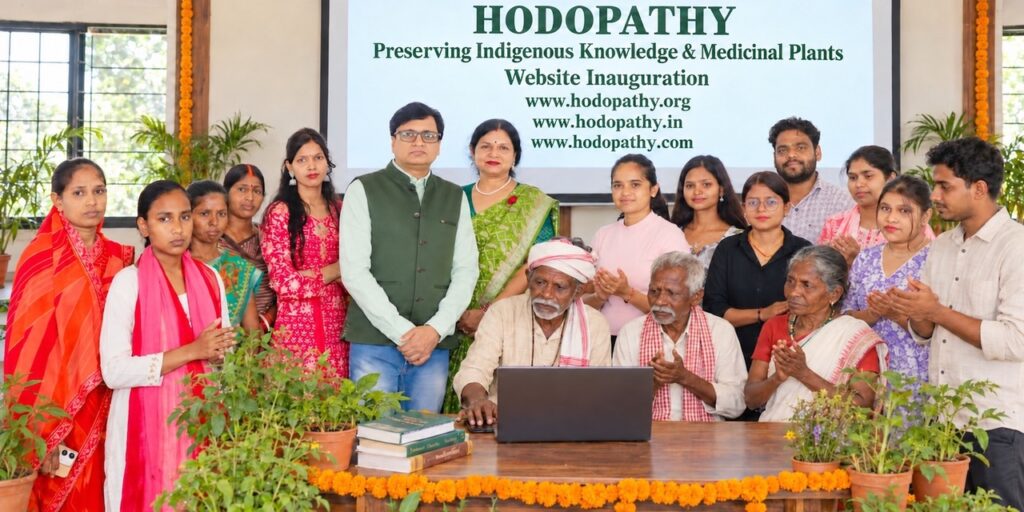
Three dedicated digital platforms launched by environmentalist Rajeev Singh on 8 October 2026 to preserve indigenous healing knowledge, conserve medicinal plants, protect forest biodiversity and connect traditional wisdom with future generations.
Giridih, Jharkhand | 8 October 2026
In a significant initiative to safeguard Jharkhand’s rich indigenous knowledge heritage, environmentalist, agripreneur and sustainability advocate Rajeev Singh inaugurated three dedicated Hodopathy websites — Hodopathy.org, Hodopathy.in and Hodopathy.com — in the presence of traditional Adivasi elders, indigenous knowledge holders and community representatives in Giridih, Jharkhand, on 8 October 2026.
The initiative seeks to preserve centuries-old traditional healing knowledge passed down through generations of Adivasi communities while promoting medicinal plant conservation, forest protection, biodiversity preservation and responsible scientific research.
The inauguration, organised at Rajeev Singh’s residential office in Giridih, brought together elderly traditional knowledge holders, community members and young participants. Their presence reflected the central philosophy of the initiative: indigenous knowledge must be preserved with the participation, dignity and recognition of the communities that have sustained it for generations.
Hodopathy: A Centuries-Old Indigenous Knowledge Heritage
Hodopathy is associated with the traditional healing knowledge and medicinal plant practices of indigenous communities in Jharkhand. This knowledge has developed through generations of observation, experience and close interaction with forests, plants and the natural environment.
For centuries, Adivasi elders and traditional healers have maintained knowledge of locally available medicinal plants, their identification, traditional preparation methods and customary applications.
Much of this knowledge has historically been transmitted orally, from elders to younger generations, rather than through written documentation.
However, changing lifestyles, declining intergenerational knowledge transfer, environmental degradation and the loss of medicinal plant habitats have created growing concerns about the long-term survival of this cultural and ecological heritage.
The Hodopathy digital initiative aims to address these challenges through systematic documentation, community participation, conservation awareness and responsible knowledge sharing.
Three Websites Launched to Preserve Traditional Knowledge
The inauguration of Hodopathy.org, Hodopathy.in and Hodopathy.com represents an important step towards establishing a digital foundation for the preservation and promotion of indigenous knowledge.
The three platforms are intended to support a common mission of protecting traditional wisdom while making reliable educational and conservation-related information accessible to interested communities, students, researchers and future generations.
The initiative focuses on four interconnected priorities:
Preserving Indigenous Knowledge: Documenting traditional knowledge, cultural practices and experiences shared voluntarily by Adivasi elders and traditional knowledge holders, with appropriate consent and recognition.
Conserving Medicinal Plants: Promoting the identification, cultivation, propagation and protection of medicinal plant species associated with indigenous traditions.
Encouraging Research: Creating opportunities for responsible scientific investigation, botanical documentation and collaboration with academic and research institutions.
Educating Future Generations: Helping young people understand the importance of indigenous heritage, medicinal plant biodiversity, ecological conservation and traditional environmental knowledge.
Together, these objectives seek to connect cultural preservation with environmental sustainability.
Traditional Adivasi Elders at the Centre of the Inauguration
One of the most meaningful aspects of the inauguration was the participation of traditional Adivasi elders and community knowledge holders.
Their presence symbolised the importance of recognising the original custodians of indigenous knowledge.
Rather than treating traditional wisdom simply as information to be collected, the initiative emphasises the need to respect the people and communities who have protected and transmitted this knowledge across generations.
Elderly knowledge holders possess valuable experience concerning local forests, medicinal plants, seasonal changes and traditional practices. Their understanding of the natural environment represents an important part of Jharkhand’s living cultural heritage.
The initiative therefore aims to encourage respectful dialogue between experienced elders and younger generations, ensuring that knowledge preservation remains connected to community participation.
Special attention is also proposed for obtaining informed consent, recognising community contributions and protecting sensitive traditional knowledge from inappropriate disclosure or commercial exploitation.
Rajeev Singh Emphasises Conservation of Knowledge, Plants and Forests
Rajeev Singh’s initiative reflects a broader environmental vision in which indigenous knowledge preservation and ecological restoration are closely connected.
Traditional knowledge concerning medicinal plants depends on the continued existence of the forests, landscapes and ecosystems in which those plants grow.
As forest habitats face increasing environmental pressures, the disappearance of plant species can also contribute to the loss of associated traditional knowledge.
Similarly, when experienced knowledge holders pass away without opportunities to share their understanding with younger generations, valuable cultural information may be permanently lost.
The Hodopathy initiative therefore seeks to address both concerns simultaneously: preserving the knowledge of indigenous communities and supporting the conservation of the natural resources on which that knowledge depends.
The larger objective is to create a sustainable relationship between traditional knowledge, biodiversity protection, environmental education and community participation.
Hodopathy Park in Gandey: Connecting Digital Knowledge with Conservation
An important component of the broader initiative is the proposed development and strengthening of Hodopathy Park in Gandey, Giridih district, as a centre associated with medicinal plant conservation and environmental learning.
The park is envisioned as a place where traditional knowledge preservation can be connected with practical conservation activities.
Its proposed areas of focus include medicinal plant cultivation, species identification, conservation awareness, educational visits and community participation.
By connecting digital documentation with physical conservation efforts, the initiative aims to encourage greater public understanding of the relationship between indigenous knowledge and living ecosystems.
The park could also provide opportunities for students, local youth, traditional knowledge holders and interested researchers to learn about medicinal plant diversity and the importance of protecting native vegetation.
Documenting the Experiences of Traditional Healers
Another important objective is the development of a structured collection of traditional knowledge contributed by experienced Adivasi elders and indigenous healers.
The proposed documentation process would focus on recording plant names, local terminology, cultural context, traditional practices and knowledge associated with different ecological environments.
The initiative also envisages preparing a publication that documents the experiences and contributions of traditional knowledge holders.
Such documentation could help preserve information that might otherwise disappear as oral traditions weaken.
At the same time, the initiative recognises that traditional medicinal practices require careful scientific evaluation before claims about safety or therapeutic effectiveness can be established.
The purpose of documentation is therefore not to present unverified remedies as scientifically proven treatments, but to preserve cultural knowledge and create opportunities for responsible interdisciplinary study.
Encouraging Youth Participation and Environmental Education
The long-term success of indigenous knowledge conservation depends significantly on the participation of younger generations.
Through the Hodopathy initiative, efforts are proposed to encourage young people to learn about medicinal plants, traditional ecological knowledge, biodiversity and the cultural significance of forests.
Future activities may include plant identification programmes, documentation workshops, conservation awareness campaigns and interactions with experienced traditional knowledge holders.
Digital platforms can also help connect students and interested individuals with educational resources concerning Jharkhand’s indigenous heritage.
By involving young people in knowledge preservation, the initiative seeks to create continuity between the experiences of elders and the aspirations of future generations.
Opportunities for Scientific Research and Institutional Collaboration
The initiative also recognises the importance of connecting traditional ecological knowledge with modern scientific methods.
Potential areas of research include botanical identification, medicinal plant conservation, biodiversity assessment, sustainable cultivation practices and scientific evaluation of traditionally documented plant uses.
Collaboration with universities, botanical experts, agricultural institutions and research organisations is envisaged as part of the initiative’s future development.
Such cooperation could help improve documentation quality, strengthen conservation strategies and create a better understanding of the ecological significance of medicinal plants.
Any scientific investigation of traditional medicinal applications would need to follow appropriate research protocols, ethical standards and applicable regulatory requirements.
Protecting Indigenous Rights and Cultural Identity
Preserving indigenous knowledge involves responsibilities beyond collecting and publishing information.
Traditional knowledge is often closely associated with community identity, cultural practices, customary relationships with nature and collective heritage.
The Hodopathy initiative therefore places importance on community consent, acknowledgement of knowledge holders and responsible management of documented information.
Sensitive knowledge should not be made publicly accessible without appropriate permission, and any future research or commercial application should respect applicable community rights and benefit-sharing requirements.
This approach seeks to ensure that digital preservation supports indigenous communities rather than separating their knowledge from its cultural origins.
A Step Towards Preserving Jharkhand’s Living Heritage
Jharkhand’s forests and indigenous communities represent an important part of India’s ecological and cultural diversity.
The knowledge developed through generations of interaction with the natural environment offers valuable insights into local biodiversity, plant conservation and traditional relationships between communities and ecosystems.
The inauguration of the three Hodopathy websites on 8 October 2026 marks an early step towards creating a more organised and accessible framework for preserving this heritage.
By bringing traditional Adivasi elders, community members and digital technology together, the initiative highlights the possibility of using modern tools to support the survival of traditional knowledge.
The effort also demonstrates that environmental conservation and cultural preservation are deeply interconnected.
The central message of the Hodopathy initiative is clear: protecting centuries-old indigenous wisdom requires protecting its knowledge holders, medicinal plants, forests and the ecosystems that sustain them.
Through Hodopathy.org, Hodopathy.in and Hodopathy.com, the initiative seeks to carry this vision forward, ensuring that the traditional knowledge of Jharkhand’s Adivasi communities receives greater recognition, responsible documentation and opportunities for preservation for future generations.
About the Hodopathy Initiative
The Hodopathy initiative, led by environmentalist and sustainability advocate Rajeev Singh in Giridih, Jharkhand, focuses on preserving indigenous knowledge, conserving medicinal plants, encouraging responsible scientific research and promoting forest biodiversity protection through community participation and digital documentation.
Official Websites:
Event: Inauguration of Three Hodopathy Websites
Date: 8 October 2026
Location: Giridih, Jharkhand, India
Initiative Led By: Rajeev Singh
Key Focus: Indigenous Knowledge Preservation, Medicinal Plant Conservation, Forest Protection and Biodiversity