
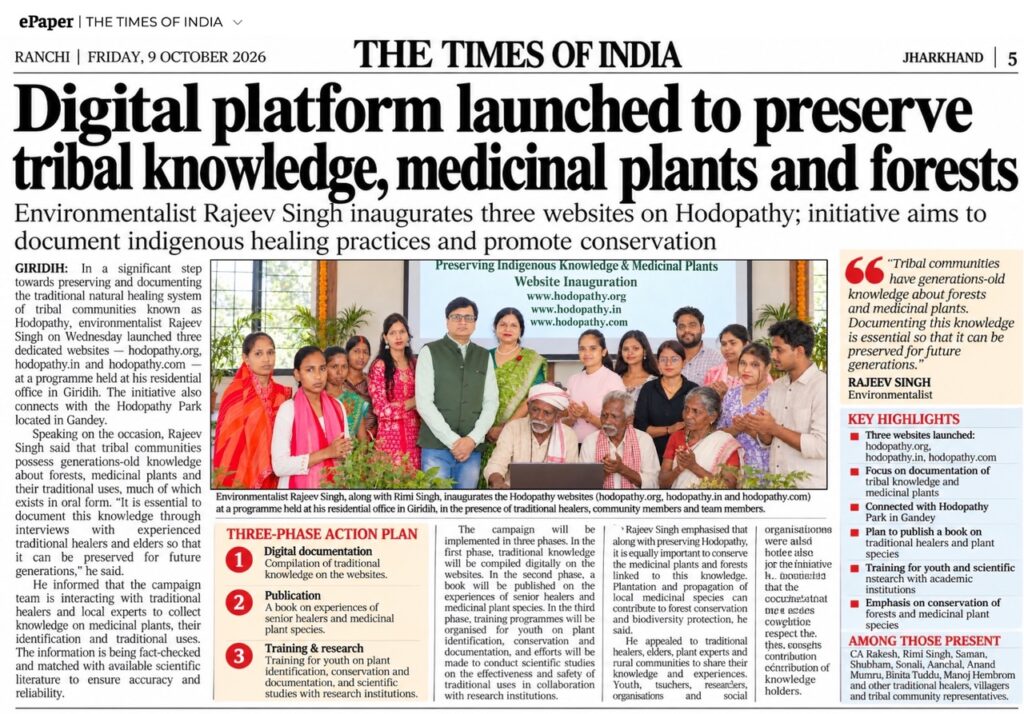
The Times of India | Ranchi Edition | 9 October 2026
Giridih, Jharkhand, India: The mission to preserve generations-old indigenous medicinal knowledge, traditional healing practices and forest biodiversity in Jharkhand has received prominent coverage in The Times of India, one of India’s leading English newspapers.
Published on 9 October 2026 under the headline “Digital platform launched to preserve tribal knowledge, medicinal plants and forests,” the report highlighted the Hodopathy conservation initiative led by environmentalist Rajeev Singh.
The newspaper covered the inauguration of three dedicated websites — Hodopathy.org, Hodopathy.in and Hodopathy.com — in Giridih, bringing together traditional healers, Adivasi elders, community representatives and younger participants.
The initiative aims to document the knowledge of indigenous communities concerning medicinal plants, forests and traditional healing practices. Much of this heritage has been transmitted orally across generations, making responsible documentation important for its long-term preservation.
The newspaper highlighted a three-phase programme involving digital knowledge collection, publication of traditional healers’ experiences and medicinal plant information, and youth training supported by proposed scientific research collaborations.
The initiative also connects with Hodopathy Park in Gandey, Giridih, where medicinal plant conservation and biodiversity protection are integral to the broader mission.
Rajeev Singh emphasised that indigenous knowledge cannot be separated from the natural ecosystems that sustain it. Protecting medicinal plants, forests and local biodiversity is therefore essential to preserving the associated cultural heritage.
A central principle of the initiative is respect for traditional knowledge holders. Their informed consent, rights, experiences and contributions will remain important considerations throughout documentation and research activities.
By connecting Adivasi elders with younger generations, the initiative seeks to encourage intergenerational learning, community participation and greater awareness of indigenous ecological knowledge.
The coverage in The Times of India brings wider attention to the importance of protecting Jharkhand’s living cultural heritage alongside the forests and medicinal plants that have supported it for centuries.
Source: The Times of India, Ranchi Edition, 9 October 2026.