
Introduction
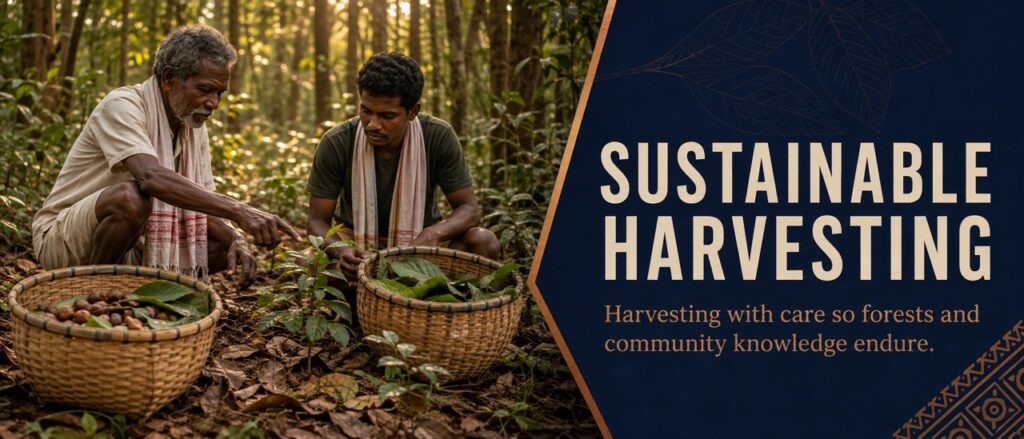
Sustainable Harvesting of Hodopathy can form an important part of a responsible framework for managing native, medicinal, aromatic, nutritional, and traditionally used plant resources.
Many plants are collected from natural habitats for food, traditional practices, research, cultural activities, horticulture, and other purposes. When harvesting exceeds a plant population’s ability to regenerate, it can contribute to declining populations, habitat degradation, loss of genetic diversity, and disruption of ecosystems.
A future-ready Hodopathy approach should therefore connect plant utilization with conservation, scientific monitoring, community participation, ethical knowledge management, research, traceability, and biodiversity protection.
The central principle is:
Harvest only what can be responsibly regenerated, protect natural populations, respect communities and ecosystems, document every stage, and use scientific evidence to improve sustainability.
Sustainable harvesting is not simply about taking fewer plants. It is about understanding which plants are being collected, where they occur, how quickly they regenerate, which plant parts are harvested, how much can safely be removed, who depends on the resource, and how harvesting affects the wider ecosystem.
1. What Is Sustainable Harvesting?
Sustainable harvesting means collecting biological resources in a manner that maintains their long-term availability, ecological function, regeneration capacity, and genetic diversity.
For Hodopathy, the concept can apply to:
- Native plants
- Medicinal plants
- Aromatic plants
- Wild edible plants
- Seeds
- Flowers
- Fruits
- Leaves
- Roots
- Bark
- Stems
- Rhizomes
- Other plant materials
A sustainable system should consider three interconnected dimensions:
🌱 Ecological Sustainability
Protect plant populations, habitats, soil, water, pollinators, and biodiversity.
👥 Social Sustainability
Respect communities, traditional knowledge, livelihoods, cultural practices, and participation.
📊 Scientific Sustainability
Use reliable data, monitoring, evidence, traceability, and adaptive management.
2. Why Sustainable Harvesting Matters
Uncontrolled collection can create multiple risks.
Potential consequences include:
- Declining wild populations
- Reduced regeneration
- Loss of mature plants
- Reduced seed production
- Habitat disturbance
- Soil erosion
- Damage to associated species
- Loss of genetic diversity
- Disruption of pollinators
- Unsustainable commercial pressure
- Loss of traditional plant resources
For species harvested for roots, bark, bulbs, rhizomes, or entire plants, the impact can be particularly important because harvesting may directly affect survival.
Sustainable harvesting therefore needs to be species-specific rather than based on one universal harvesting rule.
3. Hodopathy Sustainable Harvesting Framework
A comprehensive framework can follow:
Identify → Assess → Plan → Harvest → Record → Monitor → Regenerate → Evaluate → Improve
Identify
Confirm the correct species and plant population.
Assess
Understand abundance, regeneration, habitat, and conservation status.
Plan
Determine appropriate harvesting practices.
Harvest
Collect material using methods designed to minimize ecological damage.
Record
Document quantity, location, date, collector, plant part, and conditions.
Monitor
Observe population response and regeneration.
Regenerate
Support natural regeneration or appropriate cultivation and restoration.
Evaluate
Review ecological, social, and research data.
Improve
Modify harvesting practices when evidence indicates that changes are necessary.
4. Botanical Identification Before Harvesting
Accurate identification is fundamental.
Incorrect identification can lead to:
- Collection of the wrong species
- Ecological damage to non-target plants
- Research contamination
- Safety problems
- Loss of rare species
- Misleading scientific results
A sustainable harvesting programme should therefore use:
- Verified botanical names
- Local names
- Taxonomic references
- Photographic records
- Voucher specimens where appropriate
- Geographic information
- Expert authentication
- Digital plant records
No harvesting programme should rely solely on appearance or an unverified local name when species-level accuracy is important.
5. Assessing Wild Plant Populations
Before establishing harvesting levels, researchers should understand the population.
Possible measurements include:
- Number of plants
- Population density
- Plant age or size structure
- Seedling abundance
- Juvenile plants
- Mature reproductive plants
- Flowering
- Fruiting
- Natural regeneration
- Geographic distribution
- Habitat condition
- Harvest pressure
Long-term monitoring is more useful than a single survey because populations change over time.
6. Species-Specific Harvesting Plans
Different plants respond differently to harvesting.
Therefore, each important species should have a documented harvesting protocol.
A species profile may include:
Species → Habitat → Population → Plant Part → Harvest Season → Harvest Method → Regeneration Rate → Monitoring Method → Sustainability Threshold
For example, harvesting leaves may have a different ecological impact from harvesting roots or bark.
Scientific research should determine appropriate practices for individual species rather than assuming that one method is universally safe.
7. Sustainable Harvesting of Different Plant Parts
🍃 Leaves
Leaf harvesting may allow continued plant survival when sufficient foliage remains for normal growth.
Research should consider:
- Amount removed
- Frequency
- Plant maturity
- Seasonal growth
- Regrowth rate
🌸 Flowers
Flower collection can affect:
- Pollination
- Seed production
- Reproductive success
Therefore, harvesting should account for the plant’s reproductive cycle.
🍎 Fruits
Fruit harvesting can reduce seed availability for natural regeneration.
Sustainable practices should consider:
- Natural seed dispersal
- Wildlife dependence
- Population regeneration
- Harvest intensity
🌱 Seeds
Seed collection should leave sufficient material for:
- Natural regeneration
- Wildlife
- Future propagation
- Genetic diversity
🌿 Roots and Rhizomes
Root and rhizome harvesting can be more destructive because removing these structures may kill or severely damage the plant.
Where possible, research should investigate:
- Cultivation alternatives
- Partial harvesting methods
- Regeneration techniques
- Age-specific harvesting
- Rotational harvesting
🌳 Bark
Bark harvesting can damage or kill trees if poorly managed.
Research should investigate whether sustainable partial collection is biologically appropriate for the species. For high-risk species, cultivation or alternative plant parts may be preferable.
8. Harvesting Seasons
Harvesting at the wrong time can affect both plant survival and material quality.
Seasonal planning may consider:
- Flowering
- Fruiting
- Seed production
- Dormancy
- Regrowth
- Rainfall
- Temperature
- Plant maturity
- Pollinator activity
A future Hodopathy database could maintain species-specific seasonal harvesting calendars.
9. Rotational Harvesting
Rotational harvesting can reduce repeated pressure on the same population.
A landscape can be divided into management areas:
Area A → Harvest
Area B → Recovery
Area C → Regeneration
Area D → Conservation
The rotation can be adapted according to population monitoring and species biology.
The purpose is to prevent continuous pressure on a single population.
10. Harvesting Quotas and Sustainability Thresholds
Harvesting quantities should be based on evidence wherever possible.
Potential variables include:
- Population size
- Regeneration rate
- Annual growth
- Natural mortality
- Reproductive output
- Habitat condition
- Existing collection pressure
Instead of establishing arbitrary quotas, researchers can develop adaptive harvesting limits that are revised as new data become available.
11. No-Harvest and Conservation Zones
Not every plant population should be harvested.
A sustainable landscape can contain:
🟢 Sustainable-Use Zones
Controlled collection may be permitted.
🟡 Recovery Zones
Harvesting is temporarily reduced or stopped.
🔴 Conservation Zones
No collection is permitted.
🔵 Research Zones
Controlled scientific studies are conducted.
This zoning approach can help balance resource use with long-term conservation.
12. Protecting Threatened and Rare Plants
Species with limited populations may require stronger protection.
Priority conservation categories can include:
- Rare species
- Endemic species
- Threatened species
- Slow-growing plants
- Species with poor regeneration
- Plants with highly restricted habitats
- Species experiencing high collection pressure
For such plants, the preferred approach may be:
Protect → Propagate → Cultivate → Research
rather than continued wild harvesting.
Applicable national and regional laws and conservation regulations should always be followed.
13. Cultivation as an Alternative to Wild Collection
Cultivation can reduce pressure on natural populations for species that can be responsibly grown.
Hodopathy nurseries can support:
- Propagation
- Seed production
- Plant multiplication
- Sustainable cultivation
- Research plots
- Mother-plant collections
- Plant-material traceability
The earlier Herbal Gardens & Nurseries of Hodopathy framework can therefore directly support sustainable harvesting programmes.
14. Sustainable Harvesting and Herbal Nurseries
Nurseries can provide a controlled source of planting material.
A sustainable system can follow:
Wild Genetic Resource → Conservation Collection → Nursery Propagation → Cultivation → Harvest → Replanting
This can reduce dependence on unmanaged wild collection while maintaining traceability.
However, cultivation should be managed carefully to avoid unnecessary genetic homogenization, invasive spread, or displacement of local populations.
15. Community Participation
Local and traditional communities can be important partners in sustainable resource management.
Community programmes can involve:
- Local plant mapping
- Harvesting knowledge
- Seasonal observations
- Population monitoring
- Nursery management
- Restoration
- Sustainable collection
- Seed conservation
- Biodiversity education
Traditional knowledge should be documented with appropriate consent, attribution, privacy protections, and benefit-sharing arrangements where applicable.
Community involvement should be treated as a partnership rather than simply as a source of information.
16. Traditional Harvesting Knowledge
Traditional communities may have detailed knowledge about:
- Harvesting seasons
- Plant maturity
- Plant parts
- Collection methods
- Regeneration
- Habitat
- Sustainable practices
Such knowledge can provide valuable hypotheses and management insights.
However, documentation should distinguish between:
Traditional Practice → Historical Observation → Research Hypothesis → Scientific Evidence
This prevents cultural knowledge from being incorrectly presented as scientific proof while still respecting its importance.
17. Ethical Knowledge Documentation
A future Hodopathy Sustainable Harvesting Programme should establish ethical procedures for traditional knowledge.
These can address:
- Prior informed consent
- Attribution
- Data ownership
- Confidential knowledge
- Community participation
- Benefit sharing
- Responsible publication
- Commercialization safeguards
Knowledge should not be extracted, published, or commercialized without appropriate consideration of the rights of knowledge holders.
18. Biodiversity Protection During Harvesting
Harvesting affects more than the target plant.
Collectors should consider:
- Pollinators
- Birds
- Insects
- Soil organisms
- Seed dispersers
- Associated plants
- Wildlife habitats
- Water systems
Responsible harvesting should minimize:
- Trampling
- Soil disturbance
- Habitat destruction
- Damage to neighboring plants
- Unnecessary branch cutting
- Waste
- Fire risk
- Pollution
The objective should be ecosystem-sensitive harvesting, not simply plant-focused harvesting.
19. Harvesting Tools and Techniques
Tools should be selected according to the plant and harvesting objective.
Good practices may include:
- Clean equipment
- Species-appropriate tools
- Avoiding unnecessary plant damage
- Preventing contamination
- Maintaining equipment hygiene
- Minimizing soil disturbance
- Safe transport
Tool selection should be validated through species-specific research where harvesting can affect plant survival or material quality.
20. Traceability from Field to Research
Every important plant-material batch can receive a traceability record.
Potential information:
- Species
- Collector
- Collection area
- Collection date
- Plant part
- Quantity
- Harvest method
- Environmental conditions
- Processing
- Storage
- Batch number
- Research project
- Laboratory analysis
This creates a chain of custody:
Field → Collection → Processing → Storage → Laboratory → Research → Publication
Such traceability is particularly valuable for scientific studies because researchers need to know exactly what material was investigated.
21. Sustainable Post-Harvest Handling
Sustainability does not end when a plant is collected.
Post-harvest management can include:
- Cleaning
- Sorting
- Drying
- Storage
- Packaging
- Transport
- Contamination control
Poor handling can lead to:
- Microbial contamination
- Chemical degradation
- Loss of quality
- Waste
- Misidentification
- Research variability
Appropriate protocols should be established according to the plant material and research purpose.
22. Reducing Harvest Waste
A sustainable programme should minimize unnecessary waste.
Possible approaches include:
- Improved harvesting techniques
- Better sorting
- Appropriate storage
- Processing optimization
- Responsible use of by-products
- Composting of unsuitable plant material
- Reuse of nursery material where appropriate
Waste reduction can improve both ecological and economic sustainability.
23. Sustainable Harvesting and Research Quality
Plant-material variability can influence scientific results.
Differences in:
- Geography
- Soil
- Season
- Plant age
- Plant part
- Harvest method
- Processing
- Storage
may affect chemical composition.
Therefore, sustainable harvesting programmes should be integrated with research standardization.
A research record should make clear:
What was collected, where it came from, how it was collected, how it was processed, and how it was stored.
24. Plant Chemistry and Sustainable Harvesting
Harvesting conditions may influence the chemical characteristics of plant material.
Research can investigate relationships between:
- Harvest season
- Plant maturity
- Plant part
- Environmental conditions
- Cultivation system
- Processing
- Chemical composition
Such research should be used to improve both sustainability and scientific reproducibility.
The existence of a particular chemical constituent should not automatically be interpreted as proof of a therapeutic effect.
25. Digital Sustainable Harvesting Platform
A future Hodopathy platform could provide a centralized management system.
Potential features include:
- Plant inventory
- Harvest records
- Population maps
- Collection permits where applicable
- Harvest calendars
- Sustainability indicators
- Collector records
- Batch tracking
- Conservation alerts
- Research connections
- Nursery availability
- Seed-bank information
- Evidence records
A digital dashboard could identify species experiencing increasing harvesting pressure.
26. GIS and Biodiversity Mapping
Geographic Information Systems can help researchers visualize:
- Plant populations
- Collection zones
- Conservation areas
- Habitat changes
- Harvest intensity
- Nursery locations
- Restoration areas
- Environmental variables
GIS can support evidence-based resource planning and help identify areas requiring conservation attention.
27. AI-Assisted Sustainable Harvesting
AI and machine learning can support future resource-management systems.
Possible applications include:
- Population trend analysis
- Image-assisted plant identification
- Harvest-pressure prediction
- Habitat monitoring
- Remote-sensing analysis
- Climate-risk modelling
- Biodiversity mapping
- Research-data organization
However, AI predictions should be independently evaluated.
AI should support ecological decision-making, not replace field surveys, botanical expertise, community knowledge, or regulatory oversight.
28. Climate Change and Harvesting
Climate change can alter plant availability and regeneration.
Potential changes include:
- Geographic shifts
- Flowering changes
- Altered fruiting
- Drought stress
- Extreme rainfall
- Pest pressure
- Habitat loss
- Reduced regeneration
Sustainable harvesting plans should therefore be adaptive.
A harvesting practice that appears sustainable today may become inappropriate if environmental conditions change significantly.
29. Community Sustainable Harvesting Training
The Hodopathy Training framework can include specialized courses for sustainable plant-resource management.
Potential modules:
- Plant Identification
- Biodiversity Basics
- Sustainable Harvesting
- Plant Population Monitoring
- Harvesting Techniques
- Seed Conservation
- Nursery Propagation
- Traditional Knowledge Ethics
- Environmental Protection
- Traceability
- Data Collection
- Safety
- Research Documentation
- Climate Adaptation
Training should combine classroom education with field-based practical learning.
30. Student Research Projects
Students can participate in supervised projects such as:
Project 1
Monitor regeneration after controlled harvesting.
Project 2
Compare harvesting pressure across different locations.
Project 3
Study seasonal changes in plant populations.
Project 4
Develop a digital plant-traceability system.
Project 5
Compare wild and cultivated plant populations.
Project 6
Map native plant resources using GIS.
Project 7
Study pollinator relationships with harvested plants.
Project 8
Develop a species-specific sustainable harvesting protocol.
These projects can strengthen practical research skills while contributing useful ecological data.
31. Sustainable Harvesting Research Centres
A future Hodopathy network could establish specialized centres.
🌿 Sustainable Plant Resource Centre
Study harvesting and regeneration.
🌍 Biodiversity Conservation Centre
Monitor ecosystems and threatened species.
🌱 Propagation & Nursery Centre
Develop alternatives to wild collection.
📊 Plant Population Monitoring Centre
Collect long-term ecological data.
🧪 Plant Quality Research Centre
Study material quality and standardization.
🤝 Community Knowledge Centre
Support ethical knowledge documentation.
💻 Plant Data & AI Centre
Develop digital monitoring and analytics.
32. Certification and Quality Standards
A future sustainable-harvesting certification framework could evaluate:
- Botanical authentication
- Legal compliance
- Harvesting methods
- Population monitoring
- Traceability
- Conservation practices
- Community participation
- Worker safety
- Post-harvest handling
- Data quality
- Environmental impact
Certification should rely on transparent, independently assessable criteria.
A label alone should never be treated as proof of sustainability.
33. Sustainable Harvesting and Evidence Standards
The previously established Evidence Standards of Hodopathy can also apply to sustainability claims.
For example:
🟢 Strongly Supported
Long-term monitoring consistently demonstrates that a harvesting practice maintains the relevant population under defined conditions.
🔵 Moderately Supported
Useful monitoring exists but important uncertainties remain.
🟡 Preliminary
Early field observations suggest sustainability but require longer-term validation.
🟠 Inconclusive
Available data are insufficient or inconsistent.
🔴 Unsupported
The sustainability claim lacks adequate evidence.
⚪ Unknown
There is insufficient information to assess sustainability.
This prevents the word “sustainable” from becoming merely a marketing term.
34. Publications and Transparency
Hodopathy sustainable-harvesting programmes should publish relevant findings transparently.
Potential publications include:
- Species Sustainability Reports
- Population Monitoring Reports
- Harvesting Protocols
- Biodiversity Reports
- Community Research Reports
- Conservation Assessments
- Nursery and Cultivation Reports
- Climate-Risk Assessments
- Annual Sustainable Harvesting Reports
Where possible, methods, limitations, data sources, and uncertainties should be clearly reported.
35. Sustainable Harvesting Database
A comprehensive database could maintain:
| Category | Information |
|---|---|
| Plant Identity | Verified species information |
| Habitat | Ecological location |
| Population | Current monitoring data |
| Plant Part | Material harvested |
| Season | Appropriate collection period |
| Method | Harvesting technique |
| Quantity | Recorded collection |
| Regeneration | Population response |
| Conservation | Conservation status |
| Community | Participation and knowledge |
| Traceability | Collection-to-research record |
| Evidence | Sustainability assessment |
| Research Gaps | Unanswered questions |
This could eventually become part of the broader Hodopathy Knowledge Graph.
36. Five-Year Sustainable Harvesting Roadmap
Year 1 — Document
- Identify priority species
- Map harvesting locations
- Establish baseline population data
- Document traditional harvesting practices
- Create digital records
Year 2 — Assess
- Monitor regeneration
- Identify high-risk species
- Evaluate harvesting intensity
- Establish conservation zones
- Develop species-specific protocols
Year 3 — Implement
- Introduce sustainable harvesting practices
- Establish community programmes
- Expand nursery cultivation
- Launch traceability systems
- Begin student research
Year 4 — Validate
- Conduct long-term monitoring
- Compare harvesting systems
- Collaborate with independent researchers
- Publish findings
- Refine sustainability thresholds
Year 5 — Integrate
Develop an integrated system connecting:
🌿 Wild Plants + 🌱 Nurseries + 🌳 Conservation + 👥 Communities + 🔬 Research + 📊 Data + 💻 Technology + 🎓 Training
37. Advanced Future Vision
The future of Sustainable Harvesting of Hodopathy can move toward a data-driven adaptive management system.
The system could continuously combine:
Field Monitoring
↓
Population Data
↓
Harvest Records
↓
Environmental Data
↓
Climate Information
↓
Biodiversity Indicators
↓
AI/Data Analysis
↓
Sustainability Assessment
↓
Management Adjustment
Instead of establishing permanent harvesting rules, management can be updated as new evidence becomes available.
38. Global Sustainable Plant Resource Network
A mature Hodopathy network could connect regional programmes across different ecosystems.
Potential components include:
- Native plant gardens
- Conservation nurseries
- Community-managed resources
- Seed banks
- Botanical research centres
- Sustainable harvesting projects
- Digital plant databases
- Research laboratories
- Universities
- Conservation organizations
Each region could contribute local data while following common documentation and evidence standards.
39. Measuring Sustainability
Success should be measured through meaningful indicators rather than the quantity harvested.
Potential indicators include:
- Population stability
- Regeneration rate
- Habitat condition
- Native species conservation
- Genetic diversity indicators where appropriate
- Reduction in destructive harvesting
- Nursery replacement rates
- Harvest traceability
- Community participation
- Biodiversity indicators
- Research quality
- Data completeness
- Long-term ecological trends
The strongest system is one that can demonstrate that resource use remains compatible with conservation objectives.
40. Core Principles of Sustainable Harvesting
Hodopathy Sustainable Harvesting should follow these principles:
- 🌿 Identify plants accurately
- 🌱 Protect natural regeneration
- 🌳 Conserve habitats
- 🛡️ Prioritize threatened species
- 📊 Base harvesting decisions on evidence
- 🔄 Use adaptive management
- 👥 Respect community knowledge
- ⚖️ Support fair benefit sharing
- 🔬 Document research methods
- 📍 Maintain traceability
- 💧 Protect soil and water
- 🐝 Protect pollinators and biodiversity
- 🌱 Use cultivation where appropriate
- 🤖 Use technology responsibly
- 📚 Publish findings transparently
- 🔍 Monitor long-term outcomes
- 🌍 Treat sustainability as an ongoing process
Conclusion
Sustainable Harvesting of Hodopathy can provide a responsible bridge between plant-resource use, native biodiversity, traditional knowledge, scientific research, conservation, and community development.
The objective should not simply be to determine how much can be harvested, but to understand the complete ecological and social system surrounding each resource.
A future-ready model can be summarized as:
Identify → Assess → Protect → Plan → Harvest Responsibly → Record → Monitor → Regenerate → Validate → Adapt
When combined with Hodopathy Herbal Gardens & Nurseries, Native & Medicinal Plant Research, Conservation Programmes, Evidence Standards, Research Methods, Training, Publications, and Research Collaboration, sustainable harvesting can become part of a larger knowledge ecosystem.
The ultimate goal is to ensure that valuable plant resources remain available not only for present communities and research programmes, but also for future generations, future biodiversity, and future scientific discovery.