
Introduction
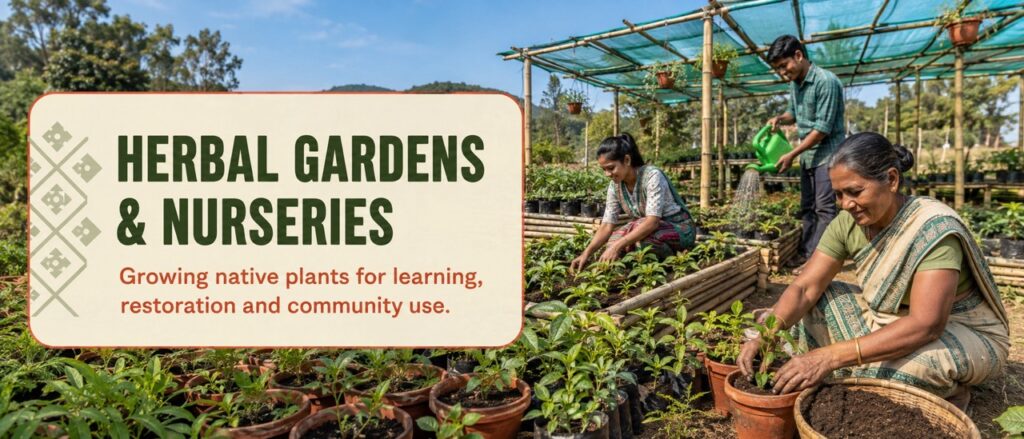
Herbal Gardens & Nurseries of Hodopathy can provide a practical foundation for the conservation, cultivation, documentation, education, and scientific study of native, aromatic, nutritional, and traditionally used plants.
A well-designed herbal garden is more than a collection of plants. It can function as a living research laboratory, conservation site, educational environment, biodiversity resource, seed and planting-material repository, and community learning space.
Similarly, a specialized nursery can support the responsible propagation of authenticated plant species while maintaining information about their origin, growing conditions, genetics, cultivation methods, and conservation status.
Within the broader Hodopathy framework, herbal gardens and nurseries can connect:
🌱 Plant Conservation → 🌿 Cultivation → 🔬 Research → 📚 Education → 🧪 Standardization → 🛡️ Safety → 🌍 Biodiversity → 🤝 Community Collaboration
The central principle should remain:
Grow responsibly, identify accurately, document systematically, conserve biodiversity, research carefully, and never equate traditional plant use with proven medical effectiveness without appropriate evidence.
1. What Are Herbal Gardens & Nurseries?
🌿 Herbal Gardens
A herbal garden is a planned growing environment containing selected plant species for purposes such as:
- Botanical education
- Traditional-knowledge documentation
- Biodiversity conservation
- Plant identification
- Cultivation research
- Nutrition education
- Phytochemical research
- Demonstration and training
- Seed conservation
- Community engagement
🌱 Herbal Nurseries
A herbal nursery focuses primarily on:
- Propagation
- Seedling production
- Plant multiplication
- Plant authentication
- Sustainable cultivation
- Distribution of planting material
- Conservation of threatened species
- Research on propagation techniques
Together, gardens and nurseries can create a practical infrastructure for the broader Hodopathy plant-research ecosystem.
2. Vision of Hodopathy Herbal Gardens
The long-term vision can be to establish a network of scientifically organized living plant collections representing native and traditionally important species.
These gardens could become:
- Living botanical libraries
- Research demonstration sites
- Conservation centres
- Training laboratories
- Community learning spaces
- Student research environments
- Biodiversity monitoring sites
- Seed and germplasm resources
- Plant-identification centres
Instead of simply displaying plants, each specimen can carry a structured information record.
For example:
Plant → Botanical Identity → Local Name → Origin → Habitat → Cultivation → Traditional Use → Research Evidence → Safety Information → Conservation Status
3. Objectives of Herbal Gardens & Nurseries
A comprehensive Hodopathy programme could have the following objectives:
- Conserve native plant diversity.
- Maintain authenticated plant collections.
- Support medicinal-plant research.
- Preserve traditional botanical knowledge.
- Provide practical training.
- Develop sustainable propagation techniques.
- Support student research.
- Establish demonstration gardens.
- Create community plant-learning programmes.
- Maintain seed and planting-material collections.
- Support ecological restoration.
- Study plant growth and environmental adaptation.
- Improve documentation and traceability.
- Encourage responsible use of plant resources.
- Create research infrastructure for future scientific programmes.
4. Types of Hodopathy Herbal Gardens
Different gardens can serve different scientific and educational purposes.
🌿 Native Plant Garden
Focuses on plant species naturally associated with the local region.
Potential objectives include:
- Biodiversity conservation
- Native plant education
- Ecological research
- Pollinator support
- Habitat restoration
- Climate-resilience studies
🌱 Medicinal Plant Demonstration Garden
Contains authenticated species that have documented traditional or research interest.
Each plant should clearly distinguish:
Traditional use ≠ established clinical evidence
The garden can therefore become an evidence-literacy environment rather than a place for unsupported health claims.
🌸 Aromatic & Essential-Oil Plant Garden
Can include plants investigated for aromatic compounds and essential oils.
Research may examine:
- Plant chemistry
- Aroma profiles
- Cultivation conditions
- Essential-oil composition
- Seasonal variation
- Extraction methods
- Safety considerations
🍃 Nutritional & Edible Plant Garden
Focuses on plants used as foods or potentially relevant to food research.
Educational areas can include:
- Traditional food plants
- Leafy greens
- Herbs
- Fruits
- Seeds
- Edible flowers
- Native vegetables
- Culinary plants
🌳 Ethnobotanical Garden
Designed to document relationships between communities and plants.
Possible information includes:
- Local names
- Traditional applications
- Cultural significance
- Food uses
- Preparation practices
- Seasonal availability
- Historical documentation
Community knowledge should be recorded ethically and with appropriate consent and attribution.
5. Specialized Research Gardens
Future Hodopathy research centres could establish controlled garden environments for experimental studies.
Research plots could investigate:
- Soil conditions
- Water availability
- Plant nutrition
- Light exposure
- Temperature
- Seasonal growth
- Propagation methods
- Pest pressure
- Disease management
- Harvest timing
- Plant-part development
- Environmental adaptation
Controlled experimentation can help distinguish observations from scientifically tested conclusions.
6. Plant Authentication System
One of the most important functions of a research-oriented nursery should be plant authentication.
Each plant accession can receive a unique identification record containing:
- Botanical name
- Family
- Genus
- Species
- Local/common names
- Source
- Collection date
- Geographic origin
- Propagation method
- Accession number
- Voucher reference where appropriate
- Photographic documentation
- Identification authority
- Conservation status
Where scientifically justified, advanced methods such as DNA-based authentication can supplement conventional botanical identification.
7. Digital Plant Passport
A future Hodopathy nursery could introduce a Digital Plant Passport for each important plant accession.
A QR code could connect the physical plant to a digital record containing:
Plant Name
↓
Botanical Classification
↓
Origin
↓
Cultivation Information
↓
Traditional Knowledge
↓
Research Publications
↓
Evidence Level
↓
Safety Information
↓
Conservation Status
This system could significantly improve traceability and educational value.
8. Nursery Propagation Programmes
A specialized nursery can investigate different propagation methods.
🌱 Seed Propagation
Research may consider:
- Seed quality
- Germination rate
- Dormancy
- Storage
- Temperature
- Moisture
- Germination conditions
🌿 Vegetative Propagation
Depending on the species:
- Cuttings
- Division
- Layering
- Grafting
- Budding
🧫 Tissue Culture
For appropriate species and research objectives, controlled propagation techniques may be investigated.
The goal should be to develop species-specific propagation protocols rather than assuming that one method works for all plants.
9. Seed Conservation
Seed conservation can be a major component of the nursery system.
A Hodopathy seed programme could maintain:
- Native seeds
- Rare plant seeds
- Traditional varieties
- Locally adapted populations
- Agricultural heritage plants
- Research accessions
Records should include:
- Seed origin
- Collection date
- Species
- Population/source
- Storage conditions
- Viability testing
- Regeneration history
For species whose seeds cannot be stored conventionally, alternative conservation approaches may be necessary.
10. Living Plant Collections
Some plants are better conserved as living specimens rather than only through seeds.
A Living Plant Repository could maintain:
- Mother plants
- Rare native species
- Medicinal plant accessions
- Aromatic plants
- Traditional food plants
- Research populations
- Propagation material
The repository can serve both conservation and research purposes.
11. Herbal Garden Soil Research
Healthy plant growth depends strongly on growing conditions.
Hodopathy garden research can examine:
- Soil structure
- Organic matter
- pH
- Water-holding capacity
- Drainage
- Nutrient availability
- Microbial communities
- Composting
- Mulching
- Sustainable soil management
The garden can become a practical demonstration site for responsible soil stewardship.
12. Water Management
Water-efficient herbal gardens can demonstrate sustainable cultivation.
Possible approaches include:
- Drip irrigation
- Rainwater harvesting
- Mulching
- Soil-moisture monitoring
- Appropriate irrigation scheduling
- Drought-tolerant native plants
- Water-recycling systems where appropriate
Digital sensors could provide data for research on plant-water relationships.
13. Organic and Ecological Cultivation Research
Hodopathy nurseries can investigate low-impact cultivation practices.
Potential research areas include:
- Compost systems
- Organic amendments
- Biological pest-management approaches
- Mulching
- Crop diversity
- Companion planting
- Soil biodiversity
- Pollinator-friendly cultivation
Claims about improved plant chemistry or health benefits should be experimentally tested rather than assumed.
14. Biodiversity-Friendly Herbal Gardens
A modern herbal garden should support more than cultivated plants.
It can also provide habitat for:
- Bees
- Butterflies
- Birds
- Beneficial insects
- Soil organisms
- Native pollinators
Garden design can incorporate:
- Native flowering plants
- Habitat corridors
- Water sources
- Nesting areas
- Diverse vegetation
- Reduced unnecessary pesticide use
This connects medicinal-plant research with broader ecological conservation.
15. Traditional Knowledge Garden
A dedicated Traditional Knowledge Garden can preserve plant-related cultural information.
Each section could document:
- Local plant names
- Historical uses
- Food traditions
- Cultural practices
- Seasonal harvesting
- Traditional cultivation
- Community stories where appropriate
However, documentation should not convert cultural knowledge into unsupported medical claims.
The garden should clearly identify whether information represents:
Traditional Knowledge → Historical Documentation → Research Hypothesis → Scientific Evidence
16. Research Demonstration Plots
Hodopathy training institutions could create small research plots for students and researchers.
Example projects:
Project A
Compare germination rates under different conditions.
Project B
Study growth response to different soil-management methods.
Project C
Monitor seasonal changes in selected native plants.
Project D
Compare propagation techniques.
Project E
Study biodiversity associated with native plant gardens.
Project F
Document pollinator activity.
Project G
Investigate post-harvest quality under different storage conditions.
Such projects teach students how to move from observation → hypothesis → experiment → data → analysis → conclusion.
17. Herbal Gardens as Living Laboratories
A mature Hodopathy herbal garden could function as an open-air laboratory.
Researchers could collect structured data on:
- Growth
- Flowering
- Fruiting
- Germination
- Biomass
- Environmental conditions
- Soil properties
- Pest occurrence
- Disease incidence
- Water requirements
- Seasonal variation
Digital sensors can support continuous monitoring.
This transforms the garden from a decorative landscape into a research and education infrastructure.
18. Plant Growth Monitoring
Digital monitoring systems could track:
- Temperature
- Humidity
- Soil moisture
- Light intensity
- Rainfall
- Plant height
- Leaf development
- Flowering
- Fruiting
Time-series data could help researchers identify relationships between environmental conditions and plant development.
19. AI and Smart Herbal Nurseries
Artificial intelligence can support future nursery management.
Potential applications include:
- Plant-image identification
- Growth monitoring
- Disease-screening assistance
- Irrigation prediction
- Environmental data analysis
- Literature organization
- Plant database management
- Research-gap discovery
- Biodiversity mapping
AI-generated plant identification should be treated as an aid rather than final botanical confirmation.
Human expertise and appropriate laboratory or taxonomic verification remain essential.
20. Herbal Garden Safety
A public or educational herbal garden should have clear safety policies.
These can address:
- Toxic plants
- Allergic reactions
- Child safety
- Plant identification
- Restricted access
- Safe handling
- Harvesting rules
- Signage
- Educational warnings
Plants should not be harvested or consumed merely because they are displayed in a “medicinal” garden.
Clear labels can distinguish between:
Educational Information and Medical Advice.
21. Quality Control in Herbal Nurseries
Quality management can cover the entire plant lifecycle:
Seed → Propagation → Nursery → Garden → Harvest → Processing → Storage → Research
Important quality-control areas include:
- Correct species
- Healthy planting material
- Contamination control
- Traceability
- Proper labeling
- Pest and disease monitoring
- Storage conditions
- Batch records
- Environmental records
This supports reproducible research and responsible plant-resource management.
22. Sustainable Harvesting
Wild collection can threaten plant populations when poorly managed.
Hodopathy programmes should prioritize:
- Cultivation over unnecessary wild collection
- Sustainable harvesting
- Regeneration
- Population monitoring
- Protected species awareness
- Traceability
- Seasonal harvesting guidelines
- Community participation
Conservation should always be considered alongside research and utilization.
23. Community Herbal Gardens
Community gardens can connect scientific education with local knowledge.
Potential activities include:
- Native plant awareness
- School gardening
- Botanical identification workshops
- Seed exchanges
- Biodiversity surveys
- Traditional-knowledge documentation
- Sustainable cultivation training
- Citizen science
Community members can contribute observations while trained researchers provide appropriate scientific documentation and validation.
24. Student Herbal Garden Programme
The previously established Student Portal and Training framework can be integrated directly with herbal gardens.
Students could complete practical modules in:
- Plant identification
- Nursery management
- Propagation
- Soil science
- Biodiversity
- Ethnobotany
- Research design
- Data collection
- Statistics
- Scientific writing
Students could maintain digital research journals documenting their observations and results.
25. Faculty and Researcher Involvement
Faculty members can supervise:
- Garden research
- Propagation trials
- Biodiversity surveys
- Ethnobotanical documentation
- Plant identification
- Soil studies
- Environmental monitoring
- Student projects
- Research publications
Interdisciplinary supervision can bring together botany, agriculture, environmental science, chemistry, nutrition, data science, and research methodology.
26. Publications from Herbal Garden Research
Herbal gardens can generate scientifically useful research outputs.
Potential publications include:
- Native Plant Inventories
- Botanical Identification Guides
- Propagation Protocols
- Biodiversity Reports
- Ethnobotanical Reports
- Cultivation Research
- Soil and Environmental Studies
- Seed Conservation Reports
- Plant Growth Studies
- Safety Reports
- Research Data Reports
- Evidence Reviews
Both successful and unsuccessful experiments should be documented where appropriate.
27. Research Collaboration Network
Hodopathy herbal gardens can collaborate with:
- Botanical institutions
- Universities
- Agricultural research centres
- Environmental organizations
- Conservation groups
- Laboratories
- Community organizations
- Seed banks
- Nurseries
- Researchers
- Data-science teams
Collaboration can strengthen authentication, research quality, conservation, and independent validation.
28. Herbal Garden Knowledge Database
A centralized database could maintain information for every plant.
| Field | Example Information |
|---|---|
| Plant ID | Unique accession number |
| Botanical Name | Verified scientific name |
| Local Name | Regional/common name |
| Origin | Geographic source |
| Habitat | Natural/ecological setting |
| Propagation | Seed/cutting/etc. |
| Garden Location | Plot or section |
| Conservation Status | Appropriate classification |
| Traditional Knowledge | Documented information |
| Research | Available studies |
| Safety | Available safety information |
| Evidence | Evidence classification |
| Images | Plant documentation |
| Research Projects | Associated studies |
This database could eventually connect with the broader Hodopathy Knowledge Graph.
29. Herbal Garden Evidence Lab
A future specialized facility could connect living plant collections with evidence evaluation.
Its workflow could be:
Plant Collection
↓
Authentication
↓
Documentation
↓
Chemical/Scientific Investigation
↓
Safety Assessment
↓
Research Evidence
↓
Independent Validation
↓
Evidence Classification
This prevents the garden itself from becoming a source of unverified therapeutic claims.
30. Conservation Nurseries for Threatened Plants
Specialized nurseries can help preserve plants facing ecological pressure.
Programmes could include:
- Threatened native plants
- Rare species
- Endemic species
- Traditional crop varieties
- Habitat-restoration species
- Seed conservation
- Living collections
- Controlled propagation
Where appropriate, nursery-grown plants could support restoration programmes in partnership with qualified conservation organizations and authorities.
31. Herbal Garden Architecture
A large Hodopathy campus could be organized into functional zones:
Zone 1 — Native Plant Garden
Local biodiversity.
Zone 2 — Medicinal Plant Collection
Authenticated traditionally used species.
Zone 3 — Aromatic Plant Garden
Aromatic and essential-oil research.
Zone 4 — Nutrition Garden
Edible and food-related plants.
Zone 5 — Ethnobotanical Garden
Community and cultural knowledge.
Zone 6 — Research Plots
Controlled experiments.
Zone 7 — Nursery
Propagation and planting material.
Zone 8 — Seed Conservation Area
Seed storage and regeneration.
Zone 9 — Biodiversity Zone
Pollinators and native ecosystems.
Zone 10 — Digital Research Centre
Data, AI, documentation, and evidence management.
32. Herbal Garden Visitor Education
Visitors can learn through:
- Botanical labels
- QR codes
- Interactive displays
- Digital plant profiles
- Guided tours
- Demonstration plots
- Educational workshops
- Research displays
- Biodiversity information
Educational signage should use careful language.
For example:
“Traditionally used for…”
is scientifically different from:
“Proven to treat…”
The distinction is essential for responsible communication.
33. Herbal Garden Research Calendar
The previously developed Training Calendar of Hodopathy can be connected with seasonal plant activities.
January–March
- Nursery preparation
- Seed testing
- Propagation research
- Soil assessment
April–June
- Plant establishment
- Water-management research
- Growth monitoring
- Biodiversity observations
July–September
- Monsoon plant studies
- Disease monitoring
- Ecological research
- Native plant restoration
October–December
- Harvest documentation
- Seed collection
- Data analysis
- Research reports
- Annual biodiversity assessment
Actual timing should be adapted to local climate and species biology.
34. Herbal Garden Certification Framework
A future quality framework could evaluate gardens and nurseries on:
- Botanical accuracy
- Plant labeling
- Documentation
- Biodiversity
- Conservation practices
- Nursery quality
- Safety
- Environmental management
- Research infrastructure
- Data management
- Ethical knowledge documentation
- Staff competency
Possible recognition levels could include:
Foundation Garden → Research Garden → Advanced Conservation Garden → Certified Research & Conservation Centre
Any certification should be based on transparent, published criteria rather than branding alone.
35. Five-Year Development Roadmap
Year 1 — Establish
- Identify priority species
- Create garden design
- Establish nursery infrastructure
- Develop plant records
- Begin botanical authentication
Year 2 — Document
- Build digital database
- Document traditional knowledge
- Develop propagation protocols
- Begin biodiversity monitoring
Year 3 — Research
- Establish experimental plots
- Conduct cultivation studies
- Expand plant safety and quality research
- Launch student research projects
Year 4 — Validate
- Collaborate with external researchers
- Replicate important findings
- Publish research
- Develop evidence maps
- Expand conservation programmes
Year 5 — Integrate
Create a connected network linking:
🌱 Gardens + 🌿 Nurseries + 🧪 Laboratories + 📚 Libraries + 🎓 Training + 📊 Data + 🔬 Research + 🌍 Conservation
36. Future Hodopathy Herbal Garden Network
The long-term goal could be a distributed network rather than a single garden.
A national or international network could include:
- Regional native-plant gardens
- Medicinal-plant research gardens
- Community gardens
- Student gardens
- Conservation nurseries
- Seed repositories
- Research centres
- Botanical databases
- Digital knowledge platforms
Each centre could specialize according to local biodiversity and research priorities.
37. Advanced Future Projects
Potential future projects include:
🌱 Global Native Plant Atlas
A digital map of documented native plant species.
🌿 Medicinal Plant Evidence Database
Connect plants with research evidence and safety information.
🧬 Plant Authentication Network
Develop standardized identification resources.
🌾 Climate-Resilient Herbal Nursery
Study native plants under changing environmental conditions.
🐝 Pollinator Herbal Garden
Investigate relationships between plants and pollinators.
💧 Smart Water Herbal Garden
Use sensors and data analytics to study water requirements.
🤖 AI Plant Research Platform
Support identification, monitoring, literature organization, and data analysis.
📚 Traditional Knowledge Archive
Preserve ethically documented plant knowledge.
🔬 Living Research Laboratory
Connect garden experiments with laboratory research.
38. Measuring Success
The success of a Hodopathy herbal-garden programme should not be measured only by the number of plants grown.
Better indicators could include:
- Number of authenticated species
- Native species conserved
- Threatened species successfully propagated
- Seed accessions preserved
- Research projects completed
- Student projects conducted
- Publications produced
- Independent collaborations established
- Biodiversity indicators
- Propagation success rates
- Data quality
- Safety records
- Community participation
- Conservation outcomes
This creates measurable and accountable development.
39. Core Principles for Herbal Gardens & Nurseries
Hodopathy Herbal Gardens & Nurseries should follow a clear set of principles:
- 🌿 Conserve native biodiversity
- 🔬 Authenticate plants scientifically
- 📚 Document traditional knowledge respectfully
- 🌱 Promote sustainable cultivation
- 🛡️ Prioritize safety
- 🧪 Support appropriate scientific research
- 📊 Maintain reliable data
- 🔁 Encourage reproducibility
- 🤝 Respect community knowledge and rights
- 🌍 Protect ecosystems
- 🤖 Use AI responsibly
- 🎓 Support practical education
- 📖 Publish findings transparently
- ⚖️ Separate traditional claims from scientific evidence
- 🔄 Continuously update knowledge
Conclusion
Herbal Gardens & Nurseries of Hodopathy can become an important practical infrastructure connecting native biodiversity, medicinal-plant documentation, conservation, sustainable cultivation, education, research, safety, technology, and community knowledge.
The most advanced model is not simply a garden containing medicinal plants. It is a living, documented, measurable, research-oriented ecosystem in which every important plant can have a traceable identity, cultivation history, conservation record, research profile, safety information, and evidence status.
The complete development pathway can be represented as:
Discover → Identify → Propagate → Conserve → Cultivate → Document → Research → Evaluate → Validate → Educate → Collaborate → Publish → Preserve
In this model, herbal gardens become living classrooms, nurseries become conservation and propagation centres, research plots become experimental environments, databases become knowledge infrastructure, and conservation programmes protect the biological resources required for future research.
The ultimate vision is to build a future-ready Hodopathy Herbal Garden & Nursery Network where biodiversity is protected, traditional knowledge is respected, scientific questions are investigated rigorously, evidence is communicated honestly, and plant resources are managed sustainably for future generations.