
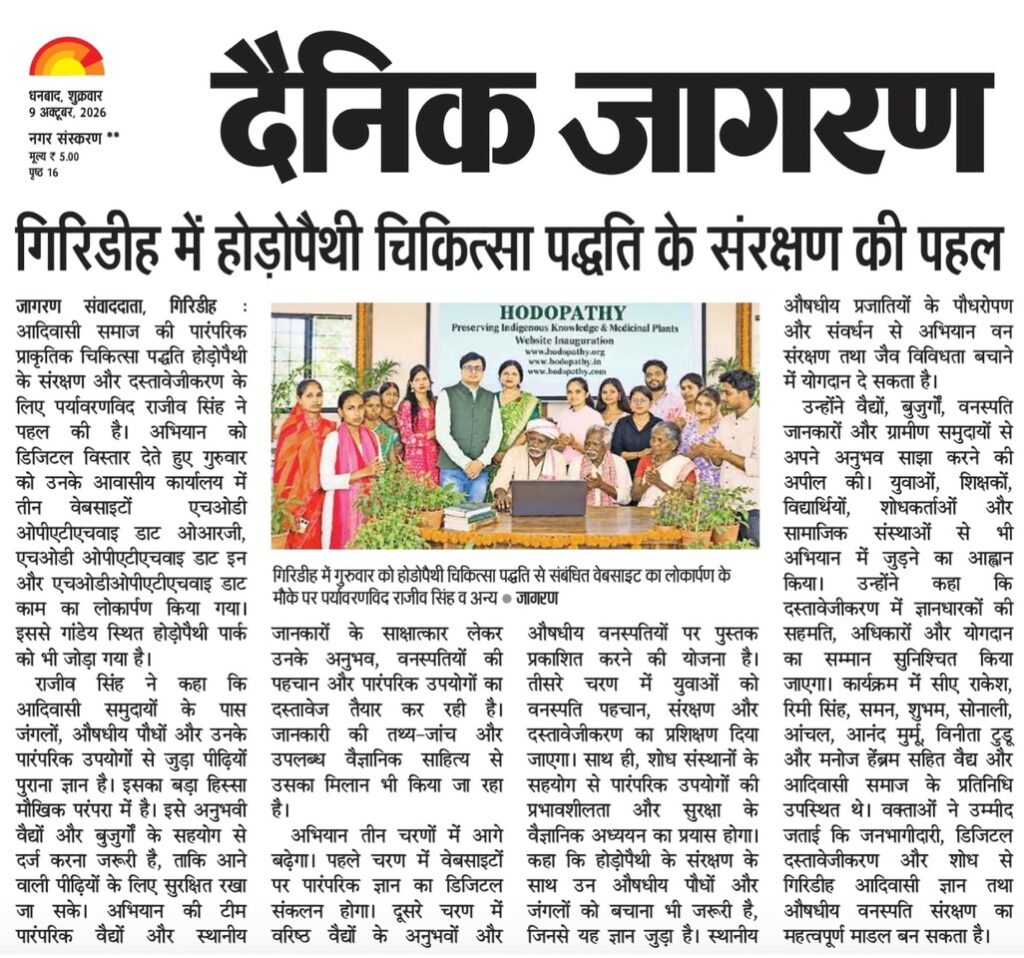
Three dedicated websites launched in Giridih to preserve centuries-old Adivasi healing traditions, document indigenous knowledge, conserve medicinal plants and protect forest biodiversity.
Dainik Jagran | Dhanbad Edition | 9 October 2026
Giridih, Jharkhand: Environmentalist, agripreneur and sustainability advocate Rajeev Singh’s initiative to preserve Hodopathy, a traditional indigenous healing system associated with Jharkhand’s Adivasi communities, has been featured in Dainik Jagran, one of India’s leading Hindi newspapers.
Published in its Dhanbad edition on 9 October 2026, under the headline “गिरिडीह में होड़ोपैथी चिकित्सा पद्धति के संरक्षण की पहल” (Initiative to Preserve the Traditional Hodopathy Healing System in Giridih), the report highlighted efforts to safeguard centuries-old indigenous knowledge, document traditional medicinal plant practices and promote forest and biodiversity conservation.
The newspaper covered the inauguration of three dedicated digital platforms — Hodopathy.org, Hodopathy.in and Hodopathy.com — at Rajeev Singh’s residential office in Giridih. These websites aim to preserve the experiences and traditional knowledge of Adivasi elders, experienced healers and local plant experts, ensuring that this valuable heritage is documented and passed on to future generations.
The initiative is also connected with Hodopathy Park in Gandey, Giridih, linking indigenous knowledge preservation with medicinal plant conservation and environmental awareness.
Preserving Centuries-Old Indigenous Knowledge
For generations, Jharkhand’s Adivasi communities have maintained extensive knowledge of forests, medicinal plants and their traditional applications. Much of this knowledge has been transmitted orally, making systematic documentation increasingly important for its long-term preservation.
Rajeev Singh and his team are working with traditional healers, community elders and local plant experts to record their experiences, identify medicinal plant species and document customary practices. The collected information is being reviewed and compared with available scientific literature to support responsible documentation.
According to Dainik Jagran, the initiative will progress through three phases. The first focuses on developing a digital repository of traditional knowledge. The second involves preparing a publication documenting the experiences of senior healers and the traditional uses of medicinal plants. The third phase will focus on training young people in medicinal plant identification, conservation and documentation.
The programme also proposes collaboration with research institutions to scientifically investigate the safety and effectiveness of selected traditional medicinal practices.
Protecting Medicinal Plants and Forest Biodiversity
Rajeev Singh emphasised that preserving Hodopathy requires protecting the medicinal plants and forests closely associated with this traditional knowledge.
The initiative seeks to encourage the identification, cultivation and conservation of indigenous medicinal plant species while strengthening community participation in biodiversity protection.
Traditional healers, Adivasi elders, forest experts, teachers, students, researchers and social organisations have been invited to participate. Respect for the consent, rights and contributions of traditional knowledge holders remains central to the documentation process.
Community Participation and a Shared Conservation Vision
The website inauguration programme brought together traditional healers, representatives of Adivasi communities and members of the organising team.
Among those present were CA Rakesh, Rimi Singh, Saman, Shubham, Sonali, Anchal Singh, Anand Murmu, Vinita Tudu and Manoj Hembrom, along with other community representatives.
Guided by four priorities — Preserve Knowledge, Protect Plants, Advance Research and Share Learning — the initiative aims to connect indigenous wisdom with digital documentation, scientific research and environmental conservation.
The coverage in Dainik Jagran has helped bring wider public attention to the importance of preserving Jharkhand’s traditional knowledge and the natural ecosystems that sustain it.
Rajeev Singh expressed his appreciation to Dainik Jagran for highlighting the initiative and contributing to public awareness about the conservation of indigenous heritage, medicinal plants and forests.
The initiative reflects his broader commitment to environmental sustainability, biodiversity protection and community-led conservation, with the long-term objective of safeguarding India’s cultural and ecological heritage for future generations.