
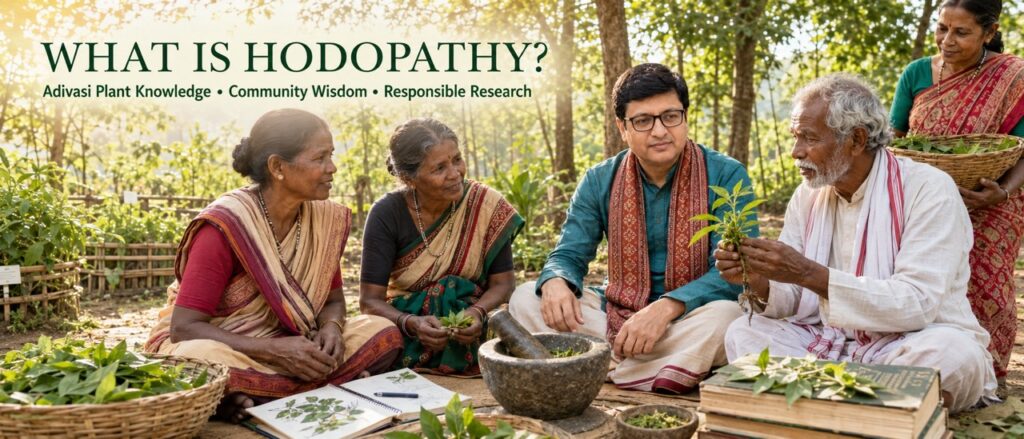
What Is Hodopathy?
Understanding Jharkhand’s Community-Rooted Indigenous Knowledge Tradition
Hodopathy is an indigenous knowledge tradition associated particularly with the Ho community and other Adivasi communities of Jharkhand. It represents generations of practical understanding developed through close observation of forests, medicinal plants, seasonal foods, natural resources and community life.
The term “Hodopathy” is commonly used to describe the nature-based knowledge and traditional practices preserved by Ho knowledge holders and practitioners. Unlike medical systems based primarily on written textbooks, much of Hodopathy has traditionally been preserved through oral teaching, observation, experience and practical demonstration.
Its knowledge has passed from elders and experienced practitioners to succeeding generations, often within families or through long periods of learning under a recognised traditional knowledge holder.
Hodopathy is not merely the use of herbs. It is a wider knowledge system connecting people, plants, forests, culture, food, lifestyle and community well-being.
A Community-Rooted Knowledge System
Hodopathy developed within communities that have lived in close relationship with forests and natural ecosystems for generations. Daily interaction with local plants, animals, seasons, soil, water and changing environmental conditions contributed to a detailed understanding of the surrounding landscape.
Community knowledge may include information about:
- Local and native plant species
- Traditional names of plants
- Parts of plants used in community practices
- Seasons in which plants are collected
- Methods of collection and preparation
- Traditional foods and local nutrition
- Relationships between lifestyle and well-being
- Responsible use of forest resources
- Protection of useful plants and natural habitats
- Cultural beliefs associated with nature
This knowledge is shaped by the local environment. A plant found in one region may have a different name, use or method of preparation in another community. For this reason, Hodopathy cannot be separated from its geographical, cultural and ecological context.
The Knowledge of Plants and Forests
Forests are central to Hodopathy. They are not viewed simply as places from which ingredients can be collected. For many Adivasi communities, forests are connected with livelihood, food, spirituality, ancestry, cultural identity and collective memory.
Traditional knowledge holders may recognise plants by their leaves, flowers, fruits, bark, roots, aroma, habitat or season of growth. They may also understand when a plant should be collected, which part should be used and how harvesting can be carried out without unnecessarily damaging the plant.
This understanding is based on accumulated community observation. It is often highly localised and may not be available in botanical books or digital databases.
Hodopathy therefore includes both knowledge of useful plants and knowledge of the ecosystems in which those plants grow.
How Hodopathy Knowledge Is Transmitted
Hodopathy has mainly survived as an oral and experiential tradition.
Knowledge may be transmitted through:
- Stories shared by elders
- Observation of experienced practitioners
- Identification of plants in forests
- Participation in collection and preparation
- Repeated practical experience
- Family and community traditions
- Local language and plant terminology
- Cultural ceremonies and customary practices
A learner may spend years observing an experienced practitioner before independently applying the knowledge. The learning process can include much more than remembering the name of a plant. It may involve understanding the plant’s habitat, season, condition, method of collection, preparation and cultural significance.
Some knowledge may be shared widely within a community, while other knowledge may remain restricted to particular families, practitioners or customary custodians.
Who Are Hodopathy Practitioners?
Hodopathy practitioners are traditional knowledge holders who possess community-based knowledge of native plants, forest resources and customary practices.
Their roles may extend beyond preparing plant-based remedies. Within their communities, they may also serve as advisers, elders, counsellors, plant identifiers and custodians of oral traditions.
Practitioners do not necessarily follow one uniform method. Their knowledge may differ according to village, family tradition, landscape, language and personal experience. Because Hodopathy has largely developed outside formal institutions, it does not currently have a single standard textbook, central curriculum or universally accepted method of practice.
This diversity is an important characteristic of living traditional knowledge. It is also one reason careful documentation and scientific study are necessary.
Traditional practitioners should be recognised respectfully, but traditional experience should not automatically be represented as scientifically proven medical evidence. Cultural recognition and scientific validation are related but distinct processes.

The Main Elements of Hodopathy
Hodopathy can be understood through several interconnected elements.
Traditional Plant Knowledge
This includes local knowledge of plants, roots, leaves, bark, flowers, fruits, seeds and other natural materials.
Community Experience
Knowledge has developed through generations of observation, practice and shared community experience.
Food and Nutrition
Traditional foods, seasonal diets and locally available ingredients may form an important part of community approaches to well-being.
Lifestyle and Environment
Daily routines, physical activity, seasonal adaptation and a close relationship with nature are part of the wider context in which Hodopathy developed.
Sustainable Use of Resources
Traditional collection practices may include taking only the required quantity, selecting appropriate plant parts and avoiding unnecessary harm to the surrounding ecosystem.
Cultural and Oral Heritage
Language, stories, beliefs, customs and community identity are inseparable from the knowledge itself.
Together, these elements make Hodopathy broader than a list of herbal ingredients.
Is Hodopathy the Same as Ayurveda?
Hodopathy and Ayurveda both involve knowledge of plants and natural materials, but they should not be treated as identical.
Ayurveda is a formally recognised Indian system of medicine with classical texts, established principles, educational institutions, professional qualifications and regulatory structures.
Hodopathy is a community-rooted indigenous tradition associated particularly with the Ho and other Adivasi communities of Jharkhand. Much of its knowledge remains oral, localised and transmitted through practitioners rather than formal educational institutions.
Some plants or preparation methods may overlap with Ayurveda or other traditional practices. However, similar use of a plant does not mean that the knowledge systems are the same.
Hodopathy should be studied and documented in its own cultural context while also allowing responsible comparison with Ayurveda, ethnobotany, pharmacognosy and other relevant fields.
Is Hodopathy a Recognised Medical System?
Hodopathy represents valuable traditional and ethnobotanical knowledge, but it is not currently a formally recognised medical system with standardised education, licensing and regulation comparable to established healthcare systems.
Research may identify biological activity or potential scientific value in plants used traditionally. However, evidence concerning a plant does not automatically validate every traditional preparation, quantity, combination or claimed application.
Before any preparation can be responsibly presented for medical use, important questions must be examined, including:
- Correct botanical identity
- Purity and possible contamination
- Safe quantity and method of preparation
- Toxicity and potential adverse effects
- Interaction with medicines
- Suitability for different individuals
- Consistency of ingredients
- Scientific evidence for the intended use
- Compliance with applicable regulations
Responsible research is therefore essential.
What Hodopathy Is Not
Hodopathy should not be misunderstood or misrepresented.
It is not:
- The invention or property of a single person
- Merely a commercial herbal-product category
- A collection of unverified internet remedies
- A substitute for qualified medical diagnosis
- Proof that every natural substance is safe
- A licence to collect plants irresponsibly from forests
- Knowledge that may be taken from communities without consent
- A basis for exaggerated or unsupported health claims
Hodopathy is a collective living heritage. Its value lies in the knowledge, experience, culture and ecological understanding preserved by communities over generations.
Hodopathy in the Modern Context
Today, Hodopathy stands at an important point. Its knowledge may contribute to ethnobotanical research, biodiversity conservation, plant identification, community nutrition studies and the documentation of indigenous heritage.
Modern methods can help record and examine this knowledge through:
- Interviews and oral-history documentation
- Photographic and geographical records
- Botanical identification
- Herbarium preparation
- Scientific literature review
- Laboratory analysis
- Safety and toxicity studies
- Conservation assessment
- Community-led digital archives
The purpose of such work should not be to remove knowledge from its original communities. It should help preserve the knowledge accurately, acknowledge its custodians and create opportunities for ethical collaboration.
Traditional knowledge and modern science can inform one another, but neither should be misrepresented. Tradition can guide researchers toward important questions, while science can examine identity, composition, safety and evidence.
Why Hodopathy Matters
Hodopathy matters because it carries more than information about plants. It preserves a distinctive way of understanding the relationship between human beings and nature.
It represents:
- The cultural memory of Adivasi communities
- Generations of observation and practical experience
- Knowledge of Jharkhand’s native plants and forests
- Local languages and botanical terminology
- Community approaches to food and well-being
- Lessons in sustainable use of natural resources
- Potential directions for responsible scientific research
If this knowledge disappears, society loses not only possible information about useful plants but also an important part of India’s indigenous cultural and ecological heritage.
A Responsible Understanding of Hodopathy
Hodopathy should be approached with curiosity, respect and responsibility.
It deserves documentation, but not exploitation. It deserves scientific study, but not exaggerated claims. It deserves public recognition, but its original community custodians must remain visible and respected.
Information about traditional plant use is provided for cultural preservation, education and research awareness. It should not be interpreted as medical advice or used for self-medication. Anyone experiencing a health concern should consult an appropriately qualified healthcare professional.
Hodopathy is a living bridge among Adivasi knowledge, Jharkhand’s forests, community heritage and responsible scientific inquiry.