
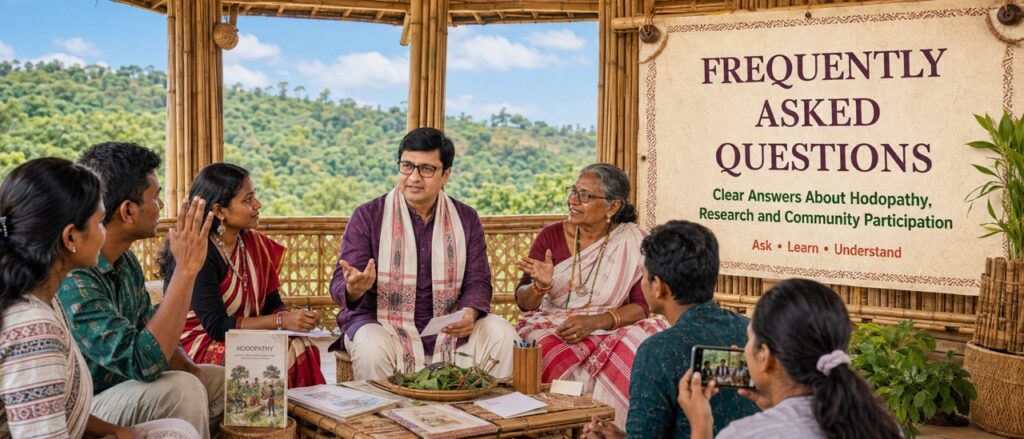
Frequently Asked Questions
Common Questions About Hodopathy, Its Heritage, Documentation and Research
The following answers explain the meaning, community roots, present scope and responsible approach of Hodopathy. They also clarify the distinction between traditional knowledge and scientifically established medical evidence.
1. What is Hodopathy?
Hodopathy is an indigenous knowledge tradition associated particularly with the Ho community and other Adivasi communities of Jharkhand. It includes generations of knowledge concerning native plants, forests, traditional foods, natural resources, seasonal practices and community well-being.
It is a broader cultural and ecological knowledge system—not simply a collection of herbal preparations.
2. Where did Hodopathy originate?
Hodopathy developed within the forest landscapes and Adivasi communities of Jharkhand, particularly among the Ho people of West Singhbhum and neighbouring regions.
Its exact beginning cannot be established through a single historical date or document because the knowledge was mainly preserved through oral teaching, community experience and practical demonstration.
3. Who founded Hodopathy?
Hodopathy was not founded by a single person, company or modern institution. It represents collective knowledge developed and preserved by Adivasi communities across generations.
Individuals and organisations may support its documentation, preservation and research, but they should not claim ownership over its community heritage.
4. Does Hodopathy belong only to the Ho community?
The term Hodopathy is associated particularly with the traditional knowledge of the Ho community. Other Adivasi communities of Jharkhand also possess valuable knowledge of forests, plants, food and community practices.
However, the traditions of different communities should not automatically be placed under one name. Each community’s identity, terminology and distinct heritage must be respected.
5. What does Hodopathy include?
Hodopathy may include knowledge related to:
- Native and traditionally important plants
- Roots, bark, leaves, flowers, fruits and seeds
- Seasonal foods and local nutrition
- Plant habitats and collection seasons
- Traditional preparation practices
- Sustainable use of forest resources
- Community customs and oral traditions
- Relationships among people, forests and well-being
The exact knowledge may differ among practitioners, families, villages and regions.
6. How has Hodopathy knowledge been preserved?
Hodopathy has mainly been preserved through oral and practical transmission.
Elders and traditional practitioners may teach learners through stories, forest visits, plant identification, observation and participation in collection or preparation. Some learners spend years acquiring knowledge under experienced practitioners.
Because much of this tradition remains unwritten, careful documentation is important for its continuity.
7. Who is a Hodopathy practitioner?
A Hodopathy practitioner is a traditional knowledge holder who possesses community-based understanding of native plants, forest resources and customary practices.
A practitioner may also serve as a community adviser, elder, counsellor or custodian of oral traditions. Knowledge and methods can differ among individual practitioners and regions because Hodopathy does not currently follow one uniform textbook or standard curriculum.
8. Is Hodopathy the same as Ayurveda?
No. Hodopathy and Ayurveda may share an interest in plants and natural materials, but they are distinct knowledge traditions.
Ayurveda has classical texts, formal educational institutions, recognised qualifications and an established regulatory structure. Hodopathy is a localised and primarily oral tradition associated particularly with the Ho and other Adivasi communities of Jharkhand.
Some plants may be known in both systems, but overlapping plant use does not make the systems identical.
9. Is Hodopathy formally recognised under AYUSH?
At the time of publication, Hodopathy is not listed as a separate formally regulated AYUSH medical system. Official AYUSH sources identify Ayurveda, Yoga and Naturopathy, Unani, Siddha, Sowa-Rigpa and Homoeopathy, while the National Commission for Indian System of Medicine Act defines its regulated Indian systems accordingly. Ministry of Ayush and India Code.
Hodopathy should therefore be presented as an indigenous knowledge and ethnobotanical tradition unless its official legal or regulatory position changes.
10. Is Hodopathy scientifically proven?
Hodopathy as a complete knowledge system has not been scientifically validated as a standardised medical system.
Some plants traditionally known to communities may have been studied individually. However, evidence concerning one plant does not automatically establish the safety or effectiveness of every traditional preparation, quantity, combination or claimed application.
Traditional knowledge can provide valuable directions for research, but scientific conclusions require appropriate botanical, laboratory, safety and clinical evaluation.
11. Are all natural plants safe to use?
No. Natural substances are not automatically safe.
A plant may cause harm if it is:
- Incorrectly identified
- Collected from a contaminated location
- Prepared improperly
- Used in an unsuitable quantity
- Combined with another substance or medicine
- Used by a person with a particular health condition
- Consumed during pregnancy or childhood without appropriate advice
People should not consume unidentified plants or use online information for self-medication.
12. Does Hodopathy.com provide medical treatment?
Hodopathy.com is primarily a platform for cultural preservation, documentation, education, conservation and research awareness.
Information published on the website is not medical advice and should not be used to diagnose, prevent or treat a health condition. Anyone experiencing a medical concern should consult an appropriately qualified healthcare professional.
13. Can Hodopathy replace modern medicine?
No. Hodopathy should not be used as a substitute for medical diagnosis, emergency care or treatment prescribed by a qualified healthcare professional.
Traditional knowledge may offer valuable subjects for scientific research, but unverified practices should not replace evidence-based healthcare.
14. Why is Hodopathy being documented?
Much of Hodopathy knowledge remains in oral form. When an experienced practitioner passes away without transferring that knowledge, generations of local observation may be lost.
Documentation can help preserve:
- Oral histories
- Local plant names
- Indigenous terminology
- Practitioner experiences
- Traditional ecological knowledge
- Cultural stories
- Forest and habitat information
- Permitted preparation practices
The purpose is to preserve living heritage while maintaining its community context.
15. Will every traditional preparation be published online?
No. Not all knowledge is suitable for public disclosure.
Some knowledge may be sacred, confidential, restricted to a family or connected with vulnerable plant species. Publishing detailed information could also encourage unsafe self-medication or uncontrolled harvesting.
Such knowledge may be kept in a restricted archive or may remain entirely within the community according to the wishes of its recognised custodians.
16. How is permission obtained from knowledge holders?
Before documenting information, the purpose of the activity should be explained clearly to the knowledge holder.
This includes explaining:
- What information will be recorded
- Whether photographs or videos will be taken
- How the material may be stored
- Whether it may be published
- Who may be able to access it
- Whether researchers or institutions may be involved
Participation should be voluntary, and contributors should be able to restrict information they do not wish to share.
17. How are traditional knowledge holders acknowledged?
Where permission is provided, documentation should identify and acknowledge the practitioner, elder, family, village or community contributing the knowledge.
When a contributor requests privacy, their identity should be protected. Recognition should always follow the preference and cultural context of the knowledge holder.
18. Can traditional community knowledge be commercially used?
Traditional knowledge should not be converted into private commercial value without proper authorisation, legal compliance, community participation and consideration of fair benefit sharing.
Any future research or development based on community knowledge must respect applicable biodiversity, intellectual-property, sourcing and benefit-sharing requirements.
Commercial interest must not override community rights, public safety or environmental protection.
19. How does Hodopathy support scientific research?
Hodopathy can help create a responsible bridge among knowledge holders, botanists, researchers, universities and scientific institutions.
Research may include:
- Ethnobotanical field studies
- Botanical identification
- Herbarium documentation
- Scientific literature review
- Laboratory analysis
- Safety and toxicity assessment
- Nutritional studies
- Conservation research
- Sustainable cultivation studies
All findings should be communicated accurately, including their limitations.
20. How is Hodopathy connected with forest conservation?
Hodopathy developed through close interaction with forests and native plants. If these ecosystems disappear, the associated knowledge may also disappear.
Hodopathy encourages:
- Protection of native plants
- Sustainable and seasonal harvesting
- Cultivation of suitable plant species
- Community herbal gardens
- Biodiversity documentation
- Conservation of soil and water
- Protection of vulnerable habitats
- Community participation in conservation
Preserving Hodopathy requires preserving its natural environment.
21. Why are the exact locations of some plants not disclosed?
Publishing the precise location of a rare, threatened or commercially valuable plant may result in uncontrolled collection, illegal trade or habitat damage.
Sensitive location information may therefore be restricted to protect the plant, its ecosystem and the community knowledge associated with it.
22. Can researchers and universities collaborate with Hodopathy?
Yes. Hodopathy welcomes responsible collaboration with universities, research institutions, botanists, ethnobotanists, laboratories, conservation organisations and social-science researchers.
Proposed collaboration should explain its purpose, methodology, intended use of information and expected community participation. Research should follow applicable ethical, scientific and institutional requirements.
23. Can traditional practitioners contribute their knowledge?
Yes. Traditional practitioners and community elders are central to the preservation of Hodopathy.
Practitioners may contribute through:
- Oral-history interviews
- Plant-identification activities
- Community documentation
- Conservation initiatives
- Practitioner meetings
- Educational programmes
- Research collaboration
No practitioner is required to share sacred, confidential or restricted knowledge.
24. Can students and young people participate?
Yes. Students and young people can contribute to responsible activities such as:
- Oral-history documentation
- Indigenous-language preservation
- Botanical photography
- Biodiversity mapping
- Community herbal gardens
- Digital archiving
- Forest-conservation awareness
- Literature review and academic research
Participation should be properly supervised and carried out with community permission.
25. Does Hodopathy.com sell herbal medicines?
The primary purpose of Hodopathy.com is to preserve knowledge, support documentation, promote conservation and encourage responsible research.
Any future product or formulation connected with natural ingredients would require separate evaluation for botanical identity, safety, quality, evidence, processing and regulatory compliance. Traditional heritage alone should never be used as proof that a product is safe or effective.
26. How can I support Hodopathy?
You can support Hodopathy by:
- Sharing verified historical or community information
- Connecting experienced knowledge holders with the initiative
- Participating in ethical documentation
- Supporting native-plant conservation
- Contributing relevant academic research
- Helping preserve indigenous plant terminology
- Reporting inaccurate or misleading information
- Proposing responsible institutional collaboration
27. How can I contact Hodopathy?
Knowledge holders, practitioners, researchers, universities, conservation organisations and interested individuals can contact Hodopathy through the website’s Contact or Connect page.
When contacting us, briefly explain your background, area of interest, location and the type of contribution or collaboration you would like to discuss.
Important Notice
The information presented on Hodopathy.com is intended for cultural preservation, education and research awareness. It is not medical advice and must not be used for self-diagnosis or self-treatment.
Never consume an unidentified plant or discontinue prescribed medical treatment based on information found on this website. Always consult an appropriately qualified healthcare professional regarding health-related decisions.
Hodopathy — Preserving Indigenous Knowledge with Respect, Evidence and Responsibility.