
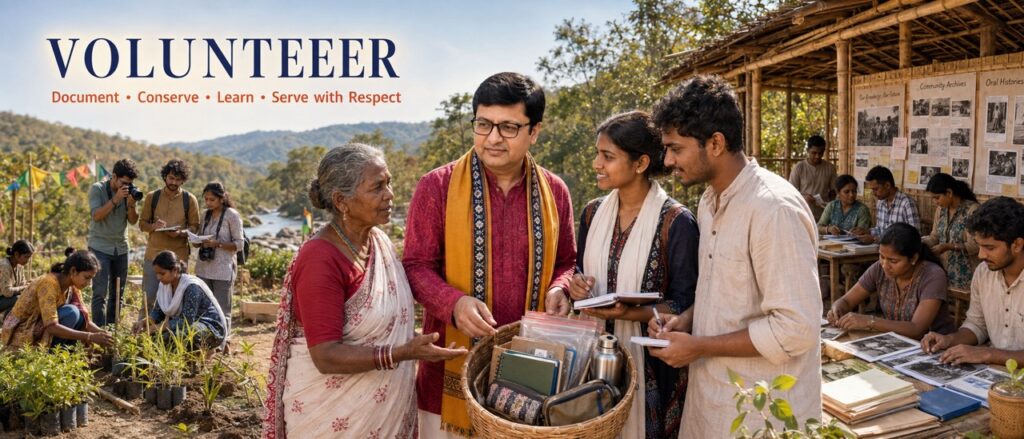
Volunteer With Hodopathy
Help Preserve Adivasi Knowledge and Protect Jharkhand’s Natural Heritage
Hodopathy welcomes responsible volunteers who want to support the preservation of Adivasi knowledge, traditional plant wisdom, medicinal-plant conservation and ethical public education.
Volunteering with Hodopathy is an opportunity to contribute your time, language skills, professional knowledge or technical abilities to a meaningful cultural and environmental initiative.
You do not need to be a medical professional or researcher to participate. What matters most is respect for communities, willingness to learn and commitment to ethical conduct.
Why Volunteer?
Jharkhand possesses rich forest biodiversity and generations of traditional knowledge related to native plants, seasonal foods, natural resources and community well-being.
Much of this knowledge remains oral. At the same time, many native and medicinal plants face pressure from habitat loss, destructive harvesting and changing environmental conditions.
Volunteers can help Hodopathy:
- Preserve oral histories
- Record local plant names
- Support community documentation
- Protect medicinal plants
- Develop native-species nurseries
- Transcribe and translate recordings
- Organise educational programmes
- Create responsible public-awareness content
- Maintain ethical digital archives
- Connect practitioners with researchers
- Encourage youth participation
- Support forest and biodiversity conservation
Volunteers must remember that traditional knowledge belongs to its recognised holders. Helping to document it does not create ownership or a right to publish it.
Who Can Volunteer?
Applications are welcome from:
- Students
- Teachers
- Farmers
- Adivasi and tribal youth
- Community members
- Environmental volunteers
- Botanists
- Agriculture graduates
- Social-science students
- Photographers and videographers
- Writers and translators
- Designers
- Data and technology professionals
- Legal and policy professionals
- Researchers
- Retired professionals
- Responsible members of the public
Some assignments may require specific qualifications, local-language skills, field experience or institutional affiliation.
Volunteers who will work directly with communities, children, personal information or biological samples may undergo additional screening and training.
Ways You Can Contribute
Community Documentation Support
Trained volunteers may assist authorised documentation teams with:
- Preparing interview materials
- Recording non-confidential oral histories
- Taking field notes
- Organising consent records
- Labelling photographs and recordings
- Preparing community copies
- Coordinating local meetings
Volunteers may not approach practitioners independently or record restricted knowledge without approval.
Local-Language Translation
Hodopathy needs support for communication in languages used across Jharkhand and neighbouring regions.
Volunteers may help with:
- Interview interpretation
- Audio transcription
- Translation of educational material
- Local-language consent explanations
- Subtitles for approved videos
- Community notices
- Plant-name records
Translation must preserve meaning accurately. Sensitive information should not be copied, shared or retained on personal devices without permission.
Plant and Biodiversity Documentation
Qualified or supervised volunteers may assist with:
- Photographing native plants
- Recording non-sensitive habitat information
- Observing flowering and fruiting seasons
- Supporting nursery records
- Monitoring planted saplings
- Documenting visible ecological changes
- Preparing educational plant labels
- Supporting community biodiversity activities
Volunteers must not taste, consume, prescribe or recommend an unidentified plant.
Plant photographs and mobile applications can support preliminary identification, but botanical identity should be confirmed by a qualified expert when accuracy or safety is important.
Medicinal-Plant Nurseries and Herbal Gardens
Volunteers may support:
- Seed and planting-material records
- Nursery-bed preparation
- Watering and maintenance
- Native-plant propagation
- Labelling
- Composting
- Survival monitoring
- Educational visits
- Restoration activities
Plants must be obtained from lawful and responsible sources. Rare species should not be removed from forests for volunteer activities.
Forest and Habitat Conservation
Possible activities include:
- Native-species plantation
- Removal of plastic waste
- Soil and water conservation
- Awareness of forest fires
- Habitat-restoration support
- Community conservation events
- Monitoring of planted areas
- Public education on sustainable harvesting
Plantation success should be measured by survival, biodiversity value and ecological suitability—not only by the number of saplings planted.
Photography and Videography
Approved volunteers may document:
- Conservation work
- Public events
- Nursery activities
- Practitioner dialogues
- Educational demonstrations
- Interviews with specific consent
Photography is not automatically allowed in a village, forest, home or traditional-practice setting.
Volunteers must obtain project approval and participant permission before recording or publishing people, practices or locations.
Writing and Content Development
Writers and editors may help create:
- Educational articles
- Practitioner profiles
- Conservation stories
- Event reports
- Local-language materials
- Social-media content
- Research summaries
- Volunteer updates
Content must avoid:
- Unsupported cure claims
- Cultural stereotypes
- Unauthorised remedy details
- Disclosure of sacred knowledge
- Identification of patients
- Precise locations of rare plants
- Exaggeration of research findings
Digital Archive Support
Volunteers with appropriate skills may help:
- Organise approved files
- Create metadata
- Clean transcripts
- Label access restrictions
- Maintain backups
- Develop search systems
- Improve digital security
- Prepare community-access copies
Access to a digital record does not grant permission to download, copy or reuse it.
Research Assistance
Qualified and institutionally supervised volunteers may support approved research through:
- Literature reviews
- Data organisation
- Non-sensitive field observations
- Botanical records
- Survey coordination
- Research summaries
- Laboratory coordination
- Community return-of-results materials
Volunteers must not conduct independent experiments on people or administer treatments.
Research involving human participants, biological samples or non-codified traditional medicine requires appropriate institutional, ethical and regulatory review.
Events and Public Awareness
Volunteers may assist with:
- Practitioner meetings
- University seminars
- Plantation programmes
- Conservation workshops
- Exhibitions
- Youth activities
- Registration desks
- Educational displays
- Community outreach
Volunteers should present themselves accurately and should not claim to be Hodopathy practitioners, doctors, researchers or official representatives unless formally authorised.
Professional Volunteering
Experienced professionals may contribute in areas such as:
- Botany and taxonomy
- Conservation planning
- Research ethics
- Data protection
- Intellectual property
- Biodiversity law
- Graphic design
- Website development
- Archival management
- Translation
- Training
- Monitoring and evaluation
Professional volunteers should disclose relevant commercial interests and conflicts of interest.
Types of Volunteer Opportunities
Field Volunteering
Field volunteers may work in villages, nurseries, farms, forests or conservation locations under approved supervision.
Field assignments may require travel, physical activity, local-language ability and adherence to safety instructions.
Remote Volunteering
Remote volunteers may support:
- Transcription
- Translation
- Design
- Research reviews
- Content editing
- Data organisation
- Website work
- Digital archiving
Sensitive files should be accessed only through approved systems.
Student and Campus Volunteering
Colleges and universities may organise supervised student groups for:
- Biodiversity awareness
- Native-plant gardens
- Educational campaigns
- Literature reviews
- Digital projects
- Conservation events
Student projects involving community interviews or traditional knowledge require prior approval and appropriate supervision.
Skilled Volunteering
Specific assignments may be available for people with professional experience in science, law, media, technology, agriculture, forestry or community development.
Short-Term and Project-Based Volunteering
Some opportunities may be linked to a particular event, field visit, publication, nursery project or documentation programme.
Availability will depend on current Hodopathy activities and supervisory capacity.
Volunteer Eligibility
General expectations include:
- Minimum age of 18 for independent volunteering
- Respect for Adivasi and tribal communities
- Willingness to follow Hodopathy policies
- Accurate representation of qualifications
- Ability to maintain confidentiality
- Responsible use of photographs and social media
- Commitment to safety
- No unauthorised medical activity
- No unauthorised collection of plants
- Disclosure of conflicts of interest
- Completion of required orientation
People below 18 may participate only in suitable supervised educational activities with appropriate parent, guardian and institutional permission.
Training and Orientation
Before beginning an assignment, volunteers may receive orientation covering:
- Hodopathy’s mission
- Adivasi identity and cultural respect
- Ethical Knowledge Policy
- Informed consent
- Photography and recording
- Confidentiality
- Medicinal-plant conservation
- Sustainable harvesting
- Field safety
- Data handling
- Responsible communication
- Complaint and incident reporting
Completion of orientation does not authorise volunteers to independently access communities, forests, traditional knowledge or biological resources.
The WHO framework for respectful engagement with Indigenous Peoples emphasises practical, rights-based and participatory approaches to work involving biodiversity, health and traditional knowledge. WHO—Biodiversity and Respectful Engagement.
Volunteer Code of Conduct
All volunteers are expected to:
- Treat community members with dignity
- Follow local customs and instructions
- Obtain permission before recording
- Protect confidential information
- Use community-preferred names
- Avoid promises they cannot fulfil
- Report information accurately
- Follow safety directions
- Protect plants and habitats
- Maintain professional boundaries
- Disclose mistakes promptly
- Return Hodopathy materials when requested
- Report concerns through the appropriate channel
No volunteer may use their role to pressure a practitioner or community member to disclose information.
Activities Volunteers Must Not Undertake
Unless specifically authorised under an approved and legally compliant project, volunteers must not:
- Diagnose or treat any person
- Prescribe plants or remedies
- Make guaranteed-cure claims
- Collect patient records
- Conduct clinical research
- Collect biological samples
- Remove plants from forests
- Enter restricted or sacred sites
- Record secret practices
- Publish community photographs
- Post field information on social media
- Share exact locations of rare plants
- Contact practitioners for personal business
- Sell products using Hodopathy’s name
- Collect donations in Hodopathy’s name
- Sign agreements on behalf of Hodopathy
- Transfer data to outside institutions
- Use restricted data for AI training
- Apply for intellectual property using volunteer information
- Present themselves as official spokespersons
Violation of these requirements may result in immediate termination of the volunteer assignment and other appropriate action.
Community Consent and Privacy
Community participation must be voluntary. Volunteers should not assume that a village leader, guide or family member can authorise every interview or recording.
Consent may be required from:
- The individual participant
- A family or lineage
- The community
- A customary institution
- The Gram Sabha
- Another recognised body
The appropriate process depends on the activity and the type of knowledge involved.
The Convention on Biological Diversity recognises that traditional knowledge should be used with the approval and involvement of its holders. Convention on Biological Diversity—Article 8(j).
Field Safety
Field volunteers must follow instructions relating to:
- Weather
- Terrain
- Wildlife
- Forest fires
- Safe drinking water
- Transport
- Clothing and footwear
- Insect and tick exposure
- Communication
- Emergency contacts
- Local access restrictions
Volunteers should not enter forests or unfamiliar rural areas alone.
Hodopathy is not an emergency medical service. Volunteers should seek qualified medical assistance when required.
Costs and Volunteer Status
Unless a specific opportunity states otherwise:
- Volunteering is unpaid
- Submission does not guarantee selection
- Travel and other expenses are not automatically reimbursed
- Expenses require prior written approval
- Volunteers are not employees
- A volunteer role does not guarantee future employment
- Certificates may be issued only for verified and satisfactorily completed assignments
- Hodopathy may discontinue an assignment when necessary
The terms of each assignment should be explained before work begins.
Selection Process
The volunteer process may include:
- Application review
- Introductory conversation
- Identity or qualification verification
- Reference or background checks where appropriate
- Assignment matching
- Ethics and safety orientation
- Acceptance of volunteer terms
- Supervised trial or initial assignment
- Performance and conduct review
Not every applicant will be matched immediately. Some assignments require local access, specialist qualifications or project funding.
How to Apply
Please provide:
- Full name
- Age
- Village or city
- District and state
- Phone number
- Email address
- Languages spoken
- Education
- Current occupation
- Relevant skills
- Previous volunteer experience
- Preferred volunteer area
- Field or remote preference
- Availability
- Expected duration
- Travel ability
- Institutional affiliation if any
- Reason for joining Hodopathy
- Two references if requested
- Any conflict of interest
Do not send confidential community knowledge, patient records or secret remedies with your application.
Contact Hodopathy
Email: care@hodopathy.com
Website: www.hodopathy.com
Suggested email subject:
Volunteer Application – [Your Name]
Become Part of a Responsible Preservation Movement
Volunteering with Hodopathy is not about collecting secret remedies or entering forests in search of valuable plants.
It is about listening respectfully, supporting communities, protecting biodiversity, preserving appropriate knowledge and helping future generations understand Jharkhand’s natural and cultural heritage.
If you are ready to contribute with patience, humility and responsibility, we welcome your application.
Volunteer with Hodopathy—Preserve Knowledge, Protect Nature and Support Communities.
This page provides general volunteer information. Volunteer opportunities depend on current projects, resources, location, eligibility and supervisory capacity. Participation does not grant authority to practise medicine, conduct research, access restricted knowledge or collect biological resources.