
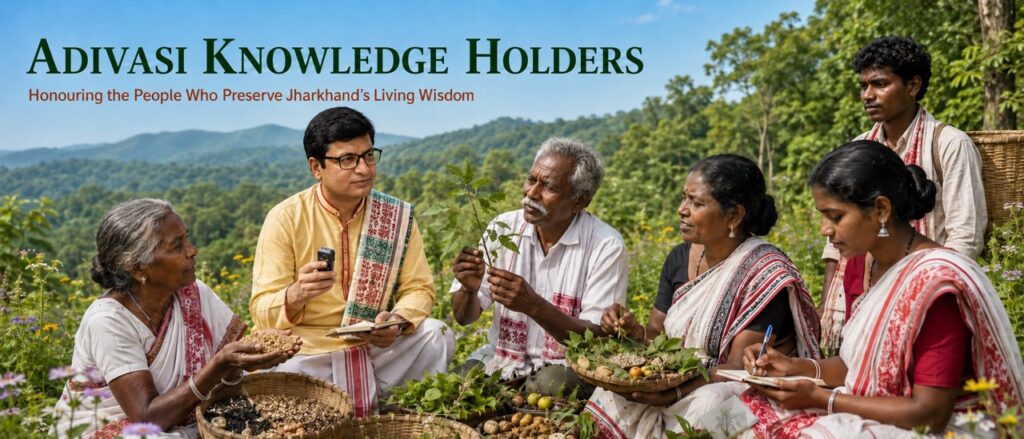
Adivasi Knowledge Holders
The Living Custodians of Hodopathy
Adivasi knowledge holders are the people who have preserved, practised and transmitted generations of understanding about forests, native plants, traditional foods, farming, seasons, natural resources and community life.
Within the Ho community and other Adivasi communities of Jharkhand, knowledge does not belong only to formally recognised practitioners. It may also live with elders, farmers, forest-resource collectors, seed keepers, food custodians, artisans, storytellers, language speakers and experienced family members.
Each person may hold a different part of the community’s collective memory.
These knowledge holders are not simply sources of information for Hodopathy. They are its living custodians. Their experiences, languages, cultural identities and relationships with the land must remain central to every effort involving documentation, research or preservation.
Who Is an Adivasi Knowledge Holder?
An Adivasi knowledge holder is a person who carries knowledge developed within and transmitted through an indigenous community.
This knowledge may have been acquired through:
- Learning from parents and grandparents
- Listening to elders and community stories
- Working in forests or agricultural fields
- Observing plants and animals
- Collecting seasonal foods and forest resources
- Saving and selecting seeds
- Preparing traditional foods
- Participating in cultural ceremonies
- Practising a community craft
- Speaking and preserving an indigenous language
- Experiencing changes in local landscapes over many years
A person does not need a formal title to be a knowledge holder. Their knowledge may be recognised through practical experience, community trust and familiarity with local traditions.
Knowledge Exists in Many Forms
Adivasi knowledge should not be reduced to information about medicinal plants.
Community knowledge may include:
Forest Knowledge
Understanding of native plants, trees, fruits, flowers, leaves, roots, water sources, wildlife and forest seasons.
Agricultural Knowledge
Experience related to local crops, seeds, soil, rainfall, mixed farming, seasonal planting and traditional cultivation practices.
Food and Nutrition Knowledge
Knowledge of seasonal foods, edible forest resources, preservation methods, recipes and community food traditions.
Ecological Knowledge
Observation of weather patterns, flowering seasons, water availability, soil conditions and changes in plant or animal populations.
Cultural Knowledge
Stories, songs, ceremonies, festivals, customary rules and beliefs connecting communities with nature.
Language Knowledge
Indigenous names for plants, animals, landscapes, seasons and practices that may not have exact equivalents in other languages.
Craft and Material Knowledge
Understanding of natural fibres, wood, bamboo, leaves, clay, dyes and other locally available materials.
Together, these forms of understanding create a complex knowledge system connected with everyday life.
Elders as Keepers of Community Memory
Elders often carry knowledge that exists nowhere else.
They may remember how forests appeared decades ago, which plants were once common, when certain foods were collected or how community practices changed over time.
Their memories can help document:
- Traditional names of plants
- Former forest and water conditions
- Seasonal calendars
- Local food practices
- Community stories and oral histories
- Changes in plant availability
- Cultural restrictions and customary rules
- Traditional methods no longer widely practised
- Earlier relationships among villages and landscapes
When an elder passes away without transferring or recording this knowledge, an irreplaceable part of community history may be lost.
Listening to elders is therefore essential to preserving Hodopathy and the wider indigenous heritage of Jharkhand.
Families as Knowledge Networks
Traditional knowledge is often preserved through families.
Parents, grandparents, siblings and other relatives may teach different skills. One person may know local plants, while another understands seeds, foods, crafts or seasonal collection.
Knowledge may be shared during ordinary activities such as:
- Working in fields
- Collecting forest produce
- Preparing meals
- Saving seeds
- Caring for animals
- Gathering fuel or leaves
- Participating in festivals
- Visiting sacred or culturally important places
- Responding to seasonal changes
These everyday learning experiences may not be described as formal education, yet they are powerful systems of intergenerational knowledge transfer.
Farmers and Seed Custodians
Adivasi farmers often hold detailed knowledge of local soils, seeds, rainfall and crop diversity.
Their experience may include:
- Selection and preservation of local seed varieties
- Understanding of different soil types
- Mixed and intercropping practices
- Seasonal planting decisions
- Natural resource management
- Crop responses to local weather
- Use of locally available organic materials
- Protection of agricultural biodiversity
- Knowledge of traditional food crops
Local crop varieties may carry cultural, nutritional and ecological importance. When they disappear, both genetic diversity and the knowledge associated with their cultivation can be lost.
Farmers and seed custodians are therefore important contributors to the wider knowledge landscape connected with Hodopathy.
Forest Gatherers and Plant Observers
People who regularly enter forests may possess highly detailed ecological knowledge.
They may recognise:
- Where particular plants grow
- When flowers, fruits or seeds become available
- Which plant populations are declining
- How rainfall affects vegetation
- Which species grow together
- Where water remains available during dry periods
- How harvesting influences plant regeneration
- Which areas require protection
Their observations can be valuable for biodiversity documentation and conservation.
However, publishing the exact locations of rare or valuable species can create risks. Sensitive ecological information should be protected from uncontrolled collection and commercial exploitation.
Food Knowledge Holders
Traditional foods are an important but sometimes overlooked part of Adivasi knowledge.
Community members may preserve knowledge of:
- Edible leaves, fruits, flowers and seeds
- Seasonal forest foods
- Traditional grains and pulses
- Preparation and cooking methods
- Fermentation and preservation
- Foods associated with festivals
- Nutrition during different seasons
- Local responses to periods of food scarcity
Such knowledge can contribute to cultural documentation, food-diversity studies and responsible nutritional research.
Traditional use alone should not be treated as proof that every wild ingredient is safe for everyone. Correct identification, preparation and scientific evaluation remain important.
Storytellers and Language Custodians
Stories and language preserve knowledge that cannot be understood through plant specimens alone.
A community story may explain why a plant is respected, how a landscape received its name or why certain resources should not be collected during a particular season.
Indigenous words may communicate details about:
- A plant’s appearance
- Its habitat
- Its stage of growth
- Its taste or aroma
- Its cultural role
- The season in which it appears
- Its relationship with another species
When an indigenous word disappears, part of the knowledge contained within that word may also disappear.
Recording local names, pronunciations, stories and meanings is therefore an essential part of knowledge preservation.
Knowledge Is Collective but Not Uniform
Adivasi knowledge is collective because it has developed through community experience over generations. However, this does not mean every community member holds identical information.
Knowledge may vary among:
- Families
- Villages
- Practitioners
- Age groups
- Occupations
- Geographical areas
- Forest environments
- Language groups
Different accounts should be documented accurately instead of being combined into a single artificial version.
Variation is a natural feature of living knowledge. It may also help researchers understand how communities adapted their practices to different landscapes and environmental conditions.
The Right to Decide What Is Shared
Knowledge holders have the right to decide whether their information may be documented or shared.
Before recording knowledge, it is important to explain:
- Why the information is being requested
- What will be recorded
- How it may be stored
- Whether names or photographs will be published
- Who may access the information
- Whether researchers may study it
- Whether any future commercial use is possible
A knowledge holder may choose to share some information while keeping other knowledge confidential.
Participation in one interview does not provide unlimited permission to reuse information for unrelated purposes. Sacred, restricted or sensitive knowledge must remain protected.
Recognition and Attribution
The phrase “community knowledge” should not be used to make individual contributors invisible.
Where permission is given, documentation should acknowledge:
- The name of the knowledge holder
- The person’s community
- The village or region
- The type of contribution
- The date of documentation
- The language in which the knowledge was shared
Some people may prefer collective community acknowledgement, while others may request privacy. Their preferences should guide how credit is presented.
No outside person or organisation should claim to have invented knowledge that was shared by Adivasi communities.
Knowledge Holders as Research Partners
Adivasi knowledge holders should be treated as partners in research rather than merely as research subjects.
They can help researchers:
- Identify locally important topics
- Understand indigenous terminology
- Interpret cultural context
- Locate plants within their habitats
- Recognise ecological changes
- Verify community accounts
- Review documentation for accuracy
- Identify information that should remain restricted
Researchers can contribute:
- Botanical identification
- Scientific literature review
- Laboratory analysis
- Biodiversity assessment
- Conservation planning
- Digital documentation
- Training and educational resources
- Responsible publication
Community participation should continue after an interview or field visit. Wherever practical, findings should be explained and shared with the people who contributed to the work.
Connecting Elders and Youth
The future of Hodopathy depends on the transfer of knowledge to younger generations.
Adivasi youth can use modern skills to support preservation through:
- Audio and video documentation
- Indigenous-language recording
- Botanical photography
- Biodiversity mapping
- Digital archiving
- Community herbal gardens
- Oral-history projects
- Research assistance
- Conservation campaigns
- Educational programmes
Technology can support preservation, but it must be used responsibly. Sensitive community knowledge should not be uploaded publicly merely because digital tools make publication easy.
Young people can become a bridge between ancestral knowledge and future research while remaining guided by elders and community values.
Protecting Knowledge from Misuse
Adivasi knowledge can be vulnerable to unauthorised publication, inaccurate representation and commercial exploitation.
Risks may include:
- Claiming community knowledge as an individual invention
- Publishing sacred or confidential information
- Using photographs without appropriate permission
- Collecting biological materials without proper authorisation
- Creating unsupported health claims
- Commercialising knowledge without community participation
- Removing knowledge from its cultural context
- Publishing locations of rare plants
- Ignoring the contribution of original knowledge holders
Preservation must protect both the information and the rights of the people who hold it.
Supporting Community Continuity
Knowledge preservation should create meaningful value for communities.
This may include:
- Recognition of knowledge holders
- Indigenous-language preservation
- Intergenerational education
- Community biodiversity records
- Training in documentation
- Conservation of native plants
- Community-led research opportunities
- Support for traditional crops and foods
- Responsible livelihood opportunities where appropriate
- Stronger connections with educational and research institutions
The purpose should not be to extract knowledge and carry it elsewhere. It should help communities retain their heritage and participate in decisions concerning its future.
Join the Knowledge-Preservation Effort
Hodopathy welcomes respectful participation from Adivasi knowledge holders who wish to contribute to cultural documentation, education, conservation or responsible research.
Knowledge holders may participate through:
- Oral-history interviews
- Indigenous-language documentation
- Plant and biodiversity records
- Traditional food documentation
- Seed and agricultural heritage initiatives
- Community meetings
- Conservation projects
- Educational programmes
- Research collaboration
Participation is voluntary. No person is required to disclose sacred, confidential or restricted knowledge.
Knowledge Remains Connected with Community
The strength of Hodopathy lies not only in what is known, but also in who has preserved that knowledge and how it remains connected with land, language and community life.
Adivasi knowledge holders deserve to be recognised as active custodians and partners. Their traditions should not be collected anonymously, separated from their cultural roots or represented without their involvement.
Information on Hodopathy.com is intended for cultural preservation, education and research awareness. It should not be interpreted as medical advice or used for self-treatment.
Adivasi knowledge is a living inheritance—carried by communities, strengthened through generations and protected for the future.