
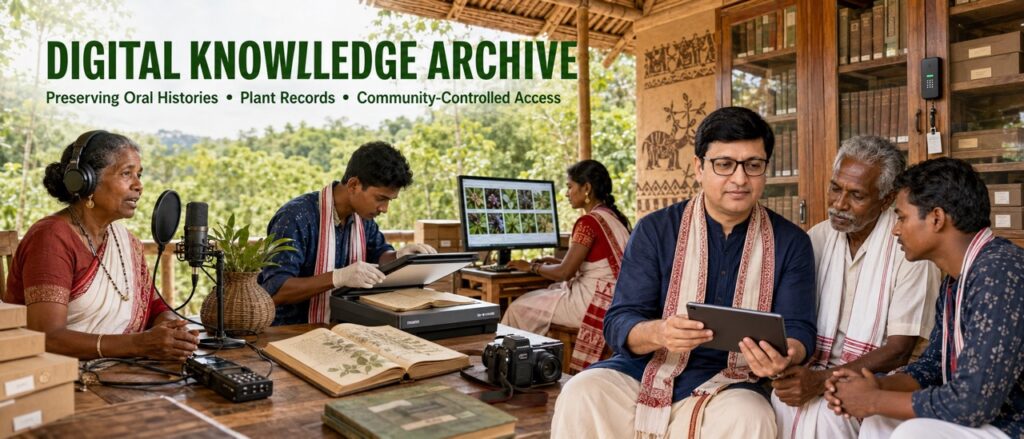
Hodopathy Digital Knowledge Archive
Preserving Indigenous Knowledge for Future Generations
The Hodopathy Digital Knowledge Archive is being developed as a structured and protected repository for preserving the oral, cultural, botanical and ecological knowledge associated particularly with the Ho community and other Adivasi communities of Jharkhand.
For generations, this knowledge has lived within people rather than databases. It has been carried through spoken language, community stories, practical experience, forest visits and teaching from elders to younger generations.
As lifestyles change and experienced knowledge holders grow older, digital tools can help preserve this heritage. However, digitisation must not make sensitive community knowledge freely available for copying, commercial exploitation or unsafe use.
The archive is therefore designed around three equally important goals:
- Preserving knowledge
- Protecting community rights
- Providing responsible access
It is intended to become a living archive that grows through community participation, careful documentation, botanical verification and continuing review.
Why a Digital Archive Is Needed
Oral traditions are dynamic and valuable, but they can also be vulnerable.
Knowledge may be lost because of:
- Ageing of elders and practitioners
- Weakening transfer between generations
- Migration from villages
- Declining use of indigenous languages
- Loss of forests and native plants
- Damage to photographs and written records
- Scattered documentation
- Inaccurate online information
- Lack of access to earlier research
- Absence of an organised preservation system
A digital archive can bring different types of records together while maintaining their relationships.
For example, a plant record may be linked with an elder’s interview, a local-language name, field photographs, botanical identification, conservation notes and related scientific literature.
This context makes the archive more valuable than an isolated list of plants or practices.
What the Archive Will Preserve
Subject to contributor permission and community restrictions, the archive may preserve several categories of material.
Knowledge Holder Profiles
Profiles may document:
- Name or approved identification
- Community and general region
- Area of knowledge
- Learning journey
- Teachers and family traditions
- Community contribution
- Personal reflections
- Message for future generations
- Participation and access preferences
Oral Histories
The archive may contain:
- Elder interviews
- Practitioner journeys
- Family memories
- Village histories
- Forest experiences
- Stories and folklore
- Environmental observations
- Intergenerational learning accounts
Indigenous Language Records
Language documentation may include:
- Local plant names
- Correct pronunciation
- Alternative regional names
- Meanings and cultural associations
- Audio recordings
- Transcriptions
- Translations
- Terms without direct equivalents
Plant and Botanical Records
Records may include:
- Indigenous and local names
- Botanical name when verified
- Identification status
- Photographs
- General habitat
- Season
- Growth characteristics
- Traditional account
- Conservation observations
- Scientific references
- Access restrictions
Traditional Food Records
The archive may preserve:
- Seasonal foods
- Edible forest resources
- Local crops and grains
- Preparation methods
- Food-preservation practices
- Festival foods
- Family food memories
- Nutritional research references
Agricultural and Seed Knowledge
Records may include:
- Local seed varieties
- Traditional crop practices
- Soil knowledge
- Seasonal planting
- Mixed farming
- Biodiversity observations
- Seed-custodian profiles
- Changes affecting local agriculture
Forest and Ecological Records
The archive may document:
- Native plants
- Changes in plant availability
- Water and soil observations
- Seasonal calendars
- Habitat change
- Community conservation practices
- General landscape records
- Sensitive environmental information under restricted access
Research and Reference Materials
Where sharing is legally and ethically permitted, the archive may link to:
- Research papers
- Botanical references
- Ethnobotanical studies
- Conservation reports
- Public institutional records
- Relevant laws and guidelines
- Educational resources
- Research summaries
Copyrighted publications should be linked or cited appropriately rather than copied without permission.
More Than an Online Library
The Digital Knowledge Archive is not intended to be a simple collection of downloadable files.
Each record should preserve relationships among:
- The knowledge
- The person who shared it
- The community
- The language
- The location
- The cultural context
- The plant or natural resource
- The evidence status
- The permissions governing access
A public visitor may see an approved summary, while the original interview and detailed documentation remain protected.
This layered structure helps preserve knowledge without exposing everything publicly.
Record Identification and Metadata
Each archive item should receive a unique identification number.
A record may include metadata such as:
- Record number
- Title
- Type of knowledge
- Contributor code
- Community
- General region
- Original language
- Date of documentation
- Interviewer
- Translator
- Photographer
- Related plant records
- Botanical identification status
- Evidence classification
- Consent status
- Access category
- Review history
- Last updated date
Metadata allows records to be searched, compared and reviewed without losing their original context.
Access Levels
Not every archive record should be publicly available.
The archive may use the following access levels:
Public Access
Material approved for publication, education and general awareness.
Public records may include:
- Approved Knowledge Holder Profiles
- General community stories
- Non-sensitive plant photographs
- Broad cultural information
- Educational summaries
- Public research references
Community Access
Records intended primarily for participating communities, knowledge holders or designated community organisations.
These may include:
- Local-language interviews
- Family histories
- Community educational resources
- Detailed cultural records
- Village-level documentation
Approved Research Access
Information available to qualified researchers or institutions under defined conditions.
Access may require:
- Research proposal
- Institutional affiliation
- Ethical approval where relevant
- Data-use agreement
- Community or contributor permission
- Commitment to acknowledgement
- Restrictions on publication
Restricted Access
Sensitive information that requires specific authorisation.
This may include:
- Detailed traditional practices
- Exact ecological locations
- Restricted oral histories
- Sensitive family knowledge
- Records awaiting community review
Confidential
Knowledge that is preserved but not available for outside access.
This may include sacred, private or highly sensitive information that contributors do not permit others to view.
Community Control and Contributor Choice
A digital archive should not take control away from the people who contributed the knowledge.
Contributors should be able to decide:
- Whether their name appears
- Whether their photograph is shown
- Whether their voice recording is public
- Whether their village is identified
- Whether researchers may access the material
- Whether sensitive information remains restricted
- How they should be acknowledged
- Whether a correction is required
Community participation should also help determine how collective knowledge is classified and represented.
Digitisation should strengthen community control—not weaken it.
Protecting Sacred and Confidential Knowledge
Some knowledge should never appear in public search results.
The archive must protect information that is:
- Sacred
- Restricted to a family
- Shared only with selected learners
- Associated with a vulnerable plant
- Connected with a sensitive cultural location
- Capable of encouraging unsafe use
- Personally private
- Vulnerable to commercial exploitation
Public access is not the only form of preservation. A protected record can remain valuable to future generations without being openly downloadable.
Protecting Rare Plants and Forest Locations
Precise geographical information may create risks.
If the exact location of a rare or commercially valuable plant is published, it may lead to uncontrolled collection, illegal trade or habitat damage.
The archive should therefore separate:
- Broad public location
- Research location
- Restricted precise location
Public plant records may identify a district or general forest region while keeping exact coordinates confidential.
Photographs should also be checked for embedded location information and visible landmarks that could reveal a protected site.
Botanical Identification Status
Every plant record should clearly show whether its botanical identity has been verified.
Possible labels include:
- Unverified
- Provisionally Identified
- Expert Reviewed
- Verified
- Disputed
- Under Review
The archive should record:
- Name of the reviewing expert
- Date of review
- Evidence used
- Alternative identifications
- Voucher or herbarium reference where available
A local plant name should never be displayed as a confirmed scientific identity unless adequate verification has taken place.
Evidence Labels
The archive should help visitors understand the difference between community knowledge and scientific evidence.
Records may use labels such as:
- Oral Tradition
- Personal Experience
- Community Practice
- Practitioner Testimony
- Ethnobotanical Record
- Botanical Evidence
- Laboratory Evidence
- Clinical Evidence
- Established Scientific Conclusion
A community account should remain valuable as cultural documentation without being misrepresented as medical proof.
Language Preservation
The archive should preserve original languages alongside translations.
Where possible, a language record may include:
- Original audio
- Original-language transcription
- English or Hindi translation
- Pronunciation guide
- Explanation of cultural terms
- Name of translator
- Translation-review status
Important indigenous words should not disappear merely because a translated version is easier to search.
Language is part of the knowledge itself.
Search and Discovery
Public archive records may eventually be searchable through categories such as:
- Knowledge holder
- Community
- District or broad region
- Indigenous language
- Plant type
- Traditional food
- Agriculture
- Forest and ecology
- Oral history
- Conservation
- Documentation year
- Evidence status
- Botanical verification status
Search results should display only information approved for the user’s level of access.
Restricted records should not reveal sensitive titles, names or locations through search previews.
Digital Preservation Standards
Digital files can be lost through hardware failure, outdated formats or poor organisation.
Long-term preservation should include:
- Consistent file naming
- Open and widely supported file formats where possible
- Multiple protected backups
- Regular integrity checks
- Version control
- Metadata export
- Secure access credentials
- Separation of public and confidential files
- Recovery procedures
- Periodic review of storage systems
The archive should preserve both the original file and any edited public version.
For example, an original audio interview should remain separate from a translated summary used on the website.
Privacy and Personal Data
The archive may contain personal information concerning contributors.
Public records should avoid displaying:
- Private phone numbers
- Personal email addresses without permission
- Exact home addresses
- Identity documents
- Financial information
- Family information unrelated to the record
- Sensitive health details
- Information concerning minors without proper safeguards
Contact between researchers and knowledge holders should be facilitated responsibly rather than exposing personal details publicly.
Corrections and Version History
Knowledge records may change over time.
A contributor may request a correction. A botanist may revise an identification. A translator may improve a term. New scientific evidence may become available.
The archive should maintain:
- Original record
- Updated version
- Date of change
- Reason for change
- Person or reviewer responsible
- Previous botanical identification where relevant
- Updated access classification
A clear version history helps maintain transparency and research value.
Research Access and Responsible Use
Researchers seeking non-public information should explain:
- Their identity and institution
- Research purpose
- Information requested
- Proposed methodology
- Publication plan
- Data-storage arrangements
- Community participation
- Expected benefits
- Funding and commercial interests
- Ethical approval where applicable
Approval to view a record does not automatically grant permission to publish, reproduce, commercialise or share it.
Research users should acknowledge the knowledge holder, community and archive according to the agreed conditions.
Copyright and Traditional Knowledge
Different archive materials may involve different rights.
For example:
- A photographer may hold rights in a photograph
- An interviewer may help create a recording
- A contributor retains interests in their personal story
- A community may hold collective traditional knowledge
- A publication may belong to its author or publisher
- The archive may organise and describe records
A digital record should not imply that Hodopathy.com owns the underlying traditional knowledge.
Use permissions should distinguish between the digital file and the community knowledge represented within it.
Community Access and Return of Records
The archive should not preserve knowledge only for outside researchers or website visitors.
Where practical, participating communities should receive access to appropriate records through:
- Printed profiles
- Audio copies
- Local-language transcripts
- Educational booklets
- Community displays
- Protected digital collections
- School or youth-learning resources
- Biodiversity records
The archive should return value to the communities whose knowledge makes it possible.
Future Features
Subject to community participation, available resources and appropriate safeguards, the Digital Knowledge Archive may gradually include:
- Searchable Knowledge Holder Profiles
- Oral-history collections
- Audio pronunciation of plant names
- Verified plant records
- Interactive regional maps using non-sensitive data
- Traditional food collections
- Community biodiversity records
- Local-language learning resources
- Research bibliographies
- Conservation alerts
- Youth documentation projects
- Community exhibitions
Features should be introduced only after access, safety and community-control requirements are established.
Contribute to the Archive
We welcome responsible contributions from:
- Adivasi elders
- Traditional practitioners
- Farmers and seed custodians
- Forest knowledge holders
- Food and language custodians
- Young community documentarians
- Botanists
- Researchers
- Universities
- Libraries and archives
- Conservation organisations
Potential contributors may contact Hodopathy through the website’s Connect or Contact page.
Please provide:
- Name and affiliation
- Community or location
- Type of material
- Source and ownership information
- Language
- Existing permission
- Proposed access level
- Cultural or privacy restrictions
- Relevant supporting records
Submission does not guarantee public publication. Each contribution should be reviewed for authenticity, consent, relevance, safety and access requirements.
A Living Archive for a Living Heritage
The Hodopathy Digital Knowledge Archive is intended to preserve knowledge without separating it from its custodians.
Its value will not be measured only by the number of files it stores. Its value will depend on whether the records remain accurate, whether knowledge holders remain visible, whether sensitive information stays protected and whether communities can participate in decisions about their heritage.
Information on Hodopathy.com is intended for cultural preservation, education and research awareness. It is not medical advice and should not be used for self-treatment.
The Digital Knowledge Archive will connect memory, community, language, biodiversity and responsible research—while keeping indigenous knowledge rooted in the people who preserve it.