
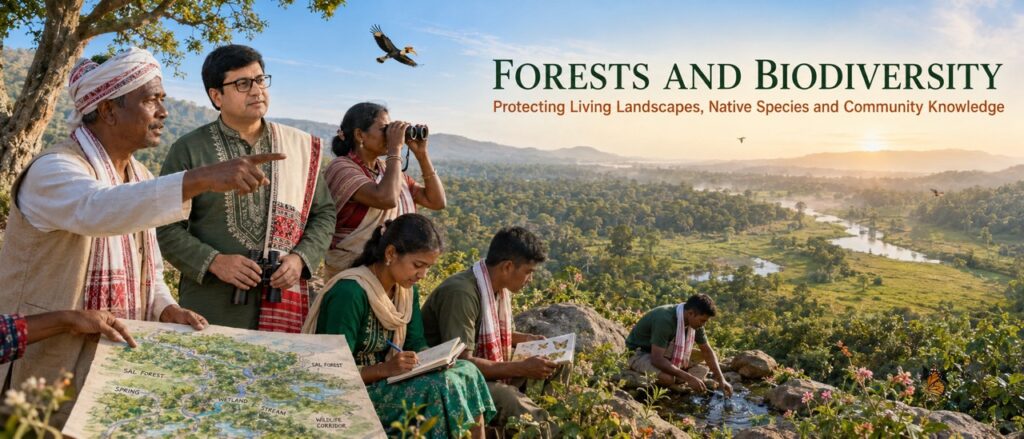
Forests and Biodiversity
The Living Foundation of Hodopathy
Hodopathy was born from the relationship among Adivasi communities, forests, native plants and generations of observation. Its knowledge cannot be understood by studying an individual herb in isolation. Every plant belongs to a wider living system shaped by soil, water, climate, microorganisms, insects, birds, animals and human communities.
Protecting Hodopathy therefore begins with protecting the forests and biodiversity that make this traditional knowledge possible.
Jharkhand: A Land Shaped by Forests
Jharkhand is known for its forests, hills, plateaus, rivers and rich Adivasi heritage. According to the India State of Forest Report 2023, Jharkhand has approximately 23,765.78 square kilometres of forest cover, representing about 29.81% of the state’s geographical area. Jharkhand Forest Department.
These forests include dry and moist deciduous ecosystems, Sal-dominated landscapes, grasslands, wetlands, sacred groves and village commons. Together, they support diverse forms of plant and animal life while contributing to local livelihoods, nutrition, culture and ecological stability.
Regions such as Saranda support communities including the Ho, Munda, Oraon and Santhal, who depend on forests for Mahua flowers and seeds, Sal leaves, mushrooms, honey, fruits, medicinal plants and other non-timber forest resources. Jharkhand Forest Department—Saranda.
Forest cover, however, is only one measure of ecological health. The quality, density, biological diversity and connectivity of a forest are equally important. A plantation containing only one or two species cannot fully replace a naturally diverse forest that has developed over generations.
Biodiversity Is More Than the Number of Plants
Biodiversity means the variety of life found within an ecosystem. It includes plants, animals, birds, insects, fungi and microorganisms, as well as the genetic diversity that exists within individual species.
A healthy forest is a network of relationships:
- Trees provide shade, leaf litter and shelter
- Roots hold soil and support water absorption
- Fungi and microorganisms recycle nutrients
- Insects pollinate flowers and decompose organic material
- Birds and animals disperse seeds
- Streams and wetlands sustain aquatic life
- Human communities protect, use and interpret the landscape
When one part of this network is damaged, many other parts may also be affected. The disappearance of a pollinator can reduce plant reproduction. Soil erosion can prevent natural regeneration. The loss of an animal that disperses seeds can gradually change the composition of an entire forest.
Protecting biodiversity therefore requires conserving relationships—not merely counting trees.
Forests as Living Knowledge Libraries
For Adivasi and tribal communities, forests are not simply collections of natural resources. They are living landscapes connected with identity, livelihood, spirituality and ancestral memory.
Traditional practitioners often recognise plants by their appearance, habitat, smell, taste, flowering period and seasonal behaviour. They may understand which plants grow near streams, on rocky slopes, under mature trees or in particular soil conditions. They may also follow customary rules about when, where and how a plant should be collected.
This knowledge has usually been transmitted orally through observation, apprenticeship and community practice. The Convention on Biological Diversity recognises that traditional knowledge developed over generations can make an important contribution to the conservation and sustainable use of biodiversity. Convention on Biological Diversity—Traditional Knowledge.
A forest is therefore both an ecosystem and a place of learning. When a forest disappears, the loss is not limited to plants and wildlife. Languages, plant names, collection practices, seasonal knowledge and cultural traditions may also disappear.
Medicinal Plants Depend on Healthy Ecosystems
Plants associated with traditional wellness practices do not exist independently of their surroundings. Their growth and natural characteristics may be influenced by soil composition, rainfall, altitude, shade, temperature, pollination and relationships with other organisms.
Environmental degradation can affect:
- The availability of medicinal and useful plants
- Natural regeneration and seed production
- The purity and quality of collected materials
- The survival of rare or slow-growing species
- Traditional harvesting seasons
- Community access to forest resources
- The continuity of practical plant knowledge
This is why Hodopathy does not view forests merely as sources of ingredients. Forest ecosystems must be protected as complete living systems.
Traditional use may guide scientific inquiry, but it does not by itself establish the safety or effectiveness of a plant for medical use. Correct botanical identification, contamination testing, safety evaluation and responsible research remain essential.
Sacred Groves and Community Conservation
Many Adivasi traditions protect particular groves, trees, hills, water sources and landscapes through customary beliefs and community rules. These sacred and culturally significant places can provide refuge for native plants, birds, insects and other species.
The Hodopathy reference study from West Singhbhum describes practitioners seeking permission from forest deities before collecting plants and treating the transfer of plant knowledge as a sacred responsibility. It also records concerns among practitioners about the excessive collection of medicinal plants after wider public interest increased. Hodopathy practitioners research paper.
Such practices demonstrate that conservation is not a new idea introduced from outside. It is already present within many community traditions. Modern conservation programmes should recognise and strengthen these traditions while respecting community rights and cultural identity.
Threats to Forest Biodiversity
Jharkhand’s forests and traditional plant knowledge face several interconnected pressures:
- Destruction and fragmentation of natural habitats
- Mining, construction and unplanned development
- Forest fires and changing rainfall patterns
- Soil erosion and declining water availability
- Excessive or destructive harvesting
- Invasive plant species
- Pollution and improper waste disposal
- Replacement of diverse forests with monoculture plantations
- Loss of community access to traditional landscapes
- Declining transmission of knowledge to younger generations
- Commercial demand for rare forest ingredients
- Disclosure of sensitive plant locations
Climate change may add further pressure by altering flowering seasons, rainfall, temperature and the geographical distribution of species.
These threats cannot be addressed through plantation drives alone. Protecting existing natural forests, restoring damaged habitats and involving local communities in decision-making are equally important.
Responsible and Sustainable Harvesting
Plants should be collected in ways that allow both the species and the surrounding ecosystem to regenerate.
Hodopathy supports responsible harvesting practices such as:
- Collecting only after confirming the correct plant identity
- Avoiding rare, threatened and legally protected species
- Taking only the quantity genuinely required
- Harvesting at the appropriate season and growth stage
- Leaving sufficient flowers, fruits and seeds for regeneration
- Avoiding the removal of entire plants wherever possible
- Collecting leaves or fruits instead of roots when appropriate
- Not repeatedly harvesting from the same small population
- Protecting young plants and seed-producing individuals
- Avoiding damage to surrounding vegetation
- Keeping collection areas free from plastic and other waste
- Maintaining records of location, season and quantity
- Following forest, biodiversity and access regulations
- Respecting community harvesting rules and restricted areas
A plant should not be collected simply because demand exists. Its ecological abundance and ability to regenerate must be considered first.
Cultivation Can Reduce Pressure on Wild Plants
Where scientifically, culturally and ecologically appropriate, selected medicinal and useful plants can be cultivated in home gardens, community nurseries, farms and agroforestry systems.
Responsible cultivation can:
- Reduce excessive dependence on wild populations
- Improve traceability of plant materials
- Create livelihood opportunities for rural communities
- Support consistent botanical identification
- Encourage conservation of local plant varieties
- Provide material for legitimate research
- Help younger generations learn about native species
Cultivation should prioritise locally adapted species and planting material from responsible sources. It should not promote invasive plants or replace diverse natural forests with single-species plantations.
For some forest plants, cultivation outside the natural habitat may also change growth patterns or chemical composition. Cultivated and wild materials should therefore be documented and evaluated separately.
Restoring Biodiversity Through Native Species
Ecological restoration is more than planting large numbers of saplings. Successful restoration requires the right species, the right location and long-term protection.
Hodopathy encourages restoration programmes that:
- Prioritise native and locally adapted plants
- Include trees, shrubs, grasses, climbers and herbs
- Protect soil organisms and natural leaf litter
- Restore streams, ponds and water-retention areas
- Create habitat for pollinators and seed-dispersing animals
- Connect fragmented forest patches
- Monitor plant survival beyond the initial plantation
- Control invasive species responsibly
- Involve village institutions and traditional knowledge holders
- Protect naturally regenerating vegetation
A naturally regenerating forest may sometimes provide greater ecological value than a newly planted monoculture. Conservation planning should therefore be guided by ecological evidence rather than plantation numbers alone.
Community-Led Biodiversity Documentation
Local communities possess detailed knowledge about plants, animals, seasonal changes and ecological pressures. This knowledge can strengthen biodiversity documentation when it is recorded with informed participation and appropriate protection.
Biodiversity Management Committees and People’s Biodiversity Registers provide local mechanisms for documenting biological resources and associated knowledge. The Jharkhand Biodiversity Board explains that the purpose of India’s biodiversity framework includes conservation, sustainable use and fair and equitable sharing of benefits arising from biological resources. Jharkhand Biodiversity Board.
Documentation should not expose the precise locations of rare plants or publish confidential community knowledge without permission. Communities should participate in deciding what information is recorded, who can access it and how it may be used.
Biodiversity and Community Livelihoods
Forest conservation is most sustainable when local communities share in its benefits and decision-making.
Community-based opportunities may include:
- Native plant nurseries
- Sustainable non-timber forest produce collection
- Seed conservation and exchange
- Local processing and value addition
- Community herbal gardens
- Biodiversity monitoring
- Ecological restoration work
- Training for young community researchers
- Responsible nature education
- Long-term purchasing arrangements for cultivated plants
Livelihood development must not encourage overharvesting or transfer control of community resources to outside organisations. Economic activity should remain within ecological limits and comply with applicable biodiversity, forest and benefit-sharing requirements.
The Hodopathy Approach
For Hodopathy, forests and biodiversity are not separate environmental subjects. They are central to the preservation of Adivasi knowledge and responsible natural-wellness research.
Hodopathy seeks to:
- Document forest-related knowledge with community consent
- Recognise Adivasi and tribal knowledge holders
- Protect sacred, secret and ecologically sensitive information
- Encourage correct botanical identification
- Promote sustainable harvesting and traceable sourcing
- Support cultivation of suitable native plants
- Develop community nurseries and conservation gardens
- Encourage scientific study of plant diversity
- Avoid the use of threatened species wherever possible
- Support habitat restoration and native-species plantation
- Create awareness about forests, soil, water and wildlife
- Comply with applicable forest and biodiversity regulations
- Encourage fair community participation and benefit-sharing
Protecting the Source of Knowledge
Hodopathy can survive only when its ecological and cultural foundations survive.
The loss of a forest may mean the loss of a medicinal plant. The loss of a plant may mean the loss of knowledge associated with its identification, season, habitat and traditional significance. The loss of a knowledge holder may mean the disappearance of generations of observation.
Conservation must therefore protect the complete relationship among forests, biodiversity, Adivasi communities and traditional knowledge.
By respecting community custodians, conserving native species, restoring ecosystems and encouraging responsible scientific research, Hodopathy aims to help preserve Jharkhand’s living natural heritage for future generations.
Hodopathy—Protecting Forests, Preserving Biodiversity and Respecting Adivasi Knowledge.