
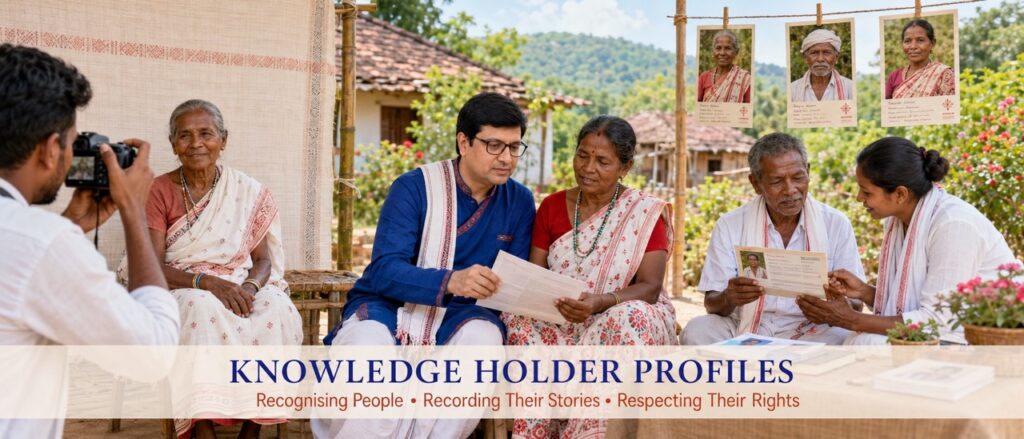
Knowledge Holder Profiles
Recognising the People Who Keep Indigenous Knowledge Alive
Knowledge Holder Profiles is dedicated to respectfully introducing the individuals who preserve and transmit Hodopathy and the wider indigenous heritage of Jharkhand.
Behind every plant name, forest memory, food tradition and community practice is a person who learned it through experience. These people may be elders, traditional practitioners, farmers, seed custodians, forest-resource collectors, food knowledge holders, storytellers, artisans or indigenous-language speakers.
Their contributions are often known within their communities but remain absent from written histories, research publications and public platforms.
This section seeks to make their work visible without separating their knowledge from its community roots or publishing information they wish to keep private.
Who Is a Knowledge Holder?
A knowledge holder is a person who carries knowledge developed within and transmitted through a community.
Their understanding may come from:
- Parents and grandparents
- Community elders
- An experienced practitioner
- Years of working in forests or fields
- Seed selection and farming
- Traditional food preparation
- Observation of plants and seasons
- Cultural ceremonies
- Family stories
- Indigenous language
- Community crafts
- Long-term experience within a particular landscape
A knowledge holder does not need a formal title or academic qualification. Their knowledge may be recognised through community trust, practical experience and the continuity of their contribution.
Who May Be Featured?
Knowledge Holder Profiles may feature:
Traditional Practitioners
Individuals who preserve specialised community knowledge of native plants, forest resources and customary practices.
Adivasi Elders
People who carry oral histories, community memories, indigenous terminology and knowledge of changing landscapes.
Farmers and Seed Custodians
Individuals who preserve local crop varieties, farming practices, soil knowledge and agricultural biodiversity.
Forest Knowledge Holders
People familiar with native plants, seasonal resources, habitats, water sources and environmental changes.
Food Knowledge Holders
Individuals who preserve traditional recipes, seasonal foods, edible forest resources and methods of preparation or preservation.
Language and Story Custodians
Speakers, storytellers and cultural contributors who preserve indigenous words, oral narratives, songs and community history.
Artisans and Material Knowledge Holders
People with knowledge of bamboo, leaves, fibres, clay, wood, natural colours or other locally available materials.
Community Conservation Leaders
Individuals working to protect forests, native plants, water sources, biodiversity and sacred natural places.
Young Knowledge Documentarians
Youth who are learning from elders and using photography, audio, video, writing or digital tools to preserve community heritage responsibly.
These categories may overlap. One person may carry several forms of knowledge.
Why These Profiles Matter
Knowledge is often discussed without naming the people who preserved it.
A botanical record may identify a plant but omit the elder who shared its local name. A research paper may describe traditional use without explaining which community provided the information. A photograph may show a practitioner without recording their identity or contribution.
Knowledge Holder Profiles seeks to correct this invisibility.
The profiles aim to:
- Recognise individual contributors
- Preserve personal and community histories
- Record how knowledge was learned
- Document indigenous terminology
- Connect knowledge with its cultural context
- Encourage intergenerational learning
- Help responsible researchers identify potential collaborators
- Show the diversity of knowledge within communities
- Inspire respect for Adivasi heritage
- Ensure that knowledge holders remain visible in the Hodopathy narrative
Recognition should not be limited to famous or formally educated people. Everyday community experience can also carry extraordinary cultural value.
What a Profile May Include
With the person’s permission, a Knowledge Holder Profile may include:
- Name or preferred identification
- Photograph
- Community
- Village or general region
- Indigenous language
- Area of knowledge
- How the knowledge was acquired
- Years or nature of experience
- Teachers or elders acknowledged by the contributor
- Plants, foods, crafts or ecological subjects studied
- Community and conservation activities
- Personal reflections
- Concerns about knowledge loss
- Message for younger generations
- Types of collaboration welcomed
- Date and method of documentation
The profile will include only information the contributor has agreed to share.
Exact addresses, personal contact details, confidential practices and sensitive plant locations should not be published publicly.
Every Profile Begins with Consent
No person should be profiled merely because they were photographed, interviewed or identified by someone else.
Before creating a profile, the contributor should understand:
- Why the profile is being prepared
- What information will be included
- Where it may be published
- Whether photographs or videos will be used
- Whether researchers may view the profile
- Whether the person’s name and location will appear
- How they may request a correction
- Whether any information will remain restricted
A person may agree to share their name but not their photograph. Another may permit a photograph while requesting that their village not be identified. Some may prefer to be recognised collectively with their community.
These choices should be respected.
Community Recognition and Verification
A Knowledge Holder Profile should not rely only on self-description.
Where appropriate and with permission, the profile may be supported through:
- Community references
- Confirmation from elders
- Family testimony
- Practitioner associations
- Field documentation
- Previous research participation
- Records of conservation or cultural work
- Interviews with more than one person
Verification should be respectful. It should not become an examination designed to humiliate or dismiss a knowledge holder.
The purpose is to ensure that profiles are accurate and credible while recognising that indigenous knowledge is not always documented through formal certificates.
Profiles Are Not Professional Certifications
Inclusion in Knowledge Holder Profiles recognises a person’s cultural, ecological or community knowledge.
It does not automatically mean that the person:
- Holds a medical degree
- Is professionally licensed
- Has a government-recognised qualification
- Is authorised to provide clinical treatment
- Has scientifically validated every practice described
- Is endorsed for all health-related claims
The profile should clearly identify the nature and source of the person’s knowledge.
Community recognition, cultural knowledge, professional registration and scientific validation are separate matters and should not be confused.
Protecting Confidential Knowledge
A profile does not need to reveal detailed formulas, quantities or restricted practices.
Certain information may remain confidential because it is:
- Sacred
- Restricted to a family
- Shared only with selected learners
- Associated with a rare plant
- Capable of encouraging unsafe use
- Vulnerable to commercial exploitation
- Personally sensitive
The value of a knowledge holder can be recognised without requiring them to disclose everything they know.
A respectful profile tells the person’s story while protecting the boundaries they establish.
Scientific and Medical Responsibility
A profile may document a practitioner’s experiences or a community’s traditional understanding. Such information should be identified clearly as traditional knowledge or personal testimony.
It should not be rewritten as a scientifically proven health claim.
Profiles must avoid:
- Guaranteed treatment claims
- Claims that a person can cure every condition
- Advice encouraging self-medication
- Instructions for using unidentified plants
- Statements discouraging professional healthcare
- Unsupported descriptions of safety
- Sensational testimonials
Where scientific research concerning a plant is mentioned, the source and limits of that evidence should be stated accurately.
Information on Hodopathy.com is intended for cultural preservation, education and research awareness. It is not medical advice.
Photography with Respect
A profile photograph should represent the knowledge holder with dignity.
Images should:
- Be captured with appropriate permission
- Reflect the person’s real environment where possible
- Avoid misleading or staged activities
- Respect cultural dress and personal choice
- Protect sacred or restricted locations
- Avoid revealing sensitive plant sites
- Include accurate captions
- Credit the photographer where appropriate
Images should not portray Adivasi knowledge holders as primitive, exotic or anonymous.
Every person should be represented as an individual with their own identity, experience and voice.
Preserving the Original Voice
A knowledge holder’s own words are an important part of their profile.
Interviews may be conducted in the contributor’s preferred language. Translation should preserve the original meaning and important indigenous terms.
Where possible, the contributor should be given an opportunity to review:
- Their name and identification
- The translated interview
- The profile summary
- Selected quotations
- Photographs and captions
- Information about their village
- Any stated area of expertise
Editing may improve clarity, but it should not change the person’s meaning or add dramatic statements they did not make.
A Suggested Profile Format
Each published profile may follow a clear structure:
Name and Identity
The knowledge holder’s name or preferred form of identification.
Community and Region
The community and general geographical area connected with their knowledge.
Area of Knowledge
The principal subjects the person understands or preserves.
Learning Journey
How and from whom the knowledge was acquired.
Community Contribution
The person’s role in education, conservation, culture, farming or community life.
Personal Reflections
The knowledge holder’s views concerning tradition, environmental change and future generations.
Knowledge Protection
Information about what may be shared publicly and what remains restricted.
Message for the Future
Advice or hopes expressed for young people and the continuation of indigenous heritage.
Documentation Details
The date, language, interviewer, translator and method used to prepare the profile.
This structure can make profiles consistent without forcing every person’s story into the same format.
Corrections and Continuing Participation
A profile should not become a permanent record that the contributor can never question.
Knowledge holders should be able to request:
- Correction of factual errors
- Improved translation
- Replacement of a photograph
- Updating of their activities
- Removal of sensitive information
- Changes to their preferred identification
- Review of newly added material
Requests should be examined respectfully and acted upon where appropriate.
The knowledge holder should remain connected with the profile after publication.
Nominate a Knowledge Holder
Community members, families, researchers and responsible organisations may recommend a person for a Knowledge Holder Profile.
A nomination should include:
- Name of the proposed knowledge holder
- Community and general location
- Area of knowledge
- Reason for the nomination
- Relationship between the nominator and the person
- Confirmation that the person knows about the nomination
- Preferred language for communication
- Available photographs or documentation
- Any known privacy or cultural restrictions
Nomination does not guarantee publication. The person’s direct consent and an appropriate verification process are required before a profile can be published.
Create Your Own Profile
A knowledge holder may also contact Hodopathy directly to express interest in being documented.
They may contribute through:
- An in-person interview
- An audio conversation
- A video interview
- A written account
- Family-supported documentation
- A community meeting
- Collaboration with a responsible researcher
Contact Hodopathy through the website’s Connect or Contact page and provide a brief introduction to your knowledge, community, location and preferred method of participation.
Making Knowledge Holders Visible
Hodopathy cannot be preserved through plant records alone. The people who carried the knowledge must also be remembered.
Knowledge Holder Profiles is an effort to ensure that elders, practitioners, families, farmers and community contributors are recognised by name and represented with dignity.
Their profiles can become a bridge among community memory, intergenerational learning, conservation and responsible research.
Every knowledge holder carries a part of living heritage. Recognising the person helps preserve the knowledge—and the community story behind it.