
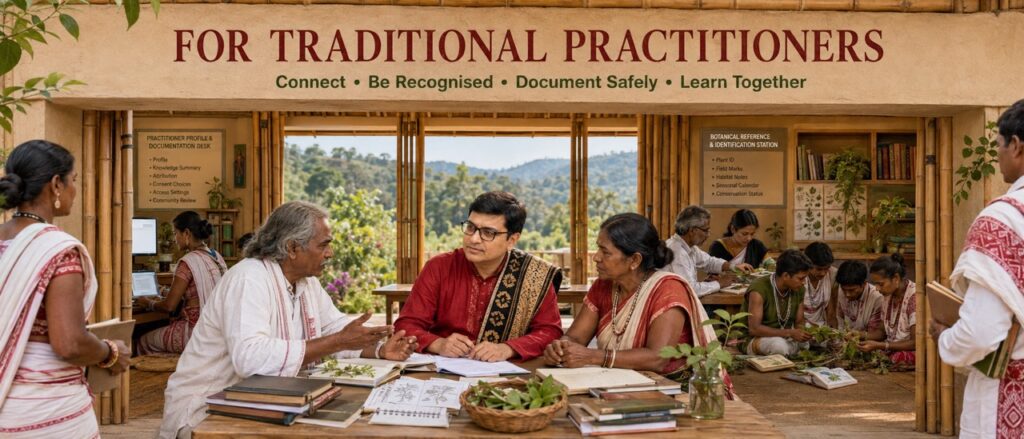
For Traditional Practitioners
Join Hodopathy in Preserving Adivasi Knowledge with Dignity and Respect
Traditional practitioners are among the most important custodians of Hodopathy. Their knowledge has been developed through observation, apprenticeship, community experience and close relationships with forests, native plants and seasonal cycles.
Much of this knowledge remains oral. As senior practitioners grow older and younger generations follow different occupations, valuable plant names, preparation traditions, conservation practices and cultural histories may be lost.
Hodopathy invites traditional practitioners to participate in a respectful effort to preserve this living heritage—without forcing them to disclose sacred, secret or restricted knowledge.
Who Is a Traditional Practitioner?
For the purpose of Hodopathy, a traditional practitioner may include a person who has received or developed community-recognised knowledge relating to:
- Native and forest plants
- Traditional foods and nutrition
- Seasonal wellness practices
- Plant identification and collection
- Preparation of traditional botanical materials
- Community well-being
- Local environmental conditions
- Forest and biodiversity conservation
- Cultural or spiritual aspects of healing
- Knowledge transmitted through family or apprenticeship
Different communities may use different names for their practitioners. Hodopathy respects community-preferred names and does not seek to impose a single title or identity.
Why Connect with Hodopathy?
Hodopathy seeks to create a responsible platform where practitioners can connect with one another and, where appropriate, with:
- Adivasi elders and knowledge holders
- Botanists and taxonomists
- Universities
- Research institutions
- Conservation organisations
- Nutrition professionals
- Qualified laboratories
- Farmers and medicinal-plant cultivators
- Biodiversity institutions
- Ethical documentation specialists
The purpose is not to replace traditional knowledge with modern science. It is to build a respectful bridge through which knowledge can be preserved, plants can be conserved and suitable subjects can be evaluated responsibly.
The World Health Organization’s work on traditional medicine and Indigenous Knowledges similarly emphasises partnerships grounded in trust, respectful engagement and co-creation with elders, practitioners, researchers and communities. WHO—Respectful Indigenous Engagement.
How Practitioners May Participate
Participation can take many forms. A practitioner may choose one activity without agreeing to others.
Share an Oral History
Practitioners may record:
- How they learned
- Who taught them
- How knowledge was traditionally transferred
- Their relationship with forests and plants
- Changes they have observed over time
- Challenges facing traditional practitioners
- Their hopes for younger generations
An oral history does not need to reveal remedies, formulations or confidential practices.
Document Local Plant Names
With appropriate permission, practitioners may help record:
- Local plant names
- General habitat
- Seasonality
- Identification features
- Conservation concerns
- Traditional collection methods
- Changes in availability
Botanical experts may later help authenticate the plant’s scientific identity.
Exact locations of rare or sensitive plants should not be published.
Participate in Practitioner Dialogues
Hodopathy aims to encourage meetings where practitioners can discuss:
- Knowledge preservation
- Medicinal-plant conservation
- Sustainable harvesting
- Practitioner recognition
- Ethical research
- Intergenerational learning
- Community rights
- Common challenges
A practitioner’s participation in a dialogue does not require disclosure of secret knowledge.
Support Medicinal-Plant Conservation
Practitioners can help identify conservation priorities and guide:
- Community herbal gardens
- Native-species nurseries
- Seed conservation
- Sustainable collection practices
- Protection of sacred groves
- Monitoring of declining species
- Education of young collectors
- Habitat restoration
Traditional observations can provide valuable early warnings about changes in plant populations.
Teach the Next Generation
Experienced practitioners may choose to participate in community-approved apprenticeship, youth education or practitioner-training programmes.
Knowledge transfer should follow customary rules. Hodopathy will not assume that every tradition should be taught publicly or outside the community.
Contribute to Responsible Research
Practitioners may help researchers understand:
- Appropriate research questions
- Cultural context
- Traditional terminology
- Plant-selection history
- Preparation principles
- Ecological relationships
- Community priorities
- Possible safety concerns
Research participation should be based on informed consent, appropriate ethics review and clearly agreed roles.
You Decide What to Share
Traditional practitioners have the right to decide:
- Whether to participate
- What knowledge may be recorded
- What must remain confidential
- Whether their name may be published
- Whether photography is allowed
- Whether audio or video may be recorded
- Whether biological samples may be collected
- Whether information may be used for research
- Whether information may be published
- Whether commercial use may be considered
- Whether third parties may receive access
- Whether future permission is required
Permission to record knowledge does not automatically transfer ownership of that knowledge.
The Convention on Biological Diversity recognises that access to traditional knowledge should involve the approval and participation of its holders and that benefits arising from its use should be shared equitably. Convention on Biological Diversity—Article 8(j).
Sacred and Secret Knowledge Will Be Respected
Some knowledge belongs only to:
- A particular family
- A lineage of practitioners
- Selected apprentices
- A customary institution
- A village or community
- A spiritual or ceremonial tradition
Hodopathy does not require practitioners to reveal such knowledge.
A practitioner may state that information is:
- Publicly shareable
- Shareable only within the community
- Available only for restricted research
- Confidential
- Sacred or secret
- Not to be recorded
These restrictions should be documented and followed.
Information should not be obtained indirectly from another person when the recognised custodian has declined to share it.
Our Documentation Process
Where a practitioner agrees to documentation, the process may include the following stages.
1. Initial Conversation
Hodopathy or an authorised collaborator will explain:
- Purpose of documentation
- People involved
- Information requested
- Recording method
- Possible research
- Storage and access
- Publication possibilities
- Potential benefits and risks
- Practitioner rights
- Complaint process
2. Consent
The practitioner will decide whether and how to participate.
Consent may be written, orally recorded, witnessed or documented through an appropriate community process.
3. Documentation
Only the agreed information should be recorded. The practitioner may pause or stop the interaction at any time.
4. Classification
The practitioner and documentation team should identify whether the information is public, restricted, confidential or sacred.
5. Review
Where practical, the practitioner should have an opportunity to review sensitive descriptions, names, photographs or recordings before publication.
6. Storage
Records should be stored according to the agreed level of access.
7. Future Use
A new purpose—such as commercial development, intellectual property, third-party transfer or artificial-intelligence training—may require renewed permission and additional agreements.
Recognition and Attribution
Practitioners who contribute to documentation, conservation or research should receive appropriate recognition in the form they prefer.
Options may include:
- Full name
- Practitioner title
- Community name
- Village or regional attribution
- Group acknowledgement
- Joint authorship where appropriate
- Anonymous or coded recognition
- No public identification
Hodopathy will not publish a practitioner’s name or image merely to make content appear more credible if permission has not been given.
Fair Benefits
Where a practitioner’s knowledge or a community’s biological resources contribute to research, education, intellectual property or commercial development, fair benefits should be considered.
Benefits may include:
- Payment for time and participation
- Employment
- Training
- Research participation
- Nursery and conservation support
- Equipment
- Community education
- Scholarships for young people
- Practitioner meetings
- Publication recognition
- Access to research results
- Technology transfer
- Royalties or other monetary benefits
- Community development funds
- Long-term cultivation or sourcing opportunities
The type of benefit should be discussed before significant use begins and documented through understandable terms.
India’s biodiversity framework recognises eligible holders of traditional knowledge and conservers of biological resources as potential benefit claimers. The exact legal process depends on the activity, parties and applicable approvals. National Biodiversity Authority.
Research Does Not Mean Disrespect
Scientific evaluation is not intended to dismiss practitioner experience. It can help investigate:
- Correct botanical identity
- Purity and contamination
- Chemical composition
- Nutritional characteristics
- Safety
- Stability
- Consistency
- Environmental sustainability
Traditional experience and scientific research answer different questions. Both should be presented accurately.
A history of traditional use can guide research, but it does not automatically establish clinical safety or effectiveness for every person, condition or dosage.
Researchers should report positive, negative and inconclusive results honestly.
Patient Privacy and Safety
Practitioners should not be asked to disclose identifiable patient information without appropriate permission and ethical safeguards.
Hodopathy will not knowingly publish:
- Patient names
- Identifiable medical records
- Patient photographs
- Personal health histories
- Treatment videos
- Sensitive family information
without appropriate consent and review.
Practitioners are encouraged to refer people for urgent or qualified medical care when symptoms may indicate an emergency or serious illness.
Traditional knowledge should not be promoted through guaranteed-cure claims, fear-based advertising or instructions that may lead people to delay necessary medical treatment.
Protecting Medicinal Plants
Traditional practitioners often possess knowledge of how plants should be collected without damaging natural populations.
Hodopathy encourages practitioners to support:
- Collection only of correctly identified species
- Protection of rare plants
- Seasonal harvesting
- Leaving plants for seed production
- Avoiding destructive uprooting
- Protection of sacred groves
- Community harvesting rules
- Cultivation of suitable species
- Native-plant nurseries
- Restoration of damaged habitats
- Clean and traceable collection
A plant should not be harvested simply because it has market demand. Its ecological ability to regenerate must come first.
What Hodopathy Does Not Provide
Participation in Hodopathy does not automatically provide:
- Government registration
- A medical licence
- Certification to practise medicine
- Recognition under AYUSH
- Permission to collect forest resources
- Approval to sell a medicine or supplement
- Clinical validation of a remedy
- Intellectual-property ownership
- Guaranteed research funding
- Guaranteed product development
- Guaranteed income or employment
Any such approval depends on the relevant authority, law, evidence and regulatory process.
Hodopathy may document or collaborate with a practitioner without endorsing every claim or practice attributed to that practitioner.
What We Will Not Ask You to Do
Hodopathy will not knowingly ask a practitioner to:
- Reveal sacred knowledge against customary rules
- Share another practitioner’s knowledge without authority
- Collect protected plants illegally
- Harvest rare plants destructively
- Make guaranteed-cure claims
- Experiment on patients outside ethical safeguards
- Sign documents that have not been explained
- Surrender all future rights through vague terms
- Accept publication without agreed permission
- Transfer samples without necessary approval
- Allow commercial use without appropriate review and terms
Practitioners should ask questions before agreeing to any activity.
How to Join the Hodopathy Practitioner Network
If you are a traditional practitioner or authorised community knowledge holder and wish to connect with Hodopathy, please share:
- Your full name
- Practitioner or community title
- Village, district and state
- Community or tribal affiliation if you wish to disclose it
- Languages spoken
- General area of knowledge
- How you learned or received the knowledge
- Years of experience
- Interest in documentation, conservation or research
- Whether you represent only yourself or an authorised group
- Preferred method of contact
- Whether a local meeting or translator is required
You are not required to send secret remedies, patient records or detailed formulations in your first message.
Contact Hodopathy
Email: care@hodopathy.com
Website: www.hodopathy.com
Suggested email subject:
Traditional Practitioner – Request to Connect
If you prefer not to use email, an authorised Hodopathy representative may help document your initial request through an appropriate local process.
An Invitation from Hodopathy
Rajeev Singh is working through Hodopathy to connect traditional practitioners and Adivasi knowledge holders with researchers, botanists, conservationists, universities and responsible institutions.
The purpose is not to take control of community knowledge. It is to help create a platform where practitioners are heard, plants are protected, knowledge is preserved and suitable subjects can be studied responsibly.
If you wish to preserve your experience, connect with other practitioners, support medicinal-plant conservation or participate in ethical research, Hodopathy welcomes the opportunity to speak with you.
Hodopathy—Respecting Traditional Practitioners, Preserving Living Knowledge and Protecting Nature.
This webpage provides general information. Hodopathy is not a licensing authority or emergency medical service. Participation does not grant legal authority to practise medicine, collect protected biological resources or market health products.