
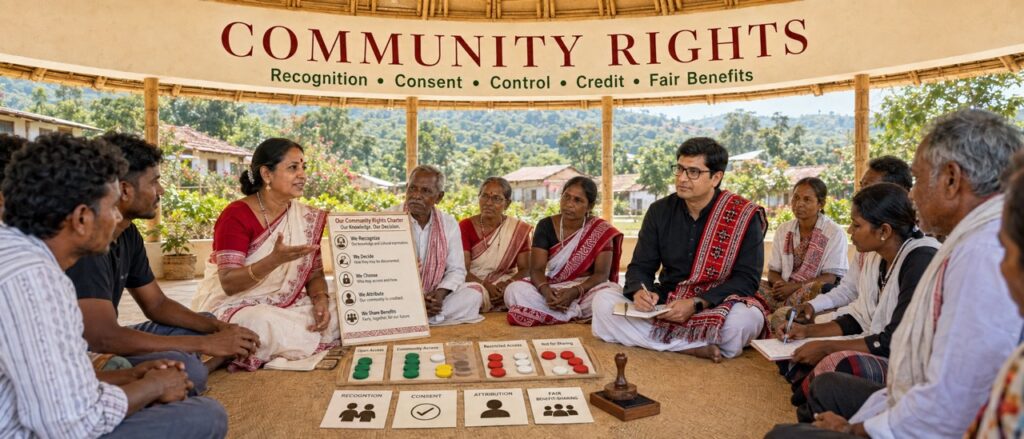
Community Rights
Respecting the People Who Preserve Hodopathy’s Living Knowledge
Hodopathy is rooted in knowledge developed and preserved by Adivasi communities, tribal practitioners, elders, families and forest-dependent people. Their understanding of native plants, forests, seasonal foods and nature-based practices has been carried forward through generations.
This knowledge should not be separated from the people who hold it. Communities must be respected as custodians, participants and decision-makers—not treated merely as sources of information, plant materials or labour.
Community rights are therefore central to the documentation, conservation, research and responsible development of Hodopathy.
What Are Community Rights?
Community rights are the collective and individual rights of people connected by shared territory, culture, ancestry, customary practices or traditional knowledge.
Depending on the community and legal context, these rights may relate to:
- Land, forests and customary resources
- Collection and use of minor forest produce
- Protection and management of community forests
- Traditional knowledge and cultural practices
- Sacred sites and culturally sensitive information
- Participation in local decision-making
- Documentation of local biodiversity
- Recognition and attribution
- Fair and equitable benefit-sharing
- Community livelihoods
- Transmission of knowledge to future generations
- Protection against unauthorised use or misrepresentation
A community may hold knowledge collectively, while particular practitioners, families or lineages may hold specialised knowledge. These different layers of responsibility must be understood before consent is sought or information is recorded.
Rights Are More Than Access to Resources
Community rights are sometimes discussed only in terms of access to forests or the collection of forest produce. These are important, but community rights are much broader.
They also include the right to:
- Be treated with dignity
- Decide whether knowledge may be shared
- Protect sacred or secret traditions
- Participate in research and conservation planning
- Understand how information will be used
- Refuse participation without pressure
- Receive copies of documentation
- Correct inaccurate representation
- Be recognised for contributions
- Share fairly in resulting benefits
- Raise concerns and seek remedies
Respecting community rights means recognising communities as equal partners in decisions that affect their knowledge, culture, resources and future.
The Indian Legal Context
Several Indian laws and institutions are relevant to community rights connected with forests, biological resources and traditional knowledge. Their application depends on the location, activity, status of the resource and facts of each case.
Forest Rights Act
The Scheduled Tribes and Other Traditional Forest Dwellers (Recognition of Forest Rights) Act, 2006 recognises certain individual and community rights of forest-dwelling Scheduled Tribes and other traditional forest dwellers.
The Ministry of Tribal Affairs explains that the Act includes rights relating to forest resources and community forest resources for sustainable use, conservation and management. Ministry of Tribal Affairs—Forest Rights Act.
Where recognised under the Act, community forest resource rights can strengthen the role of Gram Sabhas and forest-dwelling communities in protecting, regenerating and managing forests traditionally used and conserved by them.
PESA and the Gram Sabha
The Provisions of the Panchayats (Extension to the Scheduled Areas) Act, 1996—commonly known as PESA—provides a framework for local self-governance in Scheduled Areas.
Among its provisions, PESA recognises the importance of Gram Sabhas, customary practices and community resources. It also provides for ownership of minor forest produce by the Gram Sabha or Panchayat at the appropriate level, subject to its legal application and implementation. India Code—PESA Act.
Because implementation may involve state laws, rules and recognised local institutions, project-specific legal guidance should be obtained before accessing community forest resources.
Biological Diversity Framework
India’s Biological Diversity Act establishes mechanisms for the conservation of biodiversity, sustainable use of biological resources and fair and equitable sharing of benefits.
Biodiversity Management Committees are local institutions involved in conservation, sustainable use and documentation. People’s Biodiversity Registers may record local biological resources and associated traditional knowledge in consultation with communities. National Biodiversity Authority—BMCs and People’s Biodiversity Registers.
The National Biodiversity Authority describes traditional knowledge holders as potential “benefit claimers” under the applicable biodiversity framework. Access, research, commercial use and intellectual-property activities may require approvals, registration, consultation, agreements or benefit-sharing, depending on the circumstances. National Biodiversity Authority FAQs.
These legal frameworks should be read together with other applicable forest, wildlife, intellectual-property, research and local-governance requirements.
Free, Prior and Informed Consent
Hodopathy supports free, prior and informed consent—or the approval and effective involvement of knowledge holders—as a fundamental ethical principle.
Free
Consent should be given voluntarily. It should not result from pressure, manipulation, misleading promises, unequal bargaining power or fear of losing services or opportunities.
Prior
Permission should be obtained before interviews, recordings, photography, sample collection, publication, research or commercial development begins.
Informed
The proposed activity should be explained clearly, including:
- Who is conducting it
- Why the knowledge or material is requested
- What information will be recorded
- Where it will be stored
- Who may access it
- Whether it will be published
- Whether samples will be transferred
- Whether commercial use or intellectual property is possible
- What risks may arise
- What benefits are proposed
- How long permission will continue
- How complaints or withdrawal will be handled
Consent as an Ongoing Process
Consent should not be treated as a one-time signature. If the purpose of a project changes, new permission may be required.
Permission to conduct an interview does not automatically include permission to:
- Publish the recording online
- Reveal the identity of the practitioner
- Share the material with another institution
- Develop a commercial formulation
- Apply for intellectual property
- Use the material in advertising
- Train artificial-intelligence systems with the data
- Deposit samples in an external repository
Each materially different use should be addressed transparently.
The Convention on Biological Diversity calls for the knowledge of Indigenous Peoples and local communities to be used with the approval and involvement of its holders and for resulting benefits to be shared equitably. Convention on Biological Diversity—Article 8(j).
Who Has the Authority to Give Consent?
Identifying the appropriate authority can be complex.
Consent may need to involve:
- The individual knowledge holder
- A family or lineage
- A traditional practitioner
- Community elders
- The Gram Sabha
- A customary institution
- A Biodiversity Management Committee
- A recognised forest-rights institution
- Government or statutory authorities
No single institution should automatically be assumed to represent every type of knowledge.
For example, general community approval may not be sufficient to disclose a remedy held confidentially by one practitioner or family. Similarly, an individual should not disclose collectively held sacred knowledge without appropriate community authority.
A responsible process may therefore require layered consent—from both the community institution and the specific knowledge holder.
The Right to Keep Knowledge Confidential
Documentation is not always the same as preservation.
Recording traditional knowledge can help prevent its loss, but it can also expose it to copying, misappropriation and commercial use. Communities should be able to decide that certain knowledge will not be recorded, published or shared outside an authorised circle.
Sensitive information may include:
- Sacred ceremonies and prayers
- Knowledge restricted to initiated practitioners
- Exact locations of rare medicinal plants
- Family-held preparation methods
- Images of sacred places or objects
- Cultural practices not intended for public display
- Knowledge whose disclosure may damage biodiversity
- Personal information about patients or community members
Confidential records should have clearly defined access restrictions. Digital security, storage location, authorised users and future transfer must be discussed before documentation begins.
The fact that knowledge has been shared orally with a researcher does not make it freely available to the public.
The Right to Accurate Representation
Adivasi and tribal communities should not be presented as primitive, superstitious, voiceless or frozen in the past. They are contemporary communities whose knowledge systems continue to adapt and develop.
Researchers, writers and organisations should:
- Use community-preferred names
- Avoid stereotypes and romanticisation
- Present cultural context accurately
- Distinguish community testimony from scientific findings
- Avoid claiming that one person represents an entire tribe
- Allow contributors to review sensitive descriptions
- Correct errors promptly
- Obtain permission before using names and photographs
- Avoid exaggerated medical claims attributed to communities
Respectful representation protects both community dignity and the credibility of Hodopathy.
Recognition and Attribution
When knowledge holders contribute to documentation, research or conservation, their role should be recognised in a form they approve.
Recognition may include:
- Naming the practitioner or community
- Acknowledgement in reports and publications
- Joint authorship where contribution meets authorship standards
- Recognition of local guides and field researchers
- Identification of the geographical and cultural source
- Community ownership statements
- Certificates or records of contribution
- Participation in public presentations
Some knowledge holders may prefer anonymity. Attribution should never expose a person or community to unwanted attention, commercial pressure or conflict.
Recognition must be based on consent—not imposed for publicity.
Fair and Equitable Benefit-Sharing
If community knowledge or biological resources contribute to research, education, intellectual property or commercial development, communities should have a fair opportunity to share in the benefits.
Benefits may be monetary or non-monetary.
Monetary Benefits
These may include:
- Upfront payments
- Research-participation fees
- Royalties
- Milestone payments
- Community development funds
- Conservation payments
- Fair prices for cultivated or collected materials
- Profit-sharing arrangements
Non-Monetary Benefits
These may include:
- Training and scholarships
- Employment
- Community nurseries and herbal gardens
- Research equipment
- Access to research findings
- Technology transfer
- Local processing facilities
- Conservation support
- Educational resources in local languages
- Healthcare or community infrastructure
- Participation in governance
- Joint ownership or licensing arrangements where appropriate
Benefits should be discussed before the knowledge or resource is used. Agreements should be understandable, transparent and proportionate to the contribution.
A one-time payment for an interview should not automatically extinguish future benefit-sharing expectations if the knowledge later contributes to significant commercial value.
Community Rights in Research
Ethical research should involve communities in more than data collection.
Where appropriate, communities can participate in:
- Defining research priorities
- Selecting plants or practices for study
- Developing consent procedures
- Collecting and interpreting field information
- Monitoring ecological impacts
- Reviewing culturally sensitive findings
- Determining publication restrictions
- Sharing research results
- Deciding how samples and data are stored
- Planning future applications
Research results should be returned to communities in accessible language and formats. Communities should not have to purchase reports or products derived from knowledge they helped provide.
Traditional knowledge may guide scientific investigation, but it does not by itself prove clinical safety or effectiveness. Research communication should respect community experience while distinguishing it from laboratory, observational and clinical evidence.
Rights in Photography and Digital Media
A photograph or video can reveal identity, location, cultural practices and sensitive plant information. Permission to take an image should not be assumed to include unrestricted use.
Before recording, contributors should understand:
- Where the image will appear
- Whether it will be used commercially
- Whether names and locations will be shown
- Whether it may be edited
- Whether third parties may reuse it
- How long it will remain online
- Whether it may be used in advertising or artificial-intelligence systems
Children and vulnerable individuals require additional protection. Patient-related images and health information should not be recorded or published without appropriate ethical and legal safeguards.
Rights and Responsibilities Are Connected
Community rights do not separate people from conservation. Many community rights frameworks recognise the close connection among access, sustainable use, protection and regeneration.
Responsible community management can include:
- Protecting sacred groves
- Preventing destructive harvesting
- Monitoring rare plants
- Maintaining water sources
- Managing fire risks
- Conserving wildlife habitats
- Restoring degraded areas
- Teaching younger generations
- Developing community harvesting rules
- Maintaining local biodiversity records
Conservation programmes should support communities in carrying out these responsibilities rather than removing them from decisions about their landscapes.
Grievances, Correction and Remedy
Communities and knowledge holders should have a clear way to report concerns.
A responsible grievance process should allow people to:
- Question how their knowledge is being used
- Correct inaccurate information
- Request removal of an unauthorised image
- Report violation of a consent agreement
- Raise concerns about benefit-sharing
- Challenge harmful harvesting practices
- Seek review by an independent person or committee
- Receive a timely written or clearly explained response
Where misuse has occurred, appropriate remedies may include correction, removal, renewed negotiation, compensation, suspension of the activity or referral to a competent authority.
Hodopathy’s Commitment to Community Rights
Hodopathy seeks to work through partnership rather than extraction.
We are committed to:
- Respecting Adivasi and tribal identity and dignity
- Recognising communities as custodians of living knowledge
- Seeking appropriate consent before documentation or use
- Respecting customary authorities and local institutions
- Protecting sacred, secret and sensitive knowledge
- Recognising individual and collective knowledge holders
- Maintaining transparent records of knowledge sources
- Preventing unauthorised transfer or publication
- Encouraging community participation in research
- Supporting fair and equitable benefit-sharing
- Promoting community livelihoods and conservation
- Protecting personal information and sensitive locations
- Providing opportunities to correct inaccurate representation
- Complying with applicable forest and biodiversity laws
- Avoiding misleading health or commercial claims
- Creating accessible channels for questions and grievances
Knowledge with Dignity
Hodopathy cannot be preserved by collecting knowledge while ignoring the rights of the people who sustain it.
The protection of traditional knowledge must include the protection of community identity, decision-making, confidentiality, livelihoods and access to fair benefits. Scientific research and responsible innovation can create valuable opportunities, but only when communities participate with dignity and informed choice.
By respecting community rights, Hodopathy aims to preserve more than information. It seeks to protect a living relationship among Adivasi communities, forests, plants, culture and future generations.
Hodopathy—Community Knowledge, Community Participation and Community Rights.
This webpage provides general educational information and is not legal advice. The application of Indian forest, biodiversity, research and community-rights laws depends on the specific activity, location and parties involved. Appropriate legal and regulatory guidance should be obtained for individual projects.