
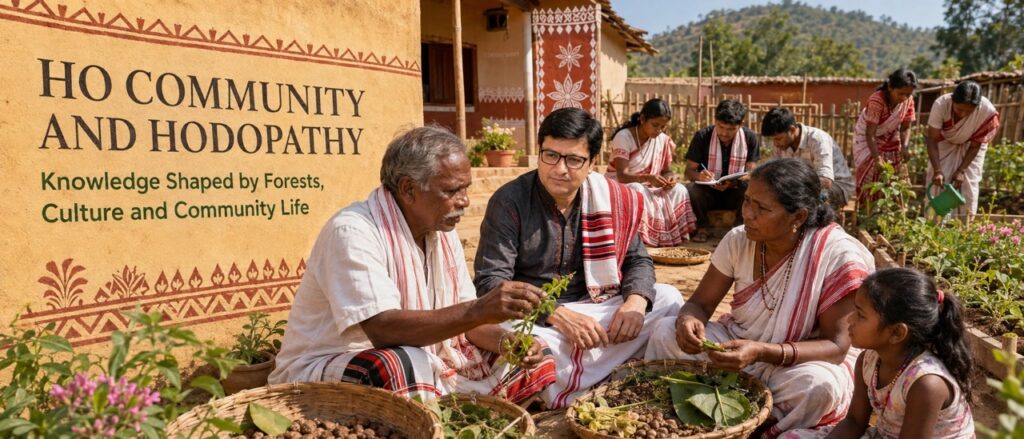
Ho Community and Hodopathy
A Living Relationship Among People, Forests and Indigenous Knowledge
Hodopathy is deeply associated with the Ho community of Jharkhand. Its knowledge developed through generations of observation, practical experience and close interaction with forests, native plants, seasonal foods and local ecosystems.
The Ho community did not create this knowledge within formal institutions or preserve it primarily through written textbooks. It has lived through families, elders, traditional practitioners, indigenous language, oral narratives and daily participation in community life.
Understanding Hodopathy therefore requires more than studying plants. It requires understanding the people, culture and landscapes that have protected this knowledge across generations.
The Ho Community of Jharkhand
The Ho are one of the prominent Adivasi communities of Jharkhand, particularly associated with West Singhbhum and adjoining regions.
The word “Ho” means “human being” or “people” in the Ho language. The community has its own language, oral traditions, social institutions, festivals and cultural practices.
For generations, many Ho villages have maintained close relationships with:
- Forests and native vegetation
- Agricultural land
- Hills and water sources
- Seasonal foods
- Sacred natural spaces
- Community-based decision-making
- Indigenous language and oral traditions
- Local biodiversity
These relationships created an environment in which detailed knowledge of plants, soil, food, seasons and forests could develop and be transmitted.
The Ho community is diverse. People’s experiences differ according to village, location, occupation, education, age and family tradition. No single description can represent every Ho person or settlement.
West Singhbhum and the Saranda Landscape
West Singhbhum is central to discussions about the Ho community and Hodopathy. The district contains extensive forested landscapes, including the well-known Saranda region.
The name Saranda is commonly understood in the Ho language as the “land of seven hundred hills.” The region contains forests, rivers, streams and diverse plant life. Jharkhand’s Forest Department describes the cultures and livelihoods of communities in the Saranda region as closely connected with forests and notes the importance of the landscape for local agriculture and village life.
Within such landscapes, generations of observation helped community members understand:
- Where particular plants grow
- How vegetation changes with the seasons
- Which plants are traditionally associated with food or household use
- When fruits, flowers, leaves and seeds become available
- How rainfall affects forests and agriculture
- Which resources require careful collection
- How plant availability changes over time
The forest thus became a living place of learning.
How Hodopathy Developed Within the Community
Hodopathy did not begin with a single discovery. It developed gradually as community members observed nature, remembered experiences and shared useful knowledge.
A person may have noticed that a particular plant appeared in a certain season. Another may have learned how an elder identified it. A family may have preserved a traditional preparation, while a forest gatherer understood where the species grew and how it could be collected responsibly.
Across generations, these individual experiences became part of collective community knowledge.
The development of Hodopathy may be understood through:
- Repeated observation of local plants
- Practical experience within households
- Knowledge shared by elders
- Long-term learning under practitioners
- Observation of animals and natural processes
- Seasonal food and forest practices
- Community memory
- Indigenous terminology
- Cultural relationships with nature
This accumulated knowledge forms the foundation of Hodopathy.
Hodopathy as Part of a Wider Cultural Heritage
Hodopathy should not be separated from the wider cultural life of the Ho community.
Knowledge about plants may be connected with:
- Language and local terminology
- Food traditions
- Agricultural practices
- Seasonal festivals
- Forest collection
- Family learning
- Sacred landscapes
- Community responsibilities
- Stories and oral history
- Respect for natural cycles
A plant may carry ecological, cultural and linguistic meaning beyond its traditional use. Its local name may describe where it grows, what it looks like or how the community understands it.
Removing the plant from this context can result in an incomplete or misleading account.
Hodopathy is therefore not merely an inventory of natural ingredients. It is one expression of a larger relationship between the Ho people and their environment.
The Role of Ho Elders
Elders are important custodians of community memory.
They may carry knowledge about:
- Plants that were once more widely available
- Traditional names no longer commonly spoken
- Earlier forest conditions
- Seasonal food practices
- Cultural stories associated with landscapes
- Customary methods of collection
- Community restrictions concerning natural resources
- Changes in rainfall, water and vegetation
Their memories can help document both cultural history and environmental change.
When an elder passes away without transferring this knowledge, the community may lose information that cannot be recovered from books or online sources.
Preserving the voices of elders is therefore essential to the continuity of Hodopathy.
Ho Traditional Practitioners
Some members of the Ho community possess specialised knowledge and are recognised locally as traditional practitioners.
They may learn through:
- Family inheritance
- Guidance from an experienced practitioner
- Years of forest observation
- Practical participation
- Community teaching
- Oral narratives
- Repeated experience
Their knowledge can include plant identification, local habitats, collection seasons and customary preparation practices.
Traditional practitioners may also serve as advisers, counsellors, elders or custodians of restricted knowledge.
Not every Ho person is a Hodopathy practitioner, and not every practitioner holds the same information. Knowledge varies among families, villages and individuals.
Community recognition of a practitioner is culturally important, but it is distinct from scientific validation or formal professional healthcare qualifications.
The Importance of the Ho Language
Language carries knowledge that scientific terminology alone cannot preserve.
Ho plant names may contain information about:
- Appearance
- Aroma
- Taste
- Habitat
- Season
- Cultural meaning
- Traditional association
- Relationship with another plant or animal
When such a name is replaced entirely by a common or scientific name, part of its cultural meaning may disappear.
Responsible Hodopathy documentation should therefore record:
- The original Ho name
- Correct pronunciation where possible
- Regional variations
- The meaning of the name
- The contributor who shared it
- The corresponding botanical identity when verified
Botanical names support scientific accuracy, while Ho terminology preserves cultural and ecological meaning. Both should remain visible.
Oral Tradition and Community Learning
Much of Hodopathy has been transmitted orally.
Knowledge may pass through:
- Conversations with elders
- Stories told within families
- Forest visits
- Observation of practitioners
- Participation in food preparation
- Seasonal collection activities
- Community ceremonies
- Repeated practical experience
Oral tradition is dynamic. Accounts may differ from one village or family to another. Such differences should not automatically be treated as mistakes.
They may reflect local environments, distinct family traditions or changes that occurred over time.
Documentation should preserve these variations rather than forcing them into a single standard account.
The Community Is Not Uniform
It is important to avoid presenting the Ho community as if every person shares identical beliefs, knowledge or practices.
Ho individuals may differ in their:
- Familiarity with Hodopathy
- Relationship with forests
- Use of traditional practices
- Religious or cultural interpretation
- Education and occupation
- Interest in documentation
- Willingness to share knowledge
- Views regarding scientific research
Some community members may wish to preserve and share particular knowledge. Others may consider it private or restricted.
Responsible engagement requires listening to individuals and communities rather than making assumptions based solely on identity.
Community Ownership and Individual Recognition
Hodopathy represents collective community heritage, but individual contributors should not become invisible.
If a practitioner or elder shares information, documentation should record their contribution where permission is given. Depending on the contributor’s preference, recognition may include:
- Their name
- Village or region
- Community
- Area of knowledge
- Date of documentation
- Language used
- Family or practitioner tradition
Some people may prefer collective acknowledgement or anonymity.
No outside individual, company or institution should present Hodopathy as a personal invention or claim unrestricted ownership over knowledge received from the Ho community.
Research with the Ho Community
Research involving Hodopathy should treat Ho knowledge holders as partners rather than merely as sources of information.
Community members can help researchers:
- Identify local terminology
- Understand cultural context
- Locate plants within their habitats
- Explain seasonal practices
- Interpret differences among accounts
- Recognise environmental changes
- Identify sensitive knowledge
- Review documentation for accuracy
Researchers can contribute:
- Botanical identification
- Scientific literature review
- Herbarium preparation
- Laboratory analysis
- Safety evaluation
- Conservation assessment
- Digital documentation
- Training and educational resources
Community experience and scientific research serve different functions. Traditional use can suggest important research questions, but it does not automatically establish medical safety or effectiveness.
Research findings must be communicated accurately, including their limitations.
Protecting Sacred and Restricted Knowledge
Not all Ho community knowledge is intended for public disclosure.
Certain knowledge may be:
- Restricted to a family
- Shared only with selected learners
- Connected with sacred practices
- Considered culturally sensitive
- Associated with a rare plant
- Unsuitable for publication because of safety risks
Such information should not be published merely because it may attract public interest.
Knowledge holders should decide what may be recorded, who may access it and how it may be used. Preservation may involve a restricted archive or continued protection within the community rather than open online publication.
The Ho Community and Forest Conservation
The future of Hodopathy is closely connected with the future of Jharkhand’s forests.
Deforestation, mining pressure, habitat disturbance, uncontrolled collection and changing climate conditions may reduce the availability of native plants. When a species disappears from a landscape, the knowledge associated with it can also fade.
Ho knowledge holders can contribute to:
- Community biodiversity records
- Identification of threatened plants
- Sustainable harvesting guidance
- Native-plant cultivation
- Community herbal gardens
- Forest-restoration activities
- Protection of water sources
- Documentation of environmental change
Conservation initiatives should include the people who know and depend upon the landscape.
Connecting Ho Elders and Youth
Intergenerational participation is essential for the continuity of Hodopathy.
Young Ho community members can help elders and practitioners preserve knowledge through:
- Audio and video interviews
- Ho-language documentation
- Botanical photography
- Digital archives
- Biodiversity mapping
- Community herbal gardens
- Oral-history projects
- Responsible academic research
- Conservation campaigns
Modern education and indigenous heritage do not have to exist in conflict. Young people can use scientific, digital and communication skills to preserve community knowledge while remaining guided by elders and cultural values.
Presenting Hodopathy Responsibly
Respect for the Ho community requires both cultural recognition and public responsibility.
Hodopathy should not be used to:
- Make unsupported claims of medical cures
- Encourage self-medication
- Promote unidentified plants
- Take community knowledge without permission
- Commercialise traditions without participation
- Publish sensitive plant locations
- Stereotype the Ho community
- Claim personal ownership over collective heritage
Information about traditional practices should be clearly distinguished from scientifically established medical evidence.
Hodopathy.com is intended for cultural preservation, education, conservation and research awareness. Its content should not be interpreted as medical advice or used as a substitute for professional healthcare.
A Heritage Carried by the Ho Community
The Ho community stands at the heart of Hodopathy because generations of Ho elders, families, forest gatherers and traditional practitioners have kept this knowledge alive.
Their contribution is not limited to identifying useful plants. They have preserved language, ecological observation, oral history, community memory and a way of understanding the relationship between people and nature.
The future of Hodopathy must therefore remain connected with the Ho community. Documentation, research and public awareness should strengthen that connection rather than erase it.
Hodopathy is a living expression of the Ho community’s relationship with Jharkhand’s forests—carried through language, experience and generations of collective knowledge.