
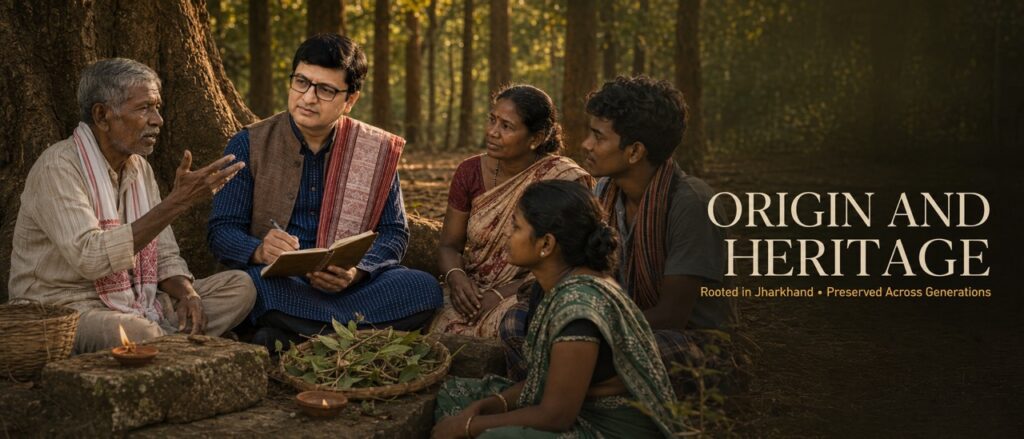
Origin and Heritage of Hodopathy
Born from Jharkhand’s Forests and Preserved Through Generations
Hodopathy is an indigenous knowledge tradition associated particularly with the Ho community and other Adivasi communities of Jharkhand. Its roots lie in generations of close interaction among people, forests, native plants, seasonal foods and the natural environment.
Hodopathy was not created at a particular institution, recorded in a single book or founded by one individual. It developed collectively through observation, experience and community learning. Its knowledge was preserved by elders, traditional practitioners, families and forest-dependent communities long before attempts were made to document it formally.
The heritage of Hodopathy is therefore inseparable from the people who carried it, the languages through which it was transmitted and the forests in which its botanical knowledge developed.
Jharkhand: The Natural Home of Hodopathy
Jharkhand is known for its forests, hills, rivers and exceptional biological diversity. Its landscapes support numerous plants traditionally used for food, household purposes, cultural practices and community well-being.
For Adivasi communities, the forest has never been merely a collection of trees. It is connected with livelihood, identity, spirituality, ancestry and collective memory. Forests provide seasonal foods, leaves, fruits, flowers, seeds, roots and other resources that have supported community life for generations.
The Saranda forests and other forested regions of West Singhbhum are especially significant to the Ho community. Generations of living within these landscapes enabled community members to observe the characteristics of local plants, their seasonal availability, their habitats and their traditional uses.
This knowledge did not emerge from laboratories or written manuals. It developed through direct and continuous interaction with the living environment.
The Ho Community and Hodopathy
The Ho people are one of the prominent Adivasi communities of Jharkhand, with a significant presence in West Singhbhum and surrounding regions. Their language, customs, festivals and community institutions reflect a strong connection with land and nature.
Within Ho society, knowledge of plants and forest resources has traditionally been carried by elders, experienced family members and traditional practitioners. Some information may be commonly known within a village, while specialised knowledge may remain with particular practitioners or families.
Traditional practitioners have often held respected positions within their communities. Their role may extend beyond knowledge of plants to include counselling, community guidance, cultural interpretation and the preservation of customary practices.
Hodopathy is deeply connected with this collective experience. It should therefore be recognised as a community-rooted knowledge tradition rather than the intellectual property of any modern individual or organisation.
An Origin Preserved Through Oral Tradition
There is no single written historical record that establishes the exact date or moment when Hodopathy began. Like many indigenous traditions, its beginnings are preserved mainly through oral accounts, community stories and inherited practices.
Knowledge was passed from one generation to another through:
- Stories and teachings shared by elders
- Observation of plants in forests
- Participation in seasonal collection
- Practical demonstrations by experienced practitioners
- Family and community traditions
- Local names and descriptions of plants
- Repeated experience over many years
- Cultural beliefs and customary practices
This oral method allowed knowledge to remain connected with the landscape and community. A learner did not simply memorise the name of a plant. The learner observed where it grew, how it changed with the seasons, which part was traditionally collected and how the plant related to the surrounding ecosystem.
Because the knowledge was transmitted orally, variations naturally developed among villages, families and practitioners. These differences form part of Hodopathy’s living heritage.
The Folklore of Dhantari
One important oral narrative connected with the traditional plant knowledge of tribal communities is the folklore of Dhantari. Different versions of this story may exist, and it should be understood as community folklore rather than independently verified history.
According to a version documented in published research, Dhantari was a tribal chief who possessed an exceptional understanding of the useful properties of plants growing around him. He shared this knowledge to support members of his community.
The narrative says that when Dhantari approached the end of his life, he wished for his knowledge to continue among people and other living creatures. The story symbolically explains how humans, birds and animals came to possess an instinctive or inherited understanding of plants.
The folklore also expresses a wider Adivasi belief: humans are not the only beings capable of learning from nature. Animals and birds may instinctively recognise plants and natural materials, and people can develop knowledge by carefully observing their behaviour.
Whether interpreted spiritually, culturally or symbolically, the Dhantari narrative highlights the importance of knowledge-sharing, observation and continuity. It reminds us that traditional plant knowledge belongs to a much larger relationship among human beings, animals and the natural world.
Forests as Living Archives
Hodopathy developed without depending primarily on written texts. For generations, the forest itself served as a place of learning.
Trees, plants, rocks, soil, water, seasons, animals and community experiences formed a living archive. Knowledge holders learned by observing changes in plants, comparing habitats and remembering the results of previous practices.
Local terminology also played an essential role. A plant could be known by a name reflecting its appearance, habitat, taste, aroma or traditional significance. Such names may contain ecological and cultural information that cannot be fully understood through botanical classification alone.
When a forest disappears, society may therefore lose more than plant species. It may also lose the language, stories and practical knowledge associated with that ecosystem.
Preserving Hodopathy consequently requires both cultural documentation and environmental conservation.
The Traditional Path of Learning
Becoming a traditional knowledge holder was not necessarily a short or formal process. Learners could spend many years observing and assisting an experienced practitioner.
The learning process might involve:
- Recognising plants in different stages of growth
- Distinguishing useful species from similar-looking plants
- Understanding seasonal availability
- Learning customary collection practices
- Observing preparation methods
- Remembering local quantities and combinations
- Understanding cultural rules and restrictions
- Developing responsibility toward the community
- Protecting confidential or restricted knowledge
Not every part of this knowledge was made public. Some traditions were preserved within families, while certain practices were entrusted only to selected learners.
This form of apprenticeship helped protect the knowledge, but it also made the tradition vulnerable. If a practitioner passed away without transferring their experience, an entire body of local knowledge could disappear.
Nature, Culture and Community Well-Being
Hodopathy grew within a way of life in which food, physical activity, forests, seasons and community relationships were interconnected.
Traditional approaches to well-being could include locally available foods, seasonal eating, plant knowledge, physical work, community support and respect for natural cycles. These elements cannot always be separated into individual remedies or products.
This is why Hodopathy should not be reduced to a list of medicinal plants. Its heritage includes a broader understanding of living responsibly within a natural environment.
It also carries the principle that natural resources should be used carefully. Traditional collection practices may involve taking only what is needed, avoiding unnecessary destruction and recognising that plants must remain available for future generations.
A Heritage Facing Change
The continuity of Hodopathy is affected by rapid social and environmental change.
Important challenges include:
- Loss and degradation of natural forests
- Declining availability of native plants
- Migration from villages to urban areas
- Reduced transfer of knowledge to younger generations
- Ageing of experienced knowledge holders
- Disappearance of indigenous plant terminology
- Unauthorised commercial use of community knowledge
- Incorrect identification of traditional plants
- Exaggerated claims made without community or scientific verification
- Lack of organised documentation
Modern education and development can create valuable opportunities, but they can also weaken intergenerational knowledge transfer when indigenous traditions are dismissed as outdated.
Preservation does not mean preventing communities from changing. It means ensuring that change does not erase their history, identity or collective knowledge.
Preserving Heritage with Consent and Respect
Documenting Hodopathy requires more than recording plant names or photographing traditional practitioners. Ethical preservation must respect the rights, dignity and decisions of the communities concerned.
Responsible documentation should include:
- Prior and informed participation of knowledge holders
- Clear explanation of how information will be used
- Proper acknowledgement of contributors
- Respect for sacred and confidential knowledge
- Accurate botanical and cultural records
- Protection against unauthorised commercial exploitation
- Compliance with applicable biodiversity requirements
- Community involvement in research and publication
- Conservation of the plants and habitats being documented
Not all knowledge needs to be placed in the public domain. Some information may be preserved in restricted archives or remain entirely within the community.
The objective should be to prevent knowledge from disappearing without making it vulnerable to misuse.
A Living Heritage—Not a Relic of the Past
Hodopathy is not simply a historical subject. It remains a living knowledge tradition carried by practitioners, elders and families.
Its relevance today extends to:
- Preservation of indigenous cultural identity
- Documentation of native plant knowledge
- Ethnobotanical and botanical research
- Biodiversity conservation
- Sustainable use of forest resources
- Study of traditional foods and nutrition
- Intergenerational education
- Responsible scientific inquiry
Modern research may help examine particular plants and documented practices. However, scientific study should not separate the knowledge from its original custodians or treat community experience as freely available material.
The future of Hodopathy depends on cooperation among communities, researchers, conservationists and responsible institutions.
Carrying Hodopathy Forward
The story of Hodopathy begins in the relationship between Jharkhand’s Adivasi communities and their forests. It continues through the elders and practitioners who have carried the knowledge across generations.
Its future will depend on whether this heritage can be documented without being exploited, studied without being misrepresented and shared without erasing the identity of its original knowledge holders.
Preserving Hodopathy means preserving more than information about plants. It means protecting community memory, indigenous language, ecological understanding, cultural dignity and a distinctive relationship with nature.
Hodopathy is a living heritage of Jharkhand—born from forests, preserved by Adivasi communities and entrusted to future generations.