
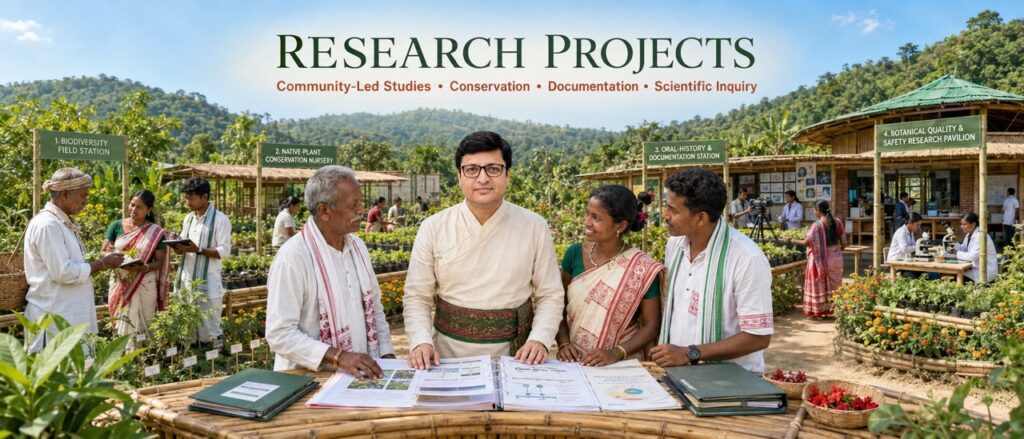
Hodopathy Research Projects
Building Knowledge Through Community Participation and Responsible Science
Hodopathy Research Projects brings together proposed and developing initiatives related to Adivasi knowledge, traditional practitioners, oral heritage, native plants, traditional foods, biodiversity, conservation and scientific evaluation.
The purpose is to create a transparent research portfolio in which every project has a clear objective, defined methodology, evidence status, community-participation plan and expected output.
A project will not be described as active or completed until its status can be verified. Proposed research areas listed on this page represent priorities and opportunities for collaboration—not claims that every activity is already underway.
Research Project Principles
Every Hodopathy research project should be guided by:
- Voluntary community participation
- Respect for knowledge holders
- Clear consent
- Accurate attribution
- Protection of sacred and confidential knowledge
- Botanical verification
- Scientific honesty
- Public safety
- Biodiversity conservation
- Transparent funding
- Disclosure of conflicts of interest
- Responsible publication
- Communication of results to participating communities
Research should investigate knowledge carefully rather than beginning with a promise to prove a desired claim.
Project Status Labels
To maintain transparency, each project should display a status label.
Proposed
A research idea that has not yet entered formal planning.
Community Consultation
The purpose, scope and participation model are being discussed with relevant communities or knowledge holders.
Planning
Methodology, team, resources, approvals and expected outputs are being developed.
Seeking Partners
The project requires qualified researchers, institutions, funding or technical support.
Ethics or Institutional Review
Required ethical, scientific or institutional approvals are being considered or processed.
Fieldwork
Approved on-ground documentation or data collection is in progress.
Botanical Verification
Plant records are being examined by qualified botanical experts.
Laboratory Evaluation
Approved samples are undergoing suitable quality, chemical or safety studies.
Data Analysis
Field or laboratory results are being reviewed.
Community Review
Contributors or community representatives are reviewing relevant records and interpretations.
Publication in Preparation
A report, paper, archive record or educational resource is being prepared.
Completed
The stated research work has been completed and its outputs are available or documented.
Paused
The project is temporarily inactive because of funding, permissions, safety, seasonal or operational reasons.
Closed
The project has ended and will not proceed further.
Every status should include the date it was last reviewed.
Priority Research Project Areas
The following projects represent major opportunities for developing the Hodopathy knowledge and research programme.
Project 1: Ho Oral Knowledge Documentation
Purpose
To record permitted oral histories, community memories, indigenous terminology and knowledge-transmission practices within the Ho community.
Possible Activities
- Interviews with elders
- Practitioner journeys
- Family histories
- Village narratives
- Indigenous-language recordings
- Community stories
- Seasonal calendars
- Intergenerational learning records
Expected Outputs
- Oral-history archive
- Transcripts and translations
- Community Stories
- Educational materials
- Local-language resources
- Research papers where appropriate
Safeguards
Sacred, family-restricted and confidential information should not be made public without specific permission.
Project 2: Traditional Practitioner Profiles
Purpose
To identify and respectfully document experienced Hodopathy practitioners and their contributions to community knowledge.
Possible Activities
- Practitioner interviews
- Learning-history documentation
- Community references
- Photographic profiles
- General areas of knowledge
- Conservation observations
- Messages for younger generations
Expected Outputs
- Verified practitioner profiles
- Audio or video interviews
- Practitioner network
- Community documentation
- Research questions for further study
Important Boundary
A cultural profile does not certify a person as a formally qualified or licensed healthcare professional.
Project 3: Adivasi Knowledge Holder Profiles
Purpose
To recognise the wider circle of knowledge holders beyond specialist practitioners.
Potential Participants
- Elders
- Farmers
- Seed custodians
- Forest-resource collectors
- Food knowledge holders
- Language custodians
- Storytellers
- Artisans
- Conservation leaders
- Youth documentarians
Expected Outputs
- Knowledge Holder Profiles
- Community contribution records
- Oral histories
- Intergenerational-learning resources
- Thematic knowledge maps using non-sensitive information
Project 4: Indigenous Plant Names and Botanical Verification
Purpose
To connect indigenous and local plant names with carefully verified botanical identities.
Possible Activities
- Recording Ho plant names
- Documenting pronunciation
- Photographing plant features
- Recording habitats and seasons
- Reviewing plants with qualified botanists
- Comparing herbarium references
- Preparing voucher specimens where appropriate and permitted
- Recording disputed identifications
Expected Outputs
- Indigenous plant-name catalogue
- Verified botanical records
- Photographic plant archive
- Identification-status labels
- Research and educational resources
Safeguards
Exact locations of rare or vulnerable plants should remain restricted.
Project 5: Community Ethnobotanical Survey
Purpose
To document relationships among communities, plants, food, agriculture, culture and forest resources.
Possible Activities
- Community interviews
- Guided forest walks
- Seasonal surveys
- Plant photography
- Habitat records
- Traditional food documentation
- Cultural-context recording
- Conservation assessment
Expected Outputs
- Ethnobotanical records
- Community biodiversity lists
- Seasonal plant calendars
- Conservation priorities
- Research papers
- Protected archive records
Evidence Boundary
An ethnobotanical record documents traditional knowledge. It does not establish clinical safety or effectiveness.
Project 6: Traditional Foods and Nutrition
Purpose
To preserve and study Adivasi food knowledge and the diversity of seasonal ingredients.
Possible Research Subjects
- Traditional grains
- Pulses
- Local oilseeds
- Edible leaves
- Forest fruits and flowers
- Fermented foods
- Preparation methods
- Food preservation
- Festival foods
- Seasonal dietary diversity
Expected Outputs
- Traditional food archive
- Recipe and preparation records
- Nutritional research priorities
- Botanical verification
- Community educational materials
- Food-diversity studies
Safety Requirement
Wild ingredients require correct identification and appropriate preparation before any nutritional conclusion is made.
Project 7: Local Seeds and Agricultural Heritage
Purpose
To document crop varieties and farming knowledge preserved by Adivasi and rural communities.
Possible Activities
- Seed-custodian profiles
- Local crop records
- Soil knowledge
- Planting calendars
- Mixed-cropping practices
- Climate observations
- Agricultural biodiversity mapping
- Farmer-led conservation
Expected Outputs
- Seed heritage catalogue
- Farmer profiles
- Community seed records
- Agricultural research priorities
- Educational materials
- Conservation initiatives
Project 8: Forest Change and Community Biodiversity
Purpose
To document community observations of environmental change.
Possible Research Questions
- Which plants are becoming difficult to find?
- How have flowering and fruiting seasons changed?
- Which habitats face increasing pressure?
- How has water availability changed?
- What harvesting practices support regeneration?
- Which native species require conservation?
- How can community participation strengthen restoration?
Expected Outputs
- Community biodiversity records
- Environmental-change narratives
- Conservation maps using non-sensitive data
- Priority species lists
- Restoration recommendations
- Research collaborations
Project 9: Sustainable Harvesting and Cultivation
Purpose
To explore ways of conserving traditionally important plants while reducing pressure on natural forests.
Possible Activities
- Community harvesting studies
- Species regeneration observations
- Cultivation trials
- Nursery development
- Community herbal gardens
- Seed and planting-material preservation
- Habitat-restoration activities
- Traceability systems
Expected Outputs
- Species-specific harvesting guidance
- Community garden models
- Cultivation records
- Conservation plans
- Training materials
- Sustainable livelihood research
Not every forest plant can be cultivated successfully outside its natural ecological setting.
Project 10: Research Literature and Evidence Mapping
Purpose
To identify and organise existing research related to Hodopathy and its associated subjects.
Possible Activities
- Bibliographic searches
- Publication classification
- Evidence-level labelling
- Botanical-name verification
- Review of study quality
- Identification of research gaps
- Correction and retraction tracking
- Plain-language summaries
Expected Outputs
- Hodopathy Research Library
- Evidence maps
- Research bibliographies
- Thematic reviews
- Priority research questions
- Public educational summaries
Project 11: Quality and Safety Review of Documented Plants
Purpose
To examine known risks and quality issues concerning selected and botanically verified plants.
Possible Research Areas
- Botanical substitution
- Adulteration
- Contamination
- Heavy metals
- Pesticide residues
- Microbial contamination
- Fungal growth
- Toxic plant parts
- Medicine interactions
- Storage and processing
- Published toxicity evidence
Expected Outputs
- Safety-review reports
- Quality-control priorities
- Risk-communication materials
- Research recommendations
- Evidence labels for archive records
A safety review should not be interpreted as approval for self-medication.
Project 12: Scientific Evaluation of Selected Plants
Purpose
To investigate selected plants only after adequate documentation, botanical verification and research justification.
Possible Stages
- Traditional account documentation
- Botanical authentication
- Literature review
- Raw-material quality testing
- Phytochemical analysis
- Laboratory research
- Toxicity assessment
- Standardisation
- Advanced research where justified
Expected Outputs
- Scientific reports
- Verified plant data
- Safety information
- Evidence-gap analysis
- Research publications
- Decisions about whether further study is appropriate
Human studies should be considered only when sufficient preliminary evidence, safety data, ethical approval and applicable regulatory requirements are in place.
Project 13: Ho Language and Plant Terminology
Purpose
To preserve language connected with plants, forests, food, seasons and community practices.
Possible Activities
- Audio pronunciation
- Local term collection
- Regional variation
- Translation review
- Story recording
- Plant-name meaning
- Youth language documentation
- Community glossary development
Expected Outputs
- Digital pronunciation archive
- Ho terminology glossary
- Local-language educational resources
- Searchable archive records
- Linguistic research
- Community learning materials
Project 14: Digital Knowledge Archive
Purpose
To create a protected and structured digital repository for Hodopathy knowledge.
Possible Components
- Knowledge Holder Profiles
- Oral histories
- Plant records
- Audio and video
- Transcriptions
- Translations
- Botanical reviews
- Research references
- Conservation records
- Access classifications
- Consent and correction history
Expected Outputs
- Public educational archive
- Community-access records
- Approved research collections
- Restricted and confidential records
- Search and discovery tools
- Long-term preservation system
Digital access should not mean unrestricted access.
Project 15: Youth Documentation and Research Training
Purpose
To prepare Adivasi youth and students to participate in knowledge preservation responsibly.
Possible Training Areas
- Oral-history interviews
- Audio and video recording
- Photography
- Indigenous-language transcription
- Botanical documentation
- Biodiversity mapping
- Research ethics
- Consent
- Digital archiving
- Scientific literature review
Expected Outputs
- Trained youth documentarians
- Community documentation teams
- Local-language records
- Biodiversity projects
- Educational resources
- Intergenerational-learning activities
Project 16: Community Rights and Ethical Governance
Purpose
To develop practical approaches for protecting community knowledge during documentation, research and publication.
Possible Research Subjects
- Contributor consent
- Community participation
- Access classification
- Attribution
- Restricted knowledge
- Research-data governance
- Benefit-sharing considerations
- Commercial-interest disclosure
- Correction and withdrawal procedures
- Community review
Expected Outputs
- Ethical documentation guidelines
- Consent models
- Data-access framework
- Community-review process
- Research-collaboration standards
- Public accountability reports
Selecting Research Projects
A proposed project should be evaluated according to:
- Community relevance
- Community interest
- Cultural sensitivity
- Scientific value
- Safety
- Botanical certainty
- Conservation impact
- Feasibility
- Available expertise
- Institutional capacity
- Funding
- Expected public or community benefit
- Risk of misuse
- Ability to communicate findings responsibly
Projects should not be selected only because they may create commercial value.
Standard Project Record
Every listed project should contain:
- Project title
- Short description
- Status
- Lead researcher or coordinator
- Community participants
- Partner institutions
- Study area
- Start date
- Expected completion date
- Funding source
- Methodology
- Ethical or institutional approval
- Data-access plan
- Expected outputs
- Current progress
- Limitations
- Last updated date
- Publications or reports
- Contact or collaboration route
If information is not yet available, the project record should say so clearly.
Community Participation
Community participation may include:
- Identifying research priorities
- Recommending knowledge holders
- Reviewing methods
- Participating in documentation
- Explaining language and cultural context
- Protecting restricted knowledge
- Reviewing records
- Interpreting findings
- Supporting conservation
- Receiving appropriate results
Community members should not be invited only after the main research decisions have already been made.
Research Partnerships
Hodopathy welcomes responsible proposals from:
- Adivasi communities
- Traditional practitioners
- Universities
- Botanical institutions
- Ethnobotanists
- Social scientists
- Food and nutrition researchers
- Scientific laboratories
- Biodiversity organisations
- Language specialists
- Archives and museums
- Conservation groups
- Public-interest institutions
A proposed partner should explain:
- Expertise
- Institutional affiliation
- Research purpose
- Methodology
- Funding
- Ethical approval
- Information required
- Community-participation model
- Expected outputs
- Publication plan
- Data-use plan
- Commercial interests
- Conservation considerations
Funding Transparency
Every funded project should identify:
- Funding organisation
- Grant or support type
- Project period
- Research purpose
- Potential conflicts of interest
- Whether a commercial outcome is expected
- Restrictions placed by the funder
- Community benefit considerations
Funding should not influence researchers to hide negative findings or exaggerate conclusions.
Reporting Results
Project findings should be reported accurately whether they are:
- Positive
- Negative
- Inconclusive
- Incomplete
- Limited by methodology
- Unable to be reproduced
Every report should distinguish among traditional knowledge, field observation, laboratory findings and clinical evidence.
Projects should also communicate appropriate results to participating communities in accessible formats.
Propose a Research Project
Researchers, institutions and community organisations may submit a project concept through the website’s Connect or Contact page.
A proposal should include:
- Project title
- Research question
- Background
- Community or study area
- Proposed participants
- Methodology
- Research team
- Institutional affiliation
- Timeline
- Funding
- Ethical approval status
- Community-participation plan
- Data-access plan
- Expected outputs
- Risks
- Conservation implications
- Publication plan
- Commercial interests
- Relevant previous work
Submission does not guarantee acceptance or collaboration.
Every project must be reviewed for relevance, ethics, scientific quality, community participation, safety and available capacity.
Research That Serves Knowledge and Community
Hodopathy Research Projects should preserve heritage, strengthen community participation, protect biodiversity and improve the quality of evidence.
Success should not be measured only by the number of studies completed. It should also be measured by whether:
- Knowledge holders remain recognised
- Communities participate meaningfully
- Sensitive knowledge stays protected
- Plants and habitats are conserved
- Methods are scientifically sound
- Limitations are communicated honestly
- Results return value to communities
- Unsupported claims are avoided
Information on Hodopathy.com is intended for cultural preservation, education and research awareness. It is not medical advice and should not be used for self-treatment.
Every Hodopathy research project should begin with community respect, proceed through reliable methods and end with transparent evidence.