
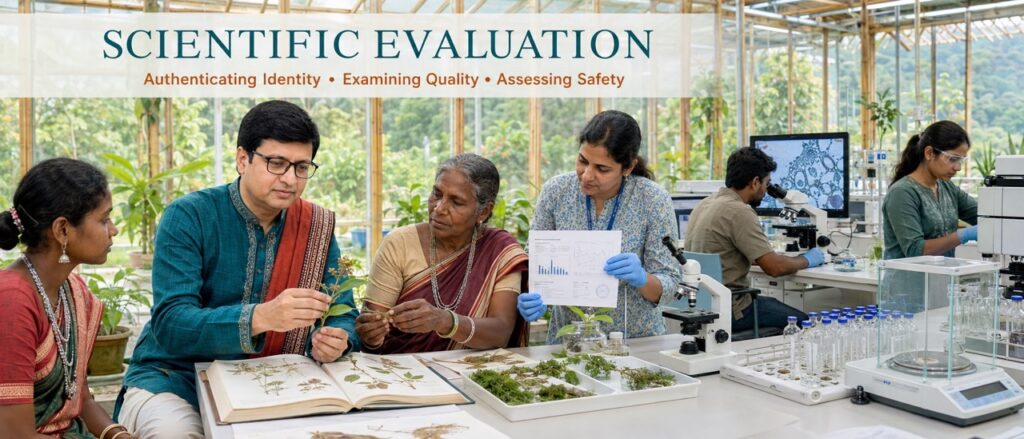
Scientific Evaluation of Hodopathy
From Traditional Knowledge to Testable Evidence
Scientific evaluation is the systematic process of examining a documented plant, preparation or traditional account to understand its identity, composition, quality, safety and possible effects.
For Hodopathy, scientific evaluation begins with knowledge shared by traditional practitioners and Adivasi knowledge holders. Their observations may help identify important plants, foods, practices and research questions.
However, traditional use alone does not establish scientific proof.
Evaluation may:
- Support part of a traditional account
- Identify a different possible explanation
- Reveal important safety limitations
- Find that available evidence is insufficient
- Show that a claim cannot be reproduced
- Indicate that further research is justified
- Conclude that a preparation should not be developed or used
Responsible science must remain open to every possible outcome.
Respecting Tradition Without Predetermining Results
The purpose of scientific evaluation is not to approve every traditional claim automatically. It is also not to dismiss community knowledge without investigation.
Traditional knowledge and scientific evidence answer different questions.
Traditional knowledge may explain:
- What communities have observed
- Which plants are culturally important
- How knowledge was transmitted
- Which plant parts were traditionally recognised
- What preparation practices were reported
- How the plant relates to food, forests or community life
Scientific evaluation may examine:
- Whether the plant is correctly identified
- Which natural compounds are present
- Whether the material is contaminated
- Whether an observed activity can be reproduced
- What quantity may create risk
- Whether results apply to people
- Whether benefits outweigh possible harms
Both forms of knowledge should be represented honestly.
Core Principles of Scientific Evaluation
Hodopathy research should follow these principles:
Correct Identity Before Testing
Research has little value if the wrong plant or plant part is studied.
Safety Before Claims
No preparation should be promoted merely because it is described as natural or traditional.
Evidence Before Conclusion
A laboratory observation should not be presented as clinical proof.
Reproducibility
Results should be capable of being repeated using clearly described methods.
Community Participation
Original knowledge holders should remain acknowledged and meaningfully involved.
Transparency
Methods, funding, conflicts of interest and limitations should be disclosed.
Conservation
Research should not threaten rare plants or encourage destructive harvesting.
Ethical Responsibility
Human or animal research should proceed only when scientifically justified and appropriately approved.
The Scientific Evaluation Pathway
Not every documented plant or practice needs to complete every stage. Research should progress only when evidence from an earlier stage justifies the next.
Stage 1: Document the Traditional Account
The first stage is to record the knowledge accurately.
Documentation may include:
- Knowledge holder
- Community
- Indigenous plant name
- Language
- General location
- Plant part
- Season
- Preparation described
- Cultural context
- Traditional association
- Differences among practitioners
- Access restrictions
- Contributor permission
The original account should remain separate from later scientific interpretation.
Stage 2: Confirm Botanical Identity
A local name is not enough to identify a species.
Botanical authentication may involve:
- Field photographs
- Leaves and their arrangement
- Bark or stem
- Flowers
- Fruits and seeds
- Growth form
- Habitat
- Review by a qualified botanist
- Comparison with botanical references
- Herbarium examination
- Voucher specimens where appropriate and permitted
Each record should show whether identification is:
- Unverified
- Provisional
- Expert reviewed
- Verified
- Disputed
Testing should not proceed under a false certainty about identity.
Stage 3: Verify the Plant Part and Source
Different parts of one plant can contain different compounds and create different risks.
Researchers should document:
- Exact plant part
- Source location
- Cultivated or wild origin
- Collection season
- Stage of growth
- Harvesting method
- Drying
- Storage
- Processing
- Time between collection and testing
Results obtained from a leaf extract cannot automatically be applied to the root, fruit, seed or whole plant.
Stage 4: Review Existing Knowledge
Before beginning new laboratory work, researchers should examine existing information.
The review may include:
- Botanical literature
- Ethnobotanical studies
- Traditional food records
- Phytochemical research
- Biological studies
- Toxicity reports
- Human research
- Medicine interactions
- Conservation status
- Regulatory information
- Corrections and retractions
A careful review can prevent unnecessary duplication and identify known risks early.
Stage 5: Assess Raw-Material Quality
Plant material should be examined for identity, purity and contamination.
Quality assessment may include:
- Foreign matter
- Moisture
- Microbial contamination
- Fungal growth
- Pesticide residues
- Heavy metals
- Adulteration
- Substitution
- Storage damage
- Natural variation among samples
A contaminated or incorrectly stored sample can produce misleading results and create safety risks.
Stage 6: Study Chemical Composition
Phytochemical research may examine the natural compounds present in a plant.
Researchers may investigate:
- Major compound groups
- Chemical markers
- Differences among plant parts
- Seasonal variation
- Geographic variation
- Effects of processing
- Stability during storage
- Variation among batches
Detecting a compound does not prove that the plant safely produces a particular effect in people.
Chemical composition is one part of the evidence pathway.
Stage 7: Evaluate Laboratory Activity
Laboratory studies may examine whether an extract or compound shows a measurable biological activity under controlled conditions.
These studies can help:
- Explore possible mechanisms
- Compare extracts
- Identify potentially active fractions
- Generate hypotheses
- Decide whether further study is justified
Laboratory findings have important limitations.
An effect observed in a test tube may not occur in the human body. The quantity used may be unrealistic or unsafe. The extract may also differ from the preparation described by the knowledge holder.
Laboratory activity should therefore be described as preliminary evidence.
Stage 8: Conduct Safety and Toxicity Studies
Safety evaluation should not be postponed until after claims are made.
Research may examine:
- Acute toxicity
- Repeated exposure
- Effects on major organs
- Allergic potential
- Genetic toxicity where relevant
- Reproductive risk
- Medicine interactions
- Risks for vulnerable populations
- Safe storage
- Contamination
- Effects of different preparation methods
The absence of a reported traditional problem does not prove safety.
Long-term or uncommon harms may not be recognised without systematic monitoring.
Stage 9: Examine Preparation and Standardisation
Traditional preparations can vary according to practitioner, season, plant source and method.
Researchers may need to document:
- Ingredient identity
- Plant part
- Proportion
- Preparation method
- Temperature
- Time
- Solvent or medium
- Fresh or dried material
- Storage
- Stability
- Batch consistency
A study cannot be interpreted reliably if the tested preparation cannot be reproduced.
Standardisation should support research quality without erasing meaningful cultural differences. Traditional variations should remain documented even when one preparation is selected for testing.
Stage 10: Preclinical Research
Preclinical studies may be considered when laboratory and safety findings justify further investigation.
Such studies may examine:
- Biological response
- Possible mechanism
- Absorption
- Distribution
- Metabolism
- Excretion
- Quantity-response relationship
- Toxicity
- Interaction with other substances
Preclinical evidence is not clinical evidence.
Results from non-human models may not apply to people and should not be advertised as proof of treatment.
Stage 11: Human Research
Human research should begin only when:
- Botanical identity is confirmed
- The preparation is reproducible
- Adequate safety information exists
- The research question is scientifically justified
- Qualified clinical and scientific experts are involved
- Independent ethical approval has been obtained
- Participants provide informed consent
- Risks can be monitored
- Applicable regulatory requirements are met
- The study is properly registered where required
- Results will be reported transparently
Appropriate study design may require:
- Clearly defined participants
- Suitable comparison group
- Randomisation
- Blinding where feasible
- Predefined outcomes
- Adequate sample size
- Adverse-event monitoring
- Statistical analysis plan
- Independent oversight
A personal testimonial cannot replace a controlled human study.
Stage 12: Independent Replication
A single positive study is rarely sufficient.
Scientific confidence increases when:
- Independent researchers reproduce the result
- Methods are transparent
- Samples are correctly identified
- Findings remain consistent across settings
- Negative results are also published
- Bias and conflicts of interest are examined
Research associated only with one team, one batch or one institution should be interpreted cautiously until replicated.
Stage 13: Evidence Review
As research accumulates, studies may be evaluated collectively.
A systematic review may examine:
- Study quality
- Participant numbers
- Consistency
- Risk of bias
- Botanical identity
- Preparation differences
- Safety findings
- Publication bias
- Relevance to the intended population
Several weak studies do not necessarily create strong evidence.
Understanding the Evidence Levels
Traditional Account
Documents inherited or community knowledge.
Ethnobotanical Evidence
Records a relationship between people and plants.
Botanical Evidence
Confirms plant identity or distribution.
Chemical Evidence
Identifies compounds.
Laboratory Evidence
Shows activity under controlled conditions.
Preclinical Evidence
Examines activity or safety in non-human models.
Observational Human Evidence
Records outcomes without random assignment.
Controlled Clinical Evidence
Tests an intervention against a suitable comparison.
Systematic Evidence
Evaluates findings across multiple studies.
Every level contributes information, but lower levels should not be described as if they provide higher-level proof.
Selecting Research Priorities
Not every traditional record should progress to laboratory or clinical study.
Possible research priorities may be selected according to:
- Quality of community documentation
- Botanical certainty
- Cultural importance
- Public-health relevance
- Existing scientific evidence
- Safety concerns
- Conservation status
- Feasibility
- Availability of qualified partners
- Community interest
- Potential for responsible benefit
- Risk of misuse
A rare plant may be culturally important but unsuitable for development if research demand could threaten its survival.
Community Participation in Evaluation
Knowledge holders can contribute more than the initial plant name.
They may help researchers understand:
- Indigenous terminology
- Plant habitat
- Seasonal variation
- Plant part
- Preparation context
- Differences among practitioners
- Cultural restrictions
- Conservation concerns
- Community priorities
Scientific evaluation should acknowledge:
- Individual contributors
- Families where appropriate
- Community of origin
- Language
- Documentation team
- Botanical experts
- Research partners
Community contributors should not disappear after laboratory work begins.
Protecting Traditional Knowledge
Scientific evaluation does not transfer ownership of community knowledge automatically to a researcher, institution or company.
Before research begins, participants should understand:
- Information being requested
- Samples being collected
- Tests being proposed
- Data-storage arrangements
- Publication plans
- Possible intellectual-property interests
- Potential commercial development
- Community participation
- Access and benefit-sharing considerations
- Confidentiality
Sacred or restricted knowledge should not be disclosed merely because it could generate a research project.
Research and Biodiversity
Scientific interest can increase pressure on a plant.
Evaluation should consider:
- Local abundance
- Habitat condition
- Reproductive cycle
- Harvesting impact
- Cultivation potential
- Alternative plant parts
- Community conservation practices
- Protection of exact locations
- Sustainable sourcing
Research should never endanger the species it seeks to understand.
Interpreting Negative or Inconclusive Results
A study may find:
- No measurable activity
- Inconsistent results
- High toxicity
- Unacceptable contamination
- Insufficient stability
- No difference from a comparison
- Benefits too small to justify risks
- Inability to reproduce earlier findings
Such results are valuable.
They can prevent unsafe development, improve future methods and protect the public from misleading claims.
Negative findings should not be hidden because they conflict with expectations.
Communicating Scientific Findings
Research communication should use language that matches the evidence.
Appropriate wording may include:
- “Traditionally reported”
- “Documented in a community survey”
- “Provisionally identified”
- “Laboratory activity was observed”
- “Preliminary findings”
- “Further safety research is required”
- “Human effectiveness has not been established”
- “Evidence remains insufficient”
Inappropriate wording may include:
- “Guaranteed cure”
- “Proven safe because it is natural”
- “Scientifically validated” based only on a laboratory study
- “No side effects” without adequate safety data
- “Works for everyone”
- “Replaces medical treatment”
Accurate language protects the credibility of both the research and the knowledge tradition.
Quality and Transparency
A scientific report should disclose:
- Research question
- Plant identity
- Sample source
- Collection and processing
- Methods
- Results
- Statistical analysis
- Limitations
- Funding
- Conflicts of interest
- Ethical approval
- Community contribution
- Data-access restrictions
- Negative findings
Research that hides methods or overstates conclusions should not be treated as reliable evidence.
Institutional Collaboration
Scientific evaluation may involve:
- Adivasi communities
- Traditional practitioners
- Botanists
- Ethnobotanists
- Chemists
- Pharmacognosy researchers
- Toxicologists
- Food and nutrition scientists
- Clinical researchers
- Universities
- Laboratories
- Biodiversity institutions
- Ethics committees
- Conservation organisations
No single discipline can answer every question.
Responsible evaluation requires collaboration among community knowledge, botanical expertise, laboratory science, safety research and ethical oversight.
What Scientific Evaluation Does Not Mean
Scientific evaluation does not mean:
- Every traditional claim will be confirmed
- Every plant will become a product
- Traditional practitioners become automatically licensed clinicians
- Laboratory results prove human effectiveness
- Natural ingredients have no side effects
- Community knowledge becomes freely available
- Researchers own the tradition
- Medical advice can be given through a website
Evaluation is a process of asking questions—not guaranteeing a desired conclusion.
Participate in Scientific Evaluation
Researchers and institutions interested in collaboration may contact Hodopathy through the website’s Connect or Contact page.
A proposal should include:
- Research question
- Relevant expertise
- Institution
- Plant or subject
- Existing documentation
- Proposed methodology
- Safety plan
- Community-participation plan
- Ethical approval status
- Funding
- Expected outputs
- Publication and data-use plan
- Commercial interests
- Conservation considerations
Every proposal should be reviewed for scientific value, community participation, safety, ethics and environmental responsibility.
Tradition Guides the Question—Evidence Guides the Conclusion
Traditional knowledge can help science identify meaningful questions. Scientific evaluation can examine those questions using systematic methods.
The relationship should be respectful but honest. Community knowledge must not be exploited, and scientific uncertainty must not be hidden.
Information on Hodopathy.com is intended for cultural preservation, education and research awareness. It is not medical advice and should not be used for self-treatment.
Scientific evaluation does not begin by assuming that a claim is true or false. It begins by documenting carefully, testing responsibly and following the evidence wherever it leads.