
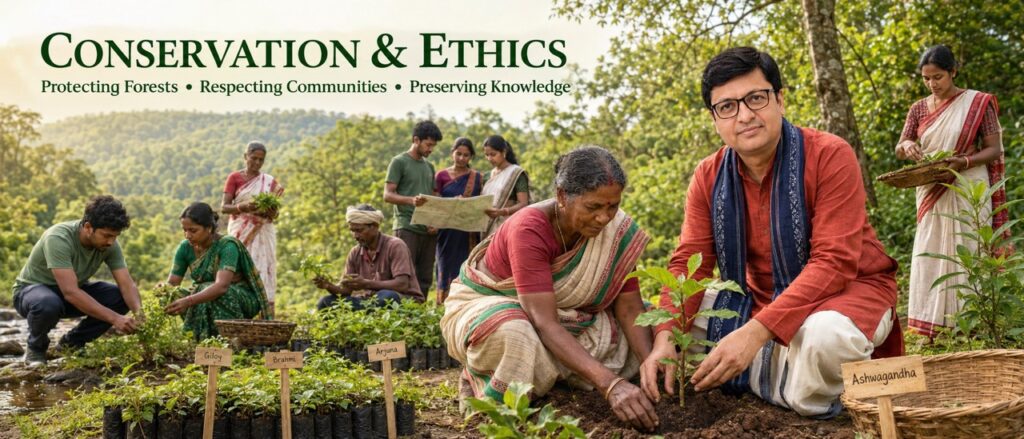
Conservation & Ethics
Protecting Adivasi Knowledge, Community Rights and the Forests That Sustain Hodopathy
Hodopathy is rooted in the traditional knowledge, lived experience and nature-based practices preserved by Adivasi and tribal communities. This knowledge has developed through generations of close interaction with forests, medicinal plants, local foods, seasonal cycles and community life.
Its preservation therefore requires more than recording the names and uses of plants. It requires respect for the knowledge holders, protection of community rights, conservation of biodiversity and responsible scientific engagement.
Hodopathy believes that traditional knowledge should never be separated from the people, culture and ecosystems that have sustained it.
Knowledge Is a Living Heritage
Traditional knowledge is not simply information waiting to be collected. It is a living heritage carried by elders, traditional practitioners, families and communities. It may include botanical understanding, harvesting practices, preparation methods, seasonal observations, spiritual beliefs and customary rules governing how knowledge is transmitted.
The research paper Hodopathy Practitioners: Demanding Space in Urban Institutions and Inclusion in AYUSHdescribes how some traditional practitioners in Jharkhand regard medicinal plants as sacred, seek permission before collection and carefully guard knowledge that is passed from teacher to apprentice. It also records concerns that uncontrolled collection could deplete medicinal plants from local forests. Read the referenced research paper.
These traditions must be approached with humility. Documentation should support cultural continuity—not turn community heritage into publicly accessible information that others can freely exploit.
Community Participation Comes First
Adivasi and tribal communities should not be treated merely as sources of information, photographs, plant materials or commercial ingredients. They must be recognised as active participants and custodians of their knowledge.
Before any interview, recording, photography, sample collection, publication, research project or product-development activity, the purpose of the proposed work should be explained clearly and in an appropriate local language.
Participation should be voluntary. Knowledge holders must be able to:
- Accept or decline participation without pressure
- Decide what knowledge may be recorded
- Specify whether their name and identity may be disclosed
- Restrict access to sensitive information
- Review how their contribution will be presented
- Withdraw permission where reasonably possible
- Participate in decisions about future use of the knowledge
Consent is not merely a signature on a form. It is an ongoing relationship based on understanding, trust and accountability.
Free, Prior and Informed Consent
Hodopathy supports the principle of free, prior and informed consent—or the approval and involvement of knowledge holders—before accessing or using community knowledge.
“Free” means that consent is given without manipulation, coercion or unfair influence. “Prior” means that permission is obtained before documentation or use begins. “Informed” means that the community understands the purpose, possible risks, expected benefits, intended audience and future uses of the information.
Consent for one purpose should not automatically be treated as permission for every other purpose. For example, permission to document a practice for a restricted research archive does not necessarily include permission to publish it online, apply for intellectual property rights or develop a commercial product.
This approach reflects the Convention on Biological Diversity, which calls for traditional knowledge to be respected and used with the approval and involvement of its holders, along with equitable sharing of benefits arising from its use. Convention on Biological Diversity—Article 8(j).
Protecting Sacred, Secret and Sensitive Knowledge
Not every form of knowledge should be published.
Some Hodopathy knowledge may be sacred, restricted to particular families, transmitted only to selected apprentices or connected with ceremonies and cultural responsibilities. Some information may also be ecologically sensitive—for example, the exact location of a rare medicinal plant.
Such knowledge should remain confidential unless its recognised custodians explicitly decide otherwise. Where documentation is permitted, access may need to be restricted through community-controlled archives, confidentiality agreements or different levels of digital access.
The World Intellectual Property Organization warns that documentation can unintentionally expose traditional knowledge to misuse. Recording information does not automatically protect it and may make it easier for outsiders to copy, publish or commercialise it. Documentation must therefore begin with an agreed protection strategy. WIPO Traditional Knowledge Documentation Toolkit.
Ethical Documentation and Data Stewardship
Hodopathy aims to document knowledge responsibly while preserving its cultural context and origin. Wherever appropriate, records should include:
- The name of the community and geographical region
- The identity of the knowledge holder, when disclosure is permitted
- Local and botanical names of plants
- Habitat, seasonality and conservation status
- Traditional methods of collection and preparation
- Cultural restrictions associated with the knowledge
- The consent conditions governing documentation and use
- Who may access the record
- Whether publication, research or commercial use is permitted
- Any acknowledgement or benefit-sharing arrangements
Photographs, audio recordings, videos, field notes and plant-location data should be stored securely. Access should be limited according to the wishes of the knowledge holders.
Community members should, wherever practical, receive copies of the documentation in accessible formats and appropriate languages. They should not lose access to their own heritage after sharing it with an institution or researcher.
Conserving Forests and Medicinal Plants
Hodopathy cannot be preserved if the forests and native plants on which it depends are destroyed. Human well-being and environmental well-being are inseparable.
Increased attention to traditional remedies can place pressure on wild plant populations. Commercial demand may encourage excessive harvesting, uprooting of entire plants or collection during unsuitable seasons. Public disclosure of the locations of rare species may create further risks.
Hodopathy therefore encourages:
- Sustainable and selective harvesting
- Avoidance of destructive root and bark collection
- Protection of rare, threatened and slow-growing species
- Collection at appropriate seasons and stages of growth
- Leaving sufficient plants for natural regeneration
- Cultivation of suitable medicinal species outside forests
- Community-managed nurseries and herbal gardens
- Habitat restoration and native-species plantation
- Traceable and legally compliant sourcing
- Monitoring of ecological impact before scaling production
Cultivation can reduce pressure on wild populations, but it should not become an excuse to weaken forest conservation. Sacred groves, natural habitats, soil, water and pollinators are all part of the ecological foundation of Hodopathy.
The World Health Organization similarly connects traditional medicine with biodiversity conservation, respectful knowledge exchange and equitable access to benefits. WHO—Traditional Medicine, Biodiversity and Indigenous Knowledges.
Recognition and Fair Benefit-Sharing
Acknowledgement is essential, but acknowledgement alone may not be sufficient. When traditional knowledge or biological resources contribute to funded research, educational programmes, intellectual property, publications or commercial development, the originating communities should have a fair opportunity to share in the resulting benefits.
Benefits may be monetary or non-monetary and could include:
- Direct payments or community development funds
- Employment and livelihood opportunities
- Training, scholarships and research participation
- Support for community nurseries and conservation projects
- Healthcare, education or local infrastructure initiatives
- Joint authorship or acknowledgement in publications
- Access to research findings and developed technologies
- Participation in governance and decision-making
- Long-term purchasing agreements with community producers
- Support for intergenerational knowledge transmission
Benefit-sharing arrangements should be transparent, documented and developed through consultation. They must also comply with India’s Biological Diversity Act, its amendments, the Biological Diversity Rules, applicable Access and Benefit-Sharing requirements and other relevant laws. India’s biodiversity framework connects the use of biological resources and associated traditional knowledge with conservation, sustainable use and fair sharing of benefits. National Biodiversity Authority—Rules and regulations.
Ethical Research and Scientific Evaluation
Scientific evaluation can help identify plants correctly, assess composition, detect contamination and examine safety and potential usefulness. However, research must not reduce traditional practitioners to anonymous “informants” while outsiders receive recognition, funding or ownership.
Ethical research should include:
- Meaningful community consultation
- Appropriate institutional ethics review
- Clearly documented consent
- Respect for privacy and cultural practices
- Botanical authentication of plant materials
- Transparent disclosure of funding and conflicts of interest
- Recognition of knowledge holders and community contributors
- Careful benefit-risk assessment
- Responsible handling of biological samples and data
- Honest publication of positive, negative and inconclusive findings
Where research involves human participants, it should follow applicable ethical and regulatory requirements. The Indian Council of Medical Research emphasises informed consent, protection of vulnerable populations, community engagement and appropriate ethical review in biomedical and health research. ICMR National Ethical Guidelines.
Traditional use may provide a valuable basis for investigation, but it does not by itself establish clinical safety or effectiveness. Scientific findings should be communicated accurately and without disrespecting the knowledge system that inspired the research.
Responsible Health Communication
Conservation ethics also includes protecting people from misinformation.
Hodopathy content should distinguish clearly among traditional use, preliminary laboratory findings, observational evidence and clinically established results. Traditional experience should be represented respectfully, but unverified remedies should not be promoted as guaranteed cures.
Responsible communication means:
- Avoiding exaggerated or absolute health claims
- Not presenting traditional knowledge as a substitute for emergency care
- Not publishing unsafe preparation methods or dosages
- Explaining that “natural” does not automatically mean safe
- Acknowledging possible toxicity, allergies and interactions
- Encouraging appropriate professional medical advice
- Updating information when better evidence becomes available
- Correcting inaccuracies transparently
Documentation on this website is intended for cultural preservation, education and responsible research. It should not be interpreted as individual medical advice, diagnosis or a recommendation for self-treatment.
Our Ethical Commitment
Hodopathy is committed to preserving Adivasi and tribal knowledge through partnership rather than extraction.
We seek to:
- Respect the dignity, identity and customary rights of knowledge holders
- Obtain informed permission before recording or using community knowledge
- Protect sacred, secret and ecologically sensitive information
- Recognise the original custodians and geographical sources of knowledge
- Promote fair and equitable benefit-sharing
- Encourage community participation in research and decision-making
- Conserve medicinal plants, native species and forest ecosystems
- Support sustainable cultivation and traceable sourcing
- Encourage independent, transparent scientific evaluation
- Avoid misleading medical claims and irresponsible commercialisation
- Preserve knowledge for future generations without removing it from community control
Preservation Through Partnership
The future of Hodopathy depends on a balanced relationship among communities, traditional practitioners, researchers, conservationists and responsible institutions.
Preservation must not mean taking knowledge away from its custodians. Research must not become exploitation. Commercial development must not damage forests or exclude the people whose traditions made innovation possible.
Hodopathy’s purpose is to help protect a living knowledge system—its people, plants, languages, cultural values and landscapes—while creating responsible pathways for documentation, conservation and scientific understanding.
When communities remain respected, biodiversity remains protected and knowledge is used with consent, Hodopathy can continue as a living heritage for generations to come.