
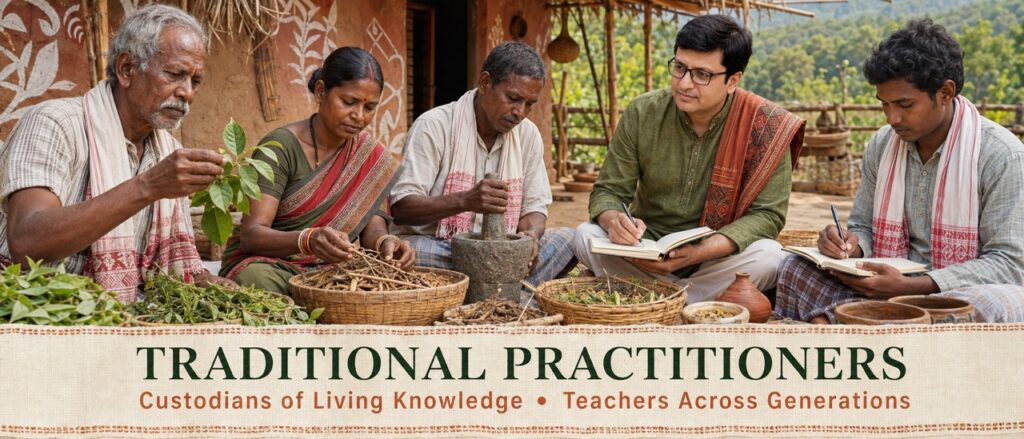
Traditional Practitioners
Custodians of Hodopathy’s Living Knowledge
Traditional practitioners are among the most important custodians of Hodopathy. Through observation, oral teaching and practical experience, they have helped preserve community knowledge of native plants, forests, seasonal resources and customary practices across generations.
Their knowledge is associated particularly with the Ho community and other Adivasi communities of Jharkhand. It is shaped by local ecosystems, languages, family traditions and years of direct interaction with nature.
Traditional practitioners should not be viewed merely as people who know certain herbs. They are living carriers of cultural memory, indigenous terminology, ecological understanding and community experience.
Recognising their contribution is essential to preserving Hodopathy responsibly.
Who Are Traditional Hodopathy Practitioners?
Traditional Hodopathy practitioners are community knowledge holders familiar with locally available plants, forest resources and inherited practices.
Depending on their background and experience, practitioners may possess knowledge concerning:
- Native and traditionally important plants
- Local names and identification characteristics
- Plant habitats and seasonal availability
- Traditional collection practices
- Parts of plants known within community traditions
- Customary methods of preparation
- Local foods and seasonal nutrition
- Sustainable use of forest resources
- Cultural beliefs associated with plants
- Changes occurring in forests and plant populations
Their knowledge is generally rooted in a particular place. A practitioner from West Singhbhum may be familiar with plants and practices that differ from those known in another part of Jharkhand.
For this reason, traditional practitioners should be understood within their specific community and ecological context.
Learning Through Observation and Experience
Hodopathy has largely been transmitted outside formal classrooms. Traditional practitioners may acquire their knowledge from parents, grandparents, elders or experienced practitioners.
The learning process can include:
- Accompanying elders into forests
- Observing plants during different seasons
- Learning local plant names
- Recognising differences among similar species
- Understanding habitats and growing conditions
- Watching traditional collection and preparation
- Listening to community stories
- Remembering cultural restrictions
- Practising under the guidance of an experienced person
- Developing responsibility toward the community
This process may continue for many years. A learner must understand more than the appearance of a plant. They may need to recognise its maturity, seasonal condition, habitat and relationship with the surrounding environment.
Such knowledge cannot always be transferred through a photograph, written list or short training programme.
How Practitioners Are Recognised
There is no single method by which every Hodopathy practitioner is selected or recognised.
In some cases, knowledge may be inherited within a family. In others, an experienced practitioner may choose or accept a learner. Certain people may develop an interest in plants from childhood and gradually earn the trust of their community through observation and service.
Community recognition may be influenced by:
- Length of experience
- Knowledge of local plants
- Ability to identify species correctly
- Understanding of community customs
- Relationship with elders
- Personal conduct
- Willingness to help others
- Respect for confidential knowledge
- Responsibility toward forests and natural resources
Traditional recognition within a community is culturally important. However, it is distinct from formal professional education, statutory registration or scientific validation.
More Than Plant Knowledge
Traditional practitioners may perform roles extending beyond knowledge of plants.
Within their communities, they may act as:
- Advisers to individuals and families
- Custodians of oral traditions
- Teachers of selected learners
- Interpreters of community customs
- Observers of ecological change
- Counsellors during difficult periods
- Participants in ceremonies and collective life
- Protectors of restricted knowledge
- Guides to local forests and landscapes
Their role may combine practical, cultural, social and spiritual responsibilities.
Not every practitioner performs all these functions. Roles vary among communities, families and individuals. Hodopathy should not be represented as a completely uniform practice.
Knowledge Varies Among Practitioners
Traditional practitioners do not necessarily follow one standard textbook or identical method.
Knowledge may differ because of:
- Geographical location
- Local plant availability
- Family tradition
- Community customs
- Language and terminology
- Individual experience
- Forest type
- Seasonal conditions
- Learning received from a particular elder
Two practitioners may use different local names for the same plant. They may also describe different practices associated with it. These variations should be documented carefully rather than removed merely to create standardisation.
Differences do not automatically mean that one practitioner is correct and another is wrong. They may reflect distinct local traditions. At the same time, variations make botanical verification and responsible scientific evaluation particularly important.
Practitioners and the Forest
Traditional practitioners often learn to understand plants within their natural habitats.
They may recognise:
- Where a plant usually grows
- Which soil or moisture conditions it prefers
- When it flowers or produces seeds
- Which season is traditionally associated with collection
- Whether the species is becoming less available
- How harvesting affects its future growth
- What other plants or ecological features surround it
The forest is therefore both a source of knowledge and a place of learning.
Uncontrolled collection can threaten the very plants on which Hodopathy knowledge depends. Traditional practitioners can make valuable contributions to biodiversity surveys, community herbal gardens, sustainable harvesting guidance and conservation planning.
Their experience can also help researchers understand changes in plant availability that may not yet appear in formal records.
Traditional Knowledge and Scientific Evaluation
Traditional practitioners offer generations of observation and community experience. Researchers offer systematic methods for examining plant identity, composition, purity, safety and biological properties.
These forms of knowledge can contribute to one another, but they should not be confused.
Traditional use may suggest an important subject for investigation. It does not by itself establish that a plant or preparation is safe or clinically effective.
Responsible evaluation may require:
- Correct botanical identification
- Verification of the plant part
- Documentation of collection conditions
- Testing for contamination
- Chemical or nutritional analysis
- Toxicity and safety studies
- Examination of possible medicine interactions
- Standardisation where appropriate
- Suitable clinical research
- Independent review of findings
Scientific investigation should acknowledge the practitioners and communities whose knowledge helped identify the research question.
Respecting Practitioners During Documentation
Interviewing a traditional practitioner is not simply an exercise in collecting information.
Before documentation begins, the practitioner should understand:
- Who is conducting the activity
- Why the knowledge is being recorded
- What information is being requested
- Whether audio, photographs or video will be captured
- Where the material may be stored
- Whether it may be published online
- Who may be able to access it
- Whether researchers or institutions may use it
- Whether any future development is being considered
Practitioners should be free to decline questions or withhold information they consider sacred, confidential or restricted.
Permission to speak does not automatically mean permission to publish, commercialise or share the information with others.
Recognition Without Exploitation
Traditional practitioners have often received limited public recognition despite carrying valuable cultural and ecological knowledge.
However, recognition must not become exploitation.
Practitioners should not be used merely for:
- Attractive photographs
- Promotional claims
- Collecting plant samples
- Accessing restricted community knowledge
- Providing credibility to an unrelated product
- Supporting exaggerated health statements
- Creating private ownership over collective knowledge
Where a practitioner contributes to documentation, research or education, their role should be acknowledged according to their wishes. Where community knowledge contributes to future development, appropriate participation and applicable benefit-sharing requirements must be considered.
Challenges Faced by Traditional Practitioners
Traditional practitioners face several challenges that can threaten the continuation of their knowledge.
These include:
- Loss and degradation of forests
- Declining availability of native plants
- Migration of younger generations
- Limited written documentation
- Disappearance of local plant terminology
- Lack of connection with research institutions
- Social stigma and dismissal of traditional knowledge
- Unauthorised use of their knowledge
- Misrepresentation by commercial interests
- Confusion between cultural recognition and medical evidence
- Limited opportunities to train responsible successors
Preservation efforts must respond to these challenges without romanticising practitioners or making claims that cannot be supported.
Practitioners as Research Partners
Traditional practitioners should be treated as contributors to knowledge rather than merely as research subjects.
They can help researchers:
- Identify locally important plants
- Understand indigenous terminology
- Locate plants within their ecological settings
- Explain variations among community practices
- Interpret cultural context
- Track changes in plant availability
- Identify subjects for botanical or ethnographic study
- Review the accuracy of field documentation
Researchers, in turn, can support:
- Botanical authentication
- Herbarium documentation
- Scientific literature review
- Laboratory analysis
- Conservation assessment
- Digital archiving
- Training in documentation methods
- Communication of verified findings
A strong partnership values the contribution of each participant without allowing one form of knowledge to erase the other.
Connecting Practitioners with Future Generations
The continuity of Hodopathy depends on intergenerational learning.
Young people can assist experienced practitioners by:
- Recording oral histories
- Photographing plants responsibly
- Learning indigenous plant names
- Creating permitted digital records
- Supporting community herbal gardens
- Participating in biodiversity mapping
- Translating community knowledge carefully
- Helping organise practitioner meetings
- Connecting elders with responsible institutions
Modern technology can support preservation, but it must not turn confidential community knowledge into unrestricted public data.
The knowledge holder should remain involved in decisions concerning access and use.
Building a Responsible Practitioner Network
Hodopathy aims to encourage a respectful network of traditional practitioners, elders and community knowledge holders.
Such a network can help:
- Connect practitioners from different regions
- Record common and differing traditions
- Encourage knowledge exchange where appropriate
- Identify urgent conservation needs
- Support community-led documentation
- Facilitate responsible interaction with researchers
- Protect knowledge from distortion
- Preserve the identity of original knowledge holders
- Encourage younger generations to learn
- Build awareness about safety and scientific evidence
The network should not be used to declare every participant a qualified medical professional. Its purpose is cultural preservation, responsible documentation, research collaboration and conservation.
How Practitioners Can Participate
Traditional practitioners who wish to contribute may participate through:
- Oral-history interviews
- Community meetings
- Plant-identification activities
- Documentation of local terminology
- Biodiversity and conservation initiatives
- Practitioner knowledge exchanges
- Educational programmes
- Responsible research collaboration
- Community herbal gardens
Participation is voluntary. Practitioners are never required to disclose sacred, confidential or restricted knowledge.
Cultural Respect and Public Safety
Traditional practitioners deserve dignity and recognition as custodians of indigenous heritage. Public safety also requires clear boundaries.
Community experience should not be transformed into guaranteed treatment claims. Information about traditional plant use should not encourage self-medication. Serious or urgent health concerns require assessment by appropriately qualified healthcare professionals.
Respecting Hodopathy means presenting both its cultural value and the limitations of current evidence honestly.
Information on Hodopathy.com is provided for cultural preservation, education and research awareness. It is not medical advice and should not be used as a substitute for professional diagnosis or treatment.
Carrying a Living Tradition Forward
Traditional practitioners connect the knowledge of past generations with the possibilities of the future.
Their memories, plant terminology, ecological observations and community experiences are essential to understanding Hodopathy. Preserving their knowledge requires trust, accurate documentation, community participation, scientific responsibility and environmental conservation.
Hodopathy can move forward only when its practitioners are treated not as anonymous sources, but as respected custodians and active partners.
Traditional practitioners are the living bridges among Adivasi heritage, community knowledge, Jharkhand’s forests and future research.