
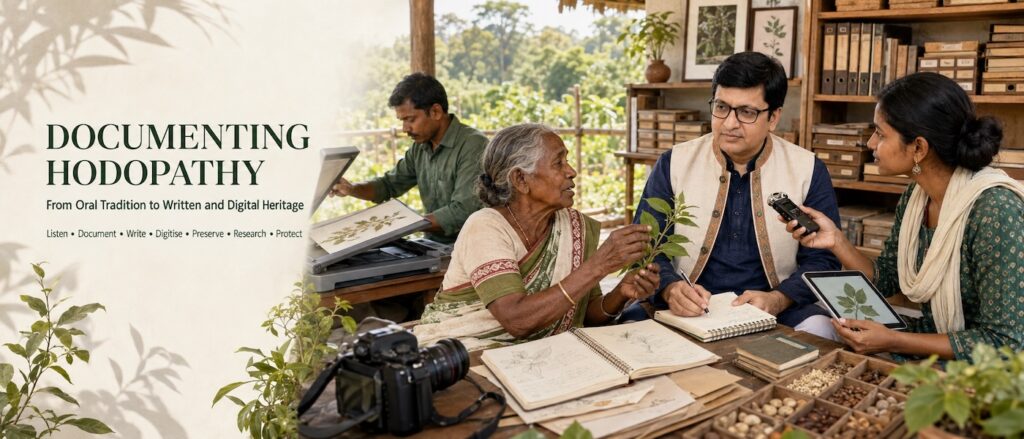
Documenting Hodopathy: From Oral Tradition to Written and Digital Heritage
Preserving Jharkhand’s Living Ethnomedicinal Knowledge
For generations, knowledge of native plants, forests, traditional preparations, seasonal practices and community well-being has been transmitted orally among the Adivasi and tribal communities of Jharkhand.
Experienced elders and traditional practitioners have passed this knowledge to family members and apprentices through conversation, observation, field practice and direct teaching. Unlike systems preserved extensively through formal manuscripts, much of this heritage has remained within community memory and lived experience.
This makes its preservation increasingly urgent.
Hodopathy seeks to build a responsible framework through which appropriate traditional knowledge can be preserved in two complementary forms:
- Written documentation creates a permanent and structured record.
- Digital documentation makes authorised knowledge searchable, organised and accessible for responsible education, conservation and research.
The purpose is not to replace traditional knowledge with a modern system. It is to document valuable knowledge before it disappears while preserving its human, linguistic, cultural, botanical and ecological context.
Why Hodopathy Requires Documentation
Oral traditions remain alive only while knowledge continues to pass from one generation to another. When an experienced practitioner or elder passes away without transferring that knowledge, decades of observation and community experience may be lost.
Several changes now threaten this continuity:
- Ageing and passing of experienced practitioners
- Migration of younger generations to urban areas
- Reduced interest in traditional learning
- Declining familiarity with local plant names
- Changes in food and lifestyle practices
- Deforestation and habitat degradation
- Increasing scarcity of certain native plants
- Fragmentation of knowledge across communities
- Lack of systematic written records
- Weakening intergenerational transmission
Once an oral tradition disappears, reconstructing it accurately can be extremely difficult.
Documentation is therefore not simply data collection. It is a form of cultural, linguistic and ecological preservation.
The Two Pillars of Hodopathy Documentation
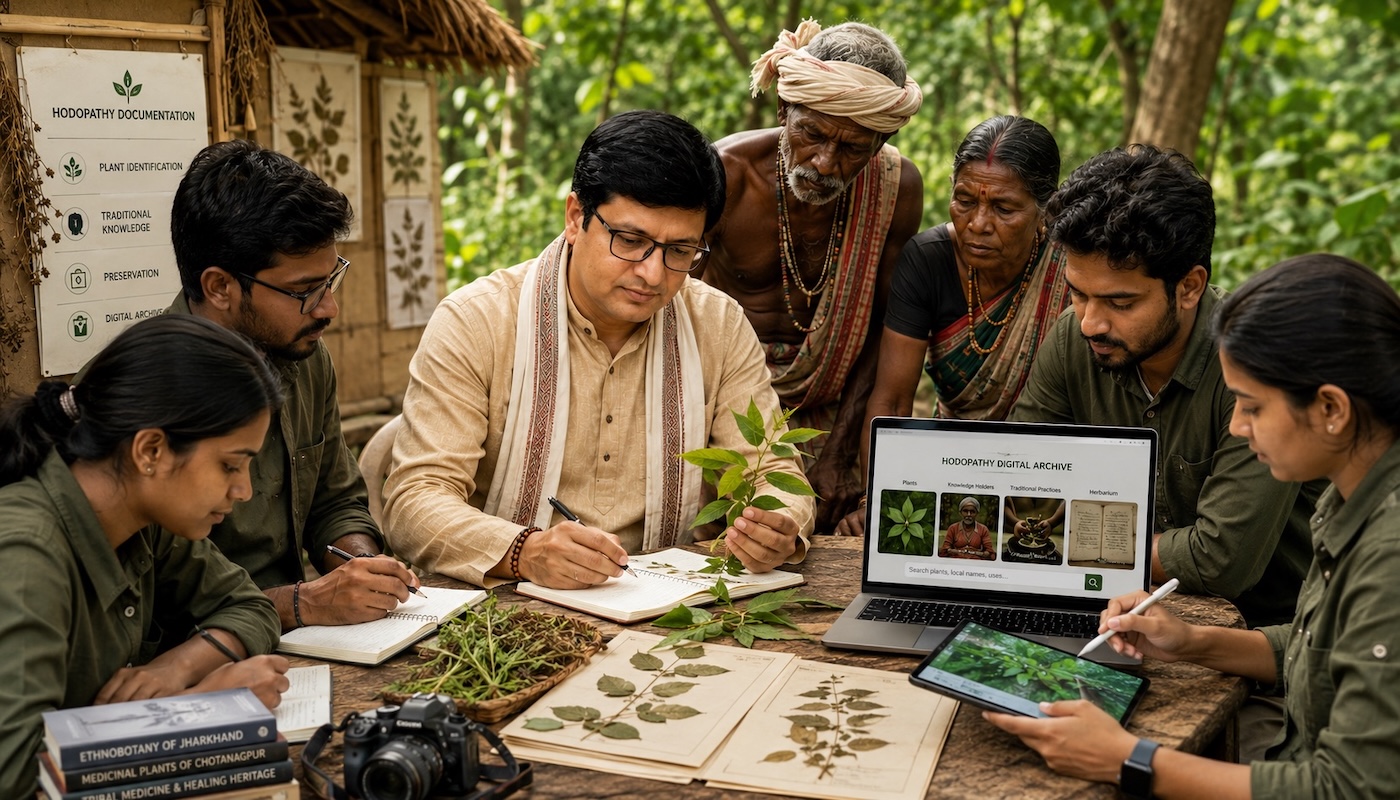
The Hodopathy documentation initiative is envisioned around two interconnected pillars: written preservation and digital preservation.
1. Written Documentation
Written documentation provides a durable foundation for preserving community-held knowledge.
Interviews, field observations, local terminology, plant descriptions, preparation traditions, cultural information and ecological observations can be organised into:
- Field notebooks
- Practitioner interviews
- Plant profiles
- Ethnobotanical monographs
- Research notes
- Photographic records
- Community histories
- Field manuals
- Books and publications
- Controlled institutional archives
What a Written Hodopathy Record May Contain
Subject to community consent and appropriate access safeguards, a written record may include:
- Traditional and local plant names
- Language and community associated with each name
- Verified botanical name
- Plant description and identification features
- Habitat and geographic context
- Traditionally selected plant parts
- Reported traditional applications
- Preparation and preservation traditions
- Seasonal collection practices
- Cultural significance
- Oral histories and practitioner observations
- Conservation information
- Relevant published scientific references
- Cautions, restrictions and areas requiring further research
Written documentation transforms scattered oral accounts into a structured knowledge record that can be reviewed, preserved and studied.
2. Digital Documentation
Written records alone are not sufficient for long-term preservation.
A carefully designed Hodopathy Digital Knowledge Repository can combine written information with photographs, audio, video, maps, botanical references, conservation records and authorised community knowledge.
Digital records can be searched, cross-referenced and updated as new botanical or scientific evidence becomes available.
Structure of a Digital Hodopathy Record
A standard digital record may follow this sequence:
Traditional Name → Language and Community → Photograph → Botanical Identification → Habitat → Reported Traditional Knowledge → Preparation Tradition → Seasonal Information → Cultural Context → Conservation Status → Scientific References
This structure can make authorised information easier to preserve, compare and study without removing it from its community and ecological context.

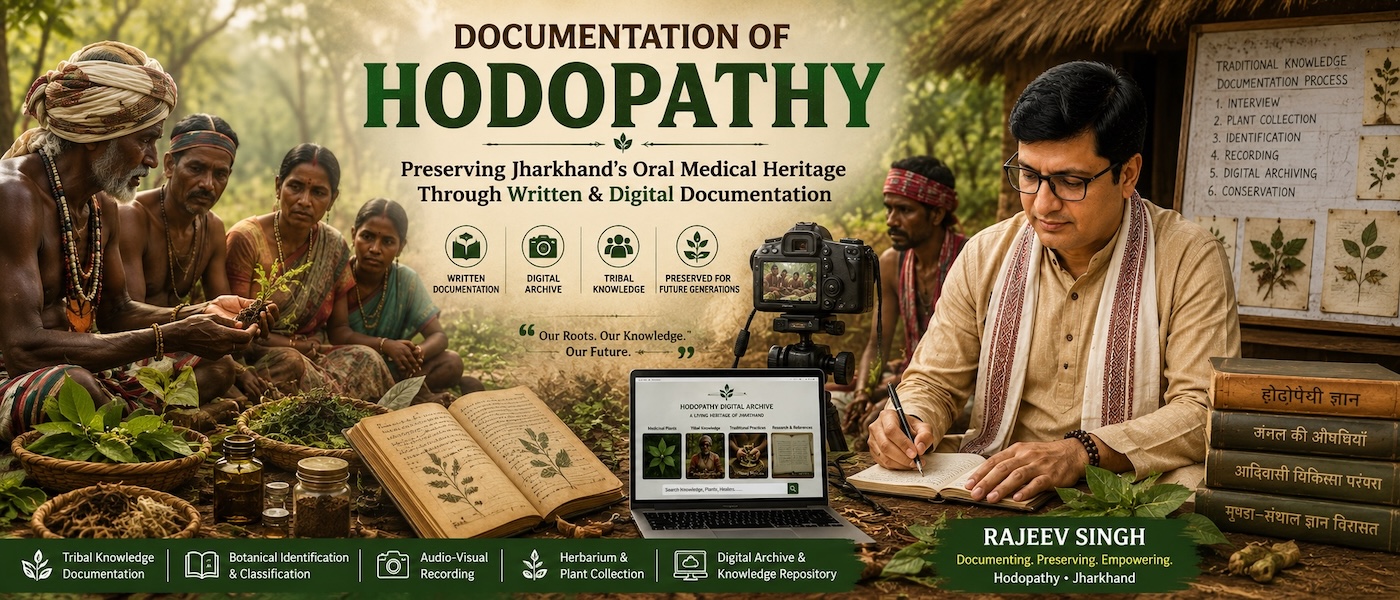
Rajeev Singh’s Documentation Approach
Recognising the need for a permanent and responsible record, Rajeev Singh, a native of Jharkhand, is working to organise the documentation and revival of Hodopathy from Giridih.
His approach seeks to connect grassroots community knowledge with structured written records, digital preservation, botanical identification, conservation and responsible research.
The methodology brings together four principal activities.
Field Documentation
Engaging directly with traditional practitioners, elders and community representatives to understand their knowledge in its original cultural and ecological setting.
Written Compilation
Converting authorised interviews, observations and field records into organised plant profiles, research notes, practitioner histories and documentation material.
Digital Preservation
Creating searchable records containing text, photographs, audio, video, references and other suitable forms of authorised documentation.
Botanical and Scientific Mapping
Connecting local plant names and community observations with botanical identification and relevant published research wherever appropriate.
Rajeev Singh’s role is to help create a bridge between knowledge holders, communities, botanists, researchers and responsible institutions.
“Documentation must preserve more than the name of a plant. It must also recognise the knowledge holder, the language, the community, the forest and the living tradition from which that knowledge emerged.”
— Rajeev Singh
Promoter and Revivalist of Hodopathy
Documenting the Knowledge Holder
Hodopathy documentation should not focus only on plants.
The knowledge holder is an essential part of the heritage. Traditional practitioners and community elders may possess understanding developed through decades of observation, practical experience and intergenerational learning.
Where ethically appropriate and specifically authorised, documentation may record:
- Knowledge-holder background
- Community and regional association
- Language and local terminology
- Areas of traditional expertise
- Plant-identification knowledge
- Preparation and preservation traditions
- Oral histories
- Methods of knowledge transmission
- Conservation practices
- Restrictions governing the sharing of knowledge
This helps preserve traditional knowledge together with its human and cultural identity.
Personal details should remain protected unless the knowledge holder has explicitly agreed to their publication.
From Oral Knowledge to Written Knowledge
The first transition in the Hodopathy documentation process is:
Oral Knowledge → Written Knowledge
A practitioner may describe a plant using a name in Mundari, Santhali, Ho, Kurukh or another local language. The practitioner may explain where it grows, when it is collected and how it is traditionally prepared.
The documentation process can organise this account as:
Local Name → Language → Community → Plant Photograph → Botanical Identification → Habitat → Traditional Knowledge → Preparation Tradition → Seasonal Information
The original terminology should be retained wherever possible. Scientific classification should support the community record—not replace its linguistic and cultural identity.
From Written Knowledge to Digital Knowledge
The second transition is:
Written Knowledge → Digital Knowledge
After information has been recorded, reviewed and appropriately authorised, it may be converted into a searchable digital record.
A digital archive may contain:
- High-resolution plant photographs
- Scanned field notes and historical records
- Digital plant monographs
- Audio recordings of oral histories
- Video interviews, where authorised
- Botanical descriptions
- Herbarium references
- Research papers
- Habitat and conservation information
- Geographic and ecological context
- Cross-referenced plant records
- Controlled access for sensitive information
Digitisation also allows records to be corrected or expanded as botanical identification improves and new research becomes available.
The Importance of Photographic Documentation
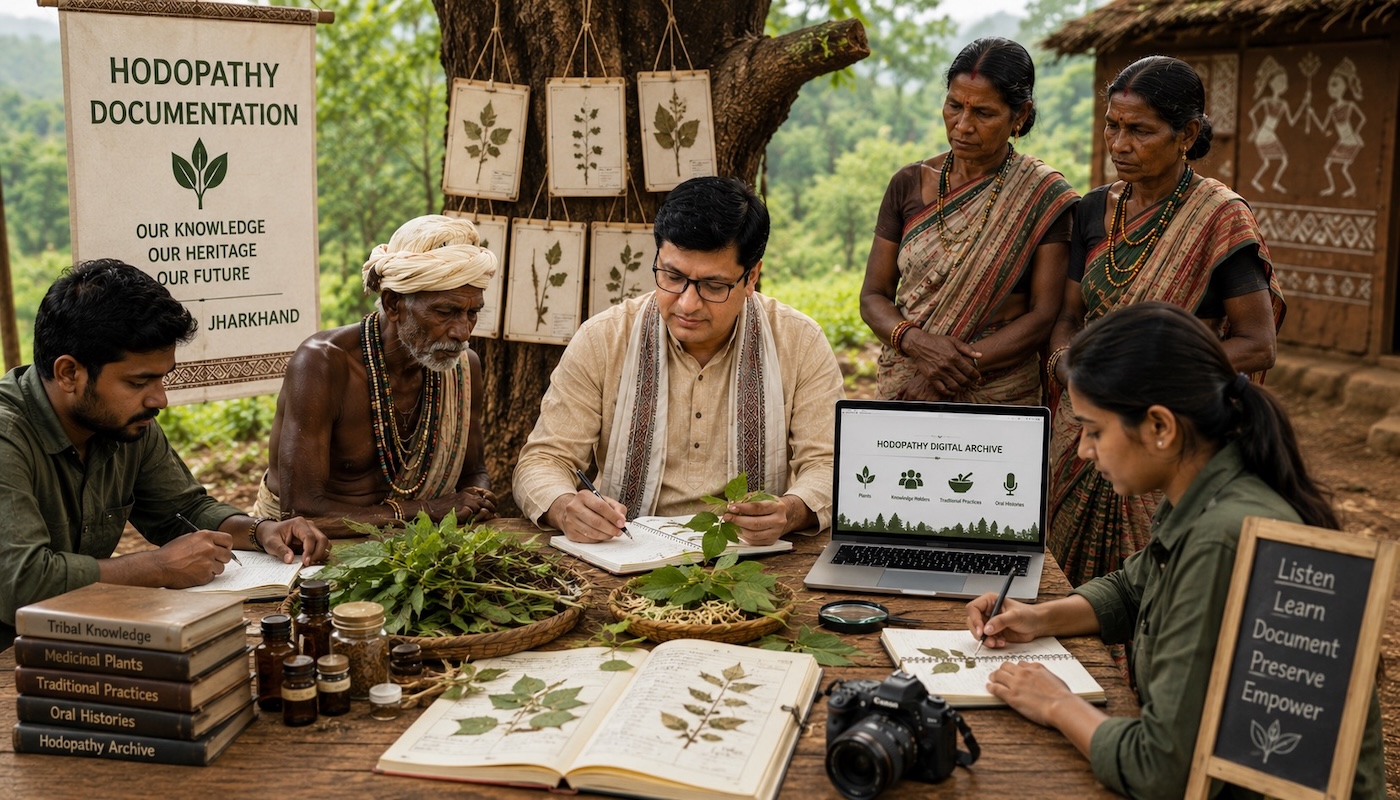
Photography is particularly valuable in ethnobotanical documentation because written descriptions alone may not be sufficient for reliable plant identification.
Where practical and sustainable, a visual plant record may include:
- Whole plant
- Leaves
- Flowers
- Fruits
- Seeds
- Stem and bark
- Roots, where collection is appropriate
- Natural habitat
- Seasonal appearance
- Traditional collection methods
- Preparation tools and processes
Each photograph should include relevant context such as location, date, season and the person responsible for identification.
Images should support identification and conservation—not encourage uncontrolled harvesting or unsafe self-use.
Preserving Local Names and Languages
A single plant may have different names across Munda, Santhal, Ho, Oraon and other communities. Local names may also vary between districts and villages.
Instead of replacing this diversity with only one scientific name, the archive should preserve:
Local Name + Language + Community + Region + Botanical Name
Where possible, records may also include audio pronunciation by a native speaker.
This approach protects linguistic heritage while making the information understandable to researchers and future generations.
The Living Archive
Documentation should not end with books, databases or cloud storage. Traditional plant knowledge is connected with living species and functioning ecosystems.
The preservation model can therefore be expressed as:
Written Archive + Digital Archive + Living Plants + Community Participation = Living Heritage
Appropriately identified plants may be included in:
- Native-species gardens
- Community nurseries
- Seed banks
- Conservation plots
- Educational plantations
- School and university botanical gardens
- Farmer-led cultivation programmes
- Ecological restoration projects
- Long-term biodiversity monitoring
A living archive connects knowledge preservation with biodiversity conservation and helps reduce dependence on uncontrolled forest collection.
Responsible Documentation and Community Rights
Traditional knowledge is not ownerless information. It represents the intellectual, cultural and ecological contribution of communities and practitioners.
The Hodopathy documentation process should therefore consider:
- Prior and informed community participation
- Clear consent before recording or publication
- Appropriate recognition and attribution
- Protection of personal information
- Confidential treatment of restricted knowledge
- Respect for sacred or community-controlled traditions
- Controlled access to sensitive records
- Protection against unauthorised commercial use
- Fair benefit-sharing considerations
- Written agreements before research or product development
- Compliance with applicable biodiversity and research requirements
Some information may be suitable for public education. Other knowledge may require restricted, research-only or community-managed access.
Sharing knowledge during an interview should never be treated as automatic permission for publication, transfer or commercial use.
Traditional Knowledge and Scientific Research
Documentation and scientific validation are separate stages.
A traditional application should be recorded as a reported traditional use unless appropriate scientific research establishes additional evidence.
Future research may include:
- Botanical authentication
- Ethnobotanical studies
- Nutritional analysis
- Phytochemical investigation
- Pharmacological research
- Toxicological assessment
- Contamination and purity testing
- Laboratory studies
- Preclinical research
- Appropriately designed and ethically approved clinical research
The archive should clearly distinguish among:
- Community knowledge
- Practitioner experience
- Preliminary observation
- Published scientific evidence
- Laboratory findings
- Clinically established conclusions
This distinction preserves traditional knowledge while maintaining scientific integrity and public safety.
Building the Hodopathy Digital Knowledge Repository
The long-term vision is to develop a comprehensive digital platform that organises authorised knowledge into searchable and interconnected collections.
Plant Library
Traditional, botanical and ecological information about documented plants.
Knowledge-Holder Archive
Authorised histories and contributions of practitioners and elders, with appropriate privacy and access controls.
Ethnobotanical Library
Field documentation, community knowledge and research associated with traditional plant practices.
Traditional Preparation Archive
Records of authorised preparation traditions without presenting unverified practices as medical prescriptions.
Oral-History Archive
Audio and video accounts recorded with the informed participation of knowledge holders.
Language and Terminology Library
Local plant names, pronunciations and community terminology across relevant languages and regions.
Forest and Biodiversity Library
Information on habitats, native flora, ecological relationships, conservation priorities and sustainable cultivation.
Research Library
Relevant botanical, nutritional, pharmacological, toxicological and conservation studies.
Digital Heritage Archive
Photographs, field notes, historical material, practitioner interviews and community records.
Access Levels within the Repository
Not every record should be publicly accessible.
The repository may use different access levels:
Public Access
General plant information, conservation education and non-sensitive cultural material.
Registered Research Access
Detailed botanical and research records available to approved scholars or institutions.
Restricted Community Access
Knowledge controlled by the contributing community or practitioner.
Confidential Archive
Sacred, sensitive, personally identifiable or commercially vulnerable information that is not publicly released.
A responsible archive protects knowledge as carefully as it preserves it.
An Invitation to Researchers and Institutions
The documentation of Hodopathy should be a collaborative and continuing process.
Hodopathy welcomes engagement from professionals and institutions working in:
- Ethnobotany
- Botany and taxonomy
- Pharmacognosy
- Nutrition and food science
- Agriculture and forestry
- Anthropology
- Indigenous knowledge studies
- Biodiversity conservation
- Natural-product research
- Digital archiving
- Regional languages
- Community development
The collaborative pathway can be expressed as:
Community Knowledge → Ethical Documentation → Written Record → Digital Preservation → Scientific Research → Conservation
Each stage should add value without separating the knowledge from its original holders.
Preserving Knowledge for Future Generations
The central purpose of documentation is simple:
Knowledge that is not recorded may be lost.
Written documentation provides permanence.
Digital documentation provides organisation, accessibility and discoverability.
Community participation provides authenticity and cultural context.
Botanical research provides scientific clarity.
Conservation protects the plants, forests and ecosystems connected with the knowledge.
Together, these elements create a stronger and more responsible preservation model for Hodopathy.
The Vision
The vision is to establish a lasting repository of Jharkhand’s indigenous ethnobotanical heritage—one that exists simultaneously as:
- Oral knowledge
- Written knowledge
- Digital knowledge
- Community memory
- Linguistic heritage
- Scientific research
- Living ecological conservation
Rajeev Singh’s contribution is focused on helping organise and preserve this knowledge so that future generations can study and understand the traditional relationship among Jharkhand’s communities, native plants and forests.
Conclusion
The documentation of Hodopathy is not simply the writing of a medical history.
It is the preservation of an oral heritage.
It is the creation of a permanent written record.
It is the development of a responsible digital repository.
It is the protection of community memory and traditional languages.
It is the recognition of knowledge holders.
It is the conservation of native plants, forests and medicinal biodiversity.
The journey can be expressed simply:
Listen → Seek Consent → Document → Write → Digitise → Preserve → Research → Protect
Through responsible written and digital documentation, Hodopathy can move from a vulnerable oral tradition towards a durable knowledge heritage—while remaining firmly connected to the people, plants, forests and communities of Jharkhand.
Document the knowledge. Preserve the heritage. Protect the living archive.
Research and Wellness Disclaimer: The Hodopathy repository is intended for documentation, preservation, education and research. Reported traditional uses do not establish medical safety or clinical effectiveness. The information must not be used for self-diagnosis or as a substitute for advice from a qualified healthcare professional.