
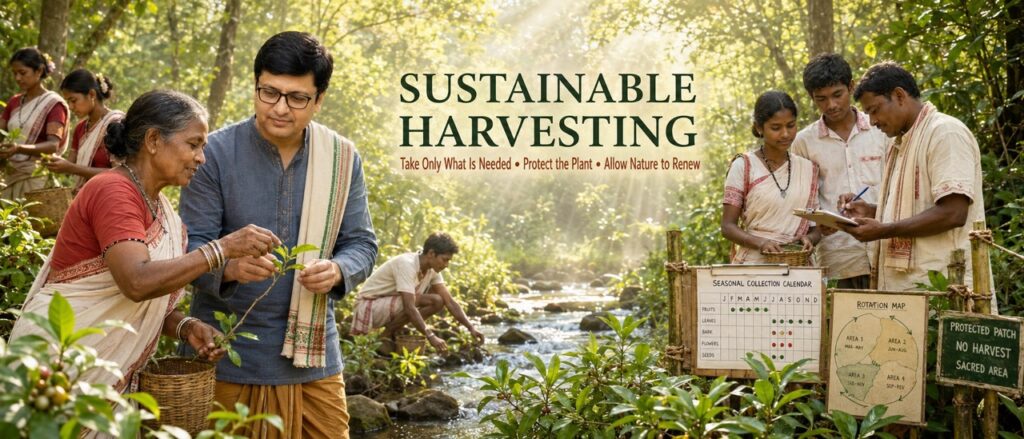
Sustainable Harvesting
Taking from Nature Without Exhausting It
Sustainable harvesting means collecting plants and other biological resources in ways that allow their populations, habitats and ecological relationships to continue into the future.
For Hodopathy, harvesting is not simply the removal of useful material from a forest. It is a responsibility towards the plant, the ecosystem, the knowledge holder, the collector and future generations.
A harvesting practice can be called sustainable only when it protects wild populations, respects community rights, follows applicable laws and provides fair benefits to the people who care for and collect the resource.
Why Sustainable Harvesting Matters
Medicinal and aromatic plants support traditional knowledge, rural livelihoods, research and a growing international natural-products sector. However, much of this material still comes from wild populations.
TRAFFIC and the FairWild Foundation estimate that 60–90% of medicinal and aromatic plant species in trade are collected from the wild. Only a limited proportion of these species have been formally assessed for extinction risk. TRAFFIC—Wild Plants.
When collection exceeds a plant’s ability to regenerate, the population may gradually decline. The first warning signs can include:
- Fewer mature plants
- Smaller plants or plant parts
- Reduced flowering and fruiting
- Longer distances travelled by collectors
- Declining quantity collected per day
- Removal of increasingly young plants
- Changes in the normal harvesting season
- Disappearance of the species from accessible areas
If these signals are ignored, a once-common plant can become locally rare.
Sustainable harvesting protects both the resource and the livelihoods that depend on it.
Sustainability Must Be Species-Specific
There is no single harvesting rule that works for every plant. A method that is suitable for a fast-growing annual herb may destroy a slow-growing tree or climber.
A responsible harvesting plan must consider:
- Botanical identity of the species
- Local abundance and distribution
- Growth rate and life cycle
- Natural regeneration
- Flowering and fruiting season
- Method of seed dispersal
- Plant part being collected
- Effect of collection on plant survival
- Habitat condition
- Wildlife dependence on the plant
- Existing community use
- Total local and commercial demand
- Conservation and legal status
The FairWild Standard follows a species- and site-specific approach and evaluates ecological, sociocultural and business conditions associated with wild collection. FairWild Standard.
Traditional experience can provide valuable information about seasons and collection methods, while ecological surveys can help determine whether current levels of harvesting remain safe. Both forms of knowledge should contribute to the management plan.
Before Harvesting Begins
Sustainable collection starts long before anyone enters the forest.
Confirm the Plant’s Identity
The plant should be identified using accepted botanical methods. Local names must also be recorded because the same plant may have different names across communities, and the same name may refer to different species.
Where materials are intended for research, processing or product development, identification should be confirmed by a qualified botanist or recognised institution.
Understand Rights and Permissions
Collectors must know who owns, manages or has customary rights over the land and biological resources. Collection should take place only with appropriate permission from communities, forest authorities and other responsible institutions.
Sacred groves, restricted community forests, wildlife habitats and legally protected areas must be respected.
Assess the Wild Population
A baseline survey should estimate:
- Size and distribution of the population
- Number of mature and young plants
- Evidence of flowering, fruiting and regeneration
- Condition of the habitat
- Existing harvesting pressure
- Other threats such as fire, grazing or invasive plants
The information should be sufficient to develop a cautious collection limit. When evidence is inadequate, harvesting should be reduced, postponed or avoided.
Prepare a Collection Plan
The plan should identify:
- Permitted collection area
- Species and plant part to be collected
- Collection season
- Approved methods and tools
- Maximum quantity
- Rotation period
- Areas where harvesting is prohibited
- People authorised to collect
- Monitoring responsibilities
- Procedures for recording and transporting material
Commercial demand should never determine the quantity collected without an ecological assessment.
Harvesting Different Plant Parts Responsibly
The biological effect of collection depends greatly on the part removed.
Leaves
Removing too many leaves can reduce photosynthesis, growth and future reproduction. Collectors should take only a limited portion from healthy mature plants and distribute collection across the population.
Young plants should normally be left untouched. Leaves affected by disease, pollution or contamination should not be collected for use.
Flowers
Flowers are essential for seed formation and may also provide food for pollinators. A substantial proportion should remain on every population so that plants can reproduce and insects can continue to feed.
Fruits and Seeds
Fruits and seeds are required for natural regeneration and may be important food for birds and animals. Collection should leave sufficient quantities on plants and the forest floor.
When seeds are gathered for cultivation, they should be collected from numerous healthy plants to maintain genetic diversity.
Bark
Destructive bark removal can permanently damage or kill a tree. Bark should never be removed around the complete circumference of the trunk.
Where bark collection is ecologically appropriate, it should follow scientifically validated, species-specific methods. Collection from fallen branches, pruned material or cultivated sources may provide safer alternatives.
Roots, Rhizomes and Tubers
Harvesting underground parts often kills the entire plant. It is among the highest-risk collection practices.
Root harvesting should not take place when:
- The species is rare or declining
- Natural regeneration is poorly understood
- Plants grow slowly
- The population is small or isolated
- Cultivated material could be used instead
- Legal permission has not been obtained
Where limited collection is considered sustainable, some mature reproductive plants and a substantial part of the population must remain undisturbed. Cultivation should be prioritised for species whose underground parts are in regular demand.
Whole Plants
Collecting entire plants removes both the individual and its future reproductive capacity. It should be avoided for perennial, uncommon or slow-growing species.
For abundant annual plants, collection may be considered only after sufficient seed production and according to a monitored management plan.
Gums, Resins and Latex
Excessive or poorly placed tapping can introduce infection and weaken or kill a plant. Appropriate tools, tapping depth, recovery periods and hygiene practices must be defined for each species.
The Right Season and Time
Traditional harvesting calendars often reflect long observation of plant growth and seasonal change. Scientific research can help verify how season affects regeneration, moisture, contamination and plant composition.
Collection should generally avoid:
- Premature plants
- Critical flowering and seed-development periods
- Seasons when the species is under environmental stress
- Collection immediately after pesticide use in surrounding areas
- Plants exposed to industrial pollution, sewage or roadside contamination
- Harvesting during forest fires, floods or other ecological disturbances
The appropriate season differs among species and plant parts. A fixed calendar should not be applied to every plant.
Rotation and No-Harvest Zones
Repeated harvesting from the same easily accessible location can exhaust a population even when each individual collection appears small.
Collection areas should therefore be divided into zones. Some zones may be harvested according to an approved rotation, while others remain unharvested for regeneration and comparison.
No-harvest zones may include:
- Areas containing rare species
- Breeding or nesting habitats
- Sacred and culturally restricted sites
- Erosion-prone slopes
- Stream banks and water-source protection areas
- Recently damaged forest patches
- Research and monitoring plots
- Sites with poor regeneration
Rotational collection gives harvested populations time to recover and provides evidence about whether management practices are working.
Clean Collection and Post-Harvest Handling
Sustainability also includes protecting the quality and integrity of collected material.
Collectors should:
- Use clean and appropriate tools
- Avoid mixing different species
- Keep material away from soil, fuel and chemicals
- Use clean, breathable collection containers
- Remove foreign matter carefully
- Record collection location and date
- Begin suitable drying or processing promptly
- Protect material from moisture, pests and mould
- Store different collection lots separately
- Maintain hygienic transport and storage conditions
The World Health Organization’s guidelines on good agricultural and collection practices emphasise correct identification, appropriate collection methods, trained personnel and careful post-harvest handling as foundations of medicinal-plant quality assurance. WHO Guidelines on Good Agricultural and Collection Practices.
Monitoring and Adaptive Management
A sustainable harvesting plan must be reviewed regularly. Permission given for one season should not become permanent permission to collect the same quantity every year.
Monitoring should examine:
- Number of mature and young plants
- Flowering and fruiting
- Seedling establishment
- Plant mortality
- Habitat condition
- Quantity collected per unit of effort
- Changes reported by traditional collectors
- Effects of rainfall, drought and fire
- Market demand and collection pressure
If regeneration declines, collection limits should be reduced or harvesting should stop. If a population recovers, the management plan can be reconsidered cautiously.
Collectors are often the first to notice ecological change. Their observations should be recorded and included in decisions.
Fair Treatment of Forest Collectors
Ecological sustainability cannot be separated from social fairness. Poorly paid collectors may be pressured to gather excessive quantities, work in unsafe conditions or harvest protected species.
A responsible supply chain should provide:
- Fair and timely payment
- Transparent weighing and grading
- Safe tools and protective equipment
- Training in identification and collection
- Written or clearly explained purchasing conditions
- Freedom from forced and child labour
- Recognition of customary access and community rights
- Participation in management decisions
- Long-term purchasing relationships
- Fair benefit-sharing where traditional knowledge contributes value
Higher market demand should create better opportunities for communities—not greater exploitation of forests or collectors.
FairWild identifies ecological, sociocultural and ethical business requirements as interconnected parts of responsible wild collection. Its framework also supports prior informed consent, mutually agreed terms and equitable sharing of benefits. FairWild and Access and Benefit-Sharing.
Traceability from Forest to Final Use
Every collection lot should be traceable to a legally and ethically approved source.
Records may include:
- Botanical and local name
- Plant part collected
- Collection location or coded source area
- Date and season
- Name or identification of the collector group
- Cultivated or wild-collected status
- Quantity and collection method
- Required permissions
- Initial processing and storage details
- Buyer and transfer records
- Botanical authentication
- Quality-testing information
Sensitive locations of rare plants should be protected from public disclosure. Traceability requires accountable internal records, not unrestricted publication of ecological data.
When Wild Harvesting Should Stop
Collection should not continue merely because a plant has commercial value or traditional importance.
Wild harvesting should be suspended when:
- The species cannot be identified confidently
- Its conservation status is uncertain and populations appear small
- Regeneration is declining
- Harvesting would destroy most individual plants
- The habitat is damaged or recovering
- Legal permissions are absent
- Community consent has not been obtained
- Sustainable collection limits cannot be established
- Traceability cannot be maintained
- Cultivated or less vulnerable alternatives are available
A temporary pause can prevent permanent loss.
Cultivation and Restoration as Alternatives
For plants under significant collection pressure, cultivation can provide a more dependable and traceable source. Community nurseries, agroforestry systems and medicinal-plant gardens can also generate livelihood opportunities.
Cultivation should use authenticated, legally sourced and locally suitable planting material. It should preserve genetic diversity and avoid introducing invasive species.
Restoration may involve:
- Protecting naturally regenerating plants
- Reducing grazing or fire pressure
- Controlling invasive vegetation
- Restoring soil and water conditions
- Reintroducing locally sourced plants where scientifically appropriate
- Connecting fragmented populations
- Monitoring survival over several seasons
Planting alone is not enough. Restored populations must survive, reproduce and become part of a functioning ecosystem.
Hodopathy’s Sustainable-Harvesting Principles
Hodopathy supports a precautionary and community-centred approach to the collection of medicinal and useful plants.
We seek to:
- Respect Adivasi and tribal knowledge holders
- Obtain appropriate community participation and permission
- Confirm plant identity before collection
- Protect rare, threatened and sensitive species
- Establish species- and site-specific collection methods
- Avoid destructive root, bark and whole-plant harvesting
- Leave sufficient plants for reproduction and wildlife
- Use rotation periods and no-harvest zones
- Maintain transparent collection and traceability records
- Train and fairly compensate collectors
- Encourage cultivation where wild collection is unsuitable
- Monitor natural regeneration and habitat condition
- Reduce or stop collection when evidence shows decline
- Comply with applicable forest and biodiversity laws
- Promote fair benefit-sharing and responsible trade
Information presented on this website is intended for conservation, education, cultural documentation and responsible research. It is not a harvesting permit, a substitute for local ecological assessment or a recommendation for medical self-treatment.
Harvesting with Responsibility
Nature can continue to support people only when people allow nature to renew itself.
Sustainable harvesting is not measured by how much material can be removed from a forest today. It is measured by whether healthy plant populations, functioning ecosystems and community livelihoods remain tomorrow.
Through careful collection, scientific monitoring, traditional knowledge, fair partnerships and respect for ecological limits, Hodopathy aims to promote a model in which the use of natural resources contributes to their long-term protection.
Hodopathy—Harvest Responsibly, Protect Biodiversity and Preserve Adivasi Knowledge.