
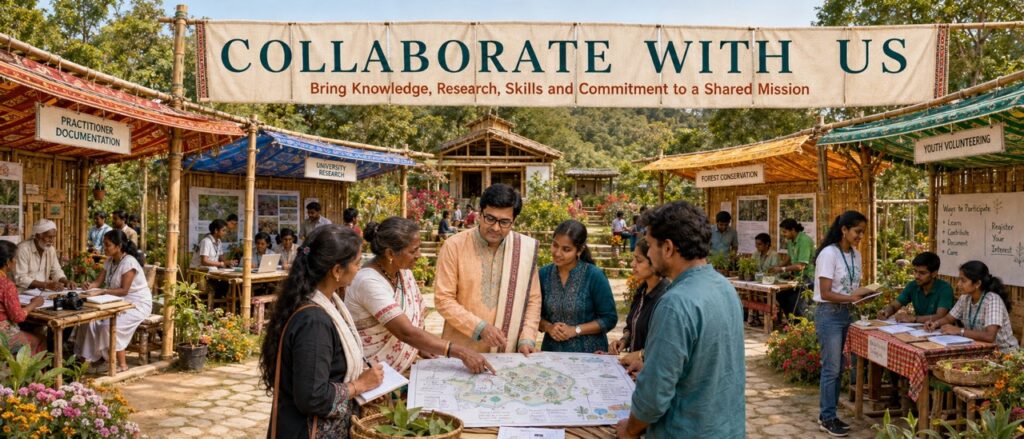
Collaborate With Us
Join Hodopathy in Preserving Adivasi Knowledge and Protecting Jharkhand’s Natural Heritage
Hodopathy welcomes responsible collaboration with Adivasi communities, traditional practitioners, researchers, universities, scientists, conservation organisations and institutions that share our commitment to ethical knowledge preservation.
Our purpose is to connect Jharkhand’s living traditions with respectful documentation, biodiversity conservation and credible scientific inquiry—without separating traditional knowledge from the communities and ecosystems that sustain it.
We invite collaborators who believe that meaningful progress must be built through consent, community participation, transparency and shared benefits.
Why Collaboration Matters
Hodopathy brings together several interconnected fields:
- Adivasi and tribal knowledge
- Traditional practitioners
- Medicinal and useful plants
- Forest and biodiversity conservation
- Ethnobotanical documentation
- Scientific research
- Nutrition and natural well-being
- Community livelihoods
- Ethical knowledge governance
- Public education
No individual or organisation can responsibly address all these areas alone.
Traditional practitioners contribute generations of observation and lived experience. Communities provide cultural and ecological context. Botanists can authenticate plant identity. Laboratories can investigate composition, purity and safety. Conservationists can assess ecological pressures. Universities can provide research methods, ethics review and student participation.
Collaboration allows these different strengths to support one another.
The World Health Organization’s work on traditional medicine, biodiversity and Indigenous Knowledges similarly promotes respectful knowledge exchange, equitable access to benefits and partnerships among knowledge holders, researchers and institutions. WHO—Traditional Medicine, Biodiversity and Indigenous Knowledges.
Who Can Collaborate?
Adivasi Communities and Knowledge Holders
Hodopathy welcomes dialogue with:
- Adivasi elders
- Tribal knowledge holders
- Traditional practitioners
- Community organisations
- Gram Sabhas and customary institutions
- Forest-dependent families
- Women knowledge holders
- Youth groups
- Local farmers and plant cultivators
Community members can help identify preservation priorities, document changing ecological conditions, develop conservation programmes and guide how knowledge should be protected and transmitted.
Participation is voluntary. Hodopathy does not require communities to disclose sacred, secret or family-restricted knowledge.
Traditional Practitioners
Traditional practitioners may collaborate in:
- Oral-history documentation
- Recording local plant names
- Mapping broad categories of practice
- Intergenerational knowledge programmes
- Practitioner meetings
- Medicinal-plant conservation
- Community herbal gardens
- Research-question development
- Ethical public education
Hodopathy will seek to distinguish practitioner testimony from scientifically established evidence. Participation does not mean that every practice will be promoted publicly or presented as a verified medical treatment.
Universities and Research Institutions
We welcome proposals from:
- Universities
- Agricultural institutions
- Medical and health-science institutions
- Pharmacy colleges
- Forestry institutions
- Botanical research organisations
- Social-science departments
- Legal and policy centres
- Public-health institutions
- Accredited research laboratories
Possible collaborations include field studies, botanical authentication, phytochemical investigation, safety research, nutritional analysis, conservation assessment and responsible archival development.
All research involving people, personal information or biological samples should follow appropriate ethics-review and regulatory procedures.
Botanists and Taxonomists
Correct plant identification is fundamental to conservation and responsible research.
Botanists, taxonomists, herbarium specialists and field ecologists may collaborate in:
- Authenticating plant species
- Recording local and scientific names
- Preparing voucher specimens where permitted
- Studying habitats and seasonal availability
- Identifying rare or threatened plants
- Developing field-identification resources
- Training community researchers
- Supporting conservation-status assessment
- Preventing substitution and misidentification
Public documentation should not reveal the precise locations of rare or ecologically sensitive plants.
Scientists and Laboratories
Hodopathy seeks collaboration with qualified laboratories and researchers working in:
- Botany
- Ethnobotany
- Pharmacognosy
- Phytochemistry
- Toxicology
- Microbiology
- Food and nutrition science
- Analytical chemistry
- Quality control
- Soil and environmental science
- Conservation biology
- Data science
Laboratory collaboration may involve identity, purity, contamination, composition, stability and safety-related evaluation.
A laboratory result should not be represented as clinical proof. Claims must reflect the type, quality and limitations of the evidence available.
Conservation Organisations
Forest departments, biodiversity institutions, environmental organisations and community-conservation groups may collaborate on:
- Medicinal-plant surveys
- Native-species nurseries
- Community herbal gardens
- Habitat restoration
- Sustainable-harvesting protocols
- Seed conservation
- Biodiversity monitoring
- Forest and water protection
- Conservation education
- Climate-resilience studies
Conservation should protect naturally diverse ecosystems, not merely increase plantation numbers.
Farmers and Responsible Cultivators
Farmers, producer groups, cooperatives and rural enterprises may collaborate in:
- Cultivation of suitable medicinal plants
- Native planting-material development
- Agroforestry systems
- Organic and natural production methods
- Seed and germplasm conservation
- Traceable sourcing
- Post-harvest handling
- Community nurseries
- Sustainable livelihood models
Cultivation projects should use authenticated planting material, protect genetic diversity and avoid invasive species.
Community-Based and Non-Governmental Organisations
Organisations with trusted local relationships may support:
- Community consultation
- Translation and local communication
- Women’s participation
- Youth engagement
- Livelihood development
- Consent processes
- Field coordination
- Biodiversity education
- Monitoring and grievance support
Organisations should disclose their funding, interests and relationship with the participating communities.
Government and Public Institutions
Hodopathy is open to dialogue with relevant:
- Forest and environment departments
- Biodiversity boards
- Tribal-welfare institutions
- Agricultural departments
- Medicinal-plants boards
- Research councils
- Universities and public laboratories
- Local governance institutions
- Biodiversity Management Committees
Public collaboration may support conservation, documentation, training, research, rural livelihoods and responsible knowledge governance.
Funders CSR Partners and Philanthropic Institutions
Responsible funding can support:
- Community documentation
- Fellowships for young researchers
- Medicinal-plant nurseries
- Forest restoration
- Laboratory studies
- Community archives
- Practitioner meetings
- Training and educational resources
- Local-language publications
- Conservation-based livelihoods
Funding must not compromise research independence, community consent or the accurate reporting of findings.
Writers Educators and Responsible Media
Writers, educators, documentary makers and media organisations may collaborate on carefully reviewed public-awareness projects.
Content should avoid:
- Cultural stereotypes
- Sensational medical claims
- Exposure of sacred knowledge
- Unauthorised photography
- Disclosure of rare-plant locations
- Misrepresentation of practitioner testimony
- Commercial use without permission
Community dignity and evidence limitations must remain central to all public communication.
Priority Areas for Collaboration
1. Ethical Knowledge Documentation
We seek to preserve oral histories, local plant names, seasonal observations, conservation practices and practitioner experiences.
Documentation must follow Hodopathy’s Ethical Knowledge Policy and applicable consent, privacy and biodiversity requirements.
2. Medicinal-Plant Identification
Collaboration can help connect local plant names and community knowledge with authenticated botanical records.
This may include photography, taxonomy, herbarium reference and habitat documentation where legally and ethically permitted.
3. Forest and Biodiversity Conservation
Projects may focus on:
- Native medicinal plants
- Sacred groves
- Community forests
- Rare-species monitoring
- Habitat restoration
- Seed conservation
- Forest-fire awareness
- Water and soil protection
4. Sustainable Harvesting
Hodopathy welcomes work on species-specific collection methods, regeneration studies, rotation systems, no-harvest zones and training for collectors.
Wild collection should proceed only when ecological evidence, community authority and applicable permissions support it.
5. Community Nurseries and Herbal Gardens
Community nurseries can conserve local plants, create learning opportunities and reduce pressure on wild populations.
Herbal gardens may serve as living reference collections, but they should not promote unsupported health claims.
6. Scientific Evaluation
Research may examine:
- Botanical identity
- Nutritional composition
- Chemical characteristics
- Contamination
- Purity
- Safety
- Stability
- Sustainable cultivation
- Post-harvest handling
Progression from traditional observation to laboratory research and clinical evidence must be represented accurately.
7. Digital Knowledge Preservation
Collaborators may help develop secure and culturally appropriate systems for preserving:
- Audio and video histories
- Plant photographs
- Local-language records
- Field notes
- Consent records
- Research findings
- Conservation data
Digital access should be classified. Not every record should be made publicly searchable or downloadable.
8. Community Training and Youth Participation
Hodopathy aims to encourage young people to learn:
- Plant documentation
- Photography
- Local-language transcription
- Botanical basics
- Nursery management
- Biodiversity monitoring
- Research ethics
- Digital archiving
- Sustainable cultivation
Youth participation should strengthen community knowledge transmission rather than remove knowledge from community control.
9. Livelihood and Benefit-Sharing Models
Partnerships may explore fair opportunities through:
- Community nurseries
- Cultivation
- Sustainable collection
- Local processing
- Conservation employment
- Training
- Research participation
- Long-term sourcing arrangements
Economic activity must remain within ecological limits and provide transparent benefits to participating communities.
10. Publications and Public Education
Hodopathy welcomes responsible collaboration on:
- Research papers
- Field reports
- Conservation manuals
- Local-language guides
- Educational videos
- Exhibitions
- Seminars
- Practitioner dialogues
- Public-awareness campaigns
Traditional use should not be presented as proven clinical treatment unless supported by appropriate evidence.
Our Collaboration Principles
Every Hodopathy collaboration should be guided by:
- Respect for Adivasi identity and dignity
- Meaningful community participation
- Prior and informed consent
- Protection of sacred and confidential knowledge
- Accurate attribution
- Fair and equitable benefit-sharing
- Scientific transparency
- Conservation of native plants and habitats
- Traceable and legal sourcing
- Responsible public communication
- Disclosure of funding and conflicts of interest
- Compliance with applicable laws and ethics requirements
- Accessible grievance and correction mechanisms
The Convention on Biological Diversity recognises that traditional knowledge should be used with the approval and involvement of its holders and that communities should share equitably in resulting benefits. Convention on Biological Diversity—Article 8(j).
What We Do Not Support
Hodopathy will not knowingly support proposals that involve:
- Unauthorised collection of traditional knowledge
- Pressure on practitioners to reveal secrets
- Destructive harvesting
- Collection of protected species without permission
- Research without appropriate ethics review
- Patient experimentation outside lawful safeguards
- Guaranteed-cure claims
- Sale of unverified treatment claims
- Biopiracy or misappropriation
- Unauthorised intellectual-property applications
- Concealed commercial interests
- Unfair or exploitative community agreements
- Public disclosure of sensitive plant locations
- Use of community data for AI training without specific permission
- Content that stereotypes or disrespects Adivasi communities
We welcome critical scientific inquiry. Collaboration does not require predetermined positive results.
How Collaboration Works
Step 1: Submit an Introduction
Send a concise proposal describing yourself, your institution and the proposed area of collaboration.
Step 2: Preliminary Review
Hodopathy will review whether the proposal aligns with its mission, ethical standards and current priorities.
Step 3: Community and Ethics Assessment
Where communities, personal information, traditional knowledge or biological samples are involved, the project will be assessed for:
- Consent requirements
- Community authority
- Privacy and confidentiality
- Knowledge restrictions
- Ecological risks
- Benefit-sharing
- Ethics approval
- Regulatory permissions
Step 4: Define the Partnership
The parties should agree on:
- Purpose and scope
- Roles and responsibilities
- Timeline
- Funding
- Data and sample management
- Publication
- Attribution
- Intellectual property
- Benefit-sharing
- Conservation responsibilities
- Monitoring and reporting
- Grievance procedures
- Exit and termination arrangements
Step 5: Obtain Approvals
No fieldwork, sample collection or restricted documentation should begin until required community, ethical, institutional and regulatory approvals are in place.
Step 6: Implementation and Review
Projects should be monitored throughout implementation. Any material change in purpose, method, partner, data use or commercial potential may require renewed review and consent.
Step 7: Share Results
Communities and knowledge holders should receive relevant findings in an understandable form. Research results should not remain available only to external institutions.
What to Include in Your Proposal
Please provide:
- Full name
- Organisation or institution
- Professional role
- Contact details
- Country and location
- Proposed collaboration title
- Purpose and expected outcomes
- Relevant experience
- Proposed project location
- Communities or institutions involved
- Methods and activities
- Timeline
- Funding source and estimated budget
- Community-participation plan
- Consent and ethics plan
- Biological-resource requirements
- Data and sample-management plan
- Publication proposal
- Intellectual-property position
- Benefit-sharing proposal
- Conservation impact
- Supporting documents or references
Early-stage ideas are welcome, but proposals involving communities or biological resources must become sufficiently detailed before implementation.
Contact Hodopathy
To discuss research, conservation, documentation, institutional partnership or community collaboration, contact:
Email: care@hodopathy.com
Website: www.hodopathy.com
Please use the email subject:
Collaboration Proposal – [Your Name or Institution]
Hodopathy may request additional information before accepting or developing a proposal. Submission does not guarantee approval, funding, endorsement or access to communities, knowledge or biological resources.
Let Us Preserve Knowledge Together
Hodopathy is being promoted and revived by Rajeev Singh with the aim of connecting Adivasi knowledge holders and traditional practitioners with scientists, conservationists, universities and responsible institutions.
The strongest collaborations will not ask only, “What knowledge can we obtain?”
They will also ask:
- How can this knowledge be protected?
- How can communities remain in control?
- How can forests and medicinal plants be conserved?
- How can evidence be developed responsibly?
- How can benefits be shared fairly?
- How can future generations participate?
If your organisation shares these commitments, we welcome the opportunity to explore a responsible partnership.
Collaborate with Hodopathy—Preserve Knowledge, Protect Biodiversity and Build Ethical Partnerships.