
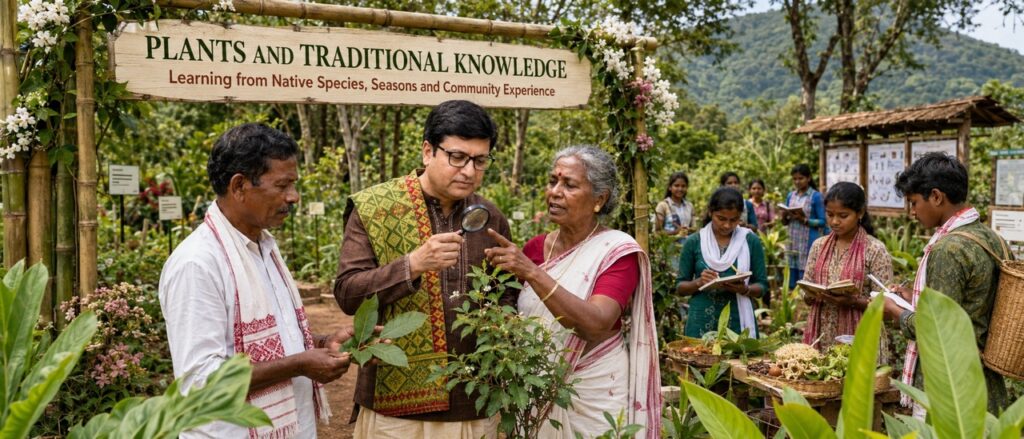
Plants and Traditional Knowledge
Understanding the Relationship Among Adivasi Communities, Native Plants and Hodopathy
Plants are an important part of Hodopathy, but Hodopathy is not merely a list of herbal ingredients.
Within the Ho community and other Adivasi communities of Jharkhand, knowledge of plants developed through generations of observation and interaction with forests, farms, seasons, food systems and community life.
A plant may be understood through its local name, appearance, habitat, season, cultural meaning and traditional association. The same species may be connected with food, farming, household use, ceremonies, crafts or community well-being.
This knowledge belongs within a wider relationship among people, language, culture and nature. Removing a plant from that context can create an incomplete or misleading understanding.
Plants as Part of a Living Landscape
Traditional plant knowledge begins with the landscape.
Knowledge holders may observe:
- Where a plant grows
- Which soil it prefers
- Whether it grows near water
- What other species surround it
- When it produces leaves, flowers or fruits
- How it changes during dry and rainy seasons
- Whether animals interact with it
- How harvesting affects its future growth
- Whether it is becoming more difficult to find
These observations are often built over many years.
A photograph or dried specimen can help identify a species, but it cannot fully communicate the relationship between that plant and the living environment in which community knowledge developed.
How Traditional Plant Knowledge Is Learned
Plant knowledge has generally been transmitted through practical experience rather than formal textbooks.
A learner may gain knowledge by:
- Accompanying elders into forests
- Working with farmers
- Collecting seasonal foods
- Observing traditional practitioners
- Helping in household preparation
- Listening to stories
- Learning indigenous plant names
- Comparing similar species
- Observing plants across seasons
- Participating in cultural practices
Learning may continue for many years.
Recognising a plant correctly may require familiarity with its leaves, bark, flowers, fruits, aroma, habitat and different stages of growth. A plant that appears distinctive during flowering may be difficult to identify at another time.
This is why traditional knowledge cannot always be transferred accurately through a short written description.
Indigenous and Local Plant Names
Local plant names are essential parts of community knowledge.
A name may describe:
- Shape
- Colour
- Texture
- Taste
- Aroma
- Habitat
- Season
- Cultural meaning
- Traditional association
- Relationship with an animal or another plant
Different villages may use different names for the same plant. The same local name may also refer to more than one species.
Responsible documentation should record:
- Original indigenous name
- Correct pronunciation
- Language
- Alternative local names
- Meaning where known
- Village or region
- Knowledge holder who shared it
- Botanical identity when verified
A scientific name supports botanical accuracy, while the local name preserves cultural meaning. Both should remain connected in the record.
Correct Plant Identification Is Essential
Incorrect plant identification can cause serious harm.
Two species may look similar while differing in:
- Chemical composition
- Toxicity
- traditional association
- edible status
- ecological importance
- conservation status
A common or local name alone is not enough to confirm identity.
Botanical verification may require:
- Clear photographs
- Leaves and their arrangement
- Stem or bark
- Flowers
- Fruits
- Seeds
- Growth form
- Habitat information
- Review by a qualified botanist
- Comparison with botanical references
- Herbarium or voucher material where appropriate and permitted
Each public record should state clearly whether the identification is unverified, provisional, expert reviewed, verified or disputed.
Uncertainty should never be hidden.
Different Plant Parts Are Not Interchangeable
A traditional account may refer to a specific part of a plant, such as:
- Leaf
- Flower
- Fruit
- Seed
- Bark
- Stem
- Root
- Tuber
- Resin
- Sap
- Whole plant
Different parts of the same plant can contain different natural compounds. One part may be traditionally consumed as food while another may be unsuitable or potentially harmful.
A responsible record should identify the exact plant part described by the contributor.
Documentation should not assume that every part of a traditionally known plant has the same properties or safety profile.
Season and Stage of Growth
Traditional knowledge may associate plants with particular seasons or stages of growth.
Knowledge holders may distinguish between:
- Young and mature leaves
- Fresh and dried material
- Flowering and non-flowering plants
- Ripe and unripe fruit
- Rainy-season and dry-season growth
- Cultivated and forest-grown plants
- Different collection times
Seasonal information can be important for identification, conservation and future research.
A plant record should therefore include the date, season and growth stage observed during fieldwork.
Traditional Knowledge Has Many Uses
Adivasi plant knowledge is not limited to health-related practices.
Plants may be associated with:
- Seasonal foods
- Agriculture
- Animal care
- Household materials
- Natural fibres
- Dyes and colours
- Cultural ceremonies
- Festivals
- Construction
- Tools and crafts
- Fuel
- Soil and water conservation
- Community well-being
- Forest restoration
A complete knowledge archive should preserve these wider relationships rather than selecting only information that appears commercially valuable.
Traditional Accounts and Evidence
A traditional account records what a community or knowledge holder understands or practises.
It may be valuable as:
- Cultural heritage
- Oral history
- Ethnobotanical information
- Ecological observation
- A possible direction for research
However, traditional use is not automatically proof of medical safety or effectiveness.
Plant records should distinguish among:
- Oral tradition
- Community practice
- Personal experience
- Practitioner testimony
- Ethnobotanical documentation
- Botanical verification
- Laboratory evidence
- Safety evidence
- Clinical evidence
- Established scientific conclusions
These categories should never be combined or confused.
Natural Does Not Always Mean Safe
Plants produce powerful natural substances. Some may cause unwanted effects or become harmful when misidentified, improperly prepared or used in unsuitable quantities.
Risk may arise from:
- Incorrect species identification
- Use of the wrong plant part
- Contamination
- Pesticide or heavy-metal exposure
- Fungal growth
- Unsuitable preparation
- Excessive quantity
- Interaction with medicines
- Individual allergy
- Pregnancy
- Childhood
- Existing health conditions
- Long-term use without evaluation
Information about a plant’s traditional use should not be treated as an instruction for self-medication.
From Traditional Knowledge to Scientific Research
Traditional knowledge can help researchers identify important questions.
Once a plant is documented and botanically verified, responsible research may investigate:
Botanical Identity
Confirming the accepted species, synonyms, distribution and distinguishing characteristics.
Quality and Purity
Examining contamination, adulteration and variation among samples.
Chemical Composition
Studying naturally occurring compounds in different plant parts.
Biological Activity
Investigating possible activity under laboratory conditions.
Safety
Assessing toxicity, unsuitable quantities and potential interactions.
Formulation and Standardisation
Examining whether preparation can be made consistent and quality controlled.
Human Research
Conducting appropriately designed studies where justified and ethically approved.
Evidence at one stage does not automatically establish evidence at the next stage. Laboratory activity alone does not prove that a plant safely treats a medical condition in people.
A Responsible Plant Record
A Hodopathy plant record may include:
- Unique record number
- Indigenous name
- Alternative names
- Language
- General location
- Knowledge holder
- Interview date
- Habitat
- Season
- Plant part
- Traditional account
- Cultural significance
- Photographs
- Botanical name
- Identification status
- Reviewing botanist
- Scientific references
- Conservation observations
- Access classification
- Community restrictions
- Evidence level
- Last review date
The original community account should remain separate from later editorial or scientific interpretation.
Photography and Field Documentation
Plant photography should support accurate identification without damaging the species or habitat.
Where available, photographs may include:
- Entire plant
- Growth form
- Leaf arrangement
- Upper and lower leaf surfaces
- Bark or stem
- Flowers
- Fruits
- Seeds
- Habitat
- Scale reference
Roots should not be exposed merely for photography.
Photographs of rare plants should be reviewed before publication to ensure that embedded geographical data or visible landmarks do not reveal sensitive locations.
Specimen Collection
Physical specimens should be collected only when:
- Scientifically necessary
- Environmentally responsible
- Permitted by the contributor and community
- Consistent with applicable requirements
- Advised by an appropriate botanical expert
- Properly labelled and deposited
Rare, threatened, sacred or locally vulnerable plants should not be collected casually.
Photography and non-destructive observation should be preferred whenever adequate.
Protecting Rare and Vulnerable Species
Publishing plant information can create unintended pressure.
A species may be threatened by:
- Habitat destruction
- Mining or construction
- Forest fires
- Unsustainable harvesting
- Commercial demand
- Uprooting
- Loss of pollinators
- Climate change
- Invasive species
- Declining community protection
The exact location of a vulnerable plant may need to remain confidential.
Public records may identify a broad district or forest region while keeping detailed coordinates under restricted access.
Sustainable Harvesting
Traditional knowledge often includes an understanding that natural resources must remain available for the future.
Responsible harvesting may involve:
- Taking only what is required
- Avoiding complete uprooting
- Leaving healthy plants for regeneration
- Collecting in the appropriate season
- Avoiding immature plants
- Protecting seed-producing individuals
- Rotating collection locations
- Not damaging surrounding vegetation
- Respecting sacred or restricted areas
Harvesting guidance must remain species-specific. A practice suitable for collecting fruit may be unsuitable for roots or bark.
Cultivation and Community Gardens
Cultivating suitable plants can reduce pressure on natural forests.
Community herbal and biodiversity gardens may support:
- Conservation
- Education
- Botanical identification
- Youth learning
- Seed and planting-material preservation
- Research
- Sustainable livelihoods
- Availability of commonly used species
Cultivation should not be treated as a substitute for protecting natural habitats. Some plants depend on ecological relationships that may be difficult to reproduce outside forests.
Community Rights and Plant Knowledge
A plant may grow in nature, but the traditional knowledge associated with it has been developed and preserved by communities.
That knowledge should not be:
- Collected without consent
- Published without context
- Claimed as an outside invention
- Commercialised without appropriate participation
- Separated from its original custodians
- Used to create misleading health claims
- Converted into unrestricted public data
- Presented without acknowledgement
Any research or development based on community knowledge must consider applicable biodiversity, access, benefit-sharing and intellectual-property requirements.
What Will Be Publicly Shared?
Public plant records may include:
- Approved indigenous names
- General cultural context
- Non-sensitive photographs
- Broad habitat information
- Botanical identification status
- Conservation awareness
- Verified scientific references
- Evidence limitations
Public records may exclude:
- Exact locations
- Sacred information
- Restricted family knowledge
- Detailed preparation instructions
- Unsafe quantities
- Confidential interviews
- Information capable of encouraging destructive harvesting
Preservation does not require publishing every detail.
Contribute Plant Knowledge
Adivasi knowledge holders, traditional practitioners, farmers, botanists and researchers may contribute to responsible plant documentation.
A contribution should ideally include:
- Contributor’s name or preferred identification
- Community and general location
- Indigenous plant name
- Language
- Clear photographs
- Habitat information
- Season
- Plant part
- Traditional or cultural context
- Existing botanical identification
- Permission and access restrictions
Submitting information does not guarantee public publication.
Every record should be reviewed for consent, botanical accuracy, cultural sensitivity, public safety and conservation risk.
Preserving Plants and the Knowledge Around Them
Plant conservation and knowledge preservation are inseparable.
When a plant disappears, society may lose biological diversity. When its local name and cultural meaning disappear, society also loses language, memory and generations of observation.
Hodopathy seeks to preserve both the plant and the human knowledge connected with it.
Information on Hodopathy.com is intended for cultural preservation, education and research awareness. It is not medical advice and should not be used to identify plants for consumption or self-treatment.
Plants are not isolated ingredients—they are living parts of forests, cultures, languages and community knowledge.