

Rajeev Singh, Jharkhand
Patron of Hodopathy • Environmental Leader • Agripreneur • Research and Knowledge Advocate
From Jharkhand’s soil to a larger vision for knowledge, nature and farmers
Rajeev Singh is a Jharkhand-based environmentalist, agripreneur and sustainability advocate whose work connects agriculture, ecological conservation, research, technology, education and community participation.
Working from Giridih, he has developed initiatives around one central conviction: sustainable progress must begin with healthy soil, living forests, scientific knowledge and empowered communities.
Through Sansar Green Mission Pvt. Ltd., Harit Sansar, Erwon Energy Pvt. Ltd. and the Sansar Institute of Agricultural Research & Training—SIART, Rajeev Singh is working to build practical bridges between grassroots challenges and modern institutions. He has a professional profile spanning environmental conservation, sustainable agriculture, ecological restoration, water conservation, and rural development. Rajeev Singh’s official profile outlines this wider environmental and entrepreneurial vision.
Within the Hodopathy Knowledge Preservation Initiative, he serves as Patron and Preservation Advocate, supporting the responsible documentation, recognition, research, and conservation of traditional knowledge associated with Jharkhand’s Adivasi communities.
This title does not suggest that Rajeev Singh founded or owns Hodopathy. Its knowledge belongs to the communities, elders and traditional knowledge holders who have preserved it across generations. His role is to help connect:
Community Knowledge → Documentation → Education → Research → Conservation
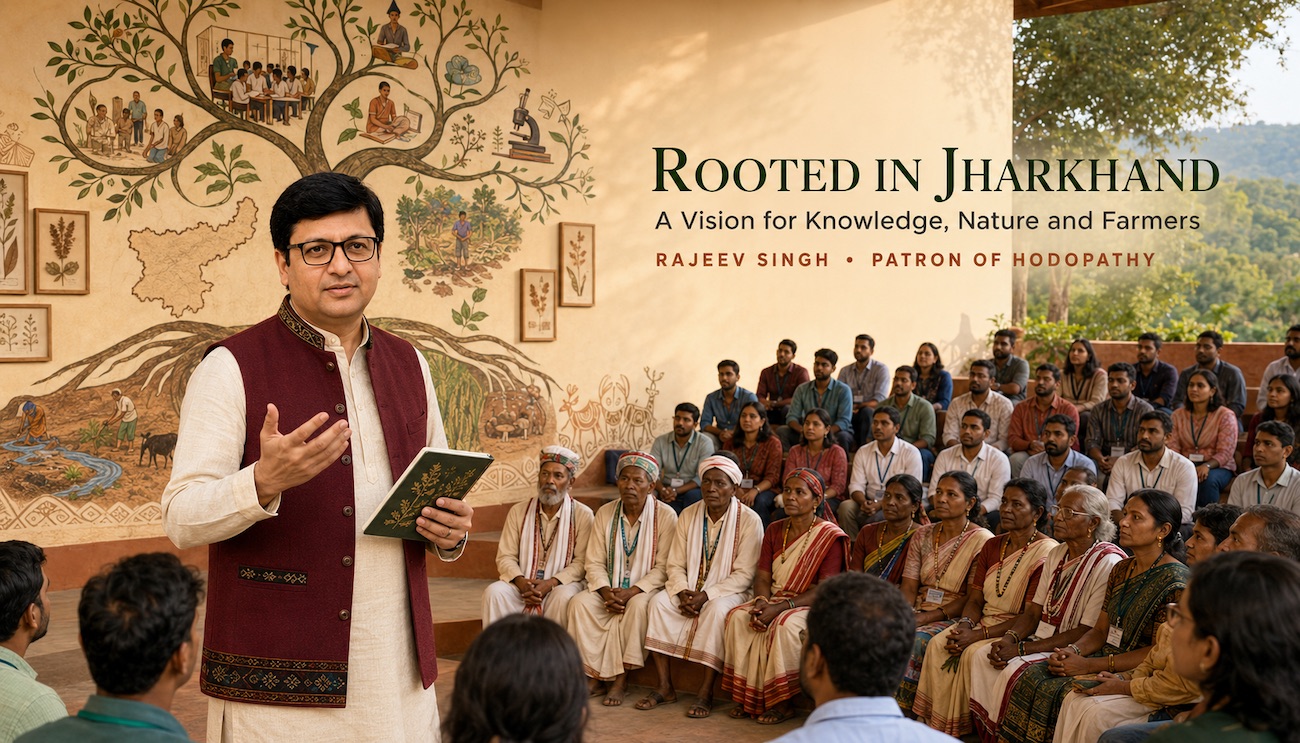
A journey rooted in Jharkhand
Rajeev Singh’s professional journey has grown at the intersection of entrepreneurship, environmental responsibility and agriculture.
His approach is practical: knowledge must move beyond conferences, reports and laboratories to address the realities of farmers, landscapes and rural communities.
This philosophy is reflected in Sansar Green’s “Mitti Se Mandi Tak”—Soil to Market vision. The model seeks to connect soil testing, agricultural inputs, scientific advisory, technology, crop production, value addition and market access within one farmer-centred ecosystem.
Rather than viewing cultivation as the end of agriculture, Rajeev Singh believes that the complete journey—from understanding the soil to helping the farmer obtain a better market—must be strengthened. Sansar Green describes its mission as combining agricultural science, artificial intelligence, sustainability and farmer empowerment.
“Agriculture is not merely about growing a crop. It is about protecting the soil, applying knowledge responsibly and ensuring that the farmer’s journey ends with dignity, value and prosperity.”
— Rajeev Singh
Why Rajeev Singh became a Patron of Hodopathy
Hodopathy represents a complementary dimension of Rajeev Singh’s environmental and agricultural mission.
The initiative uses the term to describe an indigenous ethnobotanical knowledge tradition connected with Jharkhand’s forests, medicinal plants, community practices and approaches to well-being. Much of this knowledge has survived through oral teaching instead of formal written records.
Migration, changing lifestyles, habitat degradation and the passing of experienced knowledge holders are weakening this chain of transmission. When an elder passes away without transferring what they know, generations of accumulated observations may disappear.
Rajeev Singh’s Hodopathy vision is therefore based on preservation—not ownership.
The Hodopathy mission focuses on:
- Recording oral histories with informed community participation
- Preserving traditional plant names and local terminology
- Documenting plants, habitats and seasonal observations
- Creating written, photographic and digital records
- Connecting reported plant names with botanical identification
- Encouraging responsible ethnobotanical and scientific inquiry
- Protecting community attribution and confidential knowledge
- Conserving medicinal plants and their natural ecosystems
- Connecting knowledge holders with researchers and institutions
- Creating educational resources for future generations
“Hodopathy did not begin with one individual. It grew through generations of observation, community experience and a deep relationship with Jharkhand’s forests. Our responsibility is to preserve that heritage with respect.”
— Rajeev Singh
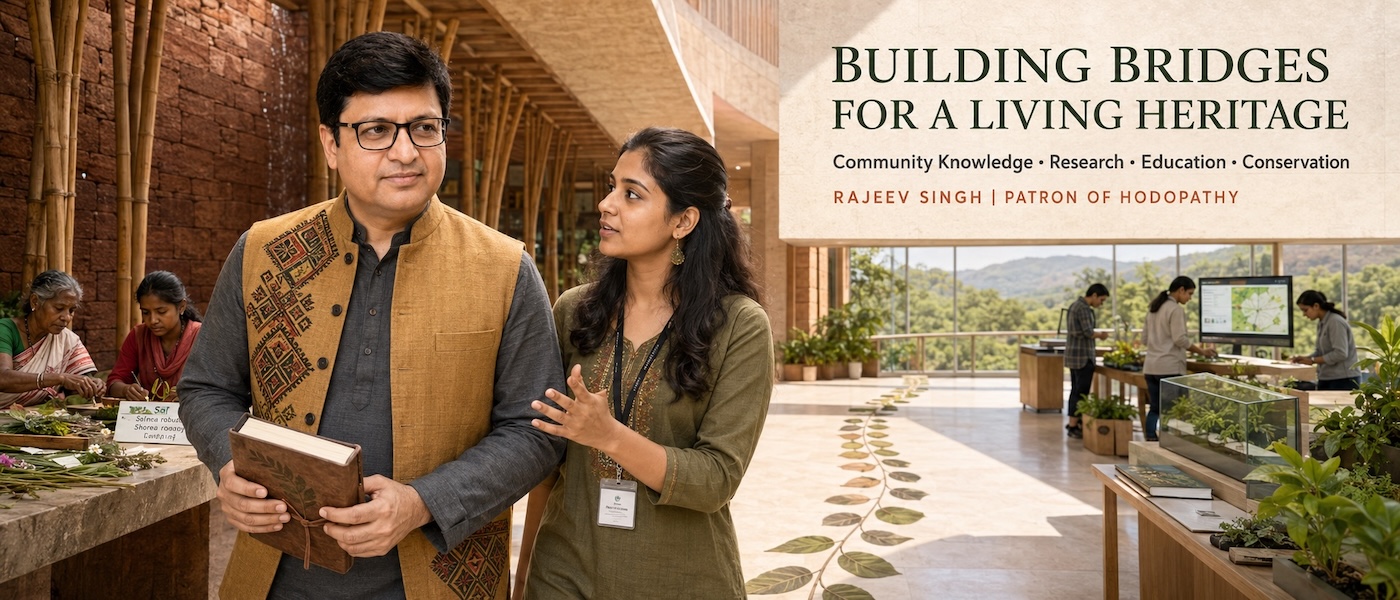
Building a bridge between traditional knowledge and science
One of the defining characteristics of Rajeev Singh’s work is his effort to connect practical knowledge with scientific institutions.
This orientation is important for Hodopathy because traditional knowledge should be respected without automatically being presented as scientifically proven medicine.
The responsible pathway is:
Traditional Observation → Ethical Documentation → Botanical Identification → Safety Assessment → Scientific Research → Evidence
A practice reported by a traditional knowledge holder should initially be recorded as a traditional observation. It should be described as scientifically validated only after appropriate botanical authentication, laboratory investigation, safety evaluation and other required studies.
This distinction protects traditional knowledge holders, researchers and the public while giving Hodopathy a credible foundation for academic inquiry.
IIT (ISM) Dhanbad: connecting Jharkhand’s innovation with technology
Rajeev Singh’s association with IIT (ISM) Dhanbad is among the most clearly documented institutional milestones of his agricultural innovation journey.
In August 2025, the CIIE, IIT (ISM) Dhanbad Foundation and Sansar Green announced a collaboration to develop AI-based organic-farming solutions. The proposed work included AI-enabled soil-health analysis, locally relevant crop recommendations, digital farmer learning, expert support and region-specific agricultural solutions.
The official announcement records Rajeev Singh’s emphasis on localised innovation and confirms institutional incubation support for Sansar Green. Read the IIT (ISM) Dhanbad press release.
In 2026, Rajeev Singh also participated in interactions at IIT (ISM) Dhanbad concerning farmer-oriented soil testing, soil intelligence, AI and agricultural innovation. These engagements demonstrate how an idea emerging from Giridih can be connected with engineering expertise, incubation and national research platforms.
The same collaborative philosophy supports his Hodopathy mission: community observations should be documented respectfully and then opened to appropriate botanical and scientific study.

Engagement with agricultural universities and incubators
Rajeev Singh and Sansar Green have pursued incubation, training, technology-transfer discussions and knowledge engagements with several agricultural and innovation institutions.
These publicly described engagements include:
Bihar Agricultural University, Sabour
Sansar Green has participated in agribusiness incubation, training and technology-transfer engagement with BAU Sabour. Public organisational communications describe discussions involving bio-inputs, organic farming, farmer training and the connection between agricultural research and field implementation.
This relationship should be described according to the latest formal documents—distinguishing completed training, incubation participation and technology-transfer discussions from any continuing institutional partnership.
IIT Ropar Technology Business Incubator Foundation
Sansar Green has explored incubation, technical guidance, laboratory access, prototyping and funding support through the IIT Ropar innovation ecosystem. Such engagement can strengthen work in soil analysis, agricultural technology and research-oriented product development.
Kerala Agricultural University
Sansar Green’s public materials describe engagement concerning microbial technologies, biofertilisers and agricultural research. Any specific technology transfer should be presented with the exact scope and status stated in the relevant agreement or official communication.
Assam Agricultural University
Engagement with Assam Agricultural University has focused on exploring research, training and technology opportunities related to biological inputs and sustainable agriculture.
These relationships illustrate Rajeev Singh’s commitment to institutional learning. They should not be grouped indiscriminately as MoUs: incubation, training, consultation, technology-transfer enquiry and formal collaboration are different achievements and should always be identified accurately.
Education as the foundation of leadership
Public organisational profiles identify Rajeev Singh as an alumnus of IIM Ranchi and Mumbai University. His background brings together management, entrepreneurship and legal and institutional understanding.
This multidisciplinary foundation is particularly relevant to Hodopathy. Preserving traditional knowledge requires more than familiarity with medicinal plants. It requires the ability to:
- Build trusted community relationships
- Understand traditional-knowledge and biodiversity rights
- Develop institutions and collaborative networks
- Organise written and digital archives
- Engage researchers and policymakers
- Manage conservation programmes
- Communicate knowledge responsibly
- Connect a regional initiative with national platforms
Education, for Rajeev Singh, is not limited to acquiring qualifications. It is a continuing process of learning from institutions, farmers, scientists, community elders and the natural environment.

SIART: creating a platform for research and education
Rajeev Singh established the Sansar Institute of Agricultural Research & Training—SIART as a platform for research, learning, innovation and capacity building.
Its stated areas of interest include:
- Organic and natural agriculture
- Soil health and microbiology
- Biofertilisers and biological inputs
- Climate-resilient agriculture
- Sustainable crop management
- Farmer training
- Rural entrepreneurship
- Technology transfer
- Student and researcher engagement
SIART’s institutional experience can eventually contribute to the educational side of Hodopathy by bringing together:
Knowledge Holders + Students + Botanists + Ethnobotanists + Agricultural Scientists + Anthropologists + Conservationists
The aim is not to absorb Hodopathy into a private institution. It is to provide an organised platform through which community-approved knowledge can be documented, studied and preserved.
Harit Sansar and the living archive
Hodopathy cannot be preserved only through books, photographs or databases. Its knowledge remains connected to living plants and functioning ecosystems.
Through Harit Sansar, Rajeev Singh promotes plantation, biodiversity conservation, ecological awareness and community participation. The larger vision goes beyond planting saplings; it emphasises appropriate species selection, continuing maintenance and long-term community responsibility.
For Hodopathy, this work can support:
- Community medicinal-plant gardens
- Native-species nurseries
- Ethnobotanical demonstration areas
- Seed and planting-material conservation
- Restoration of degraded habitats
- Educational plantations
- Photographic and botanical monitoring
The preservation model can therefore be expressed as:
Oral Knowledge + Written Archive + Digital Repository + Living Plants = Living Heritage
Documenting a plant is only the beginning. The plant, its habitat, its local name and the community knowledge connected with it must all survive.
Educator and public knowledge advocate
Rajeev Singh’s work is not confined to enterprises or institutional meetings. His public profile also highlights participation in farmer education, university programmes, conferences, digital platforms and agricultural discussions through All India Radio and Doordarshan.
Through Sansar Green and associated digital channels, agricultural and environmental information has reached a wide audience of farmers, students, gardeners and rural entrepreneurs.
This education-first approach is central to the future of Hodopathy. A responsible knowledge platform could support:
Community learning
Intergenerational exchange between experienced knowledge holders and younger community members.
School education
Awareness of Jharkhand’s forests, biodiversity, culturally significant plants and indigenous heritage.
University research
Study across ethnobotany, botany, anthropology, forestry, agriculture, biodiversity and natural-product science.
Digital preservation
Community-approved plant libraries, photographs, oral histories, interviews and educational films.
Some information may be suitable for public education. Sacred, confidential or commercially sensitive knowledge may require restricted or community-controlled access.
Protecting community rights
Rajeev Singh’s Hodopathy vision recognises that documentation must never become knowledge extraction.
Responsible preservation should be guided by:
- Prior informed participation
- Community consent
- Proper attribution
- Respect for confidential and sacred knowledge
- Protection against unauthorised commercialisation
- Community-managed access where required
- Appropriate recognition and benefit-sharing
Adivasi knowledge holders must be treated as active partners—not simply as sources from whom information is collected.
This principle is fundamental to Rajeev Singh’s position as Patron: his role is to support the custodians of Hodopathy, not replace them.
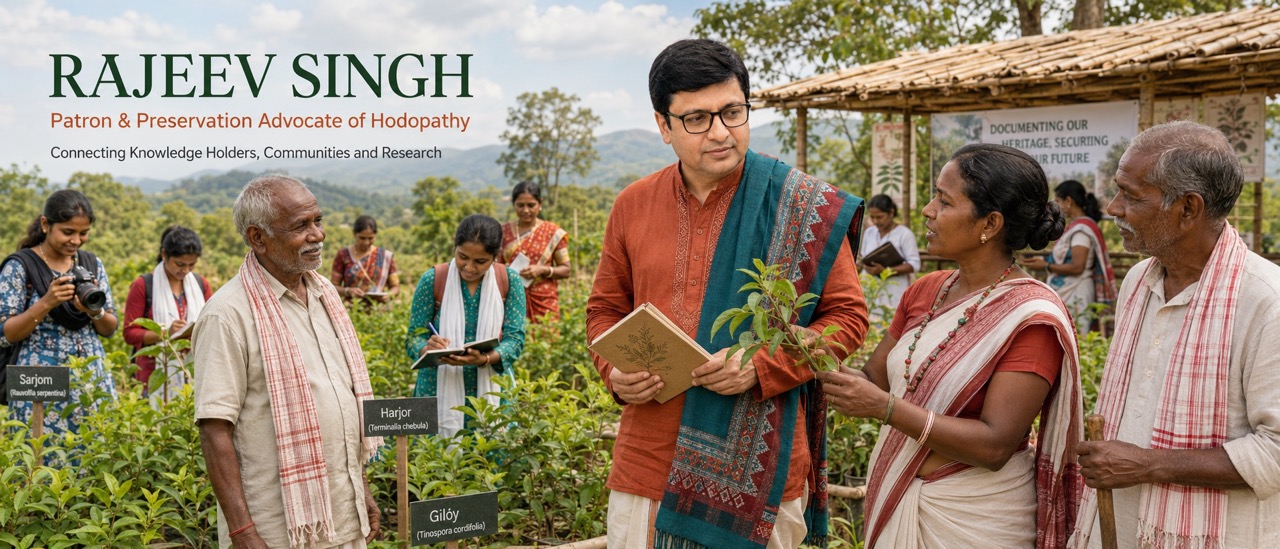
From Jharkhand to national and international recognition
Rajeev Singh’s long-term vision is to help establish Hodopathy as a responsibly documented component of Jharkhand’s indigenous knowledge heritage.
The future initiative may include:
- A written and digital Hodopathy repository
- A consent-based network of knowledge holders
- Botanical and ethnobotanical documentation
- Community medicinal-plant gardens
- Research partnerships with universities
- Publications in English, Hindi and local languages
- Educational programmes for students and communities
- Scientific investigation of selected documented plants
- Community attribution and benefit-sharing mechanisms
- National and international knowledge exchange
The purpose is not to separate Hodopathy from Jharkhand. It is to enable wider recognition while keeping its identity firmly connected to the communities, languages, forests and plants from which it emerged.
A legacy extending beyond entrepreneurship
Rajeev Singh’s journey represents an expanding definition of entrepreneurship.
Through Sansar Green, he connects agriculture with science, technology and markets.
Through Harit Sansar, he connects people with plantation, biodiversity and environmental responsibility.
Through SIART, he connects research with training and rural capacity building.
Through institutional engagements, he connects Jharkhand’s grassroots challenges with universities and innovation ecosystems.
As Patron of Hodopathy, he seeks to connect indigenous heritage with ethical documentation, responsible research and living conservation.
The larger mission can be summarised in five ideas:
Healthy Soil. Living Forests. Empowered Farmers. Responsible Research. Preserved Knowledge.
Rajeev Singh—Patron of Hodopathy
Environmental Leader | Agripreneur | Sustainability Advocate | Research and Education Promoter
Founder and Managing Director: Sansar Green Mission Pvt. Ltd.
Founder: Harit Sansar
Founder: Sansar Institute of Agricultural Research & Training—SIART
Founder: Erwon Energy Pvt. Ltd.
Patron: Hodopathy Knowledge Preservation Initiative
“The future does not require us to choose between traditional wisdom and modern science. It requires us to connect them responsibly—while respecting evidence, protecting nature and recognising the communities from whom the knowledge originates.”
— Rajeev Singh
From Jharkhand’s soil to India’s farms.
From forests to knowledge.
From knowledge to research.
From research to a sustainable future.
Rajeev Singh’s mission is not merely to build organisations. It is to build bridges—between nature and people, science and tradition, universities and communities, and the knowledge of yesterday and the possibilities of tomorrow.