
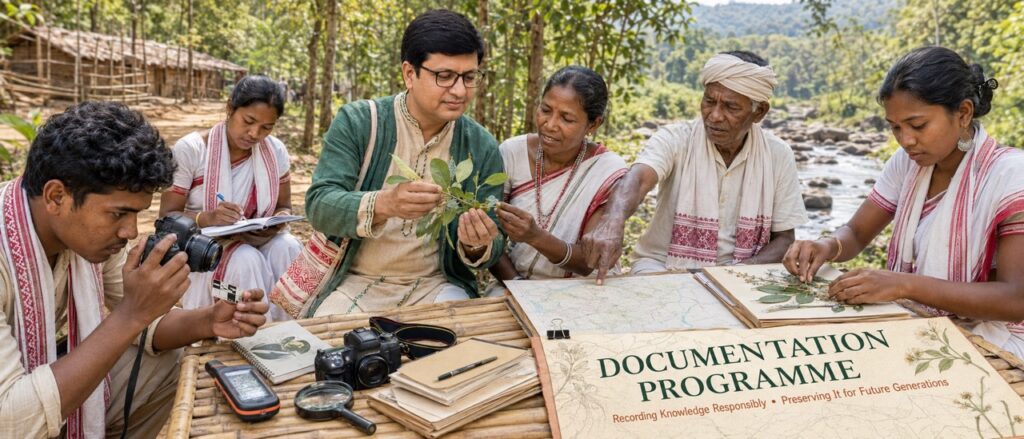
Hodopathy Documentation Programme
From Oral Heritage to a Responsible Community Knowledge Archive
The Hodopathy Documentation Programme is an initiative to preserve the indigenous knowledge associated particularly with the Ho community and other Adivasi communities of Jharkhand.
Much of this knowledge remains oral. It is held by elders, traditional practitioners, farmers, forest-resource collectors, food custodians, storytellers, indigenous-language speakers and experienced family members.
As knowledge holders grow older, younger generations migrate and forests undergo rapid change, valuable community knowledge faces the risk of being lost.
The Documentation Programme seeks to create an accurate, ethical and community-respecting record of this living heritage while protecting confidential knowledge, community identity and sensitive natural resources.
The purpose is not simply to collect information. It is to preserve knowledge with its people, language, culture and ecological context intact.
Why a Documentation Programme Is Needed
Oral knowledge remains alive through teaching and practice, but it can also be vulnerable.
Knowledge may disappear because of:
- Ageing of experienced knowledge holders
- Declining interaction between elders and youth
- Migration from villages
- Reduced use of indigenous languages
- Loss and degradation of forests
- Declining availability of native plants
- Lack of organised written or digital records
- Inaccurate or incomplete publication
- Unauthorised use of community knowledge
- Loss of cultural context during translation
When a knowledge holder passes away without transferring their experience, information developed over generations may disappear permanently.
Documentation can help create continuity, but it must be carried out with consent, accuracy and responsibility.
Programme Objectives
The Hodopathy Documentation Programme aims to:
- Identify willing traditional practitioners and knowledge holders
- Record oral histories and community experiences
- Preserve indigenous and local plant terminology
- Document permitted knowledge of forests and native plants
- Record traditional foods and seasonal practices
- Create Knowledge Holder Profiles
- Document environmental and landscape changes
- Support botanical identification and verification
- Build an organised digital and physical archive
- Protect sacred, confidential and restricted knowledge
- Encourage intergenerational learning
- Support biodiversity conservation
- Create a foundation for responsible academic and scientific research
- Ensure that original knowledge holders remain acknowledged
Documentation will focus on preservation and research awareness. It will not convert traditional accounts automatically into verified medical claims.
What the Programme May Document
With the contributor’s permission, the programme may document several forms of knowledge.
Knowledge Holders
- Names or preferred forms of identification
- Community and general region
- Area of knowledge
- Learning journey
- Teachers and family traditions
- Community contributions
- Personal reflections
- Message for future generations
Oral Histories
- Community memories
- Practitioner journeys
- Village histories
- Family traditions
- Forest experiences
- Stories and folklore
- Cultural changes
- Intergenerational knowledge transfer
Plant and Ecological Knowledge
- Indigenous and local plant names
- Photographs
- General habitat
- Seasonal availability
- Plant parts described in traditional accounts
- Customary collection practices
- Ecological observations
- Conservation concerns
- Botanical identity when verified
Food and Agricultural Knowledge
- Traditional foods
- Seasonal ingredients
- Local crops
- Seed varieties
- Food preparation and preservation
- Farming practices
- Soil and rainfall observations
- Agricultural biodiversity
Language and Cultural Knowledge
- Indigenous terminology
- Pronunciation
- Stories and songs where sharing is permitted
- Cultural meanings associated with landscapes
- Community customs
- Sacred natural places without disclosing sensitive locations
Not every category will apply to every contributor. Knowledge holders decide what they are willing to share.
The Documentation Process
The programme is designed around a careful step-by-step process.
1. Community Introduction
Before documentation begins, the purpose of the programme should be explained to community representatives and potential participants.
The discussion should cover:
- Who is conducting the programme
- Why the information is being collected
- What types of records may be created
- How information may be stored
- Whether anything may be published
- Who may access different materials
- What rights contributors retain
- How questions or concerns can be raised
Community introduction is essential for building trust and preventing misunderstanding.
2. Voluntary Participation and Consent
No person is required to participate.
Before an interview, photograph, audio recording or field visit, the knowledge holder should understand the proposed activity and choose whether to participate.
Consent may be different for different uses. A contributor may:
- Agree to an interview
- Decline photography
- Allow archival storage
- Restrict public publication
- Request anonymity
- Permit educational use
- Decline research or commercial use
- Withdraw particular details before publication
Consent should be treated as an ongoing process rather than a single signature or verbal response.
3. Knowledge Holder Interview
Interviews should be conducted in the contributor’s preferred language whenever possible.
The conversation may explore:
- Personal background
- Community role
- How the knowledge was acquired
- Local terminology
- Forest and environmental observations
- Traditional foods or farming
- Cultural memories
- Changes affecting knowledge transmission
- Concerns about conservation
- Hopes for future generations
Interviewers should avoid pressuring contributors to reveal sacred, confidential or restricted information.
4. Field Observation
Where appropriate and permitted, documentation may include field visits with knowledge holders.
Field records may capture:
- Plant photographs
- General habitat information
- Seasonal condition
- Landscape observations
- Collection practices
- Ecological relationships
- Conservation concerns
- Audio explanations
- Geographical information
Precise locations of rare, threatened, sacred or commercially vulnerable plants should not be made public.
Field observation records what is seen and explained. It does not by itself establish medical safety or effectiveness.
5. Botanical Identification
A local plant name should not automatically be treated as a confirmed botanical identity.
The same name may describe different plants in separate villages, while one plant may have several local names.
Botanical documentation may involve:
- Clear photographs of relevant features
- Observation of leaves, bark, flowers, fruits or seeds
- Habitat notes
- Comparison with botanical references
- Consultation with qualified botanists
- Herbarium specimens where appropriate and legally permitted
- Recording the status of identification
Each record should indicate whether identification is:
- Unverified
- Provisionally identified
- Verified by a botanist
- Supported by a voucher or herbarium specimen
- Under further review
Uncertainty should be recorded honestly.
6. Transcription and Translation
Audio or video interviews may need to be transcribed and translated.
Responsible processing should include:
- Preservation of the original recording
- Accurate transcription
- Identification of the language used
- Retention of important indigenous terms
- Explanation of words without direct equivalents
- Review by a competent language speaker
- Separation of the speaker’s words from editorial notes
- Recording the name of the translator where appropriate
Translation should improve accessibility without replacing the contributor’s voice.
7. Community and Contributor Review
Before public publication, the contributor should be given an opportunity to review the record wherever reasonably possible.
Review may include:
- Name and identification
- Profile description
- Photographs and captions
- Selected quotations
- Translation
- Location information
- Cultural interpretation
- Sensitive or restricted details
Community review can help correct misunderstandings and ensure that the documentation reflects the intended meaning.
8. Archiving and Access Classification
Not every record should receive the same level of access.
The programme may organise material into categories such as:
Public
Information approved for publication on the website or in educational materials.
Community Access
Records available primarily to participating communities or designated community institutions.
Research Access
Materials available to approved researchers under defined conditions.
Restricted
Sensitive records requiring specific permission before access.
Confidential
Knowledge not available for outside access or publication.
Access decisions should reflect contributor preferences, community customs, safety, biodiversity risks and applicable requirements.
Documentation Standards
Each record should include sufficient context to remain useful and credible.
Where applicable, a documentation record may contain:
- Unique record number
- Date of documentation
- Name or code of contributor
- Community
- General location
- Language
- Interviewer
- Translator
- Photographer
- Type of knowledge
- Original account
- Edited summary
- Botanical identification status
- Consent and access category
- Cultural restrictions
- Scientific references
- Review and correction history
A plant name or quotation without source information has limited preservation value.
Protecting Sensitive Knowledge
The Documentation Programme will not seek to publish every detail it encounters.
Information may be withheld when it is:
- Sacred
- Restricted to a family
- Shared only with selected learners
- Associated with a vulnerable species
- Located in a sensitive ecological area
- Capable of encouraging unsafe self-medication
- Personally identifying or private
- Vulnerable to commercial exploitation
- Shared under conditions of confidentiality
Preservation can include protected archiving. It does not require unrestricted public disclosure.
Separating Tradition from Scientific Evidence
Documentation records what a community or knowledge holder reports. It does not automatically verify the claim scientifically.
Every record should distinguish among:
- Oral tradition
- Personal experience
- Practitioner testimony
- Community practice
- Botanical verification
- Laboratory findings
- Clinical evidence
- Scientific conclusions
Traditional accounts may help identify valuable research questions. Scientific conclusions require separate investigation using appropriate methods.
The programme will avoid converting cultural documentation into unsupported claims of prevention, treatment or cure.
Community Copies and Local Access
Documentation should not exist only in an outside institution or online database.
Where practical, participating communities should receive access to suitable copies of:
- Interviews
- Photographs
- Knowledge Holder Profiles
- Language records
- Educational materials
- Biodiversity documentation
- Community reports
- Approved research findings
Formats should be accessible and appropriate for the community. This may include printed materials, audio records, local-language resources or protected digital copies.
Supporting Intergenerational Learning
Young people can contribute significantly to the programme.
With appropriate guidance, Adivasi youth and students may participate in:
- Interview recording
- Indigenous-language transcription
- Botanical photography
- Biodiversity mapping
- Digital archiving
- Community history projects
- Translation
- Herbal and conservation gardens
- Educational outreach
- Research assistance
Youth participation can help connect modern documentation tools with knowledge carried by elders.
Documentation and Conservation
The programme can support conservation by recording:
- Plants becoming difficult to find
- Changes in flowering and fruiting
- Habitat loss
- Unsustainable collection
- Changes in water availability
- Community conservation practices
- Species suitable for cultivation
- Locations requiring protection
Sensitive location data should remain restricted.
Documentation should encourage conservation—not create new pressure on rare plants.
Collaboration with Institutions
The Hodopathy Documentation Programme welcomes responsible collaboration with:
- Adivasi communities
- Traditional practitioners
- Universities
- Botanical institutions
- Ethnobotanists
- Social-science researchers
- Scientific laboratories
- Biodiversity organisations
- Forest-conservation groups
- Indigenous-language specialists
- Archives and museums
- Responsible educational organisations
A proposed collaboration should clearly describe:
- Purpose
- Methodology
- Information required
- Expected outputs
- Community participation
- Data access
- Publication plans
- Funding or commercial interests
- Applicable ethical approvals
- Plans for sharing results
Knowledge holders should be treated as partners rather than anonymous sources.
Expected Programme Outputs
Subject to community participation and available resources, the programme may develop:
- Knowledge Holder Profiles
- Oral-history collections
- Indigenous plant-name records
- Verified botanical records
- Photographic documentation
- Community story archives
- Traditional food records
- Forest and biodiversity observations
- Local-language educational materials
- Research bibliographies
- Conservation reports
- Protected digital archives
- Community exhibitions and learning resources
These outputs should be created gradually and reviewed for accuracy, consent and cultural sensitivity.
Corrections and Continuing Review
Documentation is never completely final.
A plant identification may change. A translation may require improvement. A contributor may wish to update their profile or restrict information previously approved for publication.
The programme should maintain a process for:
- Reporting errors
- Reviewing contested information
- Updating botanical identification
- Correcting translation
- Replacing inaccurate photographs
- Revising access classifications
- Recording the history of major changes
Corrections strengthen the archive’s credibility.
Participate in the Documentation Programme
We welcome participation from:
- Adivasi elders
- Traditional practitioners
- Farmers and seed custodians
- Forest knowledge holders
- Food and language custodians
- Youth documentarians
- Botanists
- Researchers
- Universities
- Conservation organisations
- Responsible volunteers
To participate, contact Hodopathy through the website’s Connect or Contact page and provide:
- Your name
- Community or institution
- Location
- Area of knowledge or expertise
- Type of contribution proposed
- Preferred language
- Any cultural or access restrictions
- Relevant experience or documentation
Every proposed activity will be considered according to community participation, ethical responsibility, accuracy and available programme capacity.
Preserving Knowledge with Its Roots Intact
The Hodopathy Documentation Programme is not an effort to remove knowledge from the community and store it elsewhere.
Its purpose is to help communities preserve their heritage, make knowledge holders visible, support conservation and create a responsible foundation for future learning and research.
Information on Hodopathy.com is intended for cultural preservation, education and research awareness. It is not medical advice and should not be used for self-treatment.
Documenting Hodopathy means preserving the knowledge, honouring its custodians and protecting the forests and communities that keep it alive.