
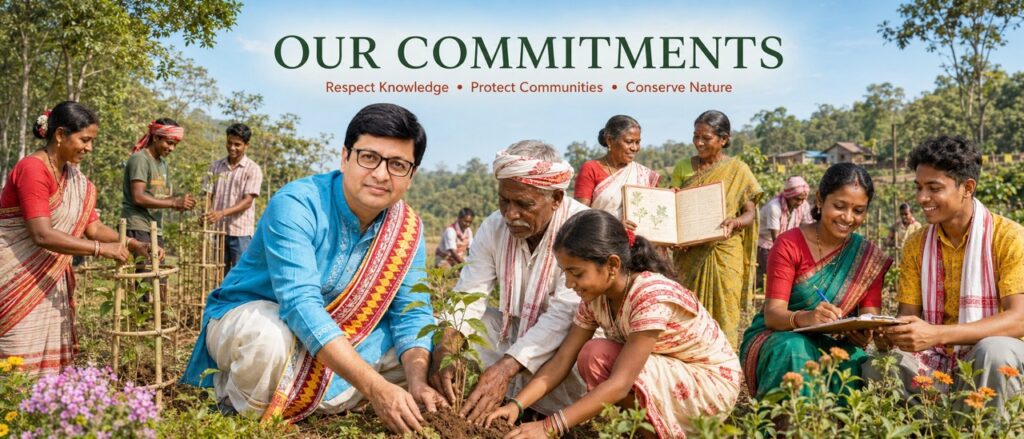
Our Commitments
Preserving Hodopathy with Respect, Responsibility and Integrity
Hodopathy is a living indigenous knowledge tradition associated particularly with the Ho community and other Adivasi communities of Jharkhand. It has been protected across generations by traditional practitioners, elders, families and forest-dependent communities.
Working with this heritage creates a serious responsibility. Documentation should not become extraction. Research should not erase the identity of original knowledge holders. Public awareness should not lead to exaggerated medical claims, unsafe plant use or damage to natural ecosystems.
Hodopathy is therefore guided by commitments that place communities, cultural dignity, scientific integrity and environmental conservation at the centre of its work.
1. Respecting the Original Knowledge Holders
We recognise that Hodopathy was not invented by a modern individual, company or institution. It represents collective knowledge developed and preserved by Adivasi communities across generations.
We are committed to:
- Recognising the communities from which knowledge originates
- Acknowledging individual practitioners and contributors where permitted
- Respecting local languages and traditional plant terminology
- Representing knowledge holders with dignity
- Avoiding claims of personal ownership over collective traditions
- Keeping community identity visible in documentation and research
- Challenging misleading representations of indigenous knowledge
Hodopathy.com exists to support the preservation of this heritage—not to claim ownership over it.
2. Prior and Informed Participation
Knowledge should not be collected merely because it is accessible. A practitioner or community member must understand why information is being requested and how it may be recorded, stored, published or studied.
Before documenting knowledge, we will seek to explain:
- The purpose of the activity
- The type of information being recorded
- How photographs, audio or video may be used
- Who may access the information
- Whether the material may be published
- Whether researchers or institutions may be involved
- How contributors may be identified or acknowledged
Participation should be voluntary. A knowledge holder should be able to decline a question, restrict the use of information or withdraw from an activity where reasonably possible.
Silence, hospitality or access to a village should never be interpreted automatically as consent.
3. Protecting Sacred and Confidential Knowledge
Not all traditional knowledge is intended for public circulation.
Some information may be sacred, restricted to a family, connected with cultural ceremonies or entrusted only to particular practitioners. Such knowledge must not be placed online simply for public interest or commercial value.
We are committed to:
- Respecting requests for confidentiality
- Avoiding publication of restricted practices
- Protecting sensitive locations of rare plants
- Using restricted-access archives where appropriate
- Not pressuring practitioners to reveal protected knowledge
- Consulting knowledge holders before disclosing sensitive information
Preservation does not always require public disclosure. Knowledge can be protected without being made universally accessible.
4. Accurate and Contextual Documentation
Traditional knowledge can be misunderstood when isolated from its cultural, linguistic and ecological setting.
We aim to document not only the name of a plant or practice, but also its context wherever appropriate and permitted. This may include:
- The community and region associated with the knowledge
- Local and indigenous plant names
- The language in which the knowledge was shared
- Habitat and seasonal information
- Cultural meaning and customary restrictions
- The identity of the contributor where permission is given
- Differences among villages or practitioners
- The date and method of documentation
We will not deliberately alter community accounts to make them appear more dramatic, marketable or scientifically conclusive.
Where different versions of an oral tradition exist, we will acknowledge that diversity instead of presenting one account as the only authentic version.
5. Scientific Honesty
We value traditional knowledge and responsible scientific inquiry, but we will not treat them as interchangeable.
A community’s traditional use of a plant is an important ethnobotanical record. It is not automatically proof that the plant or preparation is safe and effective for medical use.
We are committed to distinguishing clearly among:
- Oral and community tradition
- Documented traditional use
- Scientific literature related to a plant
- Preliminary laboratory findings
- Observational evidence
- Clinical evidence
- Scientifically established conclusions
We will avoid presenting assumptions, personal experiences or laboratory observations as confirmed medical facts.
Where evidence is limited, uncertain or conflicting, that limitation should be communicated clearly.
6. Avoiding Misleading Health Claims
Natural does not always mean safe. A plant may be harmful when incorrectly identified, collected, prepared, combined or consumed in an unsuitable quantity.
Hodopathy.com will not encourage:
- Self-diagnosis or self-medication
- Use of unidentified plants
- Replacement of prescribed treatment without medical guidance
- Claims that one preparation can cure every condition
- Guaranteed treatment outcomes
- Unsupported claims of disease prevention or cure
- The assumption that traditional use eliminates all risk
- Advice that discourages people from seeking qualified healthcare
Information published on this website is intended for cultural preservation, education and research awareness. It should not be interpreted as medical advice.
People experiencing health concerns should consult an appropriately qualified healthcare professional.
7. Responsible Research Collaboration
Researchers and institutions can play an important role in botanical identification, scientific evaluation, conservation and documentation. However, collaboration must not reduce communities to research subjects or sources of biological material.
We will encourage research relationships that:
- Explain the purpose and scope of the proposed research
- Involve knowledge holders meaningfully
- Acknowledge the sources of traditional knowledge
- Use appropriate botanical and scientific methods
- Communicate findings honestly
- Respect restrictions placed on sensitive information
- Avoid misleading community members about likely outcomes
- Follow applicable ethical and institutional requirements
- Share appropriate findings with participating communities
Research about communities should, wherever possible, also create knowledge that is accessible and useful to those communities.
8. Fairness and Responsible Benefit Sharing
Traditional knowledge should not be collected from communities and converted into private commercial value without recognition, participation or fairness.
If documented knowledge contributes to future research, educational resources, conservation programmes or responsible product development, the role of the original knowledge holders must be considered from the beginning.
We support:
- Transparent discussion about intended use
- Appropriate recognition of community contributions
- Meaningful opportunities for community participation
- Compliance with applicable biodiversity and benefit-sharing requirements
- Fair livelihood opportunities where suitable
- Protection against unauthorised ownership claims
- Responsible and traceable sourcing of natural materials
Commercial interest must never be allowed to override community rights, public safety or environmental responsibility.
9. Protecting Forests and Biodiversity
Hodopathy cannot be preserved if the plants and forests supporting it are destroyed.
Increased public attention can place pressure on traditionally important plants. Publishing information about a rare species may result in uncontrolled collection, habitat damage or illegal trade.
We are committed to promoting:
- Sustainable and seasonal harvesting
- Collection of only the quantity genuinely required
- Cultivation of suitable plants outside natural forests
- Community herbal and biodiversity gardens
- Conservation of rare and vulnerable plant species
- Protection of soil, water and wildlife habitats
- Traceable and responsible sourcing
- Community participation in conservation
- Protection of sensitive plant-location information
Human well-being must not be pursued at the cost of ecological well-being.
10. Respectful Photography and Storytelling
Photographs, videos and personal stories can help preserve heritage, but they can also misrepresent or exploit communities.
We will seek to ensure that visual and written documentation:
- Is created with appropriate permission
- Does not portray communities as primitive or inferior
- Avoids staged or misleading representations
- Respects cultural dress, ceremonies and sacred locations
- Identifies participants correctly where permission is given
- Protects the identity of participants who request privacy
- Does not use personal stories outside the agreed context
- Communicates with dignity rather than sensationalism
A powerful image or story should never be considered more important than the rights of the person represented.
11. Privacy and Responsible Data Management
Documentation may include names, voices, photographs, locations and community information. Such records must be handled carefully.
We aim to:
- Collect only information relevant to the stated purpose
- Explain how recorded material may be stored and used
- Limit access to confidential information
- Avoid publishing sensitive personal details
- Protect precise locations of vulnerable plant species
- Maintain organised records of permissions where practical
- Review requests for correction or removal responsibly
- Use digital platforms with appropriate safeguards
A public-interest purpose does not remove the responsibility to protect personal and community information.
12. Transparency and Correction
Traditional knowledge documentation is a continuing learning process. Plant names may be mistranslated, botanical identification may require revision and new research may change scientific understanding.
We are committed to:
- Correcting significant factual errors
- Updating scientific information when reliable evidence changes
- Identifying traditional accounts as traditional accounts
- Disclosing uncertainty where verification is incomplete
- Separating educational information from promotional content
- Inviting knowledge holders and researchers to report inaccuracies
- Providing appropriate attribution to published sources
- Avoiding plagiarism and unattributed copying
Credibility depends not on claiming to be perfect, but on responding openly and responsibly when correction is needed.
13. Cultural Continuity and Youth Participation
A tradition survives when future generations understand its value.
We support responsible opportunities for Adivasi and rural youth to participate in:
- Oral-history documentation
- Indigenous-language preservation
- Botanical photography
- Plant identification
- Biodiversity mapping
- Community herbal gardens
- Digital archiving
- Forest-conservation activities
- Research and educational programmes
The purpose is not to keep young people confined to the past. It is to help them carry their heritage forward while gaining the skills required to document and protect it in a changing world.
14. Compliance with Applicable Standards
Documentation, research, conservation and any future development connected with Hodopathy must operate within applicable legal and institutional frameworks.
Depending on the activity, this may include requirements related to:
- Biodiversity and biological resources
- Access and benefit sharing
- Forest and wildlife protection
- Research ethics
- Intellectual property
- Data and privacy
- Food and health products
- Advertising and public claims
- Institutional approvals
Traditional importance does not remove the need for responsible compliance.
Accountability to the Future
These commitments are intended to guide how Hodopathy is documented, researched, communicated and carried forward.
Our responsibility is not only to the present generation. It is also to the elders who preserved this knowledge, the communities to whom it belongs, the forests that made it possible and the young people who may inherit it.
Hodopathy must progress through partnership rather than extraction, evidence rather than exaggeration, conservation rather than depletion and respect rather than appropriation.
We are committed to preserving Hodopathy with its community identity protected, its knowledge represented honestly and its natural foundations conserved for future generations.