
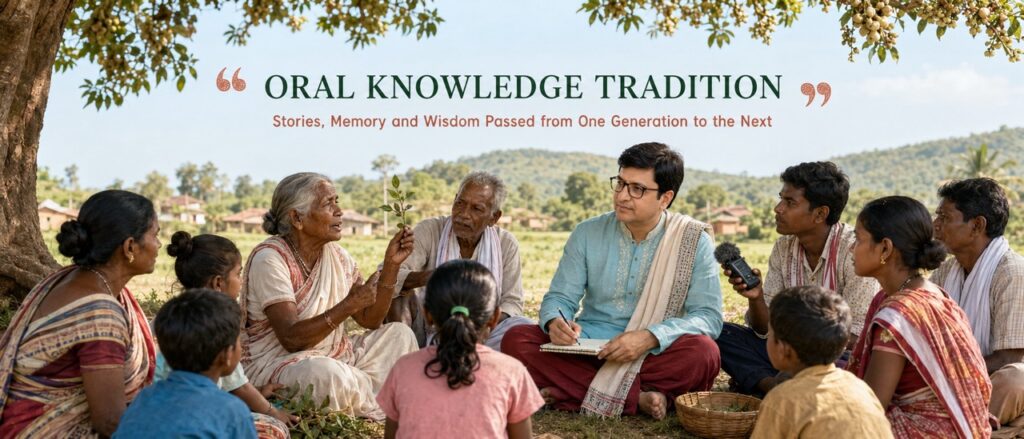
Oral Knowledge Tradition
How Hodopathy Has Been Remembered and Transmitted Across Generations
Hodopathy has survived mainly as an oral knowledge tradition. Rather than depending on a single written text or formal curriculum, its knowledge has been carried through spoken language, observation, memory, stories, practical demonstration and years of participation in community life.
Within the Ho community and other Adivasi communities of Jharkhand, elders, traditional practitioners and experienced family members have helped transmit knowledge of forests, native plants, seasonal foods, natural resources and customary practices.
Oral tradition is not simply information communicated by word of mouth. It is a living process through which knowledge is explained, demonstrated, remembered, interpreted and adapted within a particular cultural and ecological setting.
Understanding this process is essential to preserving Hodopathy responsibly.
What Is an Oral Knowledge Tradition?
An oral knowledge tradition is a system in which information, values, skills and community memories are transmitted primarily through speech and practical experience rather than through written documents.
Knowledge may be passed forward through:
- Conversations with elders
- Stories and folklore
- Songs and cultural expressions
- Practical demonstrations
- Forest visits
- Observation of plants and animals
- Participation in farming or food preparation
- Seasonal collection activities
- Apprenticeship under an experienced practitioner
- Community ceremonies and customary practices
The spoken explanation is only one part of this process. The learner must often observe, remember, participate and repeat the practice over time.
Learning Beyond Written Words
Certain forms of Hodopathy knowledge are difficult to preserve through writing alone.
A written description may explain the shape of a leaf, but direct observation can show how the leaf changes according to season, soil, sunlight or maturity. A photograph may capture a plant at one moment, but it may not communicate its aroma, texture, habitat or relationship with surrounding vegetation.
Practical learning may include:
- Recognising a plant in different stages of growth
- Distinguishing it from similar-looking species
- Understanding where it commonly grows
- Observing its seasonal changes
- Learning its local and cultural names
- Understanding customary collection practices
- Recognising when a resource should not be collected
- Remembering cultural rules associated with it
Oral knowledge is therefore closely connected with place and experience.
Elders as Oral Historians
Adivasi elders often serve as living historians of their communities and landscapes.
They may remember:
- Plants that were once common
- Traditional names no longer widely used
- Earlier forest and water conditions
- Seasonal calendars
- Local food practices
- Community stories
- Changes in farming and rainfall
- Customary rules concerning natural resources
- Knowledge inherited from previous generations
These memories can provide information that is unavailable in written records.
When an elder passes away without sharing or recording their knowledge, an irreplaceable part of community history may disappear. Oral-history documentation can help preserve these experiences, provided it is conducted with consent and cultural sensitivity.
Traditional Practitioners as Teachers
Traditional Hodopathy practitioners may pass specialised knowledge to selected learners through extended observation and practice.
A learner may accompany a practitioner into forests, observe plant identification, assist in collection and learn community terminology. The practitioner may gradually share more information as the learner develops experience, discipline and trust.
The teaching process may involve:
- Repetition
- Demonstration
- Questions and discussion
- Correction through practice
- Memory tests
- Observation across different seasons
- Responsibility toward confidential knowledge
- Respect for plants and natural resources
Such learning may continue for many years. It cannot necessarily be replaced by a short written guide or online course.
Stories as Carriers of Meaning
Stories play an important role in oral traditions.
A story may explain:
- Why a plant is respected
- How knowledge was inherited
- Why a forest area is culturally important
- What responsibilities accompany knowledge
- How people should behave toward nature
- Why certain practices are restricted
- How community identity is connected with the landscape
Stories do not always function as literal historical records. They may contain cultural memory, spiritual meaning, moral guidance or symbolic explanations.
Responsible documentation should identify oral narratives as community traditions rather than presenting them automatically as independently verified historical facts.
Their value lies in the meaning they carry for the people who preserve them.
Language as a Knowledge Archive
Indigenous language is one of the most important foundations of oral knowledge.
A local plant name may communicate information about:
- Appearance
- Habitat
- Taste or aroma
- Season
- Growth pattern
- Traditional association
- Cultural significance
- Relationship with another species
When knowledge is translated into another language, some meaning may be altered or lost.
Documentation should therefore preserve, wherever possible:
- Original community terminology
- Correct pronunciation
- Meaning and context
- Regional variations
- The language used by the contributor
- Corresponding botanical names after verification
Scientific names help establish botanical identity. Indigenous names help preserve cultural and ecological meaning. One should not replace the other.
Memory Strengthened Through Practice
Oral knowledge remains alive through use.
Community members remember information by participating in the activities connected with it. A person may recall the name of a seasonal food because they collected it with family members. A learner may remember a plant because an elder showed where it grows and how its leaves change.
Knowledge is strengthened through:
- Repeated observation
- Seasonal experience
- Shared work
- Storytelling
- Demonstration
- Community participation
- Correction by elders
- Responsibility for teaching others
When these activities decline, oral knowledge may weaken even if individual plant names have been written down.
Preservation must therefore support living transmission as well as written documentation.
Variation Within Oral Tradition
Oral traditions naturally develop variations.
Different practitioners, families or villages may preserve different versions of:
- A story
- A plant name
- A preparation practice
- A seasonal calendar
- A cultural interpretation
- A customary restriction
Variation does not necessarily mean that an account is false. It may reflect differences in geography, language, family experience or environmental conditions.
Responsible documentation should:
- Record who shared each account
- Identify the village or region
- Preserve the original language where possible
- Note differences among contributors
- Avoid combining separate traditions without explanation
- Seek botanical verification independently
The objective should be to preserve diversity accurately rather than create a false appearance of complete uniformity.
Strengths of Oral Knowledge
Oral knowledge can be flexible and responsive.
Because it is closely connected with observation, communities may adapt their understanding when:
- Plant availability changes
- Rainfall patterns shift
- New environmental pressures emerge
- People move to a different landscape
- A species becomes rare
- Farming practices change
- New experiences are shared
This adaptability helps knowledge remain relevant within changing environments.
Oral teaching also allows an experienced person to judge what a learner is ready to understand. Sensitive knowledge can be shared gradually and responsibly rather than made available to everyone without context.
Risks Facing Oral Traditions
Oral knowledge is also vulnerable.
It may be lost because of:
- Ageing of experienced knowledge holders
- Reduced interaction between elders and youth
- Migration from villages
- Decline in indigenous-language use
- Loss and degradation of forests
- Disappearance of native plants
- Social dismissal of traditional knowledge
- Lack of organised documentation
- Unauthorised commercial exploitation
- Inaccurate online representation
A single person may carry knowledge not held by anyone else. If that knowledge is not transmitted, it may disappear permanently.
This creates an urgent need for careful and community-led documentation.
Documentation Is More Than Recording Words
Recording an interview is only the beginning of documentation.
A responsible oral-knowledge record should include, where permitted:
- Name or preferred identification of the contributor
- Community and village
- Date and location of the interview
- Language used
- Original audio or video
- Accurate transcription
- Careful translation
- Plant photographs where relevant
- Botanical identification status
- Cultural and ecological context
- Restrictions placed on access or use
- Record of permission
Without this information, oral knowledge can easily be misunderstood or separated from its source.
Consent and Control
Knowledge holders must understand how their words may be used.
Before an interview or recording, they should be informed about:
- The purpose of documentation
- The subjects to be discussed
- Whether audio or video will be recorded
- How the material will be stored
- Whether it may be published
- Who may access it
- Whether researchers may study it
- Whether future commercial use is possible
A person may agree to an interview but decline photography. They may allow archival storage but not public publication. They may share a plant name while withholding the details of a restricted practice.
These choices must be respected.
Protecting Sacred and Restricted Knowledge
Not all oral knowledge should be made public.
Some information may be:
- Sacred
- Connected with ceremonies
- Restricted to a family
- Shared only with selected learners
- Associated with rare plants
- Capable of encouraging unsafe use
- Vulnerable to commercial misuse
Preserving such knowledge may require:
- A restricted community archive
- Limited institutional access
- Removal of sensitive locations
- Anonymisation of contributors
- Delayed publication
- Complete non-disclosure
Documentation should never be used as an excuse to override community restrictions.
Translation and the Risk of Distortion
Translation can change meaning.
A translator may select a familiar word that does not fully represent the original concept. Plant names may be confused. Cultural expressions may be simplified. A practitioner’s cautious statement may become an exaggerated claim.
Responsible translation should include:
- A translator familiar with the community language
- Review by the original speaker where possible
- Preservation of important original terms
- Explanation of words without direct equivalents
- Clear separation of literal and interpretive translation
- Verification of plant identity independently from the local name
The goal should be understanding—not replacing the original voice.
Digital Preservation
Digital tools can help preserve oral traditions through:
- Audio recordings
- Video interviews
- Photographic records
- Transcriptions
- Language databases
- Digital maps
- Community archives
- Educational resources
However, digital publication creates new risks. Information uploaded publicly can be copied, altered or used outside its original context.
A responsible digital archive should consider:
- Who controls the records
- Who can access different categories of information
- How permissions are documented
- Whether contributors can request corrections
- How sensitive locations are protected
- How knowledge holders are acknowledged
- How files will be preserved over time
Digital access should not mean unrestricted access.
Connecting Elders and Youth
Young people can play an important role in carrying oral knowledge forward.
They can help:
- Record interviews with elders
- Document indigenous pronunciation
- Photograph native plants responsibly
- Transcribe and translate recordings
- Create community biodiversity records
- Build protected digital archives
- Organise cultural-learning activities
- Support community herbal gardens
- Connect elders with researchers
Technology can help young people preserve community knowledge while learning directly from its custodians.
The aim is not to freeze tradition in the past. It is to create continuity between generations.
Oral Knowledge and Scientific Research
Oral accounts can provide valuable starting points for ethnobotanical and scientific research.
They may help researchers identify:
- Locally important plants
- Changes in plant distribution
- Community terminology
- Traditional food resources
- Conservation priorities
- Subjects requiring botanical investigation
However, oral tradition and scientific evidence are not the same.
A traditional account documents community knowledge. Scientific conclusions require systematic investigation, botanical verification, safety assessment and appropriate research.
Both should be presented accurately, with their different purposes and limitations clearly explained.
Keeping the Tradition Alive
The preservation of Hodopathy requires more than converting spoken knowledge into written documents.
It requires:
- Continued relationships between elders and youth
- Protection of indigenous languages
- Conservation of forests and native plants
- Respect for traditional practitioners
- Community control over sensitive knowledge
- Accurate documentation
- Responsible scientific inquiry
- Recognition of individual and collective contributors
An oral tradition remains alive when people continue to speak, practise, interpret and transmit it.
Information on Hodopathy.com is intended for cultural preservation, education and research awareness. It is not medical advice and should not be used for self-treatment.
Hodopathy survives through spoken words, shared experience and the responsibility of each generation to carry knowledge forward.