
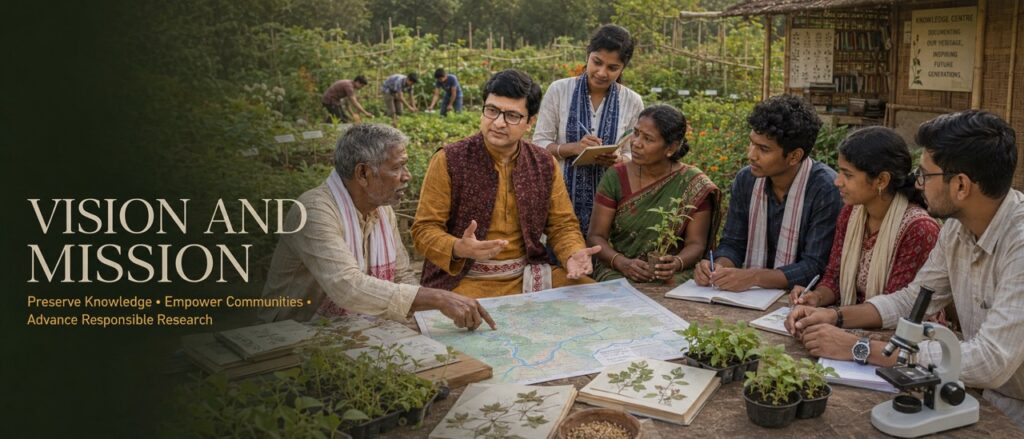
Vision and Mission
Preserving Indigenous Knowledge and Building a Responsible Future for Hodopathy
Hodopathy represents generations of knowledge developed and preserved by the Ho community and other Adivasi communities of Jharkhand. This living heritage connects people with native plants, forests, traditional foods, local ecosystems and community life.
As experienced knowledge holders grow older, forests face increasing pressure and oral traditions receive less attention from younger generations, valuable knowledge is at risk of disappearing.
Hodopathy seeks to respond to this challenge by building a responsible platform for documentation, preservation, research, conservation and collaboration.
Our direction is guided by a simple principle: indigenous knowledge must be preserved without separating it from the communities and natural environments that sustained it.
Our Vision
To establish Hodopathy as a credible and community-respecting national and international knowledge platform that preserves Jharkhand’s indigenous heritage, recognises its original knowledge holders, supports responsible scientific inquiry and contributes to the conservation of forests and biodiversity.
We envision a future in which Hodopathy is:
- Preserved accurately for future generations
- Recognised as an important part of Adivasi cultural heritage
- Documented with the participation of traditional knowledge holders
- Studied through responsible botanical and scientific methods
- Protected from distortion and unauthorised exploitation
- Connected with forest and biodiversity conservation
- Shared through education without exaggerated medical claims
- Represented on national and international knowledge platforms
- Used to encourage respectful dialogue between communities and institutions
Our vision is not to remove Hodopathy from its traditional setting or convert it into an isolated collection of plant remedies. It is to preserve it as a complete living heritage connected with people, culture, language, forests and community experience.
Our Mission
Our mission is to identify and connect Hodopathy practitioners and Adivasi knowledge holders; document permitted traditional knowledge; encourage botanical and scientific research; conserve native plants and forest ecosystems; and create an ethical bridge among communities, researchers and responsible institutions.
We aim to carry out this mission through interconnected areas of work.
1. Identifying and Connecting Knowledge Holders
Traditional knowledge is often distributed among individual practitioners, elders, families and villages. Many knowledge holders have limited opportunities to connect with researchers, universities or documentation initiatives.
Hodopathy aims to create a network through which these knowledge holders can:
- Share permitted knowledge and experiences
- Connect with other traditional practitioners
- Participate in documentation activities
- Interact with researchers and institutions
- Contribute to conservation and educational initiatives
- Receive appropriate acknowledgement for their contributions
The purpose of this network is not to standardise every local tradition. It is to create opportunities for communication while respecting differences among communities, regions and individual practitioners.
2. Documenting a Living Oral Tradition
A large part of Hodopathy knowledge remains unwritten. Oral knowledge is valuable, but it can become vulnerable when experienced practitioners pass away without transferring it to another generation.
Our mission is to support careful documentation that may include:
- Oral histories and practitioner interviews
- Local names of plants
- Photographs and botanical records
- Traditional collection seasons
- Preparation practices where disclosure is permitted
- Local foods and community nutrition traditions
- Cultural beliefs associated with plants and forests
- Stories and terminology preserved in indigenous languages
- Ecological information about plant habitats
- Changes observed in forests and plant availability
Documentation should preserve context rather than recording isolated fragments of information. It should explain who holds the knowledge, where it developed and how it relates to community life.
3. Encouraging Scientific Inquiry
Traditional experience can provide valuable directions for research. Scientific methods can help examine the botanical identity, composition, purity, safety and biological properties of documented plant materials.
Hodopathy seeks to encourage collaboration in areas such as:
- Ethnobotanical field studies
- Botanical identification and authentication
- Herbarium and specimen documentation
- Scientific literature review
- Laboratory analysis
- Safety and toxicity assessment
- Nutritional and phytochemical studies
- Conservation research
- Evaluation of sustainable cultivation methods
Traditional use should not automatically be presented as proof of medical safety or effectiveness. Scientific findings must also be communicated accurately without exaggeration.
Our mission is to encourage serious investigation while maintaining a clear distinction among traditional knowledge, preliminary findings and scientifically established evidence.
4. Preserving Community Identity
Hodopathy is part of the collective heritage of the communities that preserved it. Its identity must remain connected with those communities even when the knowledge is studied or presented outside Jharkhand.
We seek to ensure that:
- Traditional knowledge holders remain visible in the Hodopathy narrative
- Local and indigenous terminology is recorded where possible
- Community experiences are represented accurately
- Cultural practices are not reduced to commercial descriptions
- Hodopathy is not falsely presented as the invention of one individual
- Future generations understand the community roots of the tradition
Recognition must extend beyond the name of the knowledge system. It must include respect for the people, languages and landscapes that gave the knowledge continuity.
5. Protecting Forests and Native Plants
The future of Hodopathy depends on the future of its natural environment.
When forests are degraded or native plants disappear, communities lose both biological resources and the knowledge connected with them. Conservation must therefore remain an essential part of Hodopathy’s development.
Our mission includes promoting:
- Identification of traditionally important plant species
- Conservation of native plants and their habitats
- Sustainable and seasonal collection practices
- Community herbal and biodiversity gardens
- Cultivation of suitable plants outside natural forests
- Protection of soil, water and forest ecosystems
- Public awareness about responsible harvesting
- Participation of local communities in conservation activities
Hodopathy cannot contribute to human well-being by damaging the ecosystems from which it emerged.
6. Creating a Responsible Knowledge Archive
Hodopathy aims to develop an organised archive of permitted knowledge and research materials.
The archive may include:
- Recorded interviews
- Field notes
- Plant photographs
- Botanical information
- Geographic and habitat records
- Audio and video documentation
- Research papers and literature references
- Community narratives
- Conservation information
- Educational resources
Different types of knowledge may require different levels of access. Public educational information may be shared openly, while sensitive, sacred or restricted knowledge may require protection or may remain within the community.
The archive is intended to support continuity, education and responsible research—not unrestricted extraction of community knowledge.
7. Educating Future Generations
Preservation becomes meaningful when knowledge can be understood by future generations.
Hodopathy seeks to encourage educational initiatives that help young people learn about:
- Indigenous knowledge and cultural heritage
- Native plants and biodiversity
- Responsible use of natural resources
- The value of oral traditions
- Botanical identification
- Forest conservation
- Scientific research methods
- The difference between traditional knowledge and verified medical evidence
Educational activities can help Adivasi youth remain connected with their heritage while gaining the modern skills required to document and study it responsibly.
8. Building Institutional Collaboration
No single person or organisation can preserve a knowledge tradition of this scale.
Hodopathy seeks collaboration with:
- Adivasi communities and traditional practitioners
- Universities and research centres
- Botanists and ethnobotanists
- Scientific laboratories
- Biodiversity institutions
- Forest-conservation organisations
- Social-science and public-health researchers
- Indigenous-rights organisations
- Responsible educational and documentation platforms
Collaboration can provide knowledge holders with access to documentation resources and researchers with a deeper understanding of community context.
Every collaboration should support preservation, accuracy and meaningful community participation.
Our Long-Term Direction
Over time, Hodopathy aims to contribute to:
- A comprehensive and responsibly managed knowledge archive
- Better documentation of Jharkhand’s indigenous plant heritage
- Stronger connections among practitioners and researchers
- Greater recognition of original knowledge holders
- Conservation of native plants and forest habitats
- Research based on accurately documented community knowledge
- Educational opportunities for Adivasi and rural youth
- Responsible national and international awareness
- Informed discussion about indigenous knowledge and science
Success will not be measured only by the amount of information collected. It will be measured by whether the knowledge remains connected with its custodians, whether the documentation is accurate and whether the natural resources supporting the tradition are protected.
From Preservation to Continuity
Hodopathy is not simply about protecting the memory of the past. It is about creating continuity between generations.
The knowledge inherited from elders must be recorded responsibly. Native plants must be conserved. Young people must be given opportunities to understand their heritage. Researchers must approach community knowledge with seriousness and humility. Institutions must recognise that indigenous communities are partners in knowledge creation—not merely subjects of study.
Our vision provides the direction. Our mission defines the work required to reach it.
Together, communities, practitioners, researchers and responsible institutions can help ensure that Hodopathy remains a respected and living heritage of Jharkhand.
Our Vision: Indigenous knowledge recognised and preserved.
Our Mission: Communities connected, heritage documented, forests protected and research encouraged responsibly.