
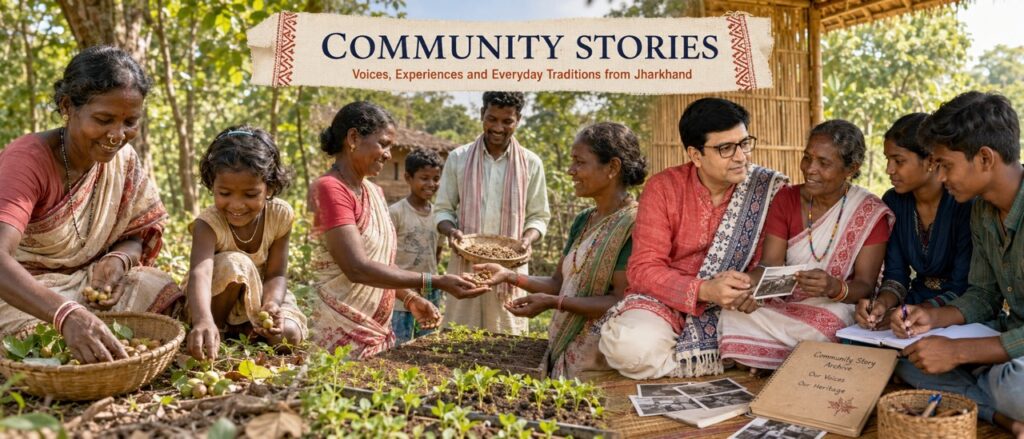
Community Stories
Preserving the Voices, Memories and Experiences Behind Hodopathy
Hodopathy lives through people and their stories.
Every elder, traditional practitioner, farmer, forest gatherer, food custodian and family may carry a different memory of plants, seasons, landscapes and community life. These stories provide meaning and context that cannot be captured through botanical names or scientific records alone.
Community Stories is a space dedicated to preserving the voices of the Ho community and other Adivasi knowledge holders connected with Hodopathy and Jharkhand’s living heritage.
Here, personal memories, oral histories, practitioner journeys, village traditions, forest experiences and intergenerational learning can be documented responsibly—with the permission and participation of the people whose stories they are.
Why Community Stories Matter
A list of plants can record names, but it cannot fully explain how knowledge became part of community life.
A story can reveal:
- Who shared the knowledge
- Where and how it was learned
- How a landscape has changed
- Why a plant is culturally important
- What responsibilities accompany knowledge
- How families transmit traditions
- How communities understand their relationship with forests
- Why certain information is protected
- What younger generations risk losing
Stories help transform isolated facts into living heritage.
They also ensure that Hodopathy is not presented as knowledge without people. Every tradition has human custodians, cultural roots and a history of transmission.
Stories Held by Elders
Adivasi elders are living archives of community memory.
They may remember:
- Forests as they appeared many years ago
- Plants that have become difficult to find
- Traditional foods associated with particular seasons
- Local names no longer commonly spoken
- Earlier farming and collection practices
- Community festivals and customs
- Water sources that have changed or disappeared
- Stories passed down by previous generations
- Practitioners who were respected within the village
- Ways in which children once learned from nature
Recording these memories can preserve knowledge that may not exist in books, government records or scientific databases.
An elder’s account should be documented in their own voice wherever possible. Translation and editing should clarify the story without replacing its original meaning.
Practitioner Journeys
Traditional practitioners may have spent many years learning from parents, grandparents, elders or other experienced practitioners.
Their stories can help explain:
- How their learning began
- Who guided them
- How they learned to recognise plants
- What responsibilities accompanied the knowledge
- How forest changes affected their practices
- Why some knowledge remains restricted
- How younger people view the tradition
- What they hope will be preserved
- What support they need from researchers or institutions
Practitioner stories should not be turned into exaggerated claims of medical success. Personal experience can be documented as testimony, but it should not be presented automatically as scientific proof.
The practitioner’s dignity, privacy and preferred form of recognition must remain central.
Stories of Forests and Landscapes
Forests are part of the cultural memory of many Adivasi communities.
Community stories may describe:
- Seasonal flowering and fruiting
- Forest foods and collection routes
- Sacred groves and culturally important places
- Rivers, streams, hills and water sources
- Encounters with wildlife
- Changes caused by environmental pressure
- Plants that were once abundant
- Community efforts to protect natural resources
- Traditional rules concerning harvesting
These stories can contribute to environmental history and conservation awareness.
However, precise locations of rare plants, sacred places or sensitive natural resources may need to remain confidential.
Food and Family Stories
Traditional foods carry memories of family, festivals, seasons and survival.
Community members may share stories about:
- Foods prepared by parents or grandparents
- Seasonal leaves, flowers, fruits and seeds
- Traditional grains and pulses
- Fermentation and preservation practices
- Foods connected with festivals
- Community meals
- Changes in food habits
- Ingredients becoming difficult to obtain
- Knowledge transmitted through cooking and gathering
Food stories can help preserve cultural diversity and support responsible research into indigenous food systems.
Traditional consumption should not automatically be interpreted as evidence that every wild ingredient is safe for all people. Correct identification and appropriate preparation remain important.
Stories of Women and Family Knowledge
Knowledge within Adivasi communities is not held only by formally recognised practitioners.
Women and other family members may preserve important knowledge concerning:
- Seasonal foods
- Seed selection
- Household gardens
- Plant collection
- Food preparation
- Childcare traditions
- Farming activities
- Forest resources
- Cultural ceremonies
- Family histories
These contributions can remain overlooked when documentation focuses only on publicly recognised male figures or specialist practitioners.
Community Stories seeks to recognise knowledge in all the places where it lives—within households, fields, forests and community spaces.
Stories from Young People
Young people experience indigenous heritage differently from their elders.
Their stories may explore:
- Learning local plant names
- Speaking or relearning an indigenous language
- Moving between village and city life
- Recording grandparents’ memories
- Participating in forest conservation
- Studying traditional knowledge academically
- Using digital tools for documentation
- Balancing modern education and cultural identity
- Developing new respect for family traditions
Youth stories show that heritage is not limited to the past. It can guide identity, research, conservation and community participation in the future.
The Oral Narrative of Dhantari
One oral narrative connected with tribal plant knowledge is the story of Dhantari.
Different versions may exist, and the account should be understood as community folklore rather than independently verified history.
In one documented version, Dhantari was a tribal chief known for his remarkable understanding of the useful properties of plants. The story describes his desire for that knowledge to continue among humans, birds and animals after his death.
The narrative expresses the belief that knowledge can be learned through close observation of nature. Animals and birds may instinctively recognise natural resources, while humans develop understanding by watching, remembering and sharing experience.
The importance of the Dhantari story lies not only in whether every detail is historically verifiable. Its cultural value comes from the ideas it carries—knowledge-sharing, continuity, observation and the relationship among people, animals and plants.
When recording such folklore, the storyteller, community, language, location and version should be documented wherever permission is given.
One Community Can Hold Many Versions
Oral stories naturally develop variations.
Two elders may remember an event differently. Neighbouring villages may preserve separate versions of the same narrative. A plant may have different local names, and a story may change as it passes between generations.
These variations should not automatically be removed.
Responsible documentation should record:
- Who shared the story
- Where it was recorded
- The language used
- When it was recorded
- Whether it was a personal memory or inherited narrative
- How it differs from other versions
- What cultural meaning the storyteller gives it
The purpose is not to declare one version correct and all others false. It is to preserve the diversity of community memory accurately.
Personal Experience and Verified Evidence
Community testimony has cultural, historical and research value. However, a personal account should not be presented as scientific proof of medical safety or effectiveness.
If a person describes a traditional practice or health-related experience, the story should be labelled clearly as:
- Personal experience
- Oral tradition
- Community account
- Practitioner testimony
- Family memory
Any scientific interpretation requires separate research, botanical verification and safety evaluation.
This distinction protects both the storyteller and the reader from misleading conclusions.
Recording Stories Responsibly
Before recording a community story, the contributor should understand:
- Why the story is being collected
- Whether audio or video will be recorded
- Whether photographs will be taken
- How the material will be stored
- Whether it may be published online
- Whether the storyteller’s name will appear
- Who may be able to access the record
- Whether researchers may study it
- Whether the person can request a correction
The storyteller may agree to some forms of use and decline others.
Permission to listen is not automatically permission to record. Permission to record is not automatically permission to publish. Permission to publish is not automatically permission for commercial use.
Preserving the Original Voice
Editing may be necessary for clarity, but it should not change the meaning of a person’s story.
Responsible presentation should:
- Preserve important original expressions
- Identify translated material
- Explain words without exact equivalents
- Avoid sensational titles
- Avoid adding unsupported details
- Allow the storyteller to review the account where possible
- Respect requests for anonymity
- Credit translators and documentarians appropriately
- Separate editorial explanation from the speaker’s words
The aim should be to help people hear the storyteller—not replace their voice.
Photography with Dignity
Photographs can preserve faces, places and practices, but they must be created and used respectfully.
Images should not:
- Portray Adivasi communities as primitive
- Stage activities deceptively
- Reveal sacred or restricted locations
- Show people without appropriate permission
- Use children’s images carelessly
- Promote unrelated commercial claims
- Separate a person’s image from its agreed context
A photograph should strengthen the dignity of the subject and the accuracy of the story.
What We Hope to Preserve
Community Stories may include:
- Elder interviews
- Traditional practitioner profiles
- Village histories
- Forest memories
- Plant-related oral narratives
- Indigenous-language stories
- Traditional food experiences
- Farmer and seed-custodian stories
- Women’s knowledge and family traditions
- Youth documentation journeys
- Conservation initiatives
- Community research experiences
- Stories of cultural continuity
Every contribution should be reviewed for permission, accuracy, privacy and public safety before publication.
Share a Community Story
We welcome contributions from:
- Ho and other Adivasi elders
- Traditional practitioners
- Community knowledge holders
- Farmers and seed custodians
- Forest-resource collectors
- Indigenous-language speakers
- Students and young documentarians
- Researchers working with community participation
- Families preserving oral histories
If you would like to share a story, contact Hodopathy through the website’s Connect or Contact page.
Please provide:
- Your name and preferred form of identification
- Community and location
- A short description of the story
- The language in which it can be shared
- Whether photographs or recordings are available
- Whether the story has publication restrictions
- Your relationship with the knowledge or event described
Submitting a story does not guarantee publication. Every contribution should be reviewed for consent, cultural sensitivity, accuracy and safety.
Stories That Keep Knowledge Alive
Community stories give Hodopathy its human voice.
They remind us that indigenous knowledge is not an anonymous collection of information. It is carried by individuals, families and communities who have observed, remembered and protected their relationship with nature across generations.
By preserving these voices responsibly, we can help future generations understand not only what was known, but also who carried the knowledge and why it mattered.
Information on Hodopathy.com is intended for cultural preservation, education and research awareness. It is not medical advice and should not be used for self-treatment.
Every community story is a bridge among memory, identity, nature and the generations still to come.