
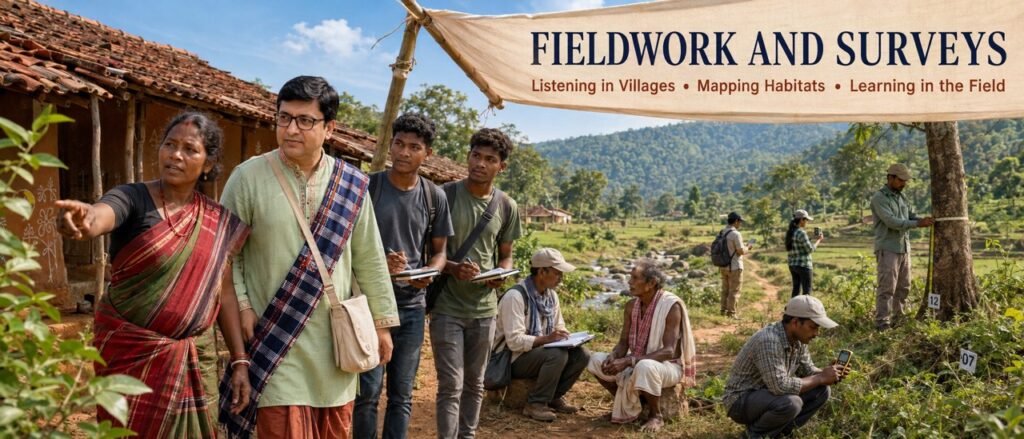
Hodopathy Fieldwork and Surveys
Documenting Knowledge Where It Lives
Fieldwork and community surveys are essential to understanding Hodopathy within its original cultural and ecological setting.
Knowledge of plants, forests, seasonal foods and community practices cannot always be understood through written sources alone. It often requires direct interaction with elders, traditional practitioners, farmers, forest knowledge holders and other community contributors.
The Hodopathy fieldwork approach is designed to document this knowledge responsibly through interviews, observation, guided forest visits, plant records, community discussions and seasonal surveys.
The purpose is not to enter a village, collect information and leave. Responsible fieldwork requires trust, participation, accurate documentation and continued communication with the people who contribute their knowledge.
Objectives of Fieldwork
Hodopathy fieldwork and surveys may be conducted to:
- Identify willing knowledge holders
- Record oral histories
- Document practitioner journeys
- Preserve indigenous plant names
- Observe plants within their natural habitats
- Record traditional foods and seasonal practices
- Understand changes in forests and biodiversity
- Document local conservation concerns
- Support botanical identification
- Identify subjects for responsible research
- Connect elders with younger documentarians
- Create community-reviewed archive records
Fieldwork records what knowledge holders report and what researchers observe. It does not automatically prove the safety or medical effectiveness of a traditional practice.
Planning Before Entering the Field
Every field visit should begin with a clearly defined plan.
The team should identify:
- Purpose of the survey
- Proposed location
- Communities involved
- Types of knowledge being documented
- Intended participants
- Languages required
- Expected duration
- Field team members
- Recording equipment
- Botanical support
- Safety arrangements
- Consent process
- Data-storage method
- Community-review plan
- Intended outputs
The team should also consider whether local, institutional, ethical or environmental permissions are required.
Unplanned collection can create confusion, inaccurate records and community mistrust.
Community Entry
Fieldwork should begin through respectful community introduction.
Where appropriate, the team may first meet:
- Village elders
- Community representatives
- Traditional practitioners
- Local organisations
- Youth groups
- Farmer groups
- Women’s groups
- Relevant local institutions
The introduction should explain:
- Who is conducting the fieldwork
- Why the survey is being organised
- What information may be requested
- Whether photographs or recordings will be made
- How the information may be used
- Whether anything may be published
- What will remain restricted
- How contributors may raise concerns
Community hospitality or permission to enter a village should not be interpreted as consent from every individual.
Each participant must be able to make their own voluntary decision.
Selecting Survey Participants
Fieldwork should reflect the diversity of knowledge held within a community.
Participants may include:
- Traditional practitioners
- Elders
- Farmers
- Seed custodians
- Forest-resource collectors
- Food knowledge holders
- Indigenous-language speakers
- Storytellers
- Artisans
- Community conservation leaders
- Young people learning from elders
Participants may be identified through community recommendations, practitioner networks, family referrals, local organisations or self-nomination.
Selection should not focus only on the most publicly visible individuals. Important knowledge may be held by people who do not have formal titles or public recognition.
Survey Approaches
Different research questions require different survey approaches.
Exploratory Survey
Used to understand the community context, identify potential contributors and define future documentation priorities.
Knowledge Holder Survey
Focused on identifying people with experience in particular areas such as plants, forests, food, agriculture, language or cultural traditions.
Oral-History Survey
Records personal memories, practitioner journeys, village histories and intergenerational knowledge.
Ethnobotanical Survey
Documents local plant names, habitat, seasonal information, traditional accounts and botanical identification.
Food and Nutrition Survey
Records seasonal foods, local crops, forest foods, recipes and preparation traditions.
Biodiversity Survey
Documents native plants, habitat changes, conservation concerns and local ecological observations.
Follow-Up Survey
Returns to earlier contributors to clarify information, observe another season or review previous records.
Each survey should use methods appropriate to its stated purpose.
Individual Interviews
Individual interviews allow knowledge holders to speak in detail about their experiences.
A semi-structured interview may include questions about:
- Personal background
- Community role
- How the knowledge was acquired
- Teachers and elders
- Indigenous terminology
- Plants and landscapes
- Seasonal changes
- Traditional foods
- Farming practices
- Environmental concerns
- Intergenerational learning
- Knowledge restrictions
- Hopes for future preservation
The interviewer should listen carefully and avoid forcing the contributor toward a predetermined answer.
Questions should not pressure participants to reveal sacred, private or restricted knowledge.
Group Discussions
Community discussions can help identify shared experiences and differing viewpoints.
A group may discuss:
- Changes in forests
- Seasonal availability of plants
- Traditional foods
- Language loss
- Youth participation
- Conservation priorities
- Community documentation needs
- Historical events
- Differences among local practices
Group discussions should be organised carefully because participants may not feel comfortable discussing confidential matters in front of others.
Personal or specialist knowledge should not be attributed to the group without clear agreement.
Guided Forest Walks
A guided walk with an experienced knowledge holder can help connect spoken information with the landscape.
During a walk, the field team may document:
- Indigenous plant names
- Habitat
- Growth form
- Seasonal condition
- Associated vegetation
- General location
- Traditional account
- Collection practices
- Conservation concerns
- Changes in availability
A guided forest walk should not become an uncontrolled plant-collection exercise.
The team should avoid:
- Unnecessary uprooting
- Breaking branches for photographs
- Collecting rare plants
- Disturbing wildlife
- Entering restricted places
- Revealing sensitive locations
- Pressuring guides to show protected resources
Observation and photography should be preferred when physical collection is unnecessary.
Seasonal Field Visits
One visit cannot capture all plant and community knowledge.
A plant may be recognisable only when it flowers or fruits. Traditional foods may be available for a short period. Forest and agricultural activities may change according to rainfall and season.
Repeated seasonal visits can help document:
- Flowering and fruiting
- Plant maturity
- Seasonal foods
- Collection periods
- Agricultural cycles
- Water availability
- Forest changes
- Community festivals
- Changes in plant identification
Every record should include the date and seasonal condition in which it was created.
Plant Photography
Field photographs should support later identification and documentation.
Where available, photographs may capture:
- Entire plant
- Growth form
- Leaf arrangement
- Upper and lower leaf surfaces
- Stem or bark
- Flowers
- Fruits
- Seeds
- Habitat
- Scale reference
Each photograph should be connected with a plant-record number, date, contributor, broad location and photographer.
Sensitive location data should be removed from public versions when necessary.
Plant Specimens
A specimen should be collected only when it is necessary, permitted and environmentally responsible.
Before collection, the field team should consider:
- Whether photographs are sufficient
- Whether the species is abundant
- Whether the contributor and community permit collection
- Whether the location is restricted
- Whether authorisation is required
- Whether a botanist has advised collection
- Where the specimen will be deposited
- How it will be labelled
Rare, threatened, sacred or vulnerable plants should not be collected casually.
Geographical Records
Location data can help researchers understand plant distribution and habitat. It can also expose rare species and sensitive community resources.
Field records may classify location information as:
Public
State, district or general forest region.
Research Restricted
More detailed location available to approved researchers.
Confidential
Exact location protected because of ecological, cultural or community concerns.
Public reports should not automatically display precise coordinates.
Field Notes
Every team member should maintain clear field notes.
Field notes may include:
- Date and time
- Location
- Purpose of visit
- Participants
- Language
- Weather
- General observations
- Interview summary
- Plant-record numbers
- Photograph references
- Consent status
- Cultural restrictions
- Questions requiring follow-up
- Problems encountered
- Researcher reflections
Observation should be separated from interpretation. The fieldworker should distinguish between what was directly seen, what a contributor reported and what the researcher inferred.
Recording Oral Accounts
Audio and video recordings can preserve voice, pronunciation and context.
Before recording, the participant should understand:
- What device is being used
- What will be recorded
- How the recording will be stored
- Whether it may be published
- Whether their identity will be shown
- Who may access the material
- How they may request a correction
If a person declines recording, written notes may be used with their permission.
The original recording should remain separate from any edited public version.
Consent During Fieldwork
Consent is not a single event completed before the first question.
During fieldwork, new situations may arise. A participant may agree to an interview but later decline photography. A guide may identify a plant but request that its location remain confidential.
The team should confirm consent again before:
- Taking photographs
- Recording audio or video
- Entering a culturally restricted place
- Collecting a plant specimen
- Recording precise location
- Publishing personal information
- Sharing records with another institution
The participant’s decision should be respected without pressure.
Field Team Conduct
Fieldworkers represent the values of the documentation programme.
Team members should:
- Dress and behave respectfully
- Follow local guidance
- Arrive at agreed times
- Avoid disrupting community activities
- Use interpreters where needed
- Ask before photographing
- Avoid promises they cannot fulfil
- Protect confidential information
- Pay attention to environmental safety
- Avoid giving medical advice
- Record uncertainty honestly
- Respect requests to stop or leave
Researchers should not treat a village as a collection site or community members as data providers.
Working Across Languages
Fieldwork may involve Ho, Hindi, regional languages and English.
Language planning should consider:
- Participant preference
- Availability of trusted interpreters
- Recording of original terminology
- Words without direct equivalents
- Regional pronunciation
- Translation review
- Confidentiality obligations of interpreters
An interpreter should translate the participant’s meaning rather than summarising it according to personal assumptions.
Important indigenous terms should remain in the record alongside explanations.
Protecting Participant Privacy
Field surveys may collect names, photographs, locations and personal experiences.
Public records should avoid exposing:
- Private contact details
- Exact home addresses
- Identity documents
- Unrelated family information
- Sensitive personal experiences
- Precise locations of rare plants
- Information the contributor classified as private
- Images of children without appropriate safeguards
Participant records should use unique codes where this improves privacy.
Avoiding Medical Misrepresentation
A survey may record traditional accounts relating to health and well-being. These accounts must be documented accurately without converting them into verified medical claims.
Fieldworkers should not:
- Promise that a practice will be scientifically approved
- Describe personal testimony as clinical evidence
- Encourage people to try a preparation
- Provide quantities or instructions for self-treatment
- Tell participants to stop prescribed medical care
- Publish guaranteed treatment claims
- Assume that natural ingredients are always safe
The survey record should label information clearly as oral tradition, community practice, personal experience or practitioner testimony.
Field Safety
Fieldwork in forests and rural landscapes requires planning.
The team should consider:
- Weather conditions
- Terrain
- Water and food
- Communication access
- Wildlife
- Local guidance
- Transport
- First-aid arrangements
- Safe working hours
- Team check-in procedures
- Restrictions on entering certain areas
No record is important enough to justify unnecessary risk to community guides or fieldworkers.
Daily Data Management
Field data should be organised as soon as possible after each visit.
The team should:
- Back up recordings
- Label photographs
- Link files to record numbers
- Store consent information
- Separate confidential records
- Write missing field notes
- Identify unclear audio
- List questions for follow-up
- Check equipment
- Protect original files
Unlabelled photographs and recordings can quickly lose their research value.
Quality Checks
After fieldwork, records should be checked for:
- Correct participant attribution
- Consent permissions
- Complete dates and locations
- Accurate transcription
- Translation quality
- Plant-record linkage
- Photograph labels
- Botanical identification status
- Cultural restrictions
- Evidence classification
- Privacy risks
- Follow-up requirements
A record should not be published directly from raw field notes.
Community Review
Community and contributor review can help identify:
- Incorrect names
- Translation errors
- Misunderstood customs
- Sensitive details
- Inappropriate photographs
- Location risks
- Missing contributors
- Differences among accounts
Review helps ensure that the record reflects what the participant intended to communicate.
Community review does not replace scientific verification. It confirms cultural and contextual accuracy.
Reporting Survey Findings
Survey reports should describe:
- Purpose
- Study area
- Dates
- Participant groups
- Selection method
- Languages
- Interview and observation methods
- Consent process
- Botanical-verification method
- Evidence limitations
- Community-review process
- Conservation concerns
- Access restrictions
- Recommendations
Reports should not identify confidential participants or sensitive locations.
Limitations should be stated openly.
Returning Information to Communities
Fieldwork should provide appropriate information back to participating communities.
Possible outputs include:
- Printed Knowledge Holder Profiles
- Photographs
- Audio copies
- Local-language transcripts
- Community reports
- Biodiversity records
- Educational materials
- Conservation summaries
- Meetings to discuss findings
The community should not encounter its own knowledge for the first time through an outside publication.
Follow-Up and Long-Term Relationships
One field visit is rarely sufficient for responsible documentation.
Follow-up may be needed to:
- Clarify a plant name
- Observe another season
- Confirm translation
- Review a profile
- Update consent
- Share results
- Correct an error
- Discuss a conservation concern
- Plan collaborative research
Trust develops through continued communication and responsible conduct.
Participate in Fieldwork and Surveys
The programme welcomes responsible participation from:
- Adivasi knowledge holders
- Traditional practitioners
- Community elders
- Young documentarians
- Botanists
- Ethnobotanists
- Social-science researchers
- Language specialists
- Universities
- Conservation organisations
- Trained volunteers
Those interested in participating may contact Hodopathy through the website’s Connect or Contact page.
Please explain:
- Your background
- Community or institution
- Location
- Language skills
- Area of experience
- Proposed contribution
- Availability
- Relevant training
- Any ethical or institutional approval
Participation will depend on community needs, appropriate skills, programme capacity and responsible fieldwork requirements.
Fieldwork Based on Respect
The value of fieldwork does not depend only on the number of villages visited, interviews completed or plants photographed.
Good fieldwork is measured by:
- Quality of relationships
- Accuracy of records
- Respect for contributor decisions
- Protection of confidential knowledge
- Botanical reliability
- Community participation
- Environmental responsibility
- Honest communication of limitations
Information on Hodopathy.com is intended for cultural preservation, education and research awareness. It is not medical advice and should not be used for self-treatment.
Hodopathy fieldwork begins with listening—then documenting carefully, verifying responsibly and returning knowledge to the communities that keep it alive.