
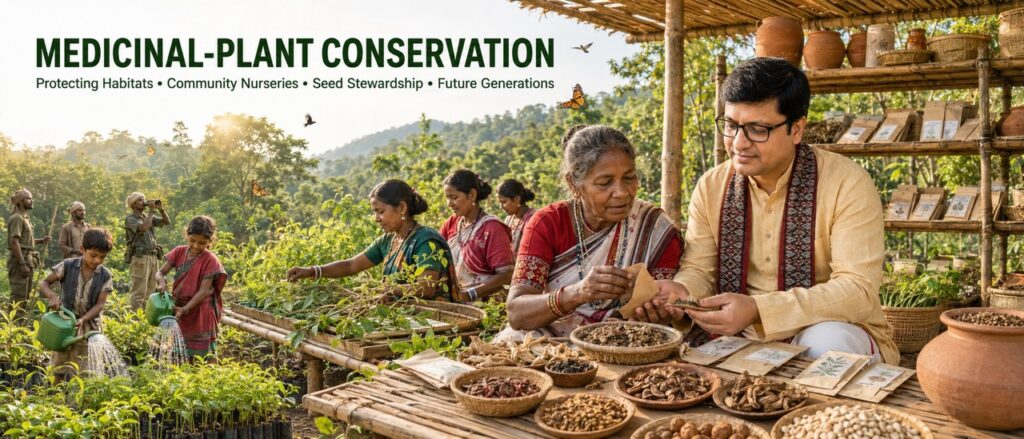
Medicinal-Plant Conservation
Protecting the Living Botanical Heritage of Hodopathy
Medicinal plants form an important part of Hodopathy’s relationship with forests, Adivasi knowledge and nature-based well-being. These plants are not simply raw materials. They are living species connected with particular soils, seasons, habitats, pollinators, microorganisms and cultural traditions.
When a medicinal plant disappears from its natural habitat, the loss extends beyond one species. Its genetic diversity, ecological relationships, local names, harvesting practices and generations of associated traditional knowledge may also be lost.
Medicinal-plant conservation is therefore essential for the ecological and cultural future of Hodopathy.
India’s Medicinal-Plant Heritage
India possesses one of the world’s richest traditions of plant-based knowledge. Government sources estimate that more than 8,000 medicinal-plant species are found in the country. Many are used in codified systems of traditional medicine, while others remain part of local, folk, Adivasi and community knowledge traditions.
The National Medicinal Plants Board works on the conservation, development and sustainable management of medicinal plants through in-situ and ex-situ conservation, cultivation, quality planting material, research, sustainable collection and community livelihood programmes. National Medicinal Plants Board.
Jharkhand’s forests are especially important because they support a wide variety of trees, shrubs, herbs and climbers associated with local food, culture and traditional wellness practices. Adivasi knowledge holders and forest-dependent families have learned to identify these plants through long observation of their habitats, seasons and physical characteristics.
Preserving this heritage requires cooperation among communities, traditional practitioners, botanists, forest managers, conservation organisations and research institutions.
Why Medicinal Plants Are Under Pressure
Growing interest in herbal products and natural ingredients can create economic opportunities, but it can also increase pressure on wild plant populations.
Medicinal plants may become vulnerable because of:
- Destruction or fragmentation of natural habitats
- Excessive collection from wild populations
- Uprooting of entire plants
- Repeated removal of bark, roots or reproductive parts
- Collection before flowering or seed formation
- Forest fires, pollution and soil erosion
- Mining, construction and land-use change
- Invasive species
- Changing rainfall and temperature patterns
- Incorrect identification and substitution
- Unregulated commercial demand
- Loss of traditional harvesting rules
- Limited knowledge about natural regeneration
- Disclosure of locations of rare species
A species can remain present in a region while its population quietly declines. Fewer mature plants, reduced seed production and the loss of genetically diverse populations may eventually make natural recovery difficult.
Conservation must therefore begin before a plant becomes rare or endangered.
Conservation Begins with Correct Identification
A medicinal plant may have several local names, while the same name may be used for different species in different regions. Plants with similar-looking leaves, roots, bark or seeds can also be confused with one another.
Incorrect identification can create conservation and safety risks. A common species may be harvested in place of a rare one, or an unsuitable plant may enter a research or product-development process.
Responsible documentation should include:
- Accepted botanical name
- Local and community names
- Family and genus
- Clear photographs of identifying features
- Habitat and geographical region
- Flowering and fruiting periods
- Plant part traditionally collected
- Herbarium or authenticated reference specimen
- Name of the botanist or expert confirming identity
- Conservation status, where assessed
- Collection and consent records
Botanical identification should be confirmed by appropriately qualified experts. Digital applications and photographs may support preliminary recognition, but they should not replace professional authentication when safety, research or commercial use is involved.
In-Situ Conservation: Protecting Plants in Their Habitats
In-situ conservation means protecting a plant within the natural ecosystem where it grows. This approach allows the species to continue interacting with soil organisms, pollinators, seed dispersers and other plants and animals.
In-situ conservation can include:
- Protection of natural forest populations
- Medicinal Plant Conservation Areas
- Sacred groves and community forests
- Biodiversity Heritage Sites
- Microhabitat restoration
- Community-managed conservation zones
- Protection of seed-producing plants
- Control of destructive extraction
- Monitoring of population size and regeneration
- Restoration of degraded habitats
The main advantage of in-situ conservation is that it protects both the species and its ecological relationships. It also allows natural evolution and adaptation to continue.
The Foundation for Revitalisation of Local Health Traditions describes Medicinal Plant Conservation Areas as natural sites established to conserve viable populations of prioritised native medicinal plants and to involve local communities and resource managers in their long-term protection. FRLHT Medicinal Plant Conservation Areas.
Ex-Situ Conservation: Protection Beyond the Wild Habitat
Ex-situ conservation protects plants outside their original habitat. It can provide additional security when wild populations are declining or habitats are under severe pressure.
Methods may include:
- Community medicinal-plant gardens
- Botanical gardens
- Nurseries
- Seed banks
- Field gene banks
- Herbal demonstration gardens
- Tissue-culture repositories
- Living collections maintained by research institutions
- Cultivation on farms and agroforestry land
Ex-situ conservation should support—not replace—the protection of natural habitats. A plant growing in a garden may not retain the complete genetic diversity or ecological relationships found in the wild.
Planting material should be collected legally and responsibly. Records should preserve its geographical origin, community source and biological characteristics.
Sustainable Wild Collection
Wild collection may remain appropriate for certain abundant species when it is based on ecological assessment and community rules. Sustainable harvesting means collecting within the natural regenerative capacity of the plant population.
Responsible collection should consider:
- The abundance and distribution of the species
- Its growth rate and reproductive cycle
- The plant part being collected
- The effect of collection on survival
- The appropriate season and maturity stage
- The percentage of a population that may be harvested
- The time required before returning to the same collection site
- The presence of young and seed-producing plants
- The needs of wildlife and local communities
- Applicable forest and biodiversity regulations
Collectors should never assume that a plant is abundant merely because it is visible in one location.
Leaves, Flowers and Fruits
Collection should leave enough healthy foliage for continued growth and sufficient flowers, fruits and seeds for reproduction and wildlife. Repeated harvesting from the same individual plants should be avoided.
Roots and Underground Parts
Root and rhizome harvesting often kills the entire plant. Such collection requires particular caution and should be avoided for rare, slow-growing or poorly studied species. Cultivation may be a more responsible source where underground parts are required.
Bark
Removing bark around the full circumference of a tree can interrupt the movement of water and nutrients and may kill it. Bark collection should follow scientifically developed, species-specific methods and should not be undertaken without proper training.
Seeds
Seed collection must leave enough material for natural regeneration. Seeds should not be collected exclusively from a few plants, as this can reduce genetic diversity in cultivated or restored populations.
Good Field Collection Practices, ecological monitoring and local knowledge should guide every collection programme. The World Health Organization’s conservation guidance similarly emphasises sustainable use and protection of medicinal plants and their habitats. WHO Guidelines on the Conservation of Medicinal Plants.
Cultivation as a Conservation Strategy
Cultivating suitable medicinal plants can reduce pressure on wild populations while supporting farmers, community nurseries and rural livelihoods.
A responsible cultivation programme should include:
- Locally suitable species
- Authenticated planting material
- Maintenance of geographical origin records
- Soil and climate suitability assessment
- Protection of genetic diversity
- Good agricultural practices
- Responsible water and nutrient management
- Avoidance of prohibited pesticides and contaminants
- Scientific harvesting schedules
- Clean drying and storage facilities
- Traceability from seed or sapling to final material
- Fair and transparent market arrangements
Cultivation should not lead to the replacement of food crops on land important for local nutrition without careful community planning. It should also avoid introducing potentially invasive species into new environments.
The National Medicinal Plants Board supports quality planting material, Good Agricultural Practices, Good Field Collection Practices, post-harvest management, testing and livelihood linkages with community institutions. Government of India—Promoting Cultivation of Medicinal Plants.
Community Nurseries and Herbal Gardens
Community nurseries can help conserve local plant diversity while transferring propagation skills to younger generations. They can raise native seedlings for farms, home gardens, restoration sites and educational programmes.
Herbal gardens can serve as:
- Living classrooms for young people
- Reference collections for plant identification
- Sources of responsibly propagated planting material
- Spaces for interaction between practitioners and researchers
- Demonstration sites for cultivation methods
- Community records of local plant diversity
- Backup populations for selected native species
A conservation garden should clearly label plants with botanical and local names. It should not display confidential preparation methods or medicinal claims without appropriate evidence and community permission.
Traditional Knowledge and Community Stewardship
Adivasi and tribal knowledge holders often possess detailed understanding of plant locations, seasonal availability, sustainable collection and signs of ecological change. Conservation programmes should recognise them as partners and decision-makers—not merely sources of information or labour.
Community participation should include:
- Prior and informed consultation
- Recognition of traditional knowledge holders
- Community-led identification of priority species
- Respect for sacred and confidential knowledge
- Employment in nurseries and conservation programmes
- Training in botanical documentation and monitoring
- Participation in decisions about access and use
- Fair sharing of benefits arising from research or commercialisation
- Support for intergenerational knowledge transmission
The Hodopathy reference study from West Singhbhum records that traditional practitioners expressed concern about people entering forests and indiscriminately removing medicinal plants after information about their use became more widely known. It also describes village herbal gardens being developed in response to pressure on wild populations. Hodopathy practitioners research paper.
This illustrates why documentation and public communication must be handled carefully. Publishing the exact location of a rare plant may create new conservation risks.
Traceability and Responsible Sourcing
Every medicinal-plant material used for research or responsible product development should have a traceable origin.
Traceability records may include:
- Botanical identity
- Cultivated or wild-collected status
- Source location
- Name of grower or authorised collector
- Date and season of collection
- Plant part collected
- Quantity collected
- Harvesting method
- Permissions and legal documentation
- Drying and storage conditions
- Laboratory authentication and quality tests
- Transfer through the supply chain
Traceability helps prevent substitution, adulteration, illegal collection and the unintentional use of threatened species. It also enables communities and cultivators to receive proper recognition and compensation.
Research, Monitoring and Recovery
Medicinal-plant conservation must be guided by evidence. Long-term research is needed to understand population trends, regeneration, seed biology, propagation, habitat requirements and the effects of harvesting.
Priority activities include:
- Baseline population surveys
- Mapping without public disclosure of sensitive locations
- Periodic monitoring of wild populations
- Conservation-status assessment
- Seed-germination and propagation studies
- Development of non-destructive harvesting methods
- Climate-resilience research
- Genetic-diversity assessment
- Restoration trials
- Community-based ecological monitoring
- Reintroduction of threatened species where scientifically appropriate
Successful conservation should be measured by the survival and regeneration of plant populations—not simply by the number of seedlings distributed or planted.
Hodopathy’s Conservation Commitment
Hodopathy seeks to promote a responsible model in which traditional knowledge, scientific research and ecological conservation support one another.
Hodopathy is committed to:
- Protecting native medicinal-plant diversity
- Respecting Adivasi and tribal knowledge holders
- Documenting plants with informed community participation
- Confirming botanical identity through qualified experts
- Protecting locations of rare and sensitive species
- Promoting sustainable and non-destructive harvesting
- Supporting community nurseries and herbal gardens
- Encouraging cultivation of suitable medicinal plants
- Maintaining transparent and traceable sourcing
- Avoiding threatened species where sustainable sourcing is not established
- Supporting seed conservation and habitat restoration
- Encouraging scientific research and long-term monitoring
- Complying with applicable forest and biodiversity laws
- Promoting fair benefit-sharing with contributing communities
- Avoiding unsupported medical claims
Information about medicinal plants on this website is intended for conservation, cultural documentation, education and responsible research. It is not a recommendation for self-treatment and should not be interpreted as proof of medical safety or effectiveness.
Conserving Plants Means Conserving Knowledge
Medicinal-plant conservation is not only about saving useful species. It is about protecting forests, biological diversity, community heritage and the knowledge relationships developed over generations.
A plant cannot be preserved only as a dried sample, photograph or database entry. It must be able to survive, reproduce and evolve within a healthy ecosystem. Its knowledge holders must also be respected and given the opportunity to transmit their understanding to future generations.
Through community partnership, sustainable cultivation, responsible harvesting and scientific conservation, Hodopathy aims to help ensure that Jharkhand’s medicinal-plant heritage remains alive, diverse and protected.
Hodopathy—Conserving Medicinal Plants, Protecting Adivasi Knowledge and Preserving Nature for Future Generations.