

The Origin of Hodopathy: A Healing Tradition Rooted in Jharkhand
Born from Forests and Preserved Through Generations
Hodopathy is an indigenous knowledge tradition associated with the Adivasi and tribal communities of Jharkhand. Its origins are rooted in the forests, villages and cultural landscape of the Chotanagpur Plateau, where communities developed a close understanding of local plants, food, seasons and natural resources.
Hodopathy was not created by a single person or recorded in one ancient manuscript. It evolved collectively over generations through observation, experience and oral teaching. Elders and traditional knowledge holders shared what they knew directly with younger members of their communities, allowing this living heritage to continue.
The Meaning of Hodopathy
The term “Hodopathy” is commonly explained through two elements:
- Hodo—understood in the local linguistic context as “human” or “person”
- Pathy—a system or approach relating to health and healing
Together, Hodopathy may be described as a traditional human-centred system of well-being based on the relationship between people and nature.
Its original practices drew upon locally available leaves, roots, bark, seeds, fruits and other natural materials. Knowledge holders also observed seasons, habitats, harvesting periods, dietary habits and the individual needs of community members.
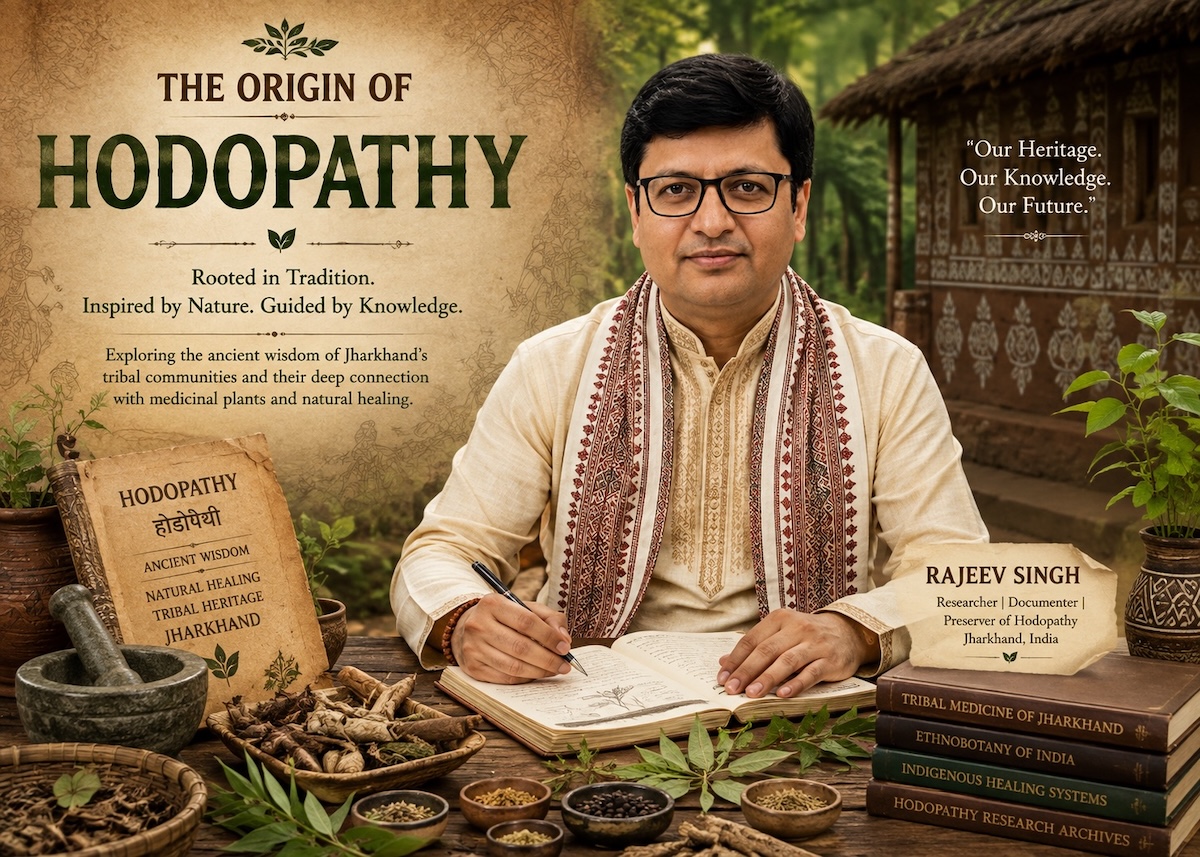
Knowledge Shaped by the Forest
For Jharkhand’s Adivasi communities, the forest has traditionally been more than a source of plants. It has supported food, livelihoods, culture and community identity.
Over time, repeated observation helped people distinguish useful plants from harmful ones and understand how particular natural materials were traditionally prepared. This knowledge was refined through lived experience and passed through community memory.
Because much of it remained oral, different communities and regions may preserve distinct names, methods and interpretations. These differences should be documented respectfully instead of being forced into a single standard narrative.
Rajeev Singh’s Work to Trace and Preserve Its Origins
Rajeev Singh, a native of Jharkhand and an environmentalist working with forests, plants and rural communities, is helping document the historical and cultural foundations of Hodopathy.
His work includes connecting with traditional practitioners and community elders, recording oral accounts, identifying local plant names and preserving information about habitats, seasonal practices and methods of knowledge transmission.
He is also working to connect this community heritage with botanical documentation, digital archiving, responsible research and medicinal-plant conservation. His purpose is not to claim ownership or founder status, but to support the preservation and wider recognition of the knowledge carried by generations of Adivasi communities.
“Hodopathy did not begin with one individual. It grew through generations of observation, community experience and a deep relationship with Jharkhand’s forests. Our responsibility is to preserve that heritage with respect.”
— Rajeev Singh
From Ancient Roots to a Responsible Future
Understanding the origin of Hodopathy requires more than studying plants. It also requires listening to knowledge holders, preserving local languages, documenting oral histories and protecting the forests in which this knowledge developed.
Traditional uses should be recorded as community knowledge unless they have been independently validated through appropriate scientific research. Future study may help examine botanical identity, preparation traditions, safety and pharmacological potential without misrepresenting unverified claims as proven medical treatments.
Hodopathy’s story is ultimately the story of a relationship—between people, plants, forests and generations.
Born from the forests. Carried through community memory. Preserved for future generations.